


We brought 14 tons of boulders home this week, which is a perfectly reasonable quantity if one is building a fairy garden with the modest ambition of becoming a minor geological landmark.
They are column rocks from a local quarry, pieces of this place that began forming millions of years before anyone imagined our house, our garden, or the peculiar family that would eventually decide the land needed considerably more mysticism. They were here before us in some form, shaped by pressures and spans of time the human mind can name but can’t truly comprehend. Now they will become part of the paths and hidden places we are making for the children, a little borrowed permanence inside a garden designed for imaginary creatures. I love knowing that the stones are local. We aren’t importing a history for this land, we’re uncovering pieces of the one already here and arranging ourselves around it.
The garden is beginning to feel less like a collection of plans and more like a world. We visited a local nursery this week and spent hours wandering through three acres of wonder, admiring trees, touching leaves, and behaving as though we hadn’t already acquired more plants than we had prepared places to put them. We did, of course, bring more home.
I built a temporary bed where they can live while we finish their permanent spaces, because apparently I have become a provider of transitional housing for shrubs. They are gathered there now, green and patient beneath the summer sun, trusting us to complete projects that have already expanded well beyond their original municipal boundaries.
Inside the house, my terrarium is booming. I have successfully created a strange, self-sustaining ecosystem inside a glass bottle, and it feels remarkably similar to motherhood. I assembled a tiny world, placed living things inside it, attempted to create the correct conditions for their survival, and now spend an unreasonable amount of time peering in to make sure no one is too wet.
My daughter begins ballet on Monday, a fact she has reminded me approximately 18 million times. No matter how many times she says it, I can’t imagine tiring of the way she says it, because each reminder contains the full force of a child approaching something she has dreamed about. Monday is coming for the rest of us at the conventional pace, but for her it is moving with the deliberate cruelty of a glacier. She is ready now, and she would prefer the calendar respect that.
Our oldest spent the week camping and had a wonderful time. He continues to struggle in many of the same ways I struggled at his age, which makes him my permanent ADHD buddy and occasionally allows me to recognize what he is feeling before either of us can explain it. I try to remind him that he teaches me as much as I teach him, because parenthood isn’t knowledge traveling neatly in one direction. Children reveal the places inside us that still need patience, and then give us an opportunity to offer them the understanding we once needed ourselves.
Ezra, my sweet Ezra, will soon be one, and how ONE-derful will that be? He is happiness in its roundest and most determined form. He loves macaroni noodles, he loves when I sing to him, and he looks at the world with such hopeful eyes that I sometimes find myself studying his face to remember what I’m fighting for.
He doesn’t yet know how complicated the world is. He knows the sound of our voices, the shape of the people who love him, and the reliable miracle of food appearing when he needs it. He lifts his arms because he expects someone to reach back, and so far, the world has answered him.
There’s something sacred in that expectation. Before hope becomes a philosophy or a political necessity, it begins as the quiet belief that when we reach for another person, we won’t be left reaching alone.
My husband and I don’t always move through life with Ezra’s confidence in one another. Marriage is strange, complicated, and intimate work. We fall in love and believe, somewhere in the most innocent parts of ourselves, that because love is real it will also be simple. Then life arrives with bills, children, exhaustion, old wounds, neurological differences, unfinished chores, and the peculiar discovery that another person can make everything easier and harder at precisely the same time.
My husband drives me crazy some days. My brain moves fast, but there are ways he complicates and steadies my life that even I can’t track. He helps me when I need him, even when he is angry with me. He laughs at the dad jokes I must tell because they’re not his thing and civilization would suffer if I stopped. He sits with me when all I can do is sit, and he reminds me that love isn’t the absence of frustration; but rather, the decision to remain tender even when tenderness requires effort.
Recently, he caught me when I fell. Not metaphorically, although he has done plenty of that too. I have a right-to-left shunt in the atrial septum of my heart, which allows some blood to cross from one side of my heart to the other without making the usual trip through the lungs. It can cause various forms of mayhem, and lately I have been experiencing intense dizziness followed by fainting. I lost consciousness and woke up in my husband’s arms.
There are few things more frightening than realizing you were briefly absent from your own body, but there are few places safer to return than the arms of someone who refused to let you hit the ground. I follow up with my cardiologist on Wednesday, we are paying attention, and I remain hopeful that everything will be all right. Luckily, I live among people who don’t often leave my side.
I have thought a great deal about being caught since then.
Which brings me to Interstate 5 near Fife, Washington, a woman suffered a medical emergency while driving with a young child strapped into the back seat. Her SUV began crossing lanes and repeatedly striking the concrete barrier while she sat unconscious behind the wheel.
A motorist named Paul Jackson pulled alongside and realized what was happening. He saw the woman unresponsive and the little boy frightened behind her, and he decided that seeing the emergency made him responsible for doing what he could.
Jackson maneuvered his Kia Forte against the SUV and slowly guided the vehicle toward the barrier until it stopped. He climbed out, put the SUV in park, helped the child to safety, and stayed with the woman until emergency responders arrived. Neither she nor the boy was seriously injured.
Jackson had been on his way to pick up his wife’s birthday cake, so he sent photographs to prove that his late arrival involved heroism rather than an unfortunate misunderstanding of bakery hours. He later surveyed the damage to his Kia and suggested that it might buff out, which is an admirable level of optimism from a man who had just used a compact sedan as a highway rescue device. His explanation for risking himself and his car was simple.
“Somebody had to do something.”
Those words contain the difference between witnessing the world and participating in it. Hope is often presented as a feeling that arrives after danger has passed, when the outcome is known and everyone is safely telling the story. I think hope more often appears while the car is still moving. It’s the moment someone sees what is happening, understands that there is no guarantee of success, and moves closer anyway.
Paul Jackson couldn’t promise that he would stop the SUV. He only knew that a woman and child were in danger and that passing them by would leave them alone inside it. Sometimes catching a life takes a few seconds, a damaged Kia, and a stranger who understands that inconvenience is not the greatest tragedy available.
Other times, it takes generations. Which brings me to four litters of wild red wolf pups that were born in North Carolina, and between 12 and 16 have survived their first vulnerable months. They are new lives in a species that has already disappeared once from the wild.
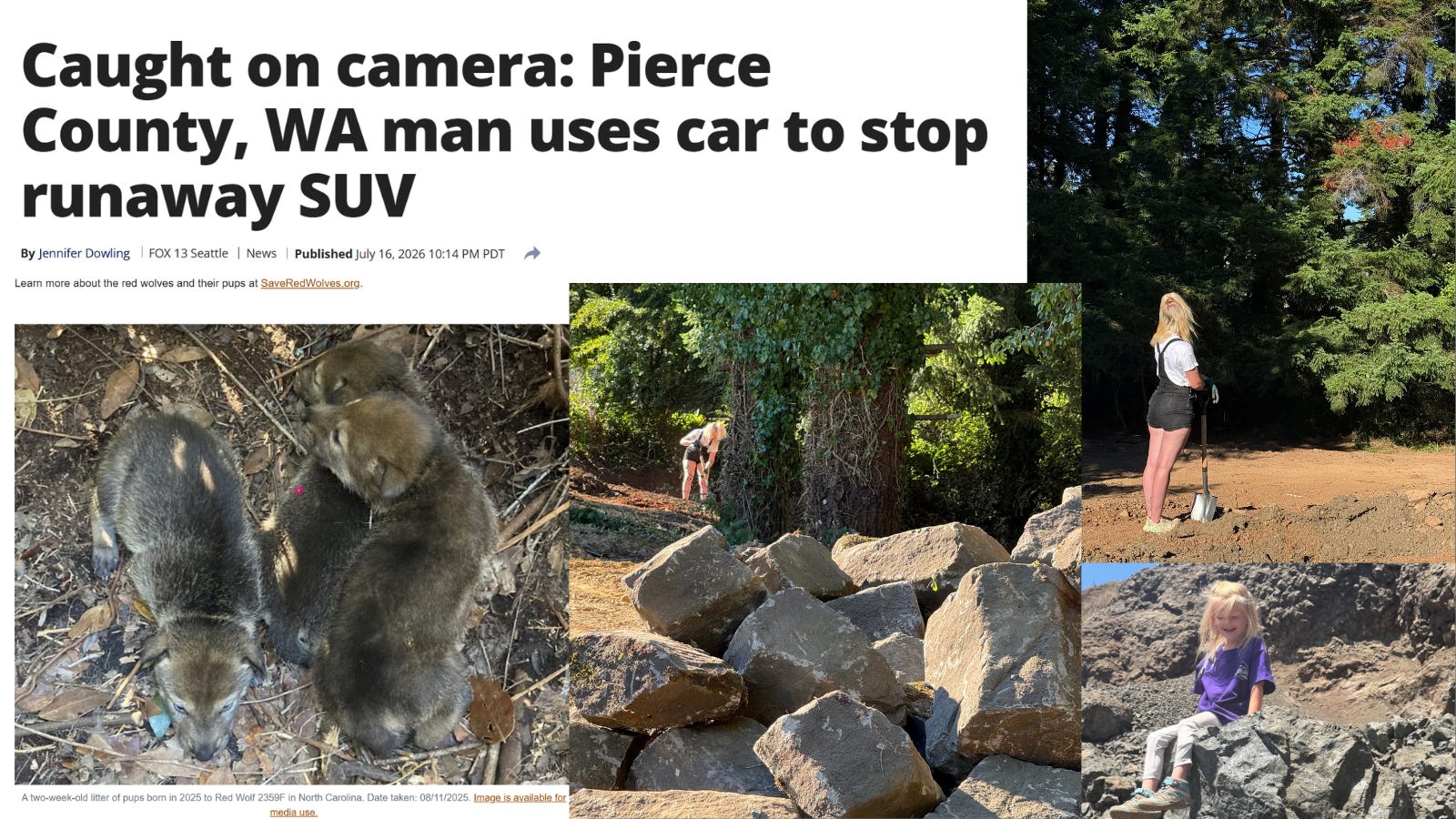
Red wolves are slender, russet creatures with narrow faces that can make them look almost foxlike, but they are a distinct species native to the United States. Humans hunted them until they were declared extinct in the wild in 1980. Conservationists reintroduced them to eastern North Carolina in 1987, and decades of work helped their population grow to at least 130.
Then shootings, vehicle collisions, and policy changes drove the population down again. During the 2010s, there were moments when as few as seven red wolves remained in the wild. Seven animals stood between existence and extinction.
Today, wildlife officials know of 22 adult and adolescent wolves in eastern North Carolina, along with this year’s pups. One of the new litters was born on private land belonging to a person who voluntarily welcomes red wolves through the Prey for the Pack program.
Red wolves mate for life, and their older children and grandparents often help raise new pups. Survival, for them, is a family undertaking. It’s not one heroic moment but a network of devotion, one generation helping hold the next until it’s strong enough to stand.
Their recovery is also a human undertaking. Scientists preserved their genetics, conservationists fought for their protection, wildlife workers returned them to the land, and communities and private landowners made room for an animal their predecessors had nearly erased.
The red wolf didn’t return because the world naturally corrected itself. It returned because people decided that extinction didn’t have to be the final sentence. That’s the hope I found this week, here among our children and our stones, and far beyond this little patch of land.
Hope isn’t a promise that nothing frightening will happen. Hearts misbehave, cars leave their lanes, children struggle, marriages strain, and species approach the edge of disappearance. The world is beautiful, but it’s never been gentle enough to justify complacency. Hope is what we build around the fragile things anyway.
It’s a husband’s arms beneath the person he loves, a stranger steering toward an emergency when he could continue home, a family of wolves raising its young, surrounded by people who have chosen to let them live, a temporary garden bed for plants that don’t yet have a permanent home, and a child lifting his hands because experience has taught him that someone will answer.
Even the boulders seem to belong to this lesson. They have endured for millions of years, carried by the land through transformations we will never witness. Now they will hold the shape of a garden where our children can wander, imagine, and grow.
Life here is messy, frightening, occasionally infuriating, confusing, loving, warm, and profoundly good. I get to live it on this old land with these little people, a husband who catches me, and 14 tons of stone waiting to become something magical.
Perhaps hope for humanity is not found in believing that none of us will fall; perhaps it is found in how many of us are still willing to reach.
https://saveredwolves.org/
Thank you once again. I understand that “Hearts misbehave” is for you very physical & send light for your coming evaluation. Today, however, it very much struck a cord in an emotional sense and I will tuck the phrase away for those days when needed. It seems to me a very sensible approach to some human situations rather than anger.