


Good morning. Today is Sunday, and instead of the usual roundup buffet of corruption, collapse, and whatever fresh nonsense fell out of Donald Trump’s phone at 3:00 a.m., we are going to pause for something that deserves more reverence than the people currently trying to exploit it are capable of giving it.
D-Day is not a branding opportunity. Nor a campaign prop, or a metaphor for whatever Fox News decided to be angry about this week. It was one of the most consequential military operations in human history: an Allied assault across the English Channel to begin the liberation of Western Europe from Nazi occupation. It was courage on a scale that still strains comprehension. It was planning, sacrifice, terror, mud, blood, steel, prayer, and the terrible knowledge that many of the men stepping into those landing craft would never come home.
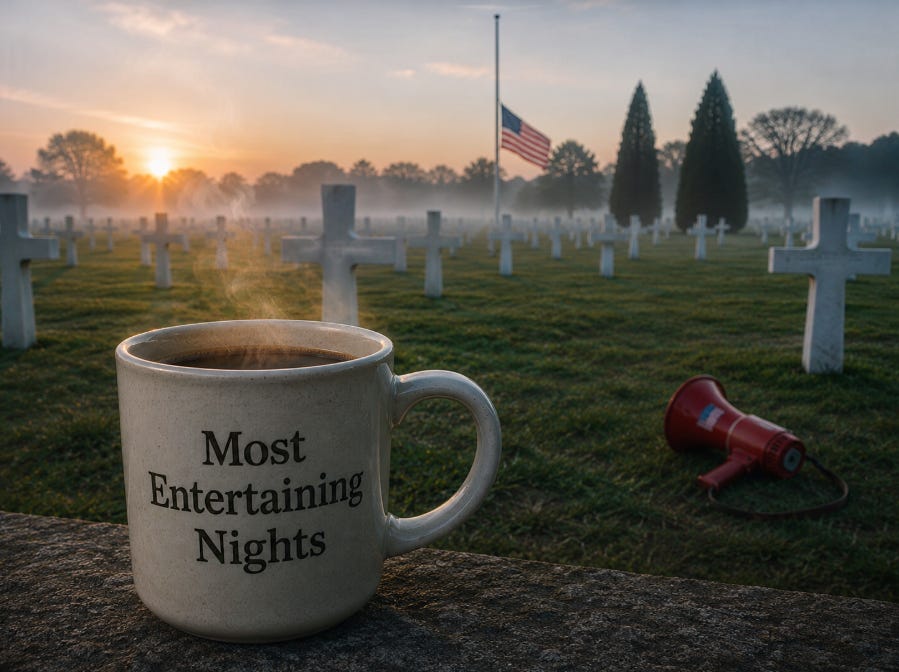
Yet, somehow, Pete Hegseth looked out over that history and thought: you know what this needs? A culture-war monologue about migrants.
Hegseth, speaking at a D-Day commemoration, began in the expected register. He praised the American dead, invoked Omaha and Utah beaches, honored the veterans present, and described the “unyielding spirit of the American warrior.” He spoke of the men who “liberate[d] an entire continent from the grip of tyranny,” of the “greatest amphibious assault in human history,” of the “blood stained sand,” and of the courage required to charge into machine-gun fire and artillery. In those moments, he was saying the things a defense secretary is supposed to say at Normandy. The dead deserve honor. The veterans deserve gratitude. The alliance that defeated Hitler deserves remembrance.
Then came the turn.
“Sadly today,” Hegseth said, “different European beaches are stormed by different dangerous ideologies.” He named beaches in Spain, Italy, Greece, and Bulgaria, then asked when European capitals would “do something about that invasion” or whether it was “too late.”
There it was. D-Day, reimagined as a segment from The Ingraham Angle. A commemoration of the men who fought fascism turned into a complaint about migrants arriving by boat. Sacred ground converted into a green room for nationalist grievance. The graves and the crosses were still there. The memory of the dead was still there. And Pete Hegseth, standing in the shadow of all that sacrifice, decided to drag the whole ceremony into the same old Trumpworld swamp: invasion, contamination, civilizational panic, and the eternal fantasy that cruelty is strength if you say it with enough flags behind you.
We were not the only ones offended.
On LBC, host Lewis Goodall heard exactly what Hegseth was doing. He described the speech as using a D-Day commemoration “not to talk about just the heroism and the blood sacrifice to defeat Nazism,” but to score political points. Goodall called it part of “something profoundly ugly happening in American conservatism right now,” a politics so drenched in grievance, decadence, and online rage that even the 82nd anniversary of D-Day becomes “just another backdrop for culture war propaganda.”
That is precisely it. Hegseth did not merely say something tasteless. He took a memorial to the defeat of fascism and tried to use it to launder the emotional architecture fascism depends on: fear, grievance, humiliation, invasion, betrayal, contamination, internal enemies, and the promise that only hard men with hard borders can save the nation.
The politics of fear, grievance, and exclusion is the fuel of fascism. It does not always arrive wearing a swastika. Sometimes it arrives wrapped in a flag, quoting scripture, praising “Western civilization,” and insisting that vulnerable people arriving by boat are an invasion. It speaks in the language of mourning. Sometimes it borrows the dead.
That is what made Hegseth’s remarks so obscene. The men who landed at Normandy were not fighting for a fortress fantasy built on ethnic paranoia. They were fighting the consequences of exactly that worldview. They were fighting Nazi tyranny, a regime that organized politics around blood, soil, hierarchy, grievance, and the dehumanization of the outsider. Hegseth, with all the subtlety of a tank driving through a stained-glass window, stood in Normandy and revived the vocabulary of invasion to describe desperate human beings crossing water.
Goodall connected Hegseth’s remarks to JD Vance’s exploitation of the Henry Nowak case. Nowak was an 18-year-old British university student who was fatally stabbed in Southampton by Vickrum Digwa, who falsely accused him of racist abuse. The case became a national outrage not only because of the murder itself, but because released police bodycam footage showed Nowak handcuffed as he lay dying, telling officers he could not breathe and that he had been stabbed. Digwa has since been sentenced to life in prison with a minimum term of 21 years, and an independent investigation into the police response is underway.
That is the actual case: a horrific murder, an allegedly disastrous police response, a grieving family, and a justice process still trying to answer how a dying teenager came to be treated as a suspect. What Vance did was something else entirely. In the tweet referenced during the LBC segment, he wrote that “Henry Nowak died the same way a civilization dies,” then blamed “European elites,” “the politics of self-hatred,” and “the mass invasion of migrants, many of whom despise the West and the people who love it.” It was a grotesque alchemy: take one horrific death, strip it of legal and institutional specificity, inflate it into civilizational collapse, and aim it at migrants, liberal democracy, and the supposedly decadent elites who refuse to be cruel enough. Goodall’s point was that Vance and Hegseth were working from the same script: every tragedy, every crime, every institutional failure, every social anxiety, and now even D-Day itself becomes proof that liberal democracy is dying and only nationalist rage can save it.
This is the shared script. Vance takes a murder and turns it into a sermon about the death of the West. Hegseth takes D-Day and turns it into a sermon about European beaches being “stormed” by migrants. Every tragedy, every crime, every social anxiety, every commemoration becomes evidence for the same conclusion: liberal democracy is weak, pluralism is suicidal, immigrants are invaders, and only their politics of rage can preserve civilization.
Instead of reverence, we get propaganda with a wreath laid in front of it.
Jake Richards, one of the MPs interviewed by Goodall, pushed back on Vance’s attempt to transplant American right-wing politics onto the Henry Nowak case. Richards said he “fundamentally” disagreed with Vance’s analysis. A horrific crime had occurred. The perpetrator had been sentenced to life imprisonment. A proper independent investigation into policing failures was underway. That, Richards argued, is how a lawful democratic process is supposed to work. What Britain did not need was the American vice president parachuting in to convert a specific tragedy into a civilizational rant.
Goodall connected Hegseth’s remarks to JD Vance’s exploitation of the Henry Nowak case. Nowak was an 18-year-old British university student who was fatally stabbed in Southampton by Vickrum Digwa, a 23-year-old British-born man who falsely accused him of racist abuse. The case became a national outrage not only because of the murder itself, but because of the police response: officers handcuffed Nowak as he lay dying after his killer claimed to be the victim, treating the bleeding teenager as a suspect despite his repeated pleas that he had been stabbed and could not breathe.
A widely circulated clip of his final minutes — amplified by the hard-right account Visegrád 24 and quote-posted by Vance himself — claimed Nowak told officers nine times that he could not breathe and four times that he had been stabbed. The exact count comes from a propaganda feed and should be held at arm’s length, but the established facts are damning enough on their own: Nowak said he had been stabbed, he was handcuffed as he lay dying, and he died. Digwa has since been sentenced to life with a minimum term of 21 years, the judge having specifically rejected his claim that Nowak racially abused him, and an independent investigation into the police response is underway.
That is the actual case: a horrific murder, a disastrous police response, a grieving family, and a justice process still trying to answer how a dying teenager came to be treated as a suspect. What Vance did was something else entirely. He wrote that “Henry Nowak died the same way a civilization dies,” then blamed “European elites,” “the politics of self-hatred,” and “the mass invasion of migrants, many of whom despise the West and the people who love it.” It was a grotesque alchemy: take one horrific death, strip it of legal and institutional specificity, inflate it into civilizational collapse, and aim it at migrants, liberal democracy, and the supposedly decadent elites who refuse to be cruel enough.
The inversion exposes itself in Vance’s own words. He described, accurately, what was done to Nowak, “abandoned, handcuffed by authorities who neither trusted nor cared for him,” and then blamed that death on migrants. But the police who handcuffed him were British, and the man who killed him was British-born. The villain of Vance’s morality play and its victim were the same nationality. The story only works backwards; told forwards, it indicts no migrant at all, which is precisely why it had to be told the other way.
Nor did Vance arrive at this framing alone, nor was he the last arm of the American government to reach for the boy. Rubio’s State Department issued its own statement on the case, pronouncing that “ideological conditioning and two-tiered policing are glaring symptoms of civilisational decline” that “must be rejected across the West.” So there it was, in the span of a single week: a Secretary of Defense at the graves of Normandy, a Vice President laundering a Central European propaganda account into the language of his office, and a State Department diagnosing the decline of an entire continent from a single Crown Court verdict. One week, three offices, one script.
Goodall’s point was that Vance and Hegseth were working from the same playbook: every tragedy, every crime, every institutional failure, every social anxiety, and now even D-Day itself becomes proof that liberal democracy is dying and only nationalist rage can save it. The State Department simply made it official.
Bailey’s historical correction was devastating because it was simple and true. D-Day was not merely a commemoration of military courage. It was the commemoration of a coalition of free peoples who came together to defeat fascism. He reminded listeners that the Allied war effort included not only British, American, and Canadian service members, but Sikhs, Muslims, Hindus of the Indian Army, African service personnel, Caribbean airmen and seafarers, and people of many faiths, ethnicities, and backgrounds. The lesson of D-Day, Bailey said, is not that nations should fear people because of where they come from. It is that free societies are strongest when they unite around democratic values.
That is the part Hegseth, and Vance cannot metabolize. The victory they claim to honor was not won by purity. It was won by alliance. It was won by democratic nations, colonized peoples, immigrants, exiles, resistance fighters, soldiers of different languages, religions, races, and nationalities, all joined against a fascist empire that believed human worth could be ranked by blood.
D-Day was a rebuke, not a monument to exclusion.
Yes, the United States played an extraordinary role. American soldiers stormed Omaha and Utah. American industry helped produce the ships, planes, vehicles, weapons, and logistical miracle that made the invasion possible. American families paid an unbearable price. But America did not do it alone.
Hegseth’s own speech briefly acknowledged Allied forces from Britain, Canada, France, Norway, Poland, and others. But the emotional center of his remarks kept snapping back to a narrower mythology: the enemy “underestimated the unbreakable will of the American Fighting Man”; the chaos of the airborne landings became “a triumph of American ingenuity and initiative”; the armada in the Channel became evidence of “speed and scale only the American War machine could produce.” Even when he gestured toward alliance, he framed the story as America’s singular fighting spirit saving “Western Civilization,” and then, almost inevitably, pivoted to scolding today’s Europe for insufficient toughness.
D-Day was not won by American exceptionalism alone. It was won by coalition, coordination, sacrifice, and shared purpose across nations and peoples. Hegseth wanted the language of alliance, but the politics of dominance. He praised partners when they bled beside us in 1944, then used their dead as a platform to lecture their descendants about migrants arriving by boat.
Fascism feeds on myth, pure nations, heroic violence, decadent enemies, betrayal from within. It thrives when memory is simplified into grievance. It grows when suffering is treated not as a warning, but as a resource to be mined for resentment.
The proper lesson of D-Day is not that civilization is saved by hating the stranger. It is that civilization is defended when free people refuse to surrender to tyranny, refuse to abandon one another, and refuse to let fear become the organizing principle of public life.
The men who landed in Normandy did not fight so that future politicians could stand beside their graves and describe migrants as an invading army. They did not fight so that the language of fascism could be repackaged as patriotism by men who confuse cruelty with courage, or so that “Western civilization” could become a slogan used to exclude the very kinds of people who helped save it.
They fought because fascism had to be defeated, because alliances mattered, and they fought because democracy, however flawed and unfinished, was worth defending.
They fought because the alternative was a world ruled by domination, hierarchy, racial mythology, and state violence.
When Hegseth uses Normandy to warn about migrants arriving by boat, and Vance uses Henry Nowak’s death to warn that civilization itself is dying, they are inverting the meaning of D-Day. They are taking the memory of those who fought fascism and conscripting it into the politics of fear, grievance, and exclusion, the very fuel fascism runs on.
Alas, because the universe apparently wanted to provide a footnote in crayon, Donald Trump spent the same day bleating on Truth Social like a malfunctioning authoritarian carnival barker.
There he was, announcing that he would be going to the G7 in France after what he called “one of the Most Entertaining Nights in American History”: UFC championship fights on the South Lawn of the White House. Because nothing says “republican virtue” like turning the people’s house into a pay-per-view cage match before jetting off to meet world leaders.
Followed, then by his ideological deep thoughts. “Has anyone ever seen a Happy Communist?” he asked, presumably after several minutes of staring into the golden void. He warned that communists do well with voters “in the early years,” but eventually bring “DEATH AND DESTRUCTION.” He claimed JD Vance and Republicans were “hunting down Fraud” in various states and finding “Billions of Dollars,” which, if fully uncovered, would supposedly balance the budget and cut taxes. Magic fraud beans: now available in bulk from the Office of Imaginary Fiscal Policy.
He ranted about Democrats, or “Dumocrats,” because apparently spellcheck has also resigned, being “in on the act.” He lumped together “Men playing in Women’s Sports,” “the Transgender Mutilization of our Children,” mail-in ballots, voter ID, and proof of citizenship into one giant casserole of panic. He congratulated Steve Hilton in California and promised the federal government would be there “with him, to help,” which is a tidy little preview of how Trump views blue-state elections: not as democratic contests, but as hostile takeovers awaiting federal backup.
Naturally, he posted about the Reflecting Pool. Bread, circuses, conspiracy theories, and a National Mall plumbing update.
So I am going to step away from the rage machine for a bit. Marz is taking me for a romp, because he understands decency, loyalty, and the importance of touching wild grass, which is more than I can say for most of this administration.
This piece is more of a rant than the usual Sunday morning roundup. I know that. I can hear it. But some things deserve anger. Some things deserve the refusal to make them polite.
When officials of the United States government look at a murdered teenager, a grieving family, a battlefield cemetery, and the anniversary of D-Day and see only raw material for nationalist propaganda, the proper response is not balance. It is revulsion. It is moral clarity, and saying plainly, that the dead deserve better than to be conscripted into the politics of fear, grievance, and exclusion.
D-Day deserves reverence. The soldiers who landed at Normandy deserve reverence. The people of every nation, faith, race, and background who fought fascism deserve reverence. What they do not deserve is Pete Hegseth using their graves as a backdrop for anti-migrant panic, JD Vance turning a boy’s death into a sermon about civilizational collapse, or Donald Trump spending the same day bleating about UFC fights at the White House, communists, fraud goblins, trans panic, mail ballots, California elections, and the Reflecting Pool.
Maybe that is the right place to end: with the work of remembering what we are actually trying to defend. A livable world. A pluralistic democracy. Politics rooted in solidarity rather than fear, and a future worthy of the people who fought, suffered, and died so that fascism would not have the final word. The refusal to let the old poison be poured into new bottles.
That is what D-Day asks of us.
A righteous rant was called for after the MAGA attack on a day that should be celebrated around the world - and you did us all proud with your great words. Permit me to share some of my thoughts and remembrances about June sixth, 1944, when I was a young West Texas farm boy who would turn five just two weeks later. I had uncles, cousins, husbands of aunts and neighbors who had gone off to fight the war, and too many didn’t return alive. But me and my imaginary friend Hector fought many battles that I had gleaned from the radio and discussions from family. My two older brothers, who were still at home, would develop doomsday scenarios off of mine and Hector’s heroic tales but I always had a magic out. If in their telling a Japanese Zero or German fighter was about to shoot us out of the air, they’d ask “what did you and Hector do then?” My answer was always “we went fishing!” When Trump and his companion’s actions are about to drive me crazy I need to remember the peace of going fishing.
Hegseth and Vance are simply practicing the Nazi strategy of telling The Big Lie, just another tactic. The Hitler-Goering-Himmler-Stephen Miller playbook is being executed with despicable purpose.