

There are a lot of decisions new parents are expected to make before they have even slept, eaten, showered, or processed the fact that a whole new human being has arrived and is now breathing outside of mom’s safe tummy. Hospitals move quickly; nurses ask questions; forms appear. Someone wants to know whether you are breastfeeding, whether you want the baby bathed, whether you consent to this test, that ointment, this shot, that vaccine, this screening, and that intervention.
It’s not hard to understand why some parents feel overwhelmed. It is not hard to understand why the phrase “routine newborn intervention” can land badly in a moment when your baby is tiny, perfect, and still covered in the evidence of arrival. There is a very normal instinct to say, “Can we just not do anything unnecessary?”
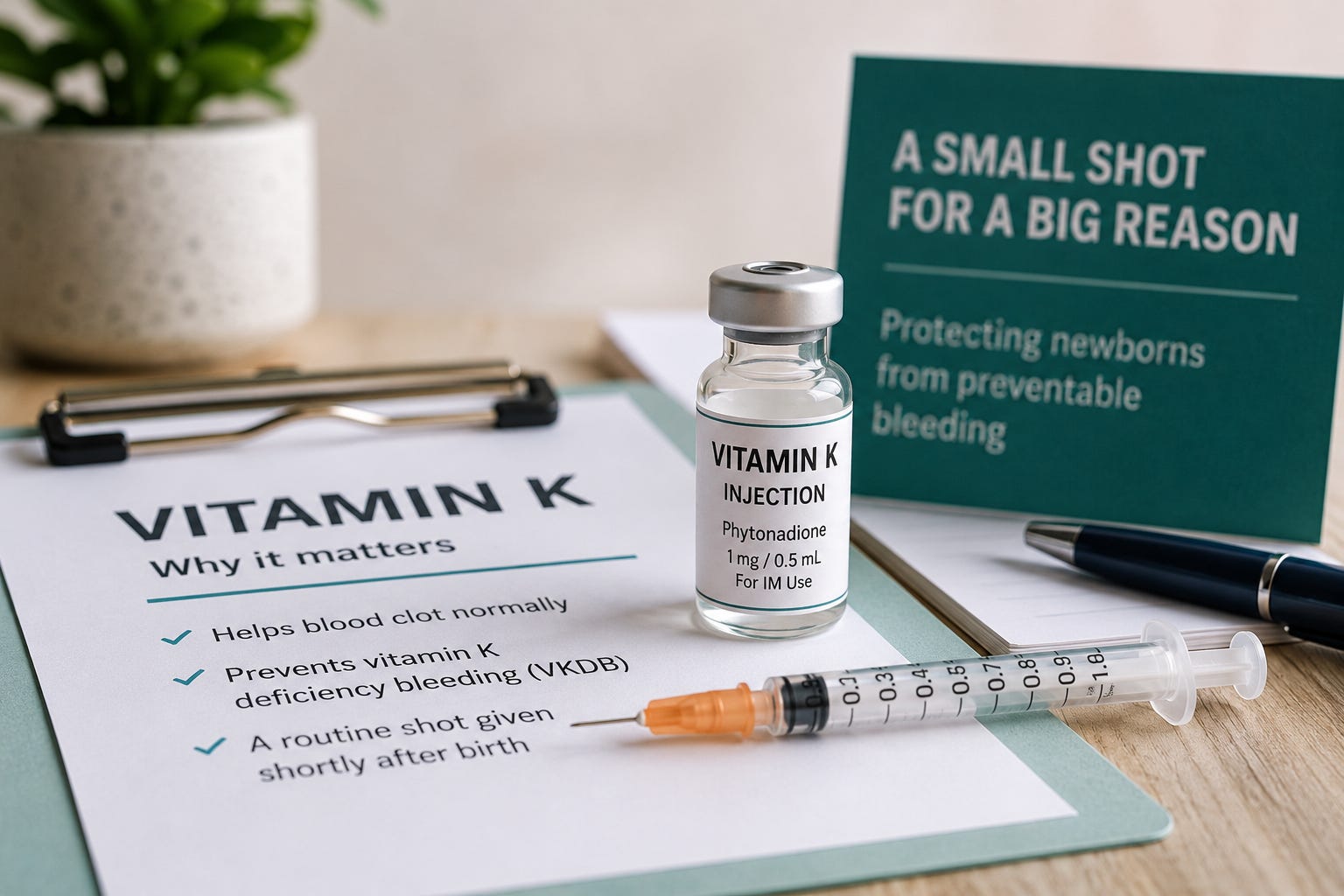
The problem, as ProPublica lays out in a devastating new investigation, is that some parents are now rejecting one of the most necessary things a newborn can receive: a single vitamin K shot that helps prevent life-threatening bleeding. It’s not a vaccine, it’s not new, and it’s not experimental. It’s a basic, long-standing public health measure that has been standard in the United States since the early 1960s, and it exists because newborn babies don’t yet have enough vitamin K to clot their blood reliably.
The consequences of refusing it can be almost unbearable to read about. ProPublica describes babies who seemed fine at birth, passed early screenings, went home, and then began to seize, stop breathing, bleed, or decline without warning. The medical term is vitamin K deficiency bleeding, or VKDB, and the CDC explains that it can happen inside the body where parents can’t see it, including in the intestines or the brain. The CDC also says infants who do not receive the shot at birth are 81 times more likely to develop late VKDB than infants who do.
That is the kind of number that should stop everyone cold. Not because parents are stupid, not because every question about medicine is bad, and not because doctors are gods who never get anything wrong, but because a baby’s brain shouldn’t become the proving ground for Facebook confidence.
The vitamin K shot has become a casualty of a much larger distrust machine, one that flattens every medical intervention into the same suspicious blob. A vaccine, a vitamin shot, an eye ointment, an antibiotic, a screening test, and a blood draw all become “toxins.” A medical recommendation becomes “Big Pharma,” a pediatrician becomes someone “pushing” something, and a hospital becomes a place that is trying to trick you before you’ve even buckled the baby into the car seat.
This is where the story becomes bigger than vitamin K, we’re watching a culture of suspicion move from the margins into the nursery. The same ecosystem that has convinced people measles is no big deal is now convincing some parents that a vitamin shot given to prevent catastrophic bleeding is somehow more dangerous than the bleeding itself. The logic is upside down, but the emotional pitch is powerful. It tells parents that refusal is protection. It tells them that saying no is bravery. It tells them that the more terrified they are of modern medicine, the more “informed” they must be.
And I want to be very careful here, because parents who fall into this aren’t usually trying to hurt their babies; most of them are trying desperately to do the opposite. Which is what makes this so heartbreaking. Fear gets dressed up as research, and misinformation knows exactly how to exploit love. It doesn’t tell a new mother, “I am going to make you take a reckless risk.” It tells her, “You are the only one brave enough to protect your baby.”
That’s a very seductive lie. One of the most important points in ProPublica’s reporting is that the United States doesn’t actually track this problem well enough. Government agencies don’t systematically track vitamin K refusals or the bleeding cases that may follow, which means doctors and public health officials are trying to understand a growing problem through partial data, hospital anecdotes, death certificates, and scattered records. ProPublica reports that deaths directly attributed to VKDB appear to be fewer than a dozen annually, but that those numbers may miss cases recorded under other immediate causes, such as bleeding in the brain.
That should make everyone angry, and not just in the abstract “public health bureaucracy is a mess” kind of way. If we are going to ask families to trust medical guidance, then we have to be able to show them what’s happening clearly. We need to know how often parents are refusing the shot, where refusal rates are rising, how many babies are being injured or dying from preventable bleeding, and we need to know whether midwives, hospitals, birth centers, online influencers, or prenatal care gaps are playing the biggest role.
Instead, we have a strange and dangerous gap. The shot works so well that many people no longer understand what it prevents. The disease has become rare enough to feel theoretical, but not rare enough to stop killing babies when prevention is refused. That is the cruel paradox of successful public health, when it works, people forget what life looked like before it existed.
A recent JAMA research letter gives a clearer picture of the trend. Looking at more than 5 million births in a large electronic health record database, researchers found that the share of U.S. newborns not receiving intramuscular vitamin K rose from 2.92 percent in 2017 to 5.18 percent in 2024. That may sound small until you remember how many babies are born every year, and how simple the prevention is. Five percent is not a fringe problem anymore, five percent is a warning light on the dashboard.
It is also worth saying plainly that vitamin K refusal is not just a private parenting preference. We have become so afraid of sounding judgmental that we sometimes pretend every parental choice exists in a sealed moral container, immune from consequences beyond the family. But a parent can’t research their way out of a newborn’s biology, babies are born with very small stores of vitamin K, breast milk contains low amounts of it, and their gut bacteria are not yet developed enough to make what they need. These are simply facts about newborn bodies.
The better way to talk about this is not to sneer at parents, because sneering doesn’t save babies. The better way is to tell the truth early, clearly, repeatedly, and without treating every false claim as though it deserves equal footing with decades of evidence. Parents should hear about vitamin K during prenatal care, not for the first time in a hospital room when they are exhausted and frightened. Pediatricians, OBs, nurses, doulas, and midwives should all be giving families the same basic message: this shot prevents rare but devastating bleeding, it has a long safety record, and delaying or refusing it can put a baby at risk before anyone sees a warning sign.
There is also room for more humane communication. If a parent is worried about bonding after birth, the CDC says the shot can be delayed up to six hours so the baby and mother can have immediate contact. That’s a useful detail because it respects the emotional reality of birth without pretending the medical reality has disappeared.
What we can’t keep doing is allowing social media algorithms to become the loudest voice in the room where newborn safety is concerned. We can’t keep treating every “I did my own research” as though it is equivalent to a century of research, clinical practice, and pediatric experience. We can’t keep watching the same pattern repeat itself, where a public health success becomes invisible, misinformation fills the silence, and then families rediscover the danger through tragedy.
A baby doesn’t need a parent who has beaten the hospital in some imaginary contest of purity. A baby needs blood that can clot, adults who can tell the difference between caution and paranoia, and a society that doesn’t abandon parents to influencers who have never had to sit beside a crib in the ICU and understand what their advice has done.
There is an old-fashioned phrase that still applies here: standard of care. It sounds boring and administrative, but in this case it’s the opposite, it means we learned something the hard way, we figured out how to prevent it, and we made that protection routine so fewer families would have to learn through grief.
A baby doesn’t need a parent who has beaten the hospital in some imaginary contest of purity. A baby needs blood that can clot, adults who can tell the difference between caution and paranoia, and a society that doesn’t abandon parents to influencers who have never had to sit beside a crib in the ICU and understand what their advice has done.
The vitamin K shot is small, cheap, and easy to overlook precisely because it works. That doesn’t make it optional, it makes it one of the quiet miracles of modern newborn care, and we should be very careful before we let fear talk parents out of it.
Insurance providers should give parents who do get their children needed shots & vaccines a discount on something - or just a small monetary reward - to incentivize parents to do the right thing. Personally, I’d like to see those who do the wrong thing not be covered by insurance for problems related to their bad choice - but my husband tells me that is mean-spirited.
It is such a standard thing to do in the UK that I am amazed that it is controversial. I remember my baby sons receiving the injections some 50 years ago. It's so sad nowadays that everything seems to require "goodies" and "baddies" and people somehow feel required to align themselves on subjects that do not have these characteristics. What happened to the "it's sensible" point of view?