


There is a peculiar moment in every democracy when the campaign signs begin multiplying like invasive weeds, the candidates start speaking in the grave tones of undertakers, and the nation, which only yesterday was a place with potholes, unpaid bills, school lunches, hospital invoices, and people trying to get through Wednesday, is suddenly transformed into a sacred object requiring immediate emotional rescue.
This is the season when everyone claims to know the soul of the country, which is convenient because the soul tends to agree with whoever is holding the microphone.
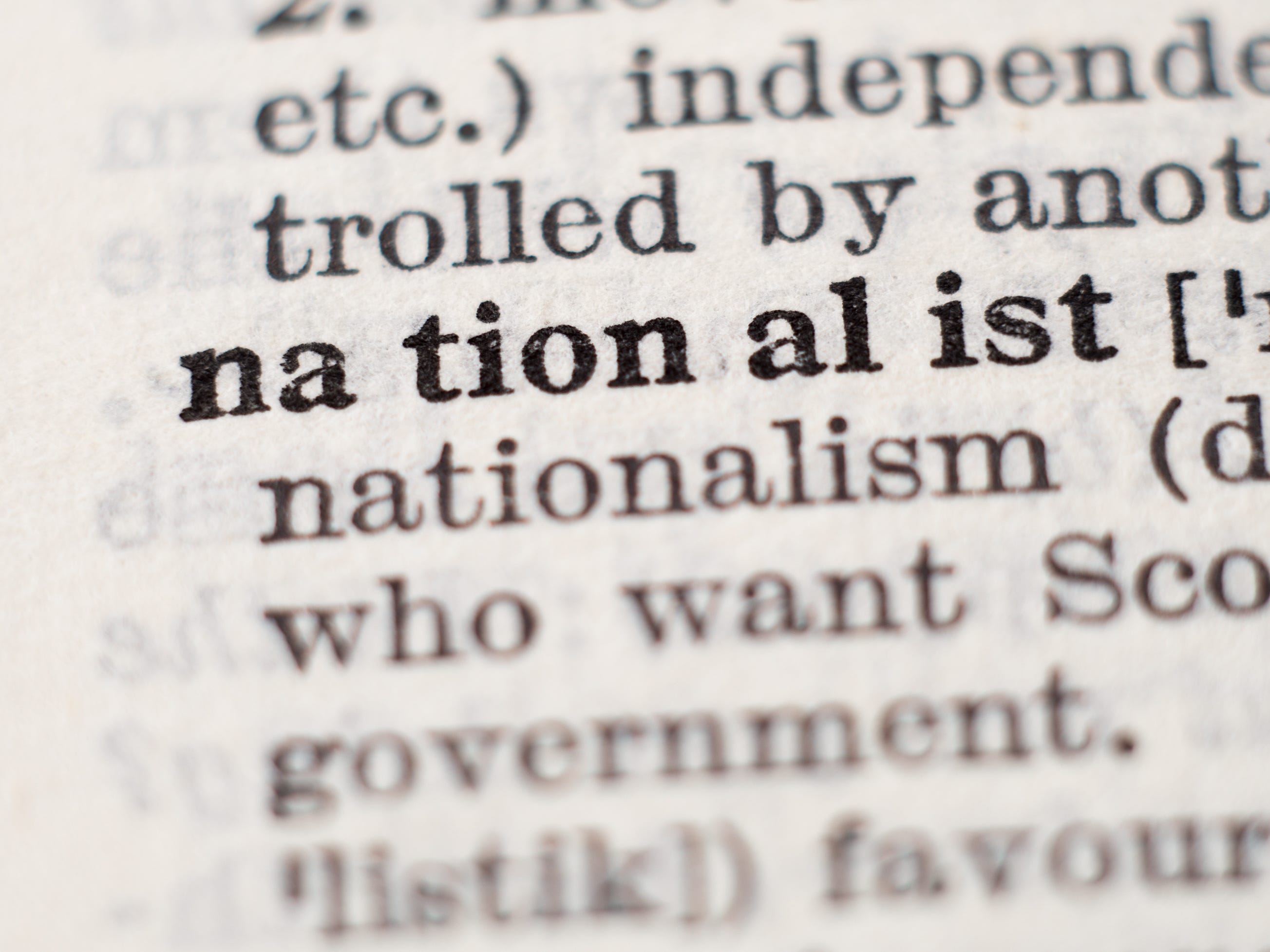
Nationalism enters democratic elections wearing several costumes at once, because it is never content to be merely an ideology when it can also be a lullaby, a sermon, a family album, a weather report, and occasionally a hostage note written in red, white, and blue.
It tells us we belong to something older than ourselves, larger than our private disappointments, and more enduring than the daily indignities of modern life, which is no small comfort in a world where the rent is high, the news is deranged, and the future appears to have been designed by consultants with excellent dental plans.
The appeal is not mysterious, because people want to belong, and they want their lives to mean something beyond the narrow arithmetic of bills paid, errands completed, years survived, and dreams quietly adjusted downward until they fit inside whatever room reality has left available.
People want to believe the place that made them, wounded them, educated them, taxed them, disappointed them, and promised them more than it ever delivered still contains some hidden moral purpose waiting to be recovered.
A nation can satisfy that hunger because it offers identity without requiring intimacy, kinship without acquaintance, and memory without the inconvenience of accuracy. Nationalism often presents itself as ancient, as if it has been sleeping in the soil since the beginning of time, waiting for a campaign consultant with a half-zip fleece and a polling budget to awaken it.
In reality, modern nationalism is not some eternal human inheritance handed down from the cave paintings. It is a relatively recent political invention, one that grew powerful when older forms of authority began to crack, when kings stopped looking inevitable, empires began to tremble, print culture spread common languages across distances, and ordinary people were invited to imagine themselves not merely as subjects of a ruler but as members of a people.
Before the modern age, most human beings belonged first to villages, regions, religions, classes, and empires, while the nation as we now understand it had not yet become the emotional headquarters of the self.
Then came the great rearrangement. The divine right of kings began to lose its spell and revolutions declared that sovereignty didn’t descend from heaven through a jeweled crown, but rose from the people.
Maps hardened into identities, schoolchildren learned official languages, newspapers helped strangers imagine themselves reading the same world at the same time, and the nation became not merely a territory, but a story people could enter, inherit, defend, revise, and, when necessary, kill or die for.
This is the brilliance and the danger of nationalism. It tells a person that their private life belongs to a larger drama, which can be a generous and sustaining idea when it inspires solidarity, sacrifice, civic responsibility, and care for people we will never meet.
It can also become a furnace when the same story is used to decide who counts as fully human, who belongs only conditionally, and who must be blamed whenever the national mood turns sour. Every nation teaches its citizens not only laws, but manners of feeling.
It teaches what should make them proud, what should embarrass them, what history should be recited, what history should be softened, what losses should become sacred, what violence should become necessary, what language should sound respectable, and what kind of person should appear natural beneath the flag.
This is how nationalism shapes culture long before anyone enters a voting booth. It settles into holidays, textbooks, monuments, military rituals, sports chants, border ceremonies, school pledges, immigration forms, campaign slogans, war movies, museum plaques, and all the sentimental machinery by which a country tells itself what kind of country it is.
Sometimes these rituals bind a society together in ways that are profoundly decent. A shared national identity can persuade people to build public schools for children who aren’t their own, fund hospitals they may never enter, protect parks they may never visit, and accept obligations to strangers on the grounds that citizenship means something larger than private convenience.
At its best, nationalism can help people resist empire, defend self-government, preserve culture, and build democratic institutions sturdy enough to survive the appetites of wealth and power.
There is a reason colonized people have so often used national identity as a language of liberation. There is a reason ordinary citizens have marched, organized, sacrificed, and suffered under banners that promised them not supremacy, but dignity. There is a reason democracy itself has often needed some version of national solidarity to function, because a society can’t govern itself if its members can’t imagine one another as participants in a shared fate.
A democracy without any common story becomes brittle, suspicious, and cold, like an apartment building where everyone hears the fire alarm but nobody believes the smoke is their problem. The trouble begins when the common story becomes a purity test, when love of country requires contempt as proof of devotion, and when the nation stops being a civic home and becomes a gated community with a choir, a weapons budget, and a very theatrical grievance committee.
Nationalism doesn’t always announce its darker intentions at the beginning, because it often arrives with flowers, family photographs, grandfathers in uniform, factories that once paid enough to raise a family, and the ache of remembering a world that may have been cruel to many people but still feels tender to those who were allowed to belong.
That tenderness is politically powerful. A person who feels humiliated by change, abandoned by institutions, mocked by elites, displaced by economic forces, or spiritually unmoored by modern life may find in nationalism a kind of emotional compensation.
It says, you aren’t lost, you aren’t small, no, you are part of something noble that has been betrayed. It says, in essence, the pain you feel has an author, and the author has a face, a language, a passport, a neighborhood, a religion, a university degree, a coastal zip code, or whatever villain the moment requires.
There is the narcotic. Nationalism can convert confusion into certainty, loneliness into belonging, and private disappointment into collective rage. The world may be complicated, but nationalism offers a plot. There are heroes, traitors, borders, invaders, martyrs, sacred ancestors, and a golden age that seems always to have occurred just before anyone currently alive was old enough to take notes.
The past becomes less a record than a costume department. This is why nationalist politics can feel so emotionally charged even when its policy agenda is vague, contradictory, or held together with bumper stickers and grievance glue. It’s selling recognition.
It says, I see you, I know what was taken from you, I know who took it, and I alone am brave enough to say what everyone else is supposedly too frightened, too corrupt, or too polite to admit.
That message lands because human beings aren’t merely rational citizens sorting through policy proposals with the serene detachment of tax attorneys comparing depreciation schedules.
We are tribal creatures with smartphones, anxious mammals with voter registration cards, and social animals who can turn almost any distinction into a moral border if frightened long enough.
We like to imagine ourselves as independent thinkers, but our identities are built in relation to others, which means we are always asking where we belong, who recognizes us, who threatens us, and who seems to be laughing at us from somewhere just beyond the velvet rope.
Nationalism answers those questions with dangerous efficiency. It gives us an enormous in-group, an inheritance, symbols to kiss, songs to sing, enemies to suspect, and a flattering explanation for why our suffering matters.
It can also provide a sense of continuity in an era that has made many people feel disposable, because when jobs vanish, towns hollow out, social trust declines, families scatter, institutions decay, and public life becomes a screaming contest conducted through pocket-sized surveillance machines, the nation may appear to be the last remaining container strong enough to hold a person’s grief.
This is where democracy becomes vulnerable. Democracy depends on ordinary disappointment being survivable. It requires citizens to lose elections without concluding that the country has been stolen, to tolerate leaders they dislike without imagining themselves conquered, to accept courts, legislatures, journalists, bureaucrats, and election workers as imperfect parts of a legitimate system rather than agents of national betrayal.
Democratic life depends on the unglamorous virtues that nationalism often finds insufficiently theatrical. It asks us to tolerate ambiguity, share power, accept loss, bargain with people we dislike, protect the rights of people who irritate us, and admit that no election can permanently settle the question of who we are.
Nationalism, when it curdles, offers the opposite pleasure. It tells us there is one real people, one authentic voice, one betrayed inheritance, and one final battle after which the nation will be purified of whatever human complexity has been blamed for its suffering.
This is how opponents become enemies, how dissent becomes disloyalty, how journalism becomes sabotage, how courts become conspiracies, and how the peaceful transfer of power, that most miraculous and least poetic democratic ritual, starts to look to some people like surrender.
The voter is no longer merely choosing a representative, they are choosing a reflection. A campaign that should be about roads, wages, schools, climate, labor, war, taxes, corruption, housing, public health, and the dull machinery of governance becomes instead a contest over who gets to define the country and who must stand outside the photograph.
When elections become battles over national identity, compromise begins to feel immoral because the other side is no longer simply wrong about policy, but wrong about who the people are.
Which brings us to the psychological trap. A person can change their opinion about a tax credit without feeling that their soul has been evicted, but it’s much harder to change an identity.
Once politics fuses itself to belonging, every disagreement becomes intimate, every ballot becomes symbolic, and every defeat becomes humiliation performed at national scale. This is not a problem of one country, one party, one century, or one ideology.
Nationalism has appeared in liberal movements, anti-colonial movements, fascist movements, democratic movements, revolutionary movements, conservative movements, and progressive movements, because it is less a single doctrine than a combustible human material that can be shaped toward dignity or domination.
The question is always what kind of nationalism is being cultivated and whom it asks us to become. A civic nationalism treats the country as a shared political project, open to anyone willing to participate in its rights, obligations, arguments, and future. An ethnic nationalism treats the country as the natural property of a particular bloodline, religion, language, ancestry, or mythic original people, leaving everyone else to live there as guests, problems, or tolerated exceptions. One version can deepen democratic responsibility by asking citizens to recognize strangers as part of a common fate. The other prepares the ground for authoritarian politics by teaching citizens to mistake exclusion for loyalty, obedience for patriotism, and domination for national renewal.
There is a democratic nationalism that can help citizens feel responsible for one another. There is an authoritarian nationalism that teaches citizens to worship power as if obedience were patriotism. There is a generous patriotism that asks people to serve the country by improving it. There is a brittle patriotism that treats criticism as vandalism, memory as treason, and equality as an insult to those who preferred the old seating chart.
The difference is important because nationalism doesn’t merely influence elections. It changes the emotional system in which elections occur. It can make cruelty sound like courage, pluralism sound like weakness, suspicion feel like vigilance, nostalgia feel like evidence, and it can make citizens forget that a nation is not a museum of one group’s innocence, but a living arrangement among people who must keep deciding how to share power without destroying one another.
And yet, it would be too easy to end here with a sermon against nationalism, as though we could simply be talked out of wanting roots, memory, recognition, and a home large enough to hold their longing. That would be tidy, but it would also be false.
People don’t stop needing belonging because intellectuals have noticed the dangers of flags. People don’t stop loving the songs they were raised with because history has footnotes.
People don’t stop grieving lost towns, lost status, lost industries, lost certainties, and lost versions of the future because someone has explained that nostalgia can be politically manipulated.
The work is not to sneer at the need, but rather, to refuse the manipulation. A mature nationalism says we belong to one another despite our differences, a dangerous nationalism says we can only belong if certain people are made to disappear from the story, a democratic nationalism says the country is unfinished and all citizens have a claim on its future, and a corrupted nationalism says, the country has already been perfected in the imagination, and democracy is tolerable only when it delivers power to those who claim to represent the “real” people.
That distinction may be the difference between solidarity and decay. The task, then, is not to scold people for wanting a country that feels meaningful, because meaning is not a childish need and belonging is not a moral failure. The task is to ask what kind of belonging we are being offered, what it costs, who pays for it, and whether the flag is being used as a symbol of shared responsibility or waved like a magician’s cape while someone steals the furniture.
Every election asks practical questions, but beneath them lives a more intimate one. Who are we willing to include in the word “we”? A democracy can survive fierce disagreement, bad candidates, ugly campaigns, foolish slogans, and even the occasional yard sign large enough to require its own municipal zoning review. What it can’t survive forever is a politics that teaches citizens to experience one another as contaminants.
The future of democracy may depend less on whether people love their country than on whether they can love it without needing to hate half the people who live there. The flag wants your vote, the harder question is what it wants you to become.
very subtle and very sensible. Thank you!
The microphone is the focal point, the message garbled, with the continued outflow of money becoming an awakening , while still the other “Trust Me “ directives are on shakey footings.
There’s a favorite Appalachian song of mine Cuckoo Bird :“Oh, the cuckoo she’s a pretty bird, and she warbles as she flies,She never hollers ‘cuckoo’ till the fourth day of July.”
A lot of people are realizing this country-a young country -is a work in progress, and has flaws. But the warble is in this case is wobbling on the 4th of July , with a lot of people concerned our gain as a sovereign nation celebration has , in fact, turned into spectacle by none other than the head barker of circus fame no names need mentioned I’ll assume.
Change is difficult especially when the facts are sketchy ( or would that be lies?)…35-40% voter participation common numbers for many midterms,local participation, or special elections a hard clue , plus an upside down collide of norms in question.
But WE are in up to our proverbial _ _ _ _ (fill in your own blanks) because little/too few want to accept fact/law/history or buy/afford the narrative at billionaires prices. Instead they bought the promises of familiar con artists with rich backers..greed their common last names …the top 2% is to whom the references mostly apply.
They have little clue of how me and YOU live. and yet they are threatened …they need MORE, MORE, MORE!
Wake up America
🇺🇸🇺🇦