


A reader commented on my bindweed piece and said the problem in her garden was mugwort. Which, naturally, meant I had to know more.
This is the risk you take when you mention a plant to me now. I’m no longer capable of receiving garden information casually, because apparently the last few months have turned my brain into a compost bin where horticulture, fascism, family life, and mild spiritual panic all break down together into something I insist on calling an essay.
So, I went looking into mugwort, and immediately, I understood the problem. Mugwort is exactly the kind of plant designed to seduce a person like me. It is ancient, aromatic, medicinal, folkloric, a little witchy, and named like something you would find in a jar at the back of a cottage owned by a woman who knows too much about the moon.
It sounds useful, mysterious, and like it should be tied with twine, hung from a beam, and used by someone with excellent cheekbones to ward off bad dreams and men who say “actually” before ruining the room. Then you learn that mugwort also spreads aggressively through underground rhizomes, thrives in disturbed ground, can form dense colonies, and is sometimes described by extension offices in the same tone usually reserved for home repair estimates and medical billing notices.
That’s the thing about mugwort. It refuses to be one thing. It has real history, uses, and old-world medicine and folklore clinging to it like smoke. It also has a growth habit that, left untended, can become everyone else’s problem. And because my garden series has apparently become an unpaid adjunct course in the political botany of American collapse, I looked at this complicated plant and thought, unfortunately, of the Republican Party.
Not because the whole party was always useless or because every Republican voter is a villain, a fool, a weed, or a tiny man in a red hat photosynthesizing grievance under fluorescent light. That would be lazy, and mugwort deserves better than lazy.
The more responsible metaphor is more interesting: a thing can have medicinal chapters and still become invasive when nobody tends its growth. A plant can be useful in one context and destructive in another and a tradition can have roots worth remembering and still be taken over by its most aggressive rhizomes.
That, to me, is where this lesson begins. Mugwort was not always only a problem and the Republican Party was not always only Trump. I know some people don’t want to hear that, especially after the last decade, and I understand the impulse. After you have watched a political party wrap itself around one man’s vanity, defend the indefensible, excuse the inexcusable, and behave like the Constitution is an inconvenient trellis in the way of personal advancement, it is hard to discuss useful roots without wanting to make a noise usually heard from possums under stress.
But history is not made better by flattening it, the Republican Party has had genuinely useful chapters. It was the party of Lincoln and the Thirteenth Amendment, which abolished slavery in the Constitution after a war that tore the country open and forced the nation to confront the monstrous contradiction at its founding.
It gave us Theodore Roosevelt’s conservation legacy, imperfect as all human legacies are, but still a real and lasting expansion of the idea that public land should belong to the public and that forests, parks, birds, wildlife, and wild places were not merely raw material waiting for the highest bidder.
It gave us Eisenhower and the interstate highway system, which reshaped the country, for better and worse, but also reflected a kind of national-scale public ambition that seems almost exotic now, like a creature spotted briefly in the woods and never seen again.
It gave us Nixon signing the Clean Air Act amendments and creating the Environmental Protection Agency, which is deeply inconvenient for everyone who would prefer history to arrive in pure moral costumes. Nixon was Nixon, which is to say that the plant identification tag comes with a warning label, but the environmental legislation mattered.
It gave us George H. W. Bush signing the Americans with Disabilities Act, one of the most important civil rights laws in modern American life, a law that expanded access, dignity, and participation for millions of people.
None of that erases the harm or purifies the soil, and none of that means we pretend the party didn’t also carry racism, backlash, corporate capture, voter suppression, union-busting, reactionary politics, Southern Strategy rot, and all the other ingredients that eventually made the bed so hospitable to Trump.
But the useful parts were real, which is why mugwort is a better metaphor than poison. Poison is too simple; mugwort is not simple. Mugwort says: I have been medicine, I have been folklore, and I have been useful to people who knew how to use me. Then mugwort, if left to itself in the wrong conditions, also says: I believe I will now become the entire garden.
So, you see, the problem is not that mugwort exists. The problem is what happens when its growth isn’t tended, when disturbed ground gives it an opening, when its rhizomes spread beyond the place where it can be useful, and when everyone admires the old medicinal associations while ignoring the fact that it’s currently colonizing the bed and shoving the other plants out of the neighborhood.
That’s the Republican story I’m interested in here. Not a story where every root was evil from the beginning, but rather, a story where the old usefulness became entitlement, where “limited government” became contempt for public goods, “personal responsibility” became a cudgel against the poor and a decorative phrase for the rich, “law and order” became a permission slip for selective cruelty, “family values” became a way to police everyone else’s family while declining to display much value in one’s own, and where “freedom” became the freedom to pollute, exploit, intimidate, deregulate, deny, defund, and carry a rifle into a sandwich shop because somebody online said tyranny was hiding near the mayonnaise.
And then Donald Trump walked down the golden escalator. Which is when the mugwort became smugwort. I’m sorry, but the word was sitting there, and I’m only human. Smugwort is what happens when the most aggressive growth habit in the bed develops a television presence, a grievance economy, and an absolute inability to experience shame. Smugwort is mugwort after gallons of Miracle-Gro and twelve hours of cable news. Smugwort is invasive, self-satisfied, impossible to embarrass, and deeply convinced that the entire garden exists as a support structure for its personal expansion.
Donald Trump didn’t plant every destructive tendency in the Republican Party. He simply fed them, fertilized them, praised the rhizomes, and gave the most invasive parts sunlight, cameras, donor money, algorithmic spread, judicial delay, congressional cover, and a party apparatus willing to stand there with a watering can saying, “This is normal growth.”
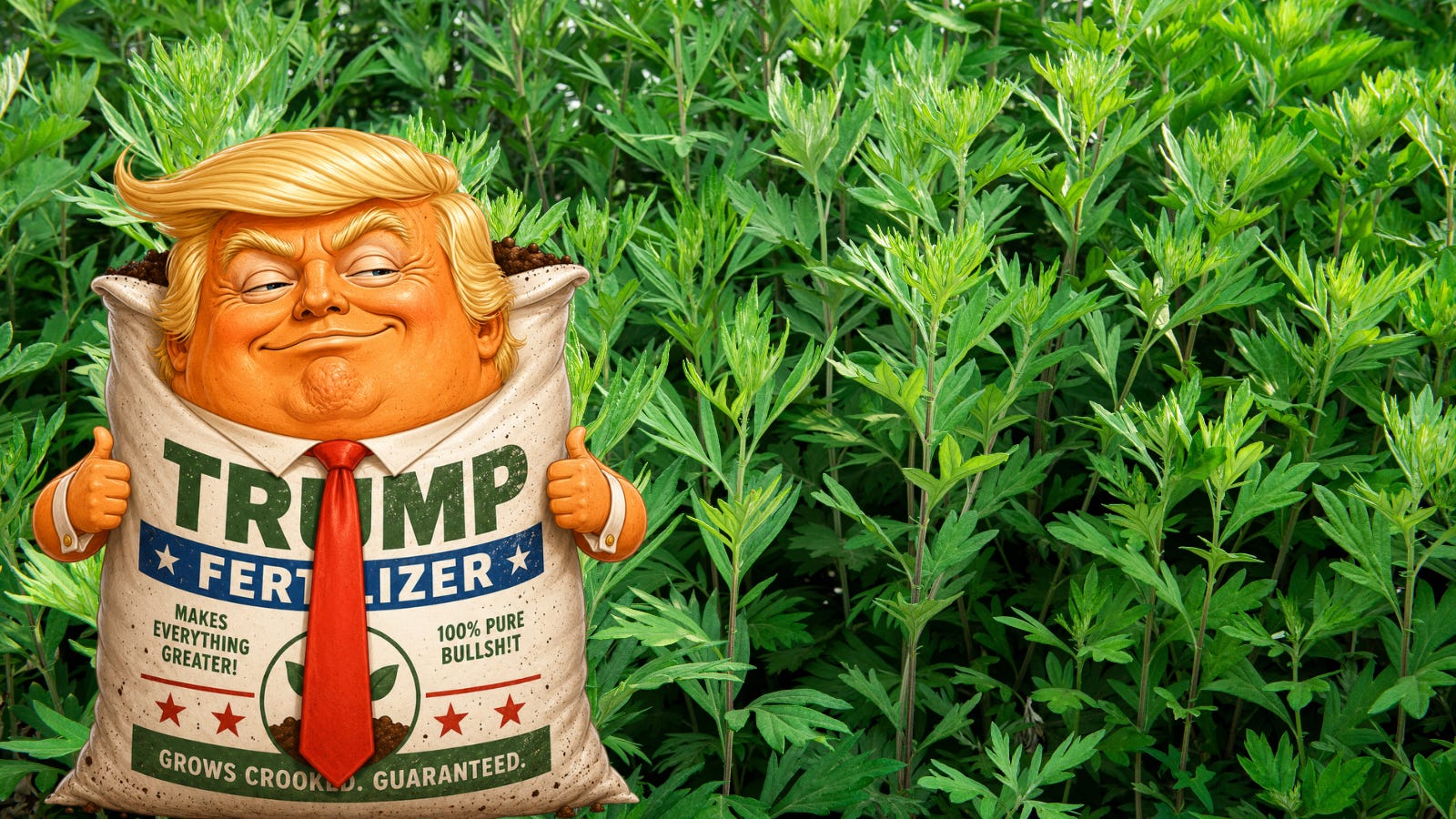
He took the disturbed ground and made it a habitat. He looked at fear, resentment, racism, misogyny, anti-intellectualism, celebrity worship, religious grievance, billionaire impunity, conspiracy thinking, and the old American appetite for a strongman, then he poured nutrients directly onto the worst part of the root system.
This is why the party didn’t simply change at the surface. It changed underground; it spread by rhizome. You can see it in the way Trumpism keeps appearing in places that once seemed separate: school boards, state legislatures, courts, churches, county commissions, cable panels, family group chats, election offices, social media feeds, and random conversations with men who believe they have discovered the secret truth of America in a meme posted by someone named PatriotEagle1776.
You pull one shoot and find the root is connected to another, you address one lie and three more emerge nearby, you think you’re dealing with one candidate, one scandal, one election, one court case, or one appalling statement, and then you realize the growth has moved through the whole bed.
That’s what makes smugwort dangerous. It’s not just loud aboveground; it’s connected underground. And yet, this is where the lesson has to stay responsible, because mugwort also reminds us that the answer is not to declare every plant with a complicated history irredeemable.
The answer is not to scorch the bed or to say that anyone who ever loved the plant, used the plant, voted for the plant, or inherited the plant must be treated as permanently beyond reach. That may feel satisfying for about twelve seconds, which is also the average lifespan of most satisfying political thoughts before reality walks in.
The better work is harder. We have to distinguish the medicinal tradition from the invasive growth, ask what is worth saving and what is crowding out life, and look honestly at the roots and stop pretending that a history of usefulness grants permanent permission to spread without limit.
This is where I want to speak directly to Republicans who still remember the medicinal side of their own plant. You don’t have to keep choosing the invasive growth, you don’t have to call the rhizomes roots, you don’t have to pretend the colony is health, you don’t have to let smugwort convince you that the garden belongs to him because he is loudest, greenest, most persistent, and least willing to die back in winter, you don’t have to confuse aggression with vitality, and you don’t have to keep watering the thing that is crowding out the parts of your own tradition that once did actual civic work.
Look up. Your gardener isn’t helping you. He is feeding the worst part of the plant and calling the takeover restoration. He isn’t tending Republican roots, he’s exploiting Republican disturbance, he’s not preserving a tradition, he’s just using its name as mulch, and finally, he’s not making the garden healthy, he’s making sure nothing else can grow tall enough to shade him.
That’s the thing about invasive politics; it always tells its hosts that dependence is loyalty. It tells them they cannot survive without the thing that is overtaking them, that the old garden is gone, the new colony is inevitable, and anyone who asks whether something else might grow there is a traitor to the bed.
But a garden isn’t loyal to one plant, and a republic is not loyal to one man. A political tradition isn’t healthy because it has become too dense for anything else to live. If Republicans want to reclaim anything useful from their own past, they can’t simply point backward at Lincoln, Roosevelt, Eisenhower, Nixon’s EPA, or George H. W. Bush’s ADA as if old medicine still works while the current plant is busy colonizing the floorboards.
Roots are not souvenirs; roots are responsibilities. The question is whether enough people inside the party are willing to stop feeding the smugwort long enough for something healthier to return.
This is where the metaphor gets uncomfortable, because tending mugwort is not the same as admiring mugwort. Sometimes the responsible gardener has to contain it, remove it from a bed where it is doing harm, or admit that the plant she wanted to like is not behaving well in the place where it’s growing.
That isn’t hatred; that’s care. The same is true of political traditions. Love of country is not pretending the invasive growth is fine because it has pretty folklore attached to it. Love of country is learning what the plant is doing now.
And what Trumpism is doing now is not medicinal. It isn’t conserving anything worth conserving, it’s not building, healing, stewarding, protecting, or governing in the old civic sense. It’s spreading, crowding, exhausting the soil, and making every other plant orient itself around its appetite.
That’s why nostalgia is such dangerous fertilizer. Nostalgia lets people look at an invasive colony and still see the old herb. It lets them say, “But this plant has history,” while ignoring the tomatoes disappearing beneath it. It lets them say, “But this plant once helped people,” while stepping over the things it is currently suppressing. It lets them say, “But this is our plant,” as if ownership is the same as health.
The underground republic keeps teaching the opposite lesson. Health is not proven by age, usefulness is not permanent, tradition is not immunity, a plant with a medicinal past can still become destructive in an untended garden, a party with civic roots can still become dangerous when its worst growth habits are fertilized by a man who mistakes domination for cultivation, and a citizen, like a gardener, has to be honest enough to see the difference.
That honesty has to be clear. Mugwort is not useless, it’s not without history, power, fragrance, folklore, or old medicine. But if it is taking over the garden, you don’t solve the problem by telling sentimental stories about the time someone used it for tea.
You solve it by tending the bed, you stop feeding the spread, you protect the plants being crowded out, and you decide what can be contained, what must be removed, and what conditions allowed the takeover in the first place.
That is the work Republicans have in front of them if they want anything other than smugwort to define their future. It’s not enough to say “this is not who we are” if the plant is in every bed. It’s not enough to whisper concern while watering the roots. It’s not enough to praise Lincoln while obeying a man who would sell the copper off the Lincoln Memorial if he could convince his supporters the proceeds would own the libs. It’s not enough to admire Roosevelt while standing silent as public lands and environmental protections are treated like obstacles to extraction. And it’s just not enough to invoke law and order while supporting a man who treats law as something that should apply to enemies and order as something that should kneel before him.
At some point, the gardener has to stop narrating the plant’s better qualities and start dealing with what it’s doing. That is true in the garden, it’s true in the republic, and it’s true now. Because the smugwort isn’t going to wake up one morning and decide to become a carefully tended medicinal herb again.
It won’t moderate itself out of respect for the other plants, it won’t look around at the crowded bed and say, “Perhaps I have taken up enough space.” That isn’t how invasive growth works; it takes the space available to it, it follows the disturbance, exploits the opening, and spreads until something stops it. This sounds bleak, but I don’t think it has to be. There is a strange hope in understanding a plant clearly, because once you know how something spreads, you know where to begin.
Once you understand that the problem is not simply one visible shoot, but a whole underground system of nourishment and spread, you can stop being shocked every time it comes back and start tending more wisely.
That’s the gift and curse of the underground republic. It keeps teaching me that nothing begins where we first notice it. The worm was never just a worm, the flatworm was never just a pest, the fungi were never just fungi, the bindweed was never just a vine, and mugwort is not just a weed.
It is a question about what happens when something useful loses proportion, when old medicine becomes invasive, when a political tradition forgets the difference between roots and rhizomes, and when a leader with no interest in health starts feeding the part of the plant most likely to take over.
So yes, I have now become the kind of person who reads a reader comment about mugwort and ends up thinking about Lincoln, Roosevelt, Eisenhower, Nixon, George H. W. Bush, Donald Trump, rhizomes, disturbed ground, and the moral hazards of Miracle-Gro.
I don’t know whether this is personal growth or a cry for help. Either way, the lesson is clear; not every old plant is useless, not every useful plant is safe, not every tradition has to become its worst habit, and not every Republican has to keep pretending the smugwort is a garden. The healthy roots are still there if they choose them, the medicinal history is still there if they mean it, the better tradition is still there if they are willing to stop feeding the invasive one, but no plant gets to claim the whole bed forever.
No man gets to call himself the whole garden, and no republic survives if everyone keeps watering the weed because they are afraid to admit what it has become.
Shanley, your essays just keep getting better and better and your metaphors ever more on point. This is your best so far.
I felt ambivalent about this essay, because as someone who does habitat restoration and wildland stewardship, I really love mugwort. Here in the coastal scrub in the San Francisco Bay Area, it is unusual and fragrant and enhances the landscape. Moreover, it is one of the few local plants that can stand up to some of our nastier invasives. But that’s in a wildland when everything exists in a complex network of friends, relations, and rivals that can go back millions of years. I can see where the situation is different when you are trying to make a community to fit your needs.