


I would appreciate it if diseases associated with medieval history would give us a little notice before returning to the headlines. A calendar invitation, perhaps, with a clear agenda and an explanation of whether we need antibiotics or simply a break from the internet. Unfortunately, the news out of Russia has arrived with considerably more speculation than clarity: a laboratory worker has died, plague is being discussed, and as of October 7, a plague outbreak hasn’t been confirmed.
Darya Shipilova was 28. She worked at the Irkutsk Anti-Plague Research Institute in Siberia and died on October 2 after developing pneumonia. Russian authorities say testing found no evidence that the pathogens she worked with caused her illness. The World Health Organization is seeking more information about what did cause it.
The official message is that everything is under control, although the explanation appears to be arriving by a separate vehicle. This is a familiar feature of government reassurance: the confidence is available immediately, while the supporting documentation will be delivered between eight and five on a day when you have other plans.
Nearly 200 people have reportedly been placed under medical observation, and quarantines have been reported. Those are contacts being monitored, rather than a tally of plague infections. Contact tracing is the useful work of finding the people who might need care before they have to find it themselves. It rarely gets a dramatic soundtrack, although it deserves considerably more funding than most things that do.
Reports of a broken test tube at the institute, alongside official denials of a laboratory accident, have given the story an additional disaster-film atmosphere. Personally, I would prefer a boring explanation with excellent documentation. We have had quite enough plot development for one decade.
WHO’s October 6 assessment put the risk at moderate to low in Irkutsk, low across Russia, and very low for its European region. It also relayed Russian authorities’ report that testing had not detected dangerous infectious pathogens among the contacts. That is reassuring, even if “moderate to low” lacks the commanding presence of a man at a podium announcing that he has personally defeated the situation.
The disease being discussed is pneumonic plague, caused by the bacterium Yersinia pestis. Plague never entirely disappeared; the bacteria still circulate among wild rodents and their fleas. Apparently it has been maintaining a modest rural presence while the rest of us assumed it had retired with the illuminated manuscripts.
The bubonic form usually follows an infected flea bite and causes painful, swollen lymph nodes. The pneumonic form infects the lungs and can spread through infectious cough droplets, typically during direct, close contact with a sick person or animal. It can progress rapidly, but antibiotics can treat it, especially when treatment starts early. CDC guidance tells clinicians to begin appropriate treatment when plague is suspected rather than wait for confirmation.
This is one of the advantages of living in the present century. We have antibiotics, laboratory testing, and people who know how to use both. We should probably keep those people adequately funded and available, given that the bacteria have declined to respect our historical-period boundaries.
Into this situation came Donald Trump, who offered American assistance and supplied his own account of microbial affairs. According to the Associated Press, he said the microbes had “gotten stronger and smarter. They’re like an army.”
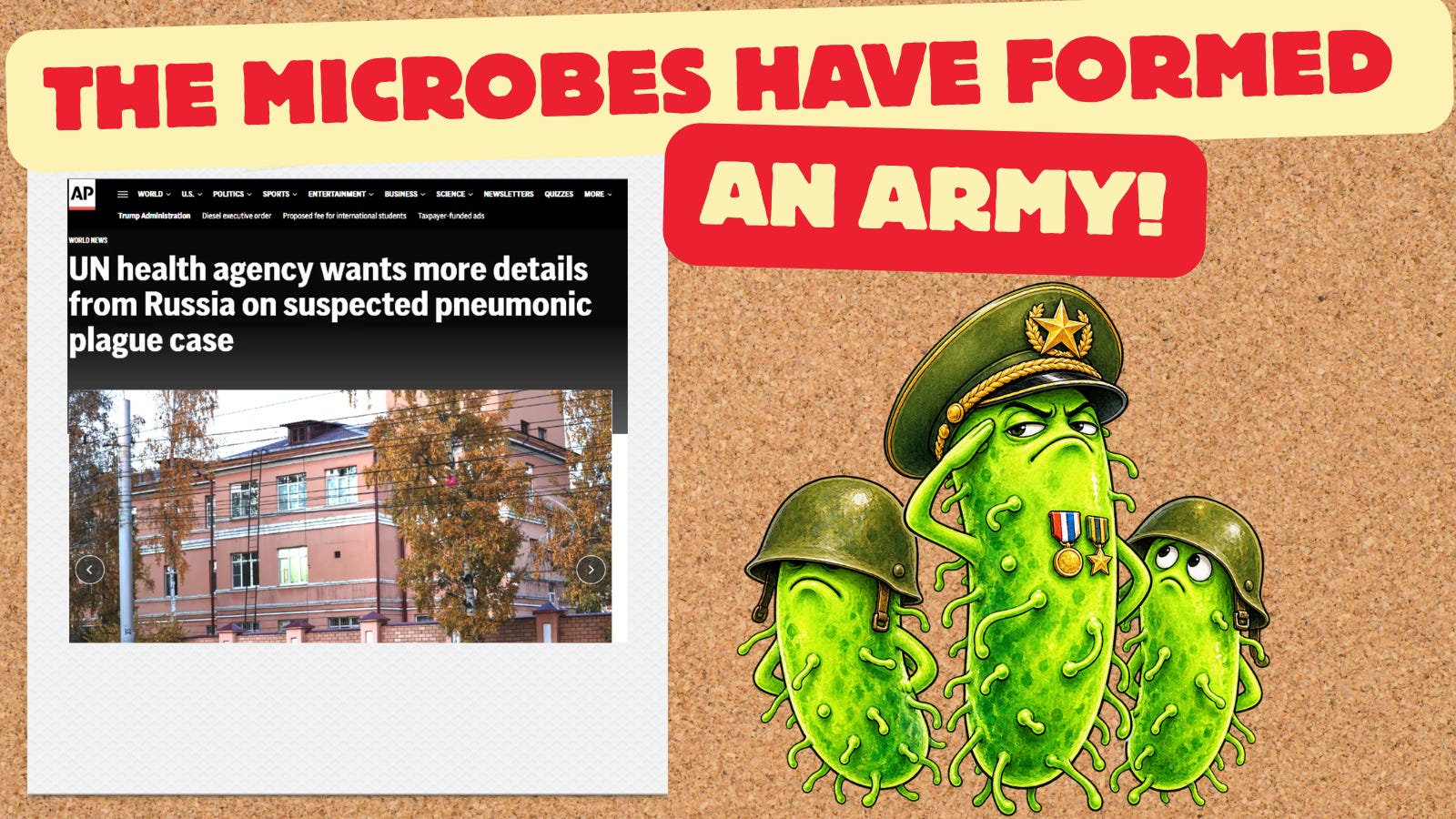
Apparently the bacteria have been attending officer training while the rest of us were trying to get through the week. I look forward to learning whether they have appointed a defense secretary or are still arguing over the uniform budget.
It is quite a promotion for an organism that was, until recently, being discussed in terms of fleas. Now it has strategic ambitions. At this rate, by Friday we’ll be hearing that the microbes are very tough negotiators, that nobody has ever seen microbes like these, and that their general called the president “sir.”
Meanwhile, the actual response remains almost aggressively ordinary: share the test results, explain the precautions, monitor the contacts, and make sure clinicians have what they need. A telephone conversation between presidents may help get information moving, but somewhere a laboratory technician still has to do the work. The bacteria won’t be impressed by how well the call went.
There is a young woman’s death at the center of this story, and the people who loved her deserve answers. So do the workers and families waiting to understand what happened. Clear information gives people something useful to act on; vague reassurance gives them an afternoon to spend imagining every possible explanation, assisted by the internet’s generous supply of people who’ve already solved the case from their kitchens.
The hopeful part is that we have ways to investigate this, treat illness, and protect people. Public health is full of quiet competence: someone processing a sample, calling a contact, checking a patient’s breathing, or sharing a result with a colleague across a border. Those people are doing the work that makes an ordinary afternoon possible for everyone else.
If the microbes really have formed an army, I suggest we fund the laboratories and let the scientists handle the briefing. They have considerably more relevant experience, and they’re less likely to mistake an adjective for a diagnosis.
Well done!
Excellent, Shanley! Thank you. I hope your family is well.