


Good morning! Tomorrow is the 250th anniversary of the signing of the Declaration of Independence, which means America gets to celebrate the moment it rejected rule by a king by watching its current president spend the holiday weekend behaving like one with a content team.
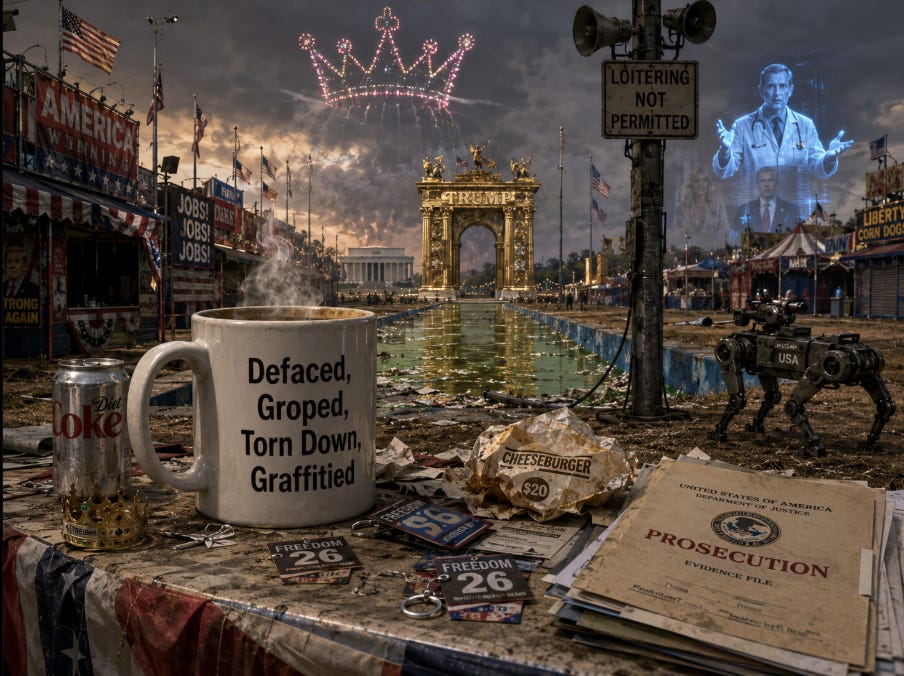
The original mad king, George III, did not begin his reign as a cartoon villain. He was King of Great Britain during the American Revolution, the monarch whose name became attached to the colonists’ long list of grievances in the Declaration of Independence. The Americans accused him of obstructing laws, interfering with colonial legislatures, keeping standing armies among them, cutting off trade, imposing taxes without consent, depriving them of trial by jury, and waging war against his own subjects. In the Declaration’s telling, the problem was not merely a bad policy here or a bad minister there. It was arbitrary power itself. One man’s will had become a system of government.
The Revolution, the founding promise was not fireworks, bunting, or souvenir hats. It was the rejection of personal rule. It was the idea that law should stand above the ruler, that power should be restrained, that public office should not exist to flatter one man’s ego, punish his enemies, enrich his allies, or turn dissent into treason.
Two hundred and fifty years later, here we are.
British broadcaster Lewis Goodall, who describes himself as an Atlanticist and an admirer of the United States, opened the anniversary weekend by asking whether the America he loved is still recoverable. He was not sneering from across the ocean. He began from affection, for American culture, American politics, American energy, American history, and the postwar democratic order America helped build. Then he looked at the country in 2026 and said the thing many of America’s friends abroad are now saying more plainly than we are: the United States is led by “a madman.” His sharpest observation was not that Trump is mad. It was that America has seen this story before. “It’s not just a question of having a mad king,” Goodall said. “They left a mad king 250 years ago. Mad kings come and mad kings go. It’s the impression they leave behind on the politics that’s the problem.”
That is the question hanging over this Fourth of July. Not whether Trump will eventually leave office. He will. Not whether the Constitution, in some damaged form, may survive him. It may. What shape the country will be in when the mad king is gone is at issue. The damage is not confined to one man’s speeches, one AI video, one purge, one pardon, one grift, one threat, one delusion, or one deranged patriotic spectacle. The damage is cumulative. It seeps into the courts, the Justice Department, the press, the military, the markets, the culture, the language, and the imagination of what is politically possible. It mutates the mold and teaches everyone to operate in Trump’s slipstream, even when they oppose him.
Right on cue, the day supplied its own evidence. Jack Smith gave his first interview, and it was not the performance of a man second-guessing himself. It was the testimony of a career prosecutor watching the rule-of-law machinery get taken apart by the people it once dared to investigate.
Smith said plainly that his team developed proof beyond a reasonable doubt that Donald Trump engaged in criminal activity, and that he would bring the same charges again regardless of whether the president were a Democrat or a Republican. No one, he said, should be above the law. Which used to be the least controversial sentence in American civics, before it became a revolutionary slogan again.
The most powerful part of the interview was not Smith defending himself. It was Smith defending the public servants Trumpworld has tried to destroy. He talked about FBI agents and prosecutors who did their jobs, followed the facts, and were then demonized, fired, or targeted for retribution. One agent, he said, was nursing his wife as she died of cancer and was fired shortly after her death. Smith went to the funeral. “That funeral was filled with heroes,” he said.
Trump understands that part very well. The goal is not just to punish Jack Smith. The goal is to make every future Jack Smith impossible. Make the lawyer need a lawyer. Make the agent wonder whether doing the assigned case will cost him his career. Make the prosecutor choose between the oath and the mortgage. Make public service feel like a trap.
Smith’s warning was institutional, not melodramatic. When judges stop trusting the Justice Department, he said, DOJ cannot do its basic job. Trust built over generations can be lost in days, expertise purged, and National security weakened. The next generation of lawyers can look at public service and decide, rationally, to do something else.
Then came the election warning. Smith said state attorneys general need to be ready to litigate everything before the next election. They should imagine every possible thing that could be tried and “don’t let reason be a limitation.” That may be the most useful sentence anyone has offered about Trump-era election protection. Do not plan for what a reasonable person would do. Plan for what Donald Trump would do after learning that accountability can be delayed, pardons can be issued, violence can be rewarded, and the machinery of justice can be turned back against the people who tried to use it.
Smith does not sound defeated. He sounds furious in the controlled way prosecutors get furious: not with fireworks, but with facts. He still believes the rule of law is recoverable. But his interview made one thing painfully clear. The damage is not abstract. It has names, funerals, fired agents, gutted offices, intimidated lawyers, and judges who no longer know whether they can trust the government standing before them.
The case against Trump may not have reached a jury. But Jack Smith just entered the evidence into the public record again.
Because this is the timeline we live in, the President of the United States posted an AI-generated video of himself as a doctor curing his critics of “Trump Derangement Syndrome.”
The deepfake patients included Rosie O’Donnell, Whoopi Goldberg, Edward Norton, Julia Roberts, and Robert De Niro, all made to confess that their opposition to Trump had ruined their lives until the great orange physician arrived with a stethoscope and a Diet Coke. The prescription, according to fake Dr. Trump, was simple: turn off “fake news,” say your prayers, and drink Diet Coke. So the commander-in-chief is now using artificial intelligence to impersonate private citizens, put words in their mouths, diagnose dissent as disease, and prescribe carbonated obedience as treatment.
Rosie O’Donnell responded by saying Trump is “quite ill” and “getting worse daily,” adding that the 25th Amendment exists for exactly this reason. Which is a fairly clean diagnosis, considering the patient just posted a synthetic video of himself as a doctor treating criticism as a psychiatric condition.
This is beyond weird. Weird left the building three deepfakes ago. This is authoritarian kitsch with a subscription to Midjourney: the leader as healer, critic as patient, dissent as pathology, propaganda as comedy. It lands on the same day Jack Smith is warning that facts, law, prosecutors, agents, judges, and election workers are all under organized attack. One man is saying the justice system depends on evidence. The other is using AI to manufacture confessions from his enemies.
Rule of law versus rule of slop.
The physical manifestation of the slop has taken up residence on the National Mall. Mother Jones sent a reporter to the Great American State Fair, and the result was less national birthday celebration than failed MAGA playground with airport security. The fair, spread across the Mall for America’s 250th, apparently consists of tiny state-themed rooms, large empty stretches of grass, very little shade, and the kind of rules that make July in Washington feel like a constitutional stress position. No bags. No full-size sunblock. No blankets to sit on while eating a $20 cheeseburger in the sun. Also, according to the report, no napkins, because even the paper goods appear to have seceded.
The merchandise, however, is thriving. You can buy a $40 “America Is Back” hat at the USDA tent or a $200 “Freedom 26” jersey at the merch tent, because nothing says civic renewal like surge-pricing patriotism under a heat dome. There is also a robotic military dog performance, which feels appropriate for a country that has reached the stage of empire where even the pets come with procurement contracts.
The aesthetic, the reporter said, is somewhere between Renaissance fair and indoor expo display accidentally left outside. The screen-printed buildings are already struggling with the weather. The model of Trump’s proposed D.C. arch is wrinkled, puckering, and apparently evolving in real time, first with mysterious boxes protruding from the top and then with added columns. Rome was not built in a day, but this arch may be disintegrating in one.
The Reflecting Pool is now possibly the most aggressively monitored body of water in North America. Surveillance machines warn people not to loiter. National Guard members patrol the fenced-off perimeter. The pool’s “American flag blue” sealant is peeling. The algae bloomed after the nanobubblers were removed for the UFC fight and returned too late. Chunks of detached sealant have become souvenirs if they blow into the grass, but if you reach into the water to touch one, you may discover the federal government’s new theory of aquatic law enforcement.
Jeanine Pirro held a press conference about the Reflecting Pool, and somehow the Republic survived the strain. The occasion was the felony indictment of David Hearn, the 67-year-old former Olympic canoeist accused of damaging the pool’s new blue liner. According to Pirro, Hearn reached into the pool and “forcefully and violently” pulled up roughly two square feet of sealant with both hands. No tools, she said. Just bare hands. So apparently we are dealing with either a hardened monument vandal or the Incredible Hulk of municipal pool liner.
Pirro framed the case as a defense of civilization itself. National monuments, she said, have been “defaced, groped, torn down, graffitied,” and damaged by individuals. This is “anarchy.” The monuments are “sacred.” Those who tamper with them will be held accountable. This was not a press conference so much as a Ken Burns documentary narrated by a prosecutor standing over two square feet of adhesive.
The key question, of course, is whether the liner was already coming apart before Hearn touched it. A reporter asked exactly that. Pirro declined to get into the evidence, then said that “irrespective” of what may have preceded the incident, prosecutors believe they can prove Hearn caused more than $1,000 in damage. That is the little blue hinge on which the whole felony swings. If the government’s patriotic pool coating was already failing, the case becomes less “attack on a sacred monument” and more “citizen notices the emperor’s pool liner has no clothes.”
Pirro also confirmed there are about a half-dozen other Reflecting Pool cases under review, some likely misdemeanors or lesser violations. So the Reflecting Pool has now officially become a criminal justice beat. The same government that can treat violent insurrectionists as misunderstood patriots has discovered zero tolerance for aquatic sealant interference.
This is all happening under the banner of Trump’s effort to make D.C. “safe and beautiful” before the 250th anniversary. The pool was renovated, but the liner peeled, algae bloomed, and the spectacle buckled. Now the administration, dare I say the mad king, has found its preferred repair strategy: indict the guy who touched it.
The court of the mad king also has a war minister, and Pete Hegseth had a very Fourth of July week, by which I mean he got booed while accusing everyone else of being blinded by ideology.
At an event in Washington, Hegseth tried to thank the troops and rally the crowd, only to be met with sustained heckling in the background. He responded by declaring that the noise was “the sound of ingratitude” from people “so blinded by ideology they can’t see law and order and common sense in front of them.” This from the man whose Pentagon is currently defending a clampdown on reporters, fighting in court over press access, and trying to explain why proven public-health measures for service members have become optional culture-war props.
Scott MacFarlane noted that Hegseth has now lost repeatedly in court over the Pentagon’s restrictive press policy, which sought to limit reporters’ movement through areas where they had long been allowed to work. On June 30, a federal judge issued a preliminary injunction against the escort requirement, the third ruling against these press restrictions, finding it likely violated the First Amendment and was retaliatory. And the judge got there by quoting Hegseth back to himself, citing the secretary’s own attacks on the press as an “endless stream of garbage” produced by the “legacy Trump-hating press” as evidence the policy was payback. The court even supplied the punchline: treating reporters worse than “baristas, short-order cooks, dry cleaners, or any other civilians given access to the Pentagon,” the judge wrote, is a perverse reading of the First Amendment. The litigation grinds on, because nothing says confidence like demanding more taxpayer-funded appeals to keep journalists on a shorter leash than the dry cleaner.
Members of Congress are moving to restore flu vaccine requirements for service members after what lawmakers describe as a flu outbreak at Lackland Air Force Base. Military veterans in Congress were not subtle. Rep. Pat Ryan called the situation a “clown show” at Hegseth’s Pentagon. Rep. Chris Deluzio pointed out that military vaccine requirements go back to George Washington and the Continental Army, because even the original revolutionaries understood that readiness does not mean letting preventable illness sweep through the ranks so the secretary can impress the anti-vax podcast wing.
This is the man now helping lead the administration’s effort to rebrand the Pentagon as the “Department of War,” because “Department of Avoidable Flu Outbreaks and Press Escort Policies” tested poorly with focus groups.
Hegseth is asking Congress for billions more tied to Iran, munitions, and military operations, while his political support looks brittle and Democrats are openly questioning whether this Pentagon can be trusted with more money. It is hard to sell yourself as the nation’s top war fighter when your signature achievements include losing to reporters, losing to viruses, and losing the room.
The rot is not confined to the Mall or the Pentagon. It also shows up wherever the president has to describe reality accurately and simply declines to, which, this week, was his own social media feed.
Take Micron. Trump posted that the chipmaker, “a GREAT American Company,” had put $250 million into “Trump Accounts” for children and that “their stock went up 9 points today.” The $250 million is real, a 250th-anniversary commitment routed, notably, through Robinhood and BNY Mellon into index funds, the gift to children arriving pre-wrapped in a private-finance toll booth. The stock line is not. Micron fell roughly 10 percent that day, shedding more than a hundred points on fears of a memory glut. The president announced a rally on a day the market handed his favorite company a double-digit loss, which is the kind of claim you can only make if you assume no one will check the ticker you are bragging about.
The NATO post ran the same play. Trump listed alliance defense spending and singled out Germany as “MUCH LOWER” than the rest, the perennial deadbeat of his 2018 grievances. Except Germany is now the second-largest defense spender in NATO, behind only the United States, having pushed past $100 billion as it rearms against a Russia testing borders, airspace, and resolve. He named the class laggard the week the class laggard became the valedictorian.
This is the mad king problem in its purest, cheapest form. Chips and alliances are not campaign scenery, semiconductors and NATO coordination are the nervous system of a 21st-century military, the actual architecture of national defense. The king does not want to build the architecture, he just wants to stand in front of it and narrate a version where the stock always rises and the allies always fail, and dare the kingdom to notice the numbers say otherwise. A serious president would understand what he is standing in front of. Trump only sees a backdrop.
While the regime wraps semiconductor plants in campaign bunting and calls it strategy, the grocery aisle has supplied its own reminder that corruption is not always theatrical. Sometimes it is breakfast.
According to the Justice Department, executives at major egg producers spent years coordinating bids in a way that helped push key egg-price benchmarks higher while Americans were being told that bird flu and inflation had simply made breakfast unaffordable. One alleged co-conspirator reportedly urged the group to bid “early and often,” because apparently even the egg cartel wanted a little machine-politics garnish with its omelet.
The companies, including Cal-Maine, Versova, and Hickman’s Egg Ranch, have agreed to a proposed settlement involving $3.3 million in payments and 53 million eggs donated to food banks, while denying wrongdoing. It is tidy, in the way these things always are: families paid the inflated grocery bill in real time, executives blamed supply shocks, and the penalty arrives later in the form of a corporate shrug and a refrigerated truck full of restitution. The price of eggs became a national symbol of household pain. Now we learn that at least part of that pain may have been carefully managed.
That is the whole 250th anniversary tableau: a president playing doctor in an AI hallucination, a prosecutor threatening ten years over pool sealant, a Defense secretary getting booed while accusing the public of ingratitude, a patriotic fair with $200 freedom jerseys and no napkins, a green Reflecting Pool under surveillance, and an egg market that allegedly turned the family breakfast into a cartel exercise.
Lewis Goodall’s question was whether America can come back from Trump. Maybe the more urgent question is whether America can still identify what it is supposed to come back to.
Independence is not a costume, a military flyover, a triumphal arch, a robotic war dog, a blue pool liner, a merch tent, or a prosecutor promising prison for bare-handed sealant interference. Independence is a system of restraints on power. It is law over personality. Evidence over command, public service over fear, and facts over hallucination. It is the refusal to let one man’s appetite become the organizing principle of the state.
The American Revolution was a revolt against the idea that a mad king could turn his will into law. Two hundred and fifty years later, the crown is gone, but the temptation is back. It does not always arrive wearing ermine. Sometimes it arrives wearing a red hat, holding a Diet Coke, posting deepfakes, pardoning loyalists, threatening enemies, and demanding that everyone applaud the peeling pool.
America can still throw itself a birthday party. The flags will fly, bunting will be arranged. The fireworks will bloom over the Mall and someone will call it beautiful.
The test is whether the country can still tell the difference between celebration and cover story. 250 years in, that is the test.
The self-imposed mad king wanna be, definitely needs to be impeached, removed, and convicted. I stand with Major Watson on that score.Then maybe, maybe we have some chance at restoring some semblance of sanity to America. We will never be what we were, but I hope we can be better.
We went to the Tall Ships parade for the Nation's 200th anniversary and it was wonderful. The ships were amazing and everyone was excited to celebrate the nation's birthday. It was an incredibly festive atmosphere. This 250th should be even better and yet I am filled with sadness and despair not only at what is happening to our country but also how many people seem not to notice.