


After a long weekend of flags, fireworks, speeches, and official reverence, the country returned to work on Monday and discovered that seriousness had apparently taken an extended holiday. This wasn’t one scandal, it was a roll call.
The president called FIFA, the stock exchanges rang their opening bells from the Oval Office, the White House accused the Smithsonian of failing to love America correctly, the Lincoln Memorial Reflecting Pool was still somehow a national political drama, a deadly heat wave gave way to flooding, Ukraine was hit again, Planned Parenthood could bill Medicaid again, though some clinics are already gone, and E. Jean Carroll’s lawyers were still trying to pry accountability out of the courts one procedural delay at a time.
We begin, because apparently we must, with international soccer becoming a branch office of the executive branch. President Trump confirmed Monday that he called FIFA President Gianni Infantino to ask for a review of the red card issued to U.S. striker Folarin Balogun during the World Cup. Balogun had been facing an automatic one-game suspension before FIFA lifted the ban, allowing him to play against Belgium. Trump insisted he had not demanded a result. “All I did was ask for a review,” he said. “I didn’t say, ‘You have to do this.’”
Trump said the referee’s call was “horrible” and explained that he thought the play involved “two great athletes that crashed into each other and got entangled.” He also admitted he didn’t initially know what a red card meant, which is, in fairness, the most believable part of the entire episode. UEFA called FIFA’s move “incomprehensible and unjustifiable,” while Belgium challenged Balogun’s eligibility. Infantino, for his part, said FIFA’s independent bodies handled the case and added, “That is how FIFA’s system works.”
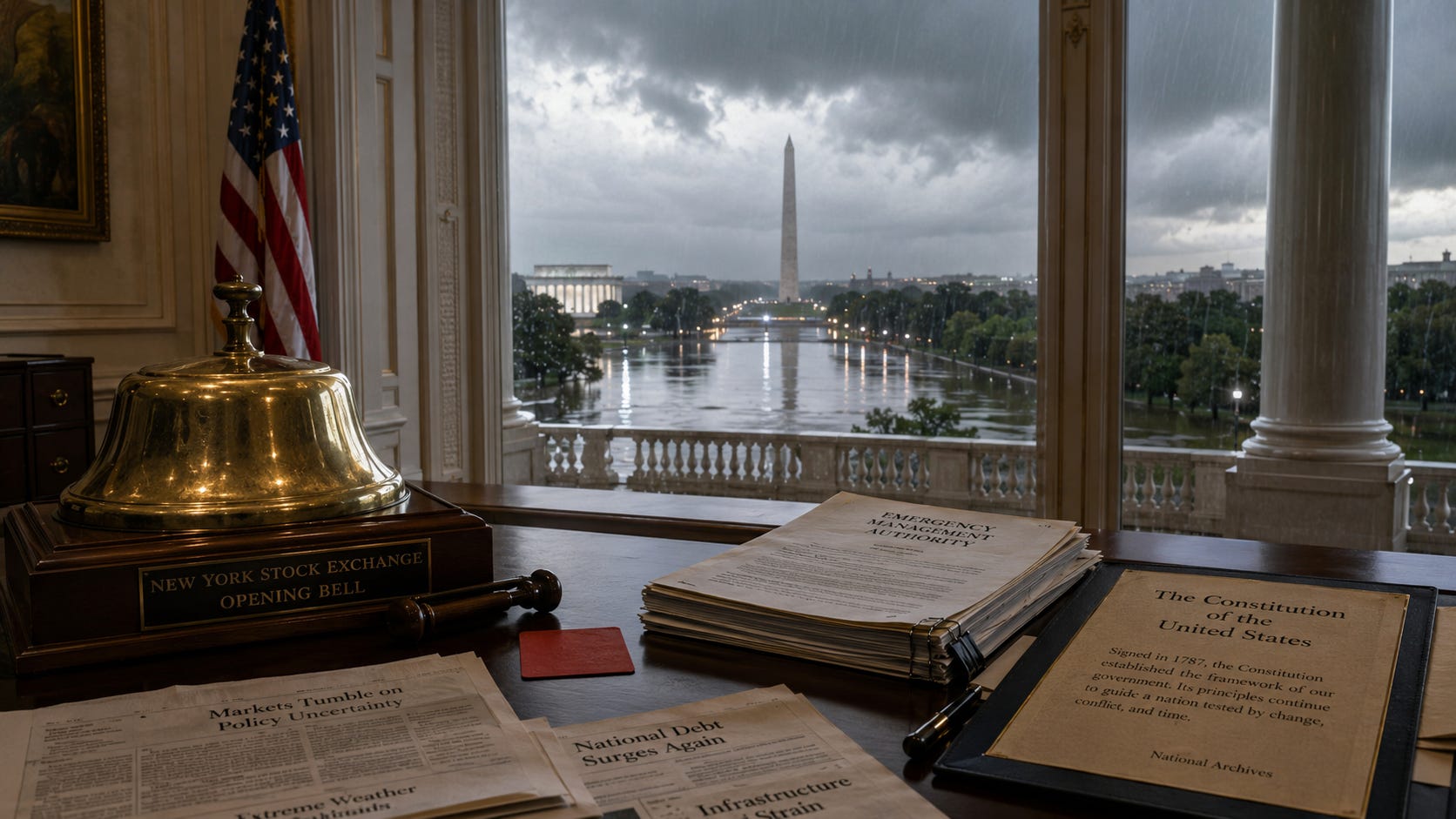
At the same Oval Office event, Trump also rang the opening bells for the New York Stock Exchange and Nasdaq from the White House to mark the first trading day for “Trump accounts,” a new government initiative that gives eligible children a $1,000 investment account. “Those accounts will begin to grow along with our booming economy,” Trump said. “We’re giving this money to children so they can have a good life.”
There is a version of this idea that is genuinely interesting. Early savings accounts for children, especially children born into poverty, have had bipartisan support for years. But there is also something almost painfully on brand about turning childhood economic insecurity into a branded financial product and launching it by bringing Wall Street into the Oval Office like a housewarming guest. Trump claimed he didn’t ask for the accounts to be named after him. “I have done that in other cases,” he said, which is less a denial than a guided tour through the gift shop.
Meanwhile, the White House decided the Smithsonian had become insufficiently patriotic. A new White House report released over Independence Day weekend accused Smithsonian leadership, particularly at the National Museum of American History, of being radical activists who “cannot be trusted to tell America’s story honestly.” The report argued that the museum had moved away from “straightforward historical education and scholarship” and toward “extreme political activism.”
This is the current governing theory of history. If the story includes pain, it is divisive. If it includes exclusion, it is activism. If it includes anyone besides the people already carved into marble, it is suspicious. The museum is not being asked to tell the truth. It is being asked to produce a national bedtime story, preferably one where everyone falls asleep before the chapter on slavery, immigration, labor, women, race, war, poverty, or dissent.
Smithsonian Secretary Lonnie Bunch, speaking separately, offered the quiet opposite of that project. “The notion of being a more perfect union, not the perfect union, is really what motivates me,” he said, adding that America’s strength is not “running away from its history,” but understanding how history shaped the country and continues to shape it.
That is the actual work of public memory; it’s a civic obligation, and there is nothing patriotic about demanding a country admire itself so loudly it can’t hear its own past.
The same fight over symbols continued, somehow, in the Lincoln Memorial Reflecting Pool, which has become one of the more absurd and revealing dramas of the America 250 spectacle. Interior Secretary Doug Burgum said the administration will not seek new bids to repair the troubled project, even as questions continue over the taxpayer money involved and damage to the pool’s liner. Burgum said the same company would be used because “they did a fantastic job.”
Nothing says fiscal discipline like a troubled public works project being praised as fantastic while it requires more repair. The pool, meant to reflect the monument to Lincoln, now mostly reflects the governing style of the moment: declare victory, blame vandals, keep the contractor, and hope nobody looks too closely at the water.
The weather, less interested in spin, continued filing its own report. Flooding rains hit New York City, Philadelphia, and New Jersey on Monday, breaking the heat dome that had settled over much of the Northeast. In New Jersey, officials were investigating at least 29 deaths last week as possibly heat-related, with victims found on streets or in homes without air conditioning. LaGuardia had reached 104 degrees on Thursday, and many places barely cooled below 80 at night, which means the body never really got a chance to recover. This is where the satire runs out of oxygen.
Heat is not dramatic in the way television prefers. It doesn’t arrive with a flag or a podium. It slips into apartments, presses on lungs, punishes the elderly, the poor, the sick, the housed-but-not-cooled, the people already living closest to the edge. Then the rain comes and everyone calls it relief, even as water fills basement apartments and strands cars on flooded highways. The climate crisis keeps being covered as a series of events, when it is increasingly the condition in which all other events occur.
Abroad, the stakes were even more immediate. A wave of Russian missiles and drones struck Ukraine, killing at least 21 people on the eve of the NATO summit in Turkey. Ukrainian officials said 15 people were killed in Kyiv and six more in the wider Kyiv region. Zelenskyy called for “strong decisions” from NATO, saying that as long as Patriot missiles remain in allied stockpiles, Russia is encouraged to keep attacking residential buildings.
There is the test, stripped of rhetoric. Not whether leaders can stand together for a photograph. Not whether they can issue one more statement about unity. The test is whether the people sleeping in apartment buildings are protected before they become another paragraph in a summit briefing.
At home, healthcare delivered one of the few pieces of news that sounded like relief, though even that came with wreckage attached. Planned Parenthood and two smaller regional abortion providers are resuming Medicaid billing for non-abortion services after being cut off for most of a year. The defunding was tied to Trump’s tax and policy law, and AP reports it has been blamed for clinic closures and reductions in breast cancer screenings, STI testing, and birth control access.
Planned Parenthood says affiliates closed nearly 30 of roughly 600 clinics over the past year. Over that same period, they dispensed about 25 percent fewer packs of birth control pills and conducted about 20 percent fewer breast cancer exams. In Maine, one provider closed three primary care clinics serving about 1,000 patients, and a senior official said former patients had to wait four to six months to establish care elsewhere.
This is the part policymakers prefer to discuss abstractly. Funding, reimbursement, eligibility, and provisions, but the real language is much simpler. A clinic closes, a screening doesn’t happen, a patient waits months, and a rural county loses one more piece of the healthcare system, then everyone acts surprised when the consequences arrive with names and bodies attached.
And then there was E. Jean Carroll, whose case remains a small, stubborn reminder that delay is not the same as innocence. A federal judge rejected Trump’s latest attempt to delay payment of the $5.8 million judgment owed to Carroll, after the Supreme Court declined to review the 2023 jury verdict. Carroll’s lawyer called the request “yet another play for time.”
That phrase could serve as the unofficial motto for much of the day. A play for time at FIFA, in court, on climate, in healthcare, in Ukraine, and at the Smithsonian, where history itself is apparently supposed to wait quietly while the administration decides which parts are flattering enough to survive.
And still, the day offered its own counterargument. Not hope exactly, but evidence. That may not be enough. It’s certainly not tidy, but it’s something. The country keeps trying to sell itself a cleaner story; but reality just keeps walking in.
I'll take reality over vanity any day.
No one is 100% "good" or 100% "bad." We are all a bit of both.
Moreover, no one is static and unchanging. We are constantly growing and evolving.
I see countries - especially ours - as "living" too. Our country grows and evolves, hopefully changing for the better.
If we don't block Trump, Vought, Miller, et al. from erasing American history, we will have an entire generation who won't know the reality, good and bad.
It's easy to remove Trump's name from a building. It will be a lot tougher to remove false history from a generation.
It's hard to maintain solidarity with a people who elect a megalomaniacal mob boss and his mafia sick-o-phants to run the most powerful nation on the planet.