


Long before an ICE agent fired into Renee Nicole Good’s car in Minneapolis, a 37-year-old U.S. citizen and mother of three who was shot and killed during a federal immigration enforcement operation in early January, long before emergency responders found her unresponsive with multiple gunshot wounds and life-saving measures failed at a downtown hospital, the federal government had already decided what kind of force it would deploy and how little accountability it would tolerate. Long before a detainee in Texas gasped, “I can’t breathe,” as guards struggled with him in a segregated detention unit later described by the medical examiner’s office as a likely homicide, and long before an off-duty federal agent shot Keith Porter Jr. outside his Los Angeles apartment on New Year’s Eve, the architecture of enforcement, from recruitment and training to public messaging and legal authority, had been reshaped in ways that made these outcomes not only possible but predictable.
That moment in Minneapolis did not occur in a vacuum. It unfolded against the backdrop of an aggressive federal immigration enforcement surge, touted as Operation Metro Surge, billed as the largest of its kind, that flooded Minneapolis with thousands of Border Patrol and ICE agents. Local officials described the operation as chaotic and unsafe, sparking protests and clashes, and even prompting a federal judge to issue an injunction barring federal agents from using nonlethal force, arbitrary detention, and retaliation against peaceful demonstrators exercising their First Amendment rights.
In 2025, ICE embarked on one of the most aggressive expansion campaigns in its history. Career expos promised instant job offers, signing bonuses worth tens of thousands of dollars, and a fast track into federal law enforcement. A journalist attending one of these events documented how cursory the vetting process had become: a six-minute interview, no meaningful background review, and no apparent concern for public statements openly hostile to ICE itself. Despite failing to complete required paperwork and consenting to no real screening, the journalist later discovered she had been formally hired anyway. The system did not merely miss red flags. It did not appear to be looking for them.
ICE’s leadership has increasingly framed immigration enforcement as a form of domestic warfare. Recruitment materials leaned heavily on nationalist imagery and racialized dog whistles, “Defend the Homeland,” “Stop the Invasion,” “Protect America”, language that collapses complex human realities into an us-versus-them struggle. In public statements, senior officials repeatedly portrayed immigrants, protesters, and even local officials as threats, while praising agents as frontline soldiers. The message was clear: restraint is weakness, and escalation is virtue.
That culture shapes how force is used in the field. In Minneapolis, thousands of ICE and Border Patrol agents were deployed under an operation branded as a security surge. The scale dwarfed local law enforcement capacity. Residents described unmarked vehicles idling on residential streets, masked agents going door to door, people pulled from cars, windows smashed, chemical agents deployed at close range. Local police, tasked with preventing carjackings, shootings, and homicides, found themselves diverted to managing the chaos federal agents were creating.
It was in this environment that Renee Nicole Good was killed. Good was a U.S. citizen, a mother of three, trying to leave an encounter with federal agents when an ICE officer stepped into her path and fired into her vehicle. Within hours, federal officials labeled her a “domestic terrorist.” No evidence was provided, and the narrative hardened instantly, even as video footage contradicted official claims of imminent danger.
What made that killing especially damning was what emerged afterward. Weeks before Good’s death, the Department of Homeland Security had circulated internal guidance warning agents that vehicle extractions, forcibly removing people from cars, were inherently dangerous and that de-escalation was key. The memo instructed officers to avoid unsafe positioning and to block vehicles rather than confront them head-on. ICE has no formal, standardized policy defining vehicle extraction at all, despite its frequent use. In Minneapolis, that guidance was ignored. Publicly, DHS insisted the agent “followed his training.” Privately, it knew better.
In Texas, Geraldo Lunas Campos died in ICE custody after a struggle with guards. A fellow detainee reported hearing him cry out that he could not breathe as guards pressed on his neck and chest. The county medical examiner later indicated the death would likely be classified as a homicide due to asphyxia. DHS claimed instead that Campos died after attempting to take his own life.
In Los Angeles, Keith Porter Jr., a 43-year-old father of two, was shot and killed by an off-duty ICE agent outside his apartment complex on New Year’s Eve. Authorities claimed the agent acted in self-defense. There was no body-camera footage, and witness accounts were contested. Once again, federal silence replaced transparency.
ICE’s reach expanded beyond physical force into pervasive surveillance. Leaked documents revealed dozens of covert operations deploying plainclothes agents into transport vans, processing centers, and detention cells to gather intelligence not obtained through formal interviews. Every detainee became a potential informant, and every interaction became data. The aim was not merely enforcement, but total awareness, tying individuals to criminal or terrorist networks by default and using those associations to generate endless “follow-on targets.”
As protests erupted in Minneapolis, federal agents targeted observers, journalists, and peaceful demonstrators. Weapons were drawn, chemical agents were fired, and people were detained simply for filming. The chilling effect on First Amendment activity was unmistakable. Only after civil liberties groups sued did a federal judge step in, issuing a preliminary injunction barring ICE from retaliating against peaceful protest, deploying crowd-control munitions, or detaining people without cause. The court made clear that merely observing federal operations was not grounds for enforcement action.
But even that legal intervention exposed the fragility of democratic safeguards. Judges can issue orders, but they cannot enforce them alone. Compliance depends on institutions willing to be constrained.
The Department of Justice announced it was investigating Minnesota Governor Tim Walz and Minneapolis Mayor Jacob Frey for allegedly conspiring to impede federal immigration agents, not through violence or threats, but through public criticism and warnings about public safety. A statute historically reserved for violent obstruction was repurposed to criminalize dissent. Senior DOJ officials issued statements that sounded less like legal analysis than intimidation. Meanwhile, the ICE agent who killed Renee Good was not under criminal investigation.
To understand how serious the Justice Department’s investigation of Minnesota Governor Tim Walz and Minneapolis Mayor Jacob Frey really is, not for acts of violence or obstruction, but for public criticism of federal enforcement, it helps to look at precedent. In the early American republic, fears of internal dissent produced the Sedition Act of 1798, which criminalized “false, scandalous, and malicious” criticism of the government and was used to prosecute editors and political opponents. Thomas Jefferson condemned it as a direct assault on free speech, and history has largely agreed. Similar impulses resurfaced during World War I, when the Espionage Act and related sedition provisions were used to imprison labor organizers and antiwar activists for speech deemed dangerous rather than conduct proven harmful. In the Cold War era, the Smith Act again stretched conspiracy law to punish political belief, until courts later narrowed its reach. Across these episodes, a pattern emerges: during moments of stress or polarization, the federal government has repeatedly expanded criminal law to suppress dissent, with lasting damage to civil liberties.
The current inquiry into Walz and Frey fits squarely within that pattern. The statute being invoked addressed violent conspiracies to obstruct federal officers, not to police rhetoric or policy disagreement. Repurposing it to scrutinize governors and mayors for warning about public safety or criticizing federal tactics marks a profound shift: dissent itself becomes suspect. The implications go beyond partisan conflict. When criminal law is used to intimidate elected officials for speech, the balance between federal authority and democratic debate tilts sharply toward the state, and away from the constitutional protections meant to restrain it.
This trajectory is not uniquely American. In interwar Europe, democratic systems collapsed not only through coups, but through legal erosion. In Weimar Germany, emergency powers under Article 48 were initially justified as temporary measures to restore order. Over time, they became routine. Civil liberties were suspended through legal mechanisms, political opposition was reframed as subversion, and democracy was hollowed out procedurally while its formal institutions remained intact. The lesson of Weimar is not that dictatorship arrives suddenly, but that it advances through normalization, investigations, prosecutions, and intimidation carried out under color of law.
More recent examples reinforce the warning. In post-Soviet Russia, Vladimir Putin rarely banned opposition outright in the early years. Instead, criminal investigations, extremism statutes, and corruption probes were used to sideline governors, mayors, journalists, and activists. Convictions were not always necessary; the process itself became the punishment. Hungary under Viktor Orbán has followed a similar path, using emergency powers and national-security rhetoric to criminalize assistance to migrants and frame criticism of state policy as collaboration with foreign threats. Across these cases, the pattern is consistent: when criticism is treated as obstruction and protest as conspiracy, the legal system ceases to check power and instead enforces it. Seen in this light, the DOJ’s investigation of Walz and Frey is not merely aggressive; it echoes a well-documented authoritarian strategy, made starker because the federal agent who killed Renee Nicole Good faces no criminal investigation at all. History does not repeat itself mechanically, but it does rhyme, and here, the rhyme is unmistakable.
Donald Trump’s renewed threat to invoke the Insurrection Act is not an impulsive reaction to events in Minneapolis. It is the culmination of a fixation that former senior officials say has shaped his thinking for nearly a decade. According to Miles Taylor, who served as chief of staff at the Department of Homeland Security during Trump’s first term, the president was repeatedly drawn to the Insurrection Act not as a last-resort constitutional tool, but as a source of what he openly described as “magical authority.” Trump, Taylor recounts, was less interested in the narrow legal conditions under which the law could be invoked than in the idea that it would allow him to deploy military force domestically, override state and local objections, and exercise power unconstrained by the checks he found so frustrating.
Taylor and other officials describe multiple moments during Trump’s first term when staff had to actively intervene to stop him from invoking the Insurrection Act without legal justification. On one occasion, on the eve of a State of the Union address, White House staff rushed to intercept him as he practiced his speech, preventing language invoking the Act from being entered into the teleprompter. At the time, Trump wanted to use the arrival of asylum seekers at the southern border as the pretext, a scenario that plainly did not meet the statute’s requirements of insurrection, rebellion, or an invasion the states were unable or unwilling to control. Yet Trump’s interest did not fade. According to Taylor, it only intensified.
In private conversations late in Trump’s first term, Stephen Miller described a future “shock and awe” strategy should Trump regain power: invoke the Insurrection Act, deploy federal force aggressively, and rush the issue to the Supreme Court as quickly as possible. The goal was not careful legal deliberation, but speed and momentum, to force the judiciary to rule after the machinery of enforcement was already in motion. This was not about restoring order. It was about discovering the outer limits of executive power and daring the system to stop him.
What makes the current moment so dangerous is that Minneapolis appears, in the administration’s own telling, to supply the long-sought pretext. Federal agents flood the city. Their presence generates chaos. Protests erupt in response to shootings, beatings, and arbitrary detentions. The unrest created by federal action is then cited as evidence that order has collapsed and extraordinary measures are required. This inversion, manufacturing disorder and then invoking emergency authority to suppress it, is precisely the abuse of the Insurrection Act that legal scholars warn against, and one without clear historical precedent in the United States.
Taylor’s account also sheds light on Trump’s deeper misunderstanding of constitutional governance. He describes a president baffled and angered by the existence of checks and balances, frustrated that courts, Congress, and even officials within his own administration could constrain him. The Insurrection Act held particular appeal because, in Trump’s mind, it represented a realm where he was most powerful, where civilian oversight receded and obedience was expected. That obsession, Taylor says, was “creepy,” not merely because of its intensity, but because it revealed a desire to turn domestic law enforcement into something resembling a military occupation.
Seen in this context, the threat to invoke the Insurrection Act in Minneapolis is not an isolated escalation. It extends years of rhetoric, planning, and frustration with democratic limits. Combined with the criminalization of dissent, the targeting of elected officials, and the insulation of federal agents from accountability, it signals a governing philosophy that treats emergency powers not as safeguards, but as tools, tools to be deployed when consent fails and criticism becomes inconvenient.
This is why the moment feels so precarious. The American constitutional system did not assume a president would be relentlessly corrupt, openly authoritarian, or indifferent to democratic legitimacy. It was built on the expectation of good faith, on norms of restraint, respect for law, and an understanding that power would be exercised within limits even when those limits were imperfectly enforced. The guardrails of democracy were meant to be reinforced by character, not constantly tested by malice.
Donald Trump has exposed that design flaw with brutal clarity. He has treated laws not as boundaries, but as tools to be gamed; institutions not as coequal branches, but as obstacles to be overcome; and emergency powers not as last resorts, but as opportunities. The Insurrection Act, which exists to preserve constitutional order when it genuinely breaks down, is now being eyed as a mechanism to override that order, to suppress dissent, sidestep local authority, and normalize military force in civilian life.
What makes this especially dangerous is that the system still largely assumes a benevolent actor at the center. Each part of the machinery, the courts, Congress, the agencies, behaves as if escalation will be checked by prudence somewhere else. But when the person wielding executive power has spent years searching for “magical authority,” openly fantasizing about absolute control, and surrounding himself with enablers eager to operationalize that impulse, those assumptions collapse.
The warnings from former insiders matter precisely because they strip away any lingering illusion that this is mere rhetoric. This is not bluster meant for a rally or a cable-news hit. It is a long-standing project, articulated privately, rehearsed internally, and now approaching execution. The threat is not hypothetical.
In systems built on trust, a bad actor can do enormous damage before formal safeguards catch up, if they ever do. That is the danger the country is confronting now: not the sudden arrival of tyranny, but the slow realization that democracy’s defenses were never designed to withstand someone determined to hollow them out from the inside.
After Renee Nicole Good was killed, more than a million dollars poured into online fundraisers for the agent who shot her. Thousands of donors celebrated the killing as patriotic, and repeated the lie that she was a terrorist. They rewarded the act before any investigation, before any trial, before any accountability.
It told every armed agent exactly what the culture now values. If you wear the uniform, aim your violence at the approved targets, and serve the narrative, the system will protect you, and enrich you.
America has seen this before. From Ferguson to Sanford, from border detention centers to foreign war zones, the pattern repeats: dehumanize first, label second, kill third, justify forever. The language and the targets change, but the logic does not.
Calling this out is not radical or un-American. It was once uniquely American. What is un-American is turning death into a fundraiser. What is un-American is celebrating state violence and teaching the next generation that killing in the name of power leads to applause and a payday.
Renee Nicole Good is dead. Her children lost their mother. And the man who killed her, an ICE agent defended by federal authorities and lionized by online fundraisers, is being treated like a folk hero by strangers who will never say her name. If that does not outrage us, then the danger is no longer theoretical. It is here, embedded in policy, culture, and daily life.
A democracy does not collapse only when tanks roll through the streets. Sometimes it collapses when violence is normalized, accountability is abandoned, and power learns it can act without consequence.
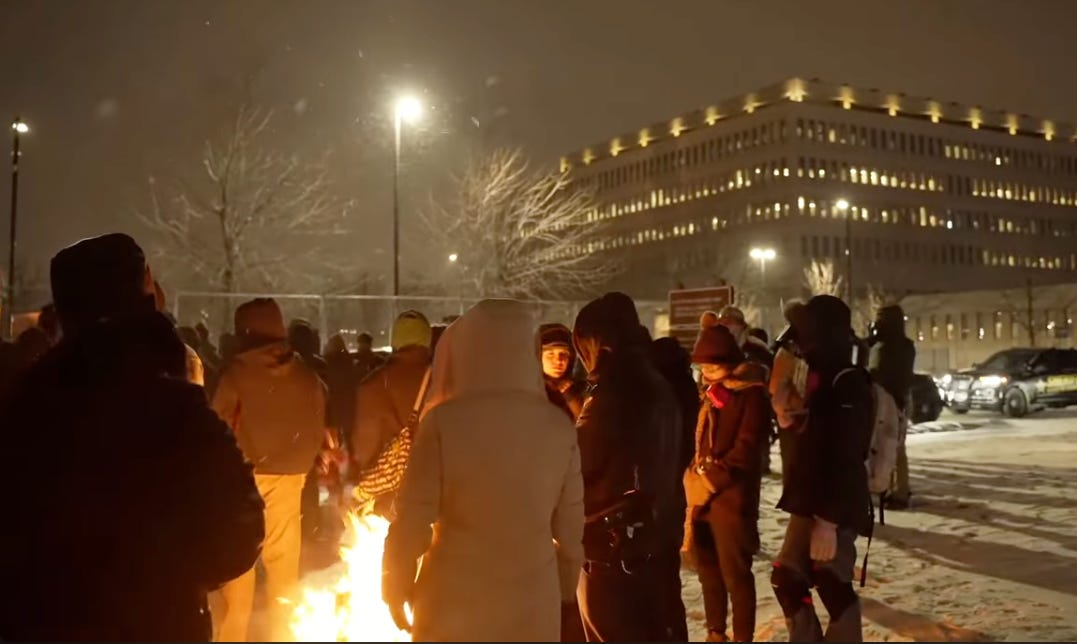
That is the moment we are living in now, but this country has not yet capitulated. Across Minneapolis and cities from New York to Boston to Austin and beyond, people have taken to the streets to demand justice and an end to federal overreach. Thousands have protested, chanting her name, and organizing under banners like “ICE Out for Good,” a coordinated set of demonstrations that underscored the public’s refusal to be cowed into silence after her killing. These protests, framed as peaceful expressions of civic outrage, are themselves acts of democratic defense, echoing the nationwide dissent that followed other high-profile police killings and reminding us that collective action still shapes public debate and pressure on authorities.
There are concrete ways forward, and they do not require abandoning peace or principle. We can flood Congress and state legislatures with calls and messages, insisting on independent investigations, meaningful use-of-force reforms, and accountability mechanisms that cannot be ignored or stonewalled. We can support legal actions and independent inquiries, like the one Renee Good’s family has initiated by hiring the firm that represented George Floyd’s family, and pressure prosecutors to pursue justice where federal entities have declined to act.
We can help document and share evidence where authorities have withheld it, mobilizing public recording of federal enforcement actions so that communities have real-time information and accountability even when official transparency fails. We can support civic participation and voter engagement, recognizing that elected officials, from mayors to governors to members of Congress, will be essential in reining in unaccountable use of force. And yes, we can organize peaceful economic and civic disruption, community walks, coordinated sit-ins, workplace slowdowns, and public vigils, that make clear we will not accept a society where state violence is both celebrated and rewarded.
These are not fringe ideas. They are the tools movements have always used to reclaim power from authorities that have lost their way. They are the actions that remind a republic what it means to be governed by the people, not by unaccountable force.
If this, the killing of a U.S. citizen on American soil, under the aegis of federal power and defended by the highest officials, does not inspire us to act, then the moral collapse is already complete.
But if it does outrage you, if it clarifies something in your mind, names a truth others are trying to bury, or awakens the sense that we cannot sit back and tolerate this, then act. Now, because waiting has already cost lives.
Am I bad to wish Trump dead every day?
I recommend Resistbot for easily communicating with your representatives in Congress. The website explains the process. You can write your own message, up to 300 words - the site will automatically format and address it for sending by fax, email or mail (a nominal charge for fax or mail).
Congressional representative websites include ways to contact their offices. “5 Calls” connects you with representative offices to speak in person.
We the people need to “flood the zones” of all elected representatives to demand more effective opposition to Trump’s lawless rampages against the Constitution and those who seek to uphold it. Every illegal ICE and DHS act of terror brought against individuals needs to be showcased in a court case. Legal groups bringing these cases need financial help. State and local law enforcement resources need to be deployed more actively to protect communities under assault, invoking state and local laws; issues of “federal supremacy” can be sorted later.
Appeasement, denial and distraction are attractive responses to the early chaos of growing tyranny, but history has an unambiguous lesson: they only facilitate things getting worse.