


When the Trump administration finalized the rescission of the Bureau of Land Management’s Public Lands Rule, it did not merely erase a regulation from the federal register, it chose, in plain sight, to narrow the meaning of care. The rule it repealed, formally known as the Conservation and Landscape Health Rule, had placed conservation, restoration, land health, and ecosystem resilience more firmly within the BLM’s multiple-use mission, which governs roughly 245 million acres of public land and 700 million acres of federal mineral estate, more land and subsurface mineral estate than any other federal agency manages in the United States.
The administration says the repeal “restores balance,” prioritizes access, empowers local decision-making, and aligns BLM regulations with national energy policy, but that language hides a profound moral choice. The final rule explicitly says conservation should not restrict “productive use” of public lands, and it eliminates tools such as restoration and mitigation leasing, which would have allowed land to be leased for healing in the same way it has long been leased for extraction.
That is the hinge of the story, because this decision does not immediately approve a single oil well, mine, road, grazing permit, or timber sale, and BLM itself says any direct environmental impacts will happen later through separate land-use decisions. Yet the absence of an immediate bulldozer does not mean the absence of harm, because rules like this are where the future is quietly arranged, where one value is given leverage and another is told to wait outside the room.
The Public Lands Rule said that intact landscapes, clean water, wildlife habitat, cultural resources, restoration, and resilience were not sentimental extras, they were the living infrastructure of the country. Its rescission says something colder, that conservation may continue only so long as it doesn’t get too much in the way of what the administration calls productive use. That phrase deserves to be held up to the light, because a sagebrush sea holding soil against the wind is productive, a desert crust fixing carbon and nitrogen is productive, a wet meadow storing water through drought is productive, an old forest holding carbon and rain is productive, and a sacred landscape carrying the memory of a people is productive in ways no lease auction can honestly measure.
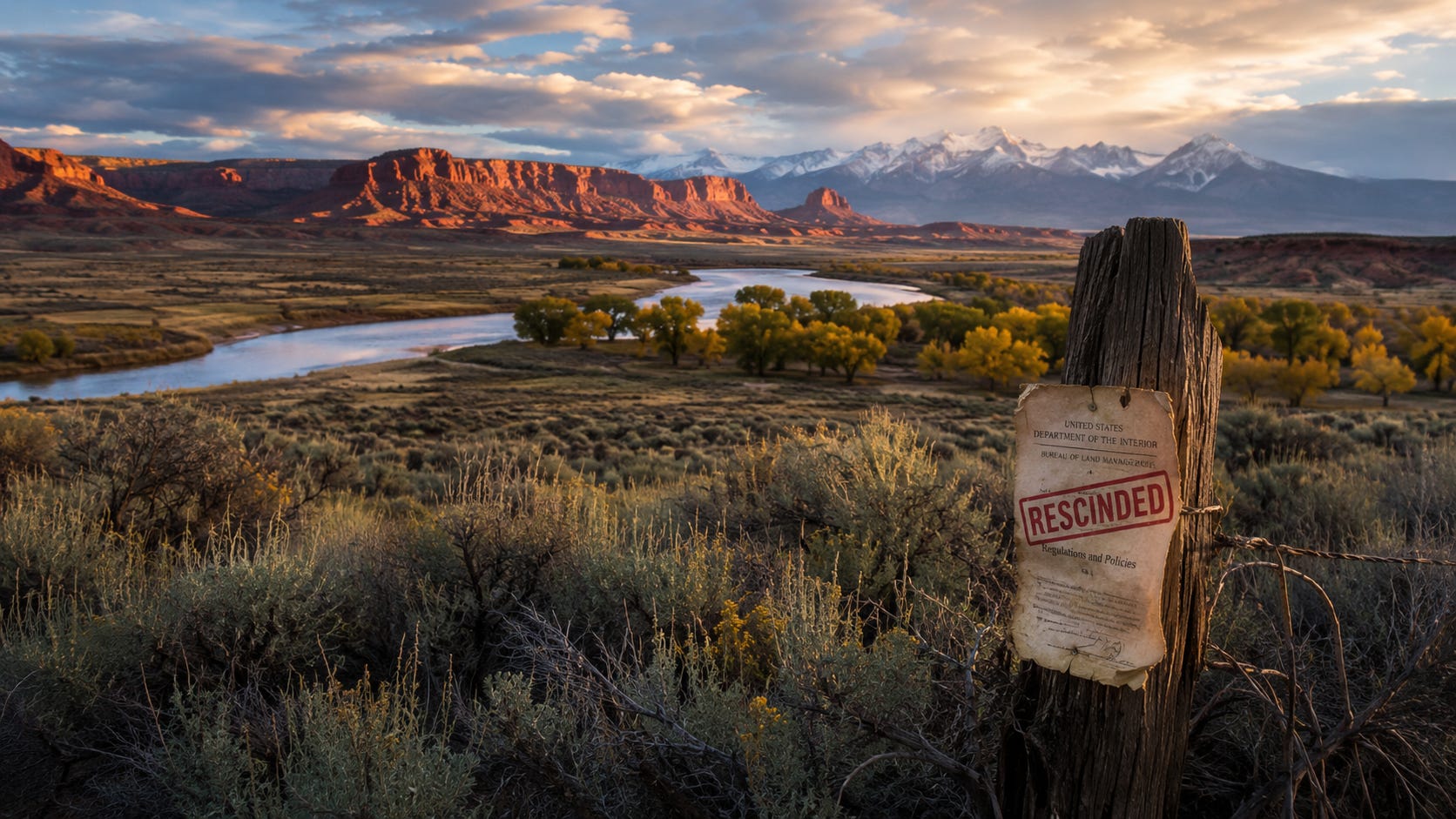
The sagebrush sea and rangelands
The sagebrush steppe is often mistaken for emptiness, especially by people who only know beauty when it rises like a cathedral or sparkles like a lake, but across the interior West, these lands are among the most quietly important ecosystems in North America. Sagebrush country supports wildlife, ranching, hunting, Indigenous cultural use, pollinators, native grasses, seasonal water flows, soil stability, and rural economies that depend on open land not being shredded into roads, pads, pits, and invasive weeds.
Scientifically, these lands are already in trouble. USGS research says that over the last 20 years, the North American sagebrush biome has lost more than 500,000 hectares of intact or largely intact sagebrush plant communities each year, much of it associated with invasive annual grasses that increase both the likelihood of fire ignition and the ease with which wildfire spreads across large landscapes. BLM’s own rangeland health standards recognize that healthy public lands depend on watersheds that store and release water properly, soils that support infiltration and moisture storage, ecological processes such as nutrient cycling and energy flow, and habitat for threatened, endangered, candidate, and special-status species.
For people, sagebrush country is not just habitat, it is home and work. Ranching families rely on forage and functioning watersheds, hunters rely on mule deer, pronghorn, elk, and sage-grouse habitat, Tribal nations rely on culturally important plants and animals, and small towns rely on a mix of grazing, tourism, guiding, fuel jobs, county revenues, and the simple fact that an intact landscape still gives people a reason to stay. The danger of this rescission is that it weakens the regulatory weight given to the long-term health of these lands at the very moment they need more attention.
When conservation is treated as a barrier instead of a public good, the sagebrush steppe becomes easier to fragment and easier to write off as land that can absorb one more road, one more well pad, one more overgrazed drainage, and one more “temporary” disturbance that never quite heals. Fire doesn’t respect those paperwork distinctions, invasive grasses don’t care whether degradation was permitted one project at a time, and rural communities are left with the smoke, the lost forage, the erosion, and the grief of watching a place become less itself.
Deserts, drylands, and biological soil crusts
The American desert is one of the places most abused by the lie of emptiness. To the untrained eye, desert land can look bare, but much of what looks bare is alive, and some of the most important life is underfoot. Biological soil crusts, or biocrusts, are communities of cyanobacteria, lichens, mosses, algae, and microfungi that live on the surface of arid and semi-arid soils, where they interact deeply with the soil and help organize plant and microbial communities.
USGS research on desert biological soil crusts explains that these crusts help stabilize soils, slow runoff, retain seeds and organic matter, and provide newly fixed carbon and nitrogen to desert soils. When disturbed by vehicles or livestock, desert soils can produce up to 36 times more sediment, and the loss of crusts can reduce fertility inputs while accelerating fertility losses. In other words, what looks like a fragile skin on the ground is part of how the desert breathes, feeds itself, holds itself together, and resists becoming dust.
Deserts also hold astonishing biodiversity, especially around springs, oases, dry lake beds, dunes, caves, remote valleys, and isolated aquatic habitats. USGS notes that desert biodiversity is shaped by this landscape heterogeneity and by evolutionary isolation, while also warning that deserts are threatened by water withdrawal, mining, roads, pollution, overgrazing, energy development, invasive species, feral species, and urban sprawl.
The communities affected here include Tribal nations with ancestral ties to desert landscapes, rural desert towns, ranchers, desert scientists, and people who simply live close enough to know that a desert spring is not scenery, it is a miracle. The rescission of the Public Lands Rule matters because desert damage can be slow to heal, sometimes taking decades or longer, and because the tools removed by the repeal were designed to make restoration and mitigation more central to BLM decision-making.
If desert lands are treated primarily as places to cross, drill, mine, graze, or route transmission lines through, then the people who live near them inherit the dust, the groundwater stress, the loss of habitat, the diminished quiet, the damaged cultural sites, and the slow stripping away of a landscape whose value was never loud enough for the market to hear.
Rivers, springs, wetlands, and riparian corridors
Water is the hidden thread running through public lands policy, especially in the West, where a ribbon of cottonwoods or willows can mean the difference between refuge and exposure, between life and disappearance. BLM lands contain streams, springs, wetlands, washes, groundwater-dependent ecosystems, riparian corridors, and aquatic habitats that support fish, birds, livestock, wildlife, recreation, and downstream communities.
These areas are climate infrastructure. They filter water, slow floods, recharge groundwater, cool surrounding habitat, store carbon in wet soils and vegetation, and provide corridors for wildlife movement as temperatures rise. The IPCC’s 2023 synthesis report stresses the interdependence of climate, ecosystems, biodiversity, and human societies, as well as the close links between climate adaptation, mitigation, ecosystem health, and human well-being.
For communities, this is not theoretical. A degraded stream can mean warmer water, fewer fish, less reliable irrigation, more erosion after fire, more sediment in reservoirs, worse flood impacts, and fewer places for livestock and wildlife to survive dry years. A damaged spring in the desert can mean the collapse of an entire local web of life, including species found nowhere else. A riparian corridor cut by roads, unmanaged grazing, mining, or poorly sited development can lose the very structure that allows it to buffer a community from drought, flood, heat, and fire.
The rescission does not erase every water protection law, and that distinction matters, but it does remove a rule that made land health, restoration, intact landscapes, and watershed resilience more explicit across BLM planning. It means communities may have to fight harder, project by project, to make the agency consider water not just as a resource to be allocated, but as a living system to be defended.
Forests and woodlands on BLM lands
Many people hear “public lands” and think of national forests, while National Forests are public lands, they are managed by the National Forest Service, while BLM manages forests and woodlands, including the Oregon and California Railroad Revested Lands, known as the O&C lands, which include more than 2.4 million acres across eighteen counties in western Oregon. These lands contain forests, plant and animal diversity, recreation areas, mining claims, grazing lands, cultural and historical resources, scenic areas, wild and scenic rivers, and wilderness.
Forests and woodlands do more than hold trees. They store carbon, regulate water, create shade, build soil, shelter wildlife, support fungi and pollinators, provide recreation, and sustain rural economies through timber, tourism, hunting, fishing, and cultural use. Recent research on mature and old-growth forests in the Pacific Northwest describes these forests as providers of crucial ecosystem services, including carbon sequestration, cultural services, regulation of hydrological cycles, and habitat for biodiversity.
The communities surrounding these lands are complicated, and that complication should be honored. Timber communities have real histories, real losses, and real families who were promised stability by industries and governments that often treated them as disposable. But the lesson of the past is not that we should repeat extraction until the last old forest is gone, it is that communities deserve economies that do not require ecological liquidation.
The rescission of the Public Lands Rule fits into a broader pattern here. The Trump administration has also pursued rescission of the 2001 Roadless Rule for national forest lands, with USDA stating that the rule affected about 30 percent of National Forest System lands, while a Federal Register notice says the proposed rescission concerns about 44.7 million acres of inventoried roadless areas. Although the Public Lands Rule directly governs BLM lands, not Forest Service lands, the political logic is the same, conservation protections are cast as obstacles, local flexibility is invoked as the cure, and the door opens wider for roads, logging, drilling, grazing, and other development decisions to be made with fewer national guardrails.
For people living near forests and woodlands, the costs of weakened protection can arrive as smoke, landslides, hotter streams, lost salmon habitat, diminished recreation, damaged drinking water, and the aching knowledge that a forest that took centuries to become itself can be reduced to revenue in a season.
National Conservation Lands, ACECs, and culturally significant landscapes
Some BLM lands are protected because the country has already recognized that they carry unusual ecological, cultural, historical, scenic, or scientific value. BLM’s National Conservation Lands include 906 units covering more than 38 million acres, including national monuments, national conservation areas, wilderness areas, wilderness study areas, wild and scenic rivers, historic trails, scenic trails, and other special designations.
These places do not merely protect views, they protect memory. They include ancestral homelands, sacred sites, archaeological landscapes, petroglyphs, migration routes, rare plants, fragile waters, fossil beds, dark skies, and the living continuity between people and place. The Public Lands Rule strengthened and clarified procedures around Areas of Critical Environmental Concern, or ACECs, which are BLM designations meant to protect important resources that may not have the fame of a national park but still carry irreplaceable value.
The rescission restores ACEC regulations to the older framework used since 1983, and eliminates the newer procedures created by the 2024 rule. To the administration, this is a return to balance; to many communities, especially Tribal nations and conservation advocates, it means removing a tool that could have helped protect places before they are harmed beyond repair.
This is where the emotional core of the issue becomes impossible to avoid. A damaged cultural site is not just an environmental impact, it is a wound in time. A destroyed spring, a fragmented migration corridor, a sacred mountain opened to extractive pressure, these are not losses that can be made whole by mitigation paperwork. The Public Lands Rule didn’t solve every injustice, but it did move federal land management closer to admitting that some places are valuable because they are alive, because they are old, and because they belong to more than the present moment.
Alaska, Arctic lands, and vast intact landscapes
BLM’s land base in Alaska is immense, about 70 million surface acres and 220 million subsurface federal mineral acres, in a state whose landscapes include tundra, boreal forest, wetlands, rivers, permafrost, migration routes, subsistence areas, and some of the largest remaining intact public lands in the country.
In Alaska, land protection is inseparable from climate. Permafrost stores carbon, wetlands hold water and support birds and fish, tundra supports caribou and subsistence lifeways, and intact landscapes buffer ecological systems that are already warming faster than much of the planet. For Alaska Native communities, the land is not a distant recreational amenity, it is food, culture, travel, language, ceremony, memory, and survival.
The danger of the rescission in Alaska is not only that more land could become vulnerable to energy and mineral development, but that the federal government is signaling a broader willingness to treat intactness itself as negotiable. The administration’s own Interior order implementing Trump’s “Unleashing American Energy” agenda directs the removal of impediments to development and use of energy and natural resources, with a focus on permitting, leasing, development, production, transportation, refining, distribution, exporting, and generation capacity.
That is an unmistakable statement of priority. The land is first imagined as inventory, then as supply, then as a set of impediments to be removed. What disappears in that language is the child watching caribou cross, the elder remembering a fishing place, the migratory bird traveling from one continent to another, the carbon held in frozen ground, and the fact that when Arctic systems destabilize, the consequences do not stay in the Arctic.
Energy lands, mining districts, and the federal mineral estate
The Public Lands Rule also matters because BLM manages not only surface lands but an enormous federal mineral estate beneath public and private lands. That means the agency has influence over oil, gas, coal, geothermal, hardrock mining, lithium, transmission corridors, rights-of-way, and the infrastructure that follows energy development across the West.
The Trump administration’s pattern is not subtle. On his first day back in office, Trump issued the “Unleashing American Energy” executive order, which declares it U.S. policy to encourage energy exploration and production on federal lands and waters, including the Outer Continental Shelf. Interior Secretary Doug Burgum later framed the Public Lands Rule as something that could block energy and mineral production, timber management, grazing, and recreation, saying its repeal would protect “our American way of life.”
At the same time, the administration moved sharply against wind energy, withdrawing all areas of the Outer Continental Shelf from new or renewed wind energy leasing and directing agencies not to issue new or renewed approvals, rights-of-way, permits, leases, or loans for onshore or offshore wind projects while a federal review proceeded. AP later reported that more than 250 onshore wind projects in more than 30 states were stalled because Pentagon reviews had not been completed, with the American Clean Power Association calling the delays a “de facto moratorium.”
This is the contradiction at the center of the administration’s energy posture. Fossil fuel extraction is framed as abundance, security, prosperity, and freedom, while conservation and renewable energy are framed as burdens, threats, uncertainty, or government favoritism. That is not neutrality, it is ideology wearing a hard hat.
The damage does not stop at the fence line of a lease. Oil, gas, coal, and mining development can fragment habitat, increase truck traffic, strain water supplies, pollute air, disturb cultural landscapes, release greenhouse gases, and leave cleanup burdens for the public. At the planetary scale, continuing to favor fossil fuel expansion while slowing renewable deployment deepens the very climate instability that makes public lands more vulnerable to fire, drought, heat, invasive species, flooding, and ecological collapse.
The communities asked to pay the price
The communities surrounding BLM lands are not monolithic, and flattening them does them a disservice. There are ranchers who fear losing grazing access, Tribal nations fighting for co-stewardship and sacred sites, oilfield workers trying to feed their families, outfitters and guides whose livelihoods depend on healthy wildlife and intact landscapes, and families who simply want clean water and breathable air.
It is true that some rural communities welcome the repeal because they believe the Public Lands Rule threatened local economies. It is also true that many of those same communities depend on the very land health the rule was designed to protect. A burned rangeland does not feed cattle. A polluted stream does not sustain fish. A dried spring does not care which political party promised jobs.
That is why the argument for protection is not anti-rural or anti-work. It is pro-future. It says communities should not be forced into a false choice between today’s paycheck and tomorrow’s water, between local jobs and living landscapes, between honoring work and surrendering the land that makes work possible.
What we owe the land, and what we owe each other
Public lands are not just acres on a map. They are watersheds, migration routes, carbon sinks, burial grounds, hunting grounds, story places, dark skies, spring seeps, old trees, living soil, and the open space a child sees from the backseat and somehow understands as freedom before anyone teaches them the word.
The Public Lands Rule was imperfect and vulnerable, as all federal rules are, but at its core it made a simple and necessary claim: that conservation is not the absence of use, it is one of the most important uses of all. To restore a damaged stream is use. To protect a migration corridor is use. To keep carbon in soil and trees is use. To give future generations more than the invoice from our extraction is use.
The rescission tells us what this administration values, and what it is willing to risk. water, wildlife, cultural landscapes, climate resilience, and the fragile trust between people and the lands that belong to them. It is willing to call protection idleness and extraction productivity, as if a living world only matters once someone has figured out how to sell it.
But the land remembers what we forget. It remembers every road cut across it’s skin, every streambank trampled bare, every sacred place treated as an obstacle. It also remembers care. It remembers restoration. It remembers people who understood that inheritance is not the same as ownership.
What we do now is about whether we still believe the future has a claim on us. We can choose extraction as the highest expression of freedom, or we can choose the older, wiser freedom of belonging to a living world and behaving as if that world is not disposable. The rescission of the Public Lands Rule is a step in the wrong direction, but it is not the final word unless we let it be.
it is disturbing and depressing how very very widely the Trump administration (Project 2025's years of planning/plotting) is attacking what makes America valuable and sustainable. Flood the zone, indeed. War, immigration, national finances, weaponization of the legal system, misogyny and racism, and they still find time to gut the national forest service and sap the foundations of public land management. They're everywhere all at once, destroying and selling.
It's hard to pay attention to everything, which is not an accident. Thank you, Mary and Shanley, for your important part in noticing what is going on and in providing a sensible framework for understanding it.
Mother Gaia is the ultimate protector of her domain....... It took billions of years to establish the stunning, beautiful, world that is hers! Then.... she relaxed, unknowingly, letting ONE single species group conquer all!
Some days I see good things and progress.... restoring the purpose promised to us! Other days, I despair... and want to hide myself in an everlasting tide of shame!