


The King has spoken, and for a moment, in that chamber, you could almost pretend things were normal.
Picture it: Mike Johnson beaming with ceremonial gravitas, JD Vance perched behind the dais like a man trying very hard not to react to anything, and King Charles III stepping into the well of Congress to a standing ovation that like genuine enthusiasm and perhaps a little muscle memory. Camilla seated nearby, the room full, the pageantry intact. The whole thing had the aesthetic of stability. A constitutional monarchy lending its ancient weight to a republic that increasingly feels like it’s being held together with duct tape and superglue.
Charles began speaking and opened the way monarchs always do, with gratitude, history, and just enough charm to soften the edges. As Oscar Wilde once put it, he reminded the room, “we have really everything in common with America nowadays except, of course, language.” A nod to 250 years of shared history. A reference to his mother standing in that same chamber in 1991. Polite, measured, almost disarmingly gentle.
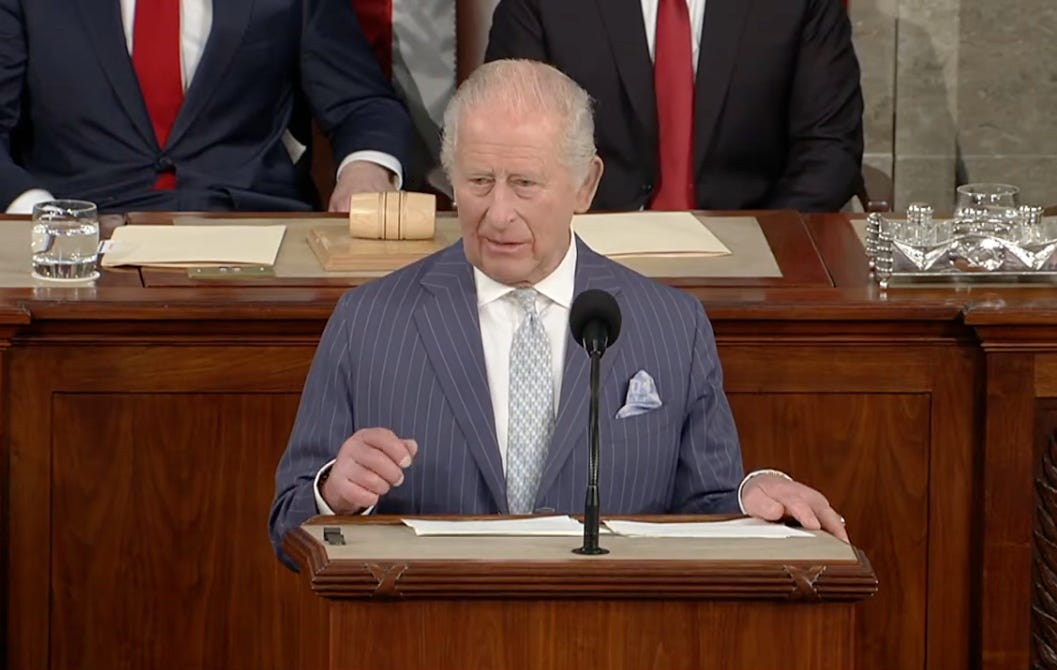
Quickly, he pivoted. “We meet in times of great uncertainty,” he said, before laying out the reality everyone in that room already knows but prefers not to say out loud: wars in Europe and the Middle East, political violence at home, a world that is objectively more volatile than the one Queen Elizabeth addressed three decades ago.
From there, the speech unfolded like a masterclass in diplomatic threading. Every line carefully constructed to say two things at once: what is polite, and what is necessary.
On the surface, it was a celebration of the “special relationship,” the long arc from revolution to reconciliation, from “no taxation without representation” to what Charles called “a partnership born out of dispute.” He framed the American Revolution not as a permanent rupture, but as the first argument in a family relationship that somehow survived both the argument and the family. The principle on which Congress was founded, he said, was “at once a fundamental disagreement between us” and “a shared democratic value” America had inherited from Britain.
That was the elegant trick of the speech: Charles turned the breakup into the origin story. The colonies rebelled, Britain lost an empire, America got a founding myth, and two and a half centuries later a British king stood under the dome of the Capitol gently suggesting that perhaps everyone had learned something. “Ours is a partnership born out of dispute, but no less strong for it,” he said, adding that when the two nations do find a way to agree, “what great change is brought about, not just for the benefit of our peoples, but of all peoples.”
Underneath, it was something else entirely. A reminder, delivered with royal restraint, that the systems underpinning that relationship are under strain. Charles emphasized both nations are rooted in shared legal traditions stretching back to Magna Carta, that executive power is constrained by checks and balances, that liberty is not the will of one but the deliberation of many. A king walked into Congress and gave a lecture on why kings don’t run things anymore.
He leaned hard into NATO, invoking 9/11 and the alliance’s response, not as nostalgia, but as a pointed comparison to the present. The same “unyielding resolve,” he said, is now needed for Ukraine.
That line landed like a diplomatic elbow. Everyone in that room knows exactly who has been undermining NATO, flirting with withdrawal, and hedging on Ukraine. Charles didn’t have to name names.
Then came climate. Charles has been talking about environmental collapse since before it was fashionable, and he wasn’t about to skip it now. He framed nature not as a moral luxury but as infrastructure, “nature’s own economy,” the foundation of prosperity and national security. Half the chamber shifted uncomfortably in their seats.
In one of the more subtle but striking moments, he referenced “victims of some of the ills that so tragically exist in both our societies today.”
According to reporting, it was a deliberate nod to Epstein’s victims, an acknowledgment threaded into a sentence so carefully constructed it could pass unnoticed unless you were listening for it. No names, no scandal, just a quiet signal that even the monarchy, or especially the monarchy, cannot pretend that story doesn’t exist.
The speech built toward its close with increasing clarity. The alliance, he warned, cannot simply coast on past achievements; it has to be renewed, actively, intentionally.
Then came the line, the one that will probably outlive the rest of the speech:
“America’s words carry weight and meaning… The actions of this great nation matter even more.”
To me, that sounded like a challenge, because while Charles was speaking and Congress was applauding, and while the chamber performed unity, the rest of the country was doing something very different.
Within hours, the Justice Department secured a new indictment against former FBI director James Comey. The basis? A social media post showing seashells arranged to read “86 47,” which the administration has chosen to interpret as a threat against the president. Yes! Seashells.
This comes after earlier attempts to prosecute Comey fell apart, after Trump publicly demanded action against his perceived enemies, after leadership changes at DOJ were tied directly to dissatisfaction over not pursuing those enemies aggressively enough.
At the same time, the FCC, under a Trump-appointed chair, moved to accelerate the review of ABC’s broadcast licenses, forcing multiple local stations into early renewal proceedings years ahead of schedule. The trigger? A Jimmy Kimmel joke about Melania Trump. Not because the joke violated any law or posed a public safety risk, but because it was offensive to the president.
Even critics inside the system aren’t mincing words. They’re calling it unprecedented, a political stunt, a message to every broadcaster in America: fall in line, or we can make your life a living hell.
In one room, a monarch, whose very institution exists because of centuries of negotiated limits on power, stood before Congress and spoke about restraint, partnership, and the rule of law. He invoked Magna Carta, NATO, democratic accountability, and the idea that no one governs alone.
Outside that room, the machinery of the American state was busy demonstrating what happens when those ideas are treated as optional.
That’s the tension Charles was trying to navigate. The tension the British government sent him to manage. It was diplomacy by proxy. Trump may dismiss elected leaders, insult allies, and bulldoze norms, but he likes the monarchy. So Britain sent the one figure he might actually listen to.
Charles did what he could. He praised, flattered, joked, and invoked shared history and shared sacrifice. He also warned to ignore the pull toward isolation, to honor alliances, defend Ukraine, and respect the rule of law. Protect the systems that make democracy function.
He came, he saw, he said what he needed to. The King did what he could and a lot of it was subtle enough that it probably went over the heads of many. As a Brit I am proud.
Elegantly written and impactful, Mary.
The speech, however diplomatic, educated and subtle, likely fell on ignorant and deaf ears for the one it was intended.
Sadness oppresses.