


Good morning! Donald Trump looks at politics as television, which is not quite the same thing as understanding either politics or television.
Bad shots can be cut. Awkward guests dropped. A chyron can declare victory while the thing being described remains stubbornly unresolved. If somebody breaks character, you go to commercial.
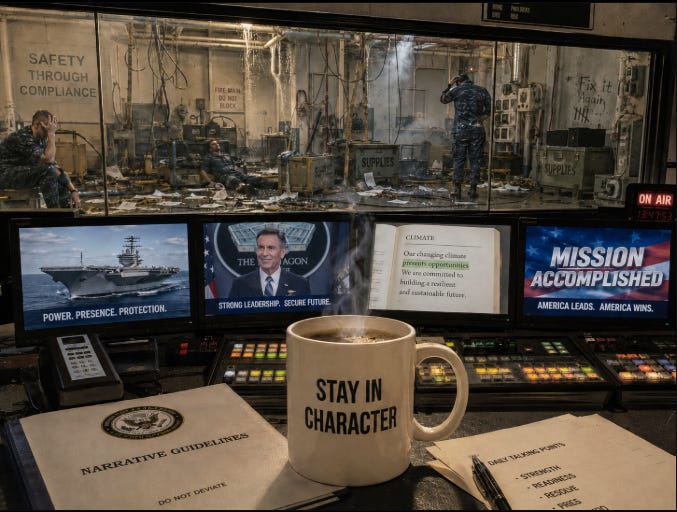
Increasingly, kayfabe feels like the organizing principle of the Trump presidency: maintain the storyline, punish anyone who breaks character, treat inconvenient reality as a production problem. Alas, the problem with governing by kayfabe is that reality isn’t under contract.
Which brings us to Stars and Stripes. On Friday, the Pentagon sent separation notices citing insubordination to publisher Max Lederer, editor Erik Slavin and Middle East reporter Lara Korte. Lederer had already announced plans to retire at the end of September, saying his understanding of the paper’s mission had diverged fundamentally from the Pentagon’s. AP and CBS confirmed the actions.
Earlier this year, applicants for jobs at Stars and Stripes began encountering questions through the federal hiring system asking how they would advance Trump’s executive orders and which presidential initiatives they’d help implement if hired. Newspaper leadership said it hadn’t requested the questions and didn’t know they were being asked.
Shortly afterward, Pentagon spokesman Sean Parnell announced that Stars and Stripes would be returned to its “original mission,” which required moving away from what he called “woke distractions.” Pentagon officials then told the conservative Daily Wire that the envisioned overhaul would use active-duty service members to produce content and could fill as much as half the paper with Pentagon-generated material. The people actually running Stars and Stripes learned about their own paper’s future through news reports.
A subsequent Pentagon memo expanded oversight, prohibited wire-service stories, banned cartoons and required content be consistent with “good order and discipline,” a standard broad enough that Jacqueline Smith, the paper’s ombudsman charged with protecting its editorial independence, warned almost anything could be swept under it. Naturally, she was fired.
A few weeks ago, something happened at Stars and Stripes that hadn’t happened in decades: according to Slavin, the Pentagon installed a Navy public-affairs officer as military deputy to the publisher. Then the publisher announced he was leaving. Then the Pentagon decided he wasn’t leaving quickly enough and sent him a separation notice anyway.
And now we arrive at the supposed acts of insubordination.
Korte had told CBS News something that, in a functioning democracy, ought to be so unremarkable nobody would remember hearing it: “I’m working for Stars and Stripes, not for the Pentagon, not for any administration, not for any policymaker.” Her separation notice cited that interview and treated the statement as insubordinate.
Slavin’s offense was somehow even more scandalous. Asked to name a hypothetical red line, he said it would be unacceptable for the Pentagon to pull a perfectly accurate story and hand him Pentagon-written copy to publish instead. That hypothetical defense of basic journalistic independence was also cited as insubordination.
The timing inevitably raises questions. Slavin’s July CBS interview drew no reaction he knew of for weeks, while the paper continued reporting on the Iran war, families evacuated from Middle East bases and, on August 11, many of the details about conditions aboard the USS Abraham Lincoln that later drove national coverage. The separation notices came roughly ten days later. But Slavin is careful to note that his notice does not cite that reporting, and there is no evidence establishing that it caused the firings.
We don’t need to speculate. The Pentagon’s stated reason is extraordinary enough: journalists at a congressionally protected independent newspaper publicly defended their independence.
Welcome to the kayfabe presidency, where the gravest offense is breaking character.
Stars and Stripes has spent generations refusing to stay obediently inside the Pentagon’s preferred storyline. Its readers are military personnel and families who need to know what is actually happening inside the institution their lives depend on. Slavin says credibility is the foundation of that relationship, and that credibility comes from readers knowing the news was produced independently of Pentagon public affairs. Turn it into another communications office and you may still have a publication. What you no longer have is Stars and Stripes.
Which is a useful segue to the Pentagon’s actual producer. The New York Times reported this week that Jennifer Hegseth, Pete Hegseth’s wife and his former Fox News producer, has become his most influential adviser and, in the paper’s memorable phrase, his “de facto producer at the Pentagon.” She reportedly preps him for appearances, sits in on meetings with journalists, interviews prospective staff, and brainstorms Defense Department videos.
There is something almost too on-the-nose about a Defense Department trying to turn its independent newspaper into a more manageable product while its secretary operates with a former television producer helping shape how the job is presented.
Clearly this would not be so striking if the underlying performance made the production work unnecessary. Instead, the department spent months denying or minimizing accounts of deteriorating conditions aboard the Lincoln while the actual logistics story slowly emerged. Bahrain, normally a critical Fifth Fleet hub, had been struck by Iranian missiles. Other Gulf ports carried similar risk; so did the Red Sea. Resupply shifted toward Diego Garcia, some 2,200 miles from the operating area, stretching what had been roughly three-day cycles toward ten. Navy leaders told MS NOW that Diego Garcia lacked the capacity to support two carrier strike groups at that tempo, because the underlying planning assumption had been a war lasting a few weeks. Downstream came shortages of food and basic hygiene items, and mounting strain on sailors and their families as the war stretched into months.
The Pentagon did not have a six-month logistics plan, but it had a producer.
Admittedly, that’s snark, but it also names the governing problem underneath all the message management: if the underlying thing worked better, controlling the description of the thing would take considerably less effort. A functioning Bahrain evacuation plan wouldn’t need so much defensive messaging. Adequate carrier supplies wouldn’t require the president insisting families weren’t actually worried.
The same instinct shows up earlier in the pipeline, and with less noise. In Florida, an investigation by WUSF and The Hechinger Report found education officials pressed science textbook publishers to weaken or remove climate-related language as part of the state approval process. “Climate change” became “changes in the environment.” “Polluting” disappeared from in front of “coal-burning power plants.” A sentence describing research linking climate change to mortality was replaced by vaguer language about CO2’s effect on health, an edit the book’s own author said actually made the science less accurate. Nobody had to pass a law called the Make Climate Science Less Specific Act.
I find this one particularly disturbing. I believe climate change is the greatest threat to my grandchildren’s future, and if I had my druthers I would spend considerably more of my time writing about climate, sustainability, resilience and the extraordinary amount of work we already know how to do. But politics determines whether we do that work at all. It determines whether we invest, prepare, adapt, regulate, teach, measure and even whether we are willing to name the problem accurately. You cannot begin solving something you have decided it is politically inconvenient to describe.
Florida’s response is the governing equivalent of putting its hands over its ears while the water rises.
The state has real leverage here, since districts are financially encouraged to choose from its approved textbook list, and books in the subjects most likely to contain climate material, environmental, earth and marine science, were initially approved at less than half the rate of other science texts. Most were eventually accepted after revision. One author noted climate claims were subjected to sourcing demands never imposed on chapters about DNA or the digestive system; he had no objection to supplying evidence, only to the fact that just one area of settled science seemed to require this exceptional proof of life.
Teachers describe the downstream effect as a “culture of caution.” Nobody hands them a formal blacklist. They just start predicting what might become controversial, what might trigger an angry parent, and censor themselves in advance. It is remarkably efficient information management; the government never has to rebut the inconvenient information, because eventually fewer people risk presenting it in the first place.
Kayfabe moves upstream. The script gets adjusted before the audience even knows a line was changed.
At the Center for American Progress, the government has less direct leverage, so it reaches for a different instrument. CAP published an analysis finding no evidence that National Guard deployments to several cities improved crime trends that were already falling, and estimated the deployments could cost taxpayers more than $1.7 billion if extended through year’s end.
Trump did not respond by commissioning a better statistical analysis. His lawyer sent CAP a letter demanding retraction, apology, and compensation, and threatening at least $5 billion in damages. CAP declined. Its lawyer answered with a line that belongs in a civics textbook, assuming Florida hasn’t edited it out by then: “The fact that the truth undermines the president’s political position is not defamation.” Disagreement over whether a policy worked, the organization argued, is exactly the kind of debate protected in a functioning democracy.
Then CAP did something delightful. It essentially said: fine, sue us. If the case proceeds to discovery, CAP wants documents and testimony on the purpose of the deployments, their cost, their actual effect on crime, and White House involvement, and it formally instructed Trump’s team to preserve potentially relevant communications. Nothing ruins a good intimidation attempt like reciprocal discovery.
Trump doesn’t need to win a suit like this for the threat to have value. Litigation consumes money, time, attention, and institutional bandwidth. A smaller research institute or nonprofit, staring down a demand threatening billions in damages, might reasonably ask itself: is publishing this worth it? That question is the product. The chilling effect isn’t collateral damage. It’s increasingly hard to avoid the conclusion that producing it is the point.
Notice the progression: control the institution you fund. Pressure the publishers you approve. Threaten the organization you can’t directly command. Different mechanisms, same desired behavior: stay in character.
Even the Navy’s symbols are apparently becoming part of the production. The service is reportedly considering removing the name of Doris “Dorie” Miller from the future carrier CVN-81 and naming the ship for Donald Trump, who never served in the military instead, though no final decision has been announced. Miller was the Black mess attendant aboard the USS West Virginia who carried wounded men to safety during the attack on Pearl Harbor, then took up an anti-aircraft gun he’d never been trained on, segregation having denied Black sailors that training, and fired on Japanese planes. He became the first Black recipient of the Navy Cross. The USS Doris Miller would have been the first carrier named for a Black American and an enlisted sailor.
This is another reminder of how much of this administration’s energy goes into curating the story America tells about itself, who gets remembered, who gets erased, which facts count, which words are permitted, which version of events stays on screen.
Independent institutions are useful precisely because they occasionally tell people in power things those people don’t want to hear. That isn’t a defect in competent government; it’s one of the mechanisms that makes competent government possible. A military newspaper reports that sailors lack supplies so someone can fix the supply chain. Scientists describe a warming planet accurately so citizens can decide what to do about it. A government capable of receiving bad information can correct itself. A government that treats bad information as a communications problem is disabling its own capacity to know when something has gone wrong.
That’s the deeper cost of the kayfabe presidency. It isn’t just that the audience is being misled. It’s that enormous governing capacity is being spent shaping the story, restricting the questions, disciplining the messengers, threatening the critics instead of fixing the conditions generating all that inconvenient information in the first place.
Change the chyron. Rewrite the script. Fire the reporter, threaten the critic.
Ships still need supplies. Ice caps keep melting. Budgets still have to add up.
Reality does not.
Mary, an excellent essay. Thank you. I agree with you that climate change is the biggest thing we are facing and giving to future generations. It is happening before our eyes and yet when we need wisdom, foresight, integrity, and honesty, we get this monstrous malicious cancer who is being used by the cabal as a destructive essence, killing everything it touches.
Mary,
It seems that nothing is safe from the unnecessary destruction that this regime is determined to wreak.
I suppose that if you have a malignant narcissist at the head of government, then this will be the end result. What a tragedy for the US and for the rest of the world.