


Good morning! The image that should stay with us from last night is not Donald Trump grinning cageside, though there was plenty of that. It is not the octagon on the South Lawn, though that would have been grotesque enough on its own. It is not even the fighters walking through the Grand Foyer, the Green Room, the Red Room, the Diplomatic Reception Room and the Palm Room as if the White House had been reduced to a very expensive UFC walkout tunnel.
The image is the B-1B Lancer roaring over Washington after 11 p.m. on a Sunday night, afterburners glowing orange over the sleeping city, shaking the Ellipse and, almost certainly, the windows of people who had not volunteered to live inside Donald Trump’s birthday content package.
Thanks, I live here.
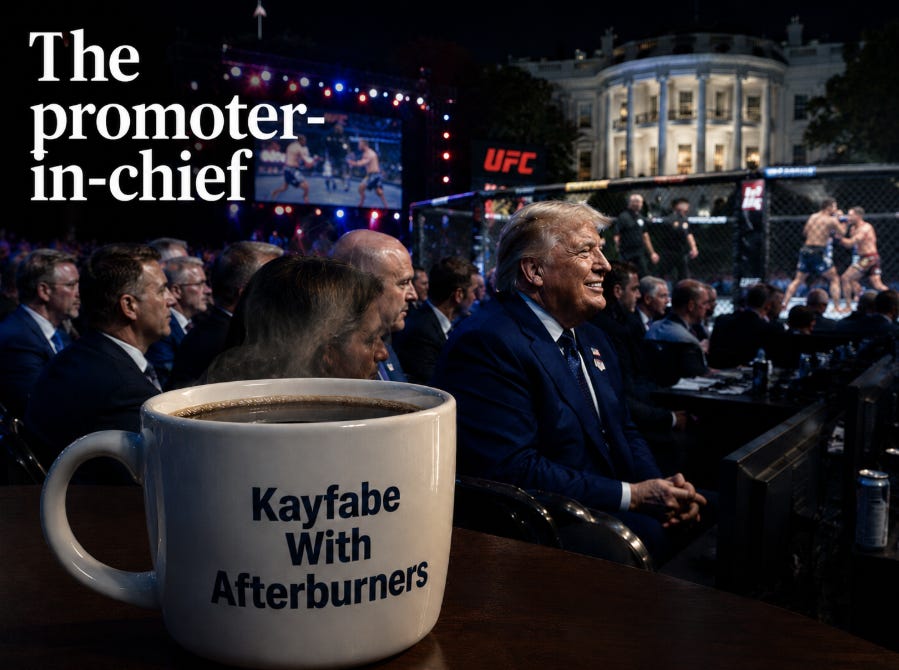
That was the reverse angle on the whole night. From inside the production, it was spectacle: America, strength, fighters, flags, flyovers, troops, chants, Trump in a USA hat, Dana White beaming, the crowd singing happy birthday to the president at a cage fight on public property. From outside the frame, it was something else: the people’s house converted into a private arena, the capital city conscripted into the sound design, and the machinery of state used as lighting, branding, and percussion.
Meanwhile, somewhere in the same rolling spectacle, an unsigned peace was being declared “complete.”
That was the split screen of Sunday night. On one side, a White House lawn transformed into a sponsored combat-sports venue. On the other, a provisional Iran framework marketed as a triumph. The two stories were not competing for attention. They were explaining each other.
The South Lawn event was offensive in almost too many ways to write about cleanly, which is how these things overwhelm the senses and escape judgment. One can get lost in the inventory. There was the UFC cage on the White House lawn. There were fighters using historic rooms as staging areas. The Oval Office turned into an entrance cue for Trump and Dana White. Thousands of fans on the Ellipse, active-duty military members in the audience, chants of “U-S-A,” and a late-night strategic bomber flyover over downtown Washington. There were Trump-linked sponsors. Trump Coin was reportedly promoted as the sponsor of closed captioning. Truth Social sponsored a bout. Fighter bonuses were tied to a Trump-family crypto venture. Polymarket sponsored the final card, with announcers giving live updates on how the fighters were “trading” during the main event.
But the scandal is the mechanism. The sponsors were not merely outside companies buying access to a public event. Several were substantially part of Trump’s own political and financial ecosystem. Trump Coin. Truth Social. A Trump-family-linked crypto venture paying fighters in its own USD1 stablecoin on the public lawn, with the payout framed as a demonstration of the product itself. The presidency was not hosting the marketplace. The presidency was the marketing channel for the president’s products.
This is the toll-booth thesis at its purest. Every public thing becomes a point of extraction. The office assembles the audience; the state supplies the setting, the military supplies the spectacle, and the cameras supply the reach. Then the Trump ecosystem sells into the crowd.
The White House did not host an event; it became a product showroom.
Presidents have hosted teams, have attended games, and posed with athletes and champions and coaches. But this was not the president honoring an outside achievement. This was the presidency itself being folded into a commercial fight card. The White House supplied the venue. The military supplied the atmosphere. Trump supplied the brand. Private companies supplied the monetization. The audience supplied the chant track. The historic rooms supplied the backdrop. Washington supplied the unwilling acoustics.
The night even found time to include the ritual humiliation politics that now passes for crowd work. After winning his heavyweight bout, Josh Hokit reportedly walked over to Trump, presented him with a chain, and then used his interview with Joe Rogan to insult Michelle Obama. The response was mixed in the White House setting and more amused at the fan event. Of course it was. The whole evening was built to test how much cruelty, commerce, nationalism, and spectacle could be laundered through the prestige of the presidency before anyone in authority remembered to be embarrassed.
No one remembered.
The Weather Channel, however, did remember to report the weather. For this, the White House rapid-response machinery attacked it. The forecast had been straightforward enough: thunderstorms, heavy downpours, gusty winds, heat, mosquitoes, and the operational problem that lightning near the venue could halt the show. The official response from Rapid Response 47 was to dismiss it as a “bullshit clickbait headline” written by a “friendless loser,” and to insist the celebration was on “rain or shine… no matter what.” Even weather, in the logic of the spectacle, becomes opposition. Rain complicates the production; therefore rain must be cast as hostile, because the forecast failed to clap. The typical kayfabe reflex.
Speaking of kayfabe. On Sunday, Trump announced that the deal with Iran was “complete.” The Strait of Hormuz would reopen. The U.S. blockade would end. Oil would flow. Peace, or something branded as peace, had arrived just in time for the birthday cage match.
The emerging reality is much less cinematic. What appears to have been reached is not a final settlement but a memorandum of understanding: a framework to extend the ceasefire, reopen Hormuz gradually, lift the U.S. naval blockade, and begin 60 days of technical talks over the questions that actually matter. Nuclear verification. Uranium disposition. Sanctions relief. Frozen assets. Lebanon. Hezbollah. Israel’s freedom of action. Shipping insurance. Mines in Hormuz. Whether the waterway is truly “toll-free” or merely renamed as “fees for full services.”
That last phrase is the whole thing in miniature. Trump sold “toll-free.” By Monday, Iran’s Foreign Ministry was already describing fees. Not tolls, you understand. Fees. Full services. Environmental maintenance. Secure passage. A toll booth by any other name still charges by the axle.
This is the problem with kayfabe statecraft. The word is made to do more work than the deal. “Complete” means unsigned. “Peace” means a 60-day window. “Toll-free” means fees may be coming. “Wall against a bomb” means details to be negotiated later. “Victory” means getting back, at immense cost, to some version of the diplomatic architecture Trump spent years denouncing.
The cost was not imaginary. The Pentagon’s own briefing to Congress reportedly put the first six days of the war at $11.3 billion. Subsequent estimates have put the continuing military burn rate around $1 billion a day, though some defense-budget analysts have called that figure high. Brown University’s Costs of War project estimated by mid-May that higher gasoline and diesel prices had already cost American households more than $40 billion, over $300 per household, with the meter still running. That is before counting the broader regional devastation of a war that has killed thousands across the region.
That is where the comparisons to the JCPOA become unavoidable. Trump tore up the Obama-era deal, spent years calling it weak, helped drag the country into war, and now arrives at the G7 prepared to sell a tentative Iran framework as a superior achievement. Perhaps the unreleased text will contain stronger inspections, more durable enforcement, and a better nuclear mechanism than currently appears. Perhaps. But the public sales pitch so far has leaned heavily on promises that sound suspiciously like the things Trump once mocked: Iran pledging not to obtain a nuclear weapon, sanctions relief tied to performance, and hard questions deferred to follow-on talks.
Critiques from analysts like Will Saletan and Michael Rubin, coming from very different political directions, become especially useful here. Saletan’s critique is that Trump destroyed an existing diplomatic framework, went to war, imposed huge costs, and is now trying to sell a similar architecture as a historic breakthrough because his name is on the marquee. Rubin’s critique is that Trump used force and then failed to convert it into a genuinely stronger settlement, leaving Iran with time, legitimacy, and potential economic relief. One sees hypocrisy and carnage. The other sees weakness and squandered leverage. Both arrive at the same place: the victory narrative is doing more work than the deal text.
That is exactly what happened on the South Lawn. The production did more work than the institution. The staging did more work than the office. The flyover did more work than the argument. Everything was designed to make domination visible, because visible domination is the one form of politics Trump has always understood.
The Iran framework follows the same logic. Announce the finish before the match is actually over. Declare the opponent humbled before the scorecards are in. Treat the signing ceremony as a formality, the unresolved issues as details, and the branding as the achievement. If the deal holds, Trump is the peacemaker. If it falters, the spoilers will be Iran, Israel, Hezbollah, Europe, the press, the weather, the deep state, Obama, or whoever is needed for the next segment.
Implementation is not a chant. Shipping companies do not sail because Trump posts “Let the oil flow.” Insurers do not clear tankers through mined waters because a memorandum has good vibes. Israel does not become bound to a U.S.-Iran framework because Iran says Lebanon is included. Iran does not surrender its nuclear leverage because Pete Hegseth calls an unfinished document a wall. Allies at the G7 are unlikely to confuse a birthday-night declaration with a stable regional settlement simply because the president says the word “complete” loudly enough.
The same man who sat grinning at a White House cage fight while his own ventures were sold to the crowd now sits with allied leaders and asks them to accept his Iran story. The same instinct that turned the South Lawn into a sponsored octagon turns a provisional armistice into a world-historical victory. The same habit of converting institutions into props follows him from the production table to the summit table.
The lawn and the summit are the same room. One has an octagon; the other has flags and translators. But the method is identical: seize the stage, declare the outcome, monetize the attention, insult the caveats, and dare reality to catch up.
Last night was not a distraction from the Iran deal. It was the rehearsal. The kayfabe armistice was brought to you by the same people who brought you UFC South Lawn, and, as always, someone was selling something the whole time.
I really hoped the most dire weather forecast would prove true, as a reminder this Nazi-emulating regime is not all-powerful despite efforts to seem otherwise. Unfortunately, he got his spectacle of bloody domination, trashing venues and symbols of the Republic in the process. Not as exhilarating for him as January 6 but in the ballpark - or octagon…
The Universe is not going to rescue us, sigh. Back to the work of resisting and defeating the fantasy of omnipotence Trump sells.
I feel that we are living through a particularly bad reality show. It will not surprise me in the least to hear that every day is being filmed "to air at a future date." Kayfabe, indeed!