

Good morning! Today’s governing theme is extraction: minerals, money, data, institutional power, climate credibility, monetary sovereignty, and the last few fumes of American hegemony. Everyone, it seems, is digging. The only question is whether they are digging for tungsten, leverage, carbon loopholes, AI margins, or a way out of Washington’s blast radius.
We begin with the kind of corruption story that arrives wearing a hard hat and carrying a flow chart. The New York Times has reported that Trump and Commerce Secretary Howard Lutnick personally helped secure a deal giving Kaz Resources access to one of the world’s largest untapped tungsten reserves in Kazakhstan, tungsten being one of those boring-but-essential metals that suddenly becomes very exciting when you remember it is used in missile warheads, fighter jets, computer chips, and other things nations tend to want before the shooting starts. Ahead of the deal, the Trump administration had approved preliminary applications for as much as $1.6 billion in federal financing for the company. Then, as if summoned by the faint smell of public money, the sons appeared.
Within weeks of the September negotiations at the St. Regis Hotel in New York, investors tied to Dominari Securities, housed in Trump Tower and partly owned by Donald Trump Jr. and Eric Trump, joined partners taking a 20 percent stake in a corporate entity connected to the Kazakhstan project. Around the same time, Cantor Fitzgerald, controlled by Lutnick’s family and overseen by his sons, helped raise $210 million for ASP Isotopes, a related player in the deal. The final agreement with Kazakhstan was signed on November 6, six days after the Trump-sons-linked investment, which had not been publicly disclosed at the time. So yes, the official story is that the president, the commerce secretary, their sons, Trump Tower, Cantor Fitzgerald, Kazakhstan, federal financing, and a suddenly mineral-curious road-building company all wandered into the same tungsten mine by coincidence.
That road-building company detail is really where the satire gives up and starts filling out a witness statement. The investment pathway involved Skyline Builders, a failing road construction firm that was useful because it was already listed on Nasdaq. By October 31, Skyline, now controlled by ASP, had taken a stake in the Kazakhstan-focused entity. Six days later, Lutnick signed the final deal in Washington. The former road builder was suddenly in the strategic-minerals business, because evidently every Infrastructure Week eventually becomes Shell Company Week if you give it enough executive branch sunlight.
Nor is this a one-off. The Times found that one or both families have financial ties to at least 14 companies actively working with the federal government on critical-minerals deals. All 14 have either benefited from offers of Trump administration financial assistance or have pending permit applications before the Commerce Department, which Lutnick oversees. The total federal funding already provided or under consideration exceeds $8.9 billion. The critical-minerals gold rush has become a family extraction industry. America gets the slogan. Kazakhstan gets the mine. The sons get the upside.
While Trump’s family is busy treating strategic minerals like a private equity Easter egg hunt, the rest of the world is reading the room. In Europe, the Parliament’s Economic and Monetary Affairs Committee has approved the digital euro, a sovereign digital currency issued by the European Central Bank and designed to let eurozone citizens hold, send, and receive money without relying on American-owned payment infrastructure. Visa and Mastercard reportedly account for 61 percent of all card payments in the euro area, and nearly all cross-border card transactions inside Europe. A croissant bought in Paris still spends part of its emotional life in the jurisdictional custody of Uncle Sam.
The digital euro would not ban U.S. payment companies. The point is to build a sovereign alternative. Europe is assembling what one might call a payment sovereignty stack: Wero for retail payments, ECB repo lines for institutional liquidity, and now the digital euro as central-bank money for citizens and merchants. This is what planning for life after U.S. hegemony looks like. Not a speech or a tantrum. Not a Truth Social post in all caps. Infrastructure. Quiet, boring, durable infrastructure, the kind empires tend to notice only after everyone else has already built the exit ramp.
That is the larger pattern. Trump is monetizing the old empire while everyone else is building the next one.
The Middle East version of that pattern remains as fragile as ever. Trump announced that Iran had “requested a meeting” in Doha, only for Iran’s Foreign Ministry to deny any planned meeting with the United States “at any level.” According to Al Jazeera, Tehran says it is sending an expert delegation to Qatar not for new U.S. talks, but to follow up on implementation of the memorandum of understanding, including the release of frozen Iranian assets. That distinction matters. Trump is selling “denuclearization” like it comes with a ribbon-cutting ceremony. Iran is saying the actual question is whether Washington has implemented the deal it already signed.
Iran says final nuclear negotiations have not begun and will not begin until key provisions of the MoU are being implemented: ending the war on all fronts, including Lebanon; lifting oil sanctions; releasing frozen funds; removing the naval blockade and U.S. forces from proximity to Iran; and sorting out who controls traffic through the Strait of Hormuz. So when Trump says the Doha meeting will be “perhaps important, perhaps not,” that is technically true in the same way a man standing on a cracked dam can say the afternoon is “fluid.”
Hormuz remains the hinge. Iran says it and Oman have reached a “common understanding” on administering the strait, including possible service fees. Oman, meanwhile, says it does not support transit fees but may discuss voluntary charges for maritime, environmental, and navigational services. Tehran is also warning France not to start de-mining operations there without Iranian consent. So the crisis has moved from missiles to maritime bureaucracy, which is progress only if you enjoy your brinkmanship with footnotes. Shipping is moving, but not normally. MarineTraffic recorded 108 verified Hormuz transits over three days, far below the pre-conflict level of roughly 130 to 140 ships a day.
While Trump tries to turn lower oil prices into a personal approval rating, Israel continues to make the “ceasefire on all fronts” clause sound more like decorative language. Al Jazeera reports Israeli forces killed Palestinians in Gaza, struck southern Lebanon again despite the ceasefire agreement with Beirut, and carried out incursions and attacks in southern Syria that drew condemnation from Türkiye, Saudi Arabia, Kuwait, the Arab League, and the Gulf Cooperation Council. The region has not so much de-escalated as changed fonts.
Trump’s Truth Social feed yesterday read less like presidential communication than the minutes of a monarchy having a nervous breakdown in public. He began by turning the Supreme Court’s refusal to rescue him from the E. Jean Carroll case into an attack on the United States itself, because apparently the republic now shares a nervous system with his personal liability exposure. A civil judgment against Donald Trump becomes a case “against the United States of America,” because in his mind the country is not a nation so much as the legal department of his ego.
Then came Iran, oil prices, gasoline retailers, poll numbers, the Federal Reserve, the Supreme Court, a golden eagle, and the Reflecting Pool, because why govern when you can pinball? The Iran posts were pure Trumpian commodity diplomacy: crude oil was down, gas prices were coming down, Iran had requested a meeting, and therefore his poll numbers were the highest ever, even higher than Election Day. Somewhere in there was the claim that Iran “will not have a nuclear weapon,” delivered less like a diplomatic update than a mattress-store holiday sale.
The gasoline post was its own little masterpiece of fake-populist menace. Retailers, Trump declared, must drop prices immediately. “Big problems” would lie ahead if they did not. Gas should be heading toward $2.50 a gallon. California’s taxes were abusive. There would be no “gauging,” by which he presumably meant gouging, unless the petroleum industry has recently taken up measurement crimes. Free markets remain sacred, of course, except when they interfere with the president’s preferred campaign graphic. Then it is central planning by caps lock.
That brings us to the Supreme Court, where Trump’s “Historic Slaughter Decision” post was not just another victory lap. It was a confession of appetite. In Trump v. Slaughter, the Court affirmed his power to fire the leadership of independent regulatory agencies, overturning roughly ninety years of precedent that had let those agencies operate at arm’s length from the White House. That is what he meant when he bragged that 90 years had been “COMPLETELY AND UNEQUIVOCALLY OVERRULED.” Most presidents at least pretend to regard the Court as an institution. Trump reads it as a demolition contractor that finally found the load-bearing wall.
But in the same ruling, the Court carved out one exception: the Fed. The justices blocked Trump from immediately firing Fed Governor Lisa Cook, rejecting the administration’s claim that the president could remove a Fed official without meaningful judicial review. Chief Justice John Roberts warned that accepting Trump’s position would allow a president to remove a Fed governor at any time, for any reason, turning for-cause protection into little more than at-will employment. So Trump won the principle and lost the application: he can now fire the heads of nearly every independent agency, except the one he most wants to control.
That exception is exactly as sturdy as the Court left it, which is to say, not very. Justice Barrett, dissenting, noted that protecting the Fed while stripping every other agency was “in serious tension” with itself, and legal scholars agree the carve-out is now precarious, because for ninety years the Fed’s independence grew alongside the independence of the agencies the Court just demoted. Knock out the surrounding fence and the Fed is left defending its autonomy on its own, with thinner logic and a president actively testing the locks.
And the Cook half sounds reassuring right up until you get to the part where the Court declined to define exactly what “cause” means, declined to rule on the allegations against Cook, and declined to specify the process by which she must be allowed to defend herself. Trump noticed the opening immediately, declaring the ruling merely procedural and promising to “take appropriate action immediately.” His former housing director Bill Pulte — now his pick for Director of National Intelligence — announced within hours that he expects Cook to be indicted for mortgage fraud. The mechanism is not subtle: the Court said he needs cause and a process, so the process becomes a prosecution, and the prosecution manufactures the cause. The Court did not hand him the Fed. But it may have handed him a map, and his intelligence nominee is already pointing at the X.
This is the pattern now. Trump loses a round, declares the loss procedural, and treats the ambiguity as permission to keep escalating. The Court said he cannot simply fire a Fed governor because he wants lower interest rates and a more obedient central bank. But it also left enough fog around the word “cause” for him to keep trying — and just dismantled the ninety years of precedent that made the Fed’s resistance look principled rather than exceptional. Fed independence is not some polite Washington tradition. It is one of the guardrails between monetary policy and campaign strategy, between interest rates and presidential tantrums, between the economy and one man’s desire to make borrowing costs obey his polling calendar.
Because no authoritarian mood board is complete without décor, Trump also promoted a gold eagle for the White House and praised a painting that appears to have been assembled from Manifest Destiny, Mount Rushmore, Apollo, and a hotel-lobby fever dream. Meanwhile, the Reflecting Pool, allegedly damaged by “Radical Left SCUM,” will be repaired with “sharp knives and muscle,” which is both a maintenance plan and, regrettably, the governing philosophy.
Wall Street, meanwhile, appears to be having the first honest conversation in the AI casino: maybe the better bet is not the companies promising artificial general intelligence by Thursday, but the companies selling them the chips, memory, cooling systems, cables, and electrical gear needed to keep the hallucination warehouse online. The Financial Times reports that the Magnificent Seven have shed more than $2.3 trillion in market value this month, falling about 10 percent in June, as investors rotate away from the hyperscalers spending hundreds of billions on AI infrastructure and toward the chipmakers profiting from that spending.
But the tell is not in the stock charts. It is in the invoices. A year ago, Uber’s engineers were competing on leaderboards to burn the most AI, a game with a name: tokenmaxxing. By April, they had spent the entire year’s budget, and the company capped each employee at $1,500 a month. Amazon killed its leaderboard. Walmart, Meta, Cisco, and AT&T all started rationing. The switch that broke the spell was billing: once AI went from a flat subscription to a charge-per-thought meter, the companies best equipped to profit from it looked at the running total and started turning it off.
The buildout assumes demand that its own anchor tenants are now metering by the prompt. Wall Street is betting $2.3 trillion that the picks-and-shovels names collect either way, but the people actually digging just checked the price of shovels. AI may still be important. It may reshape entire sectors. It may become boring infrastructure in the way electricity and search did. But right now the industry’s business model appears to be: spend a trillion dollars building the machine, then act surprised when the customers ask how much each thought costs.
Finally, ProPublica and Drilled published a remarkable investigation into how the fossil fuel industry helped shape not just climate denial, but climate “solutions.” The story centers on Princeton’s famous 2004 “Wedges” paper, which taught a generation that climate change could be addressed through a manageable mix of existing tools: renewables, conservation, nuclear power, efficiency, natural gas, and, crucially, carbon capture and storage. What readers and students generally did not know was that BP had funded the Princeton initiative behind the paper and was deeply involved as the work developed. BP executives reviewed drafts, suggested language, pushed for a more digestible public style, and even helped supply the “wedges” framing itself.
The lesson is brutal. Fossil fuel companies did not have to win forever by denying climate change. They only had to help define what counted as a reasonable response, preferably one in which fossil fuels remained safely at the table, wearing a carbon-capture lab coat. BP did not need to stand outside the academy shouting that the fire was imaginary. It could walk inside, fund the research center, help polish the language, and gently steer the conversation toward theoretical hoses that allowed the gasoline business to continue.
That is why this belongs in the sustainability file under “architecture of delay.” The old denial campaign said climate change was not real. The more sophisticated campaign said climate change was real, but do not worry, we can keep the fossil fuel system if we just capture enough carbon later. Later, as always, did a lot of work. For a generation, the world was taught that the path forward could be incremental, balanced, pragmatic, wedge-shaped. Meanwhile, emissions kept rising, fossil fuels stayed dominant, and the companies most responsible for the crisis bought themselves the most precious commodity in politics: time.
That, really, is the day’s whole story. Trump’s family extracts value from public power. Europe builds payment rails to escape American leverage. Iran and Oman fight over who administers the world’s oil chokepoint. The Supreme Court gives Trump just enough ambiguity to keep attacking independent institutions. Wall Street sells the AI future to the companies now rationing the present. BP helps define climate realism in a way that keeps fossil fuels alive for another half century.
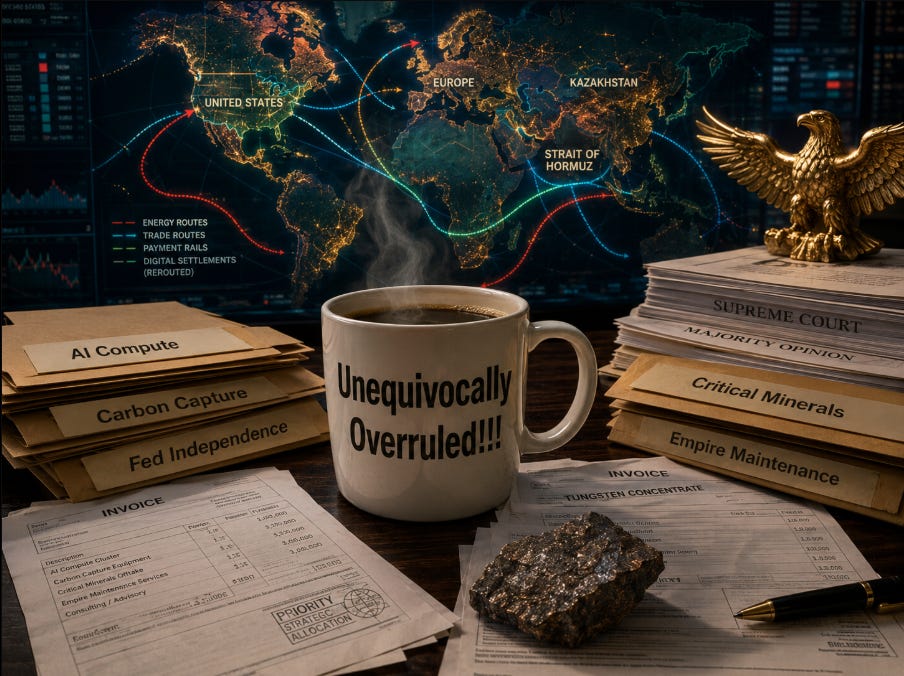
The empire is not collapsing in one cinematic scene. It is being repriced, rerouted, litigated, token-metered, carbon-captured, and quietly bypassed. Coffee up. The invoices are arriving.
where to begin? i am reminded of John Adams' plea or question at the end of the Musical "1776"... "is anybody there? does anybody care? does anyone see what i see?". in his case he was referring to a vision of what the country could be... were he alive today, he might say (or sing!) those same lines, but referring to a much darker, more ominous vision, what has happened to the country that he and so many others gave their lives and fortunes to build. Ironic also that we stand at the 250th anniversary of our founding, a date that i have looked forward to as a student of American history, and now feel cheated as any mention of that anniversary comes covered with the stench of corruption and self aggrandizement that has become our country today. the anniversary, much like the flag itself has been co opted by a megalomaniacal dictator, where corruption is no longer veiled and dealt with in back rooms, it is now out in the open and flaunted. where the vice president of the country admits that his lies about Haitian immigrants eating cats and dogs were justified to help make his point, where he stated that what Nixon did was no big deal, what the hell?, and would not even make five days of the news cycle today. i am not sure that he really understood that he was condemning the behavior of the current government in its vast corruption far more than trying to trivialize the crimes committed by Nixon. i have always said that what Nixon did was unforgivable, but it masked some of the good things he did. Same for Clinton. future generations will not be able to say that about trump. like far-too-lenient parents, we excuse and forgive... the south rose up in defense of a system that felt one race was "in God's eyes" naturally superior to another, and as such the other race deserved to be enslaved and used as property. we forgave and forgot that part of the country, its rich leaders in particular chose treason to protect their wealth and way of life. for the sake of peace, we forgave. in return we got the whitewash of "the lost cause" and bullshit about states rights... we forgave Richard Nixon, who got a pardon, setting an ugly precedent. We watch now as the oil industry is doing what the tobacco industry did.... lie and manipulate the public's opinion so that they can continue their extraction of wealth. Matt Randolph (Mr. Global) who should be required viewing by any citizen of this country recently testified in front of congress and got little press for it. he reminded everyone that "the US does not produce a drop of oil..." Russia does, Saudi Arabia does, and other countries do, but the US produces nothing. Exxon Mobil, Chevron, Shell etc produce oil in the US. and in the process, lie about the impact on the environment (global warming, fracking, the list goes on...), pay pennies for leases where they can take oil that belongs to the citizens of this country and make scads of money from it, get massive tax deductions from wells (again see Mr. Global post on same) that allow them to deduct far more money than they originally paid for the lease, the equipment, etc. well below the basis of the asset. and lastly, pay very little taxes to the US government. we are well down the list of what oil companies pay in taxes to countries where they drill... but we forgive the tobacco industry, we forgive the oil companies, we forgive the jan 6th insurrectionists, we play nice while people steal from us, pick our pockets, and harm our children, our poor, and our elderly. trump must be a student of history as he has borrowed from the Romans... give everyone a bit of bread and entertainment and they will be happy, he borrowed from Goebbels in how to manipulate mass thinking, borrowed from Mussolini in taking over the press.... and we sit back and take it... we watch as the world highway passes us by, broken down by the side of the road, out of parts out of fuel, victims of our own short sightedness...
It amazes me. Sorta a sci-fi fascination. Since Mary ,Heather , Scott, and a few others are my main squawk boxes or echo chambers..as a few of my other sided friends phrase it (no offense meant at all) I am kept on the edge of my seat. Here is but one sample ..”Yes and Bill Gates, part of the 90% population reduction group, donated millions to the development of tick borne illnesses, to encourage the reduction of meat eaters, and all the while owns a factory that makes fake meat....” since the Alpha Gal issues are running rampant here on east coast/Appalachia, etc. I wondered how to research the ‘news’ aka echo chambers. I have NO stomach for NewsMax or Fox.
Is there “A paradigm shift about to be had “ …? Is it this ‘authoritarianism ‘ in actuality…or something different?
It fascinates me…I’m concerned how much time is being consumed reading, an awful lot is NOT adding up…except for sure …’the bills’.
Amusing? Consuming? It is certainly a bit overwhelming..
I’ve got to go back and read this one again , Mary. I don’t know how you manage this amazing track record…