


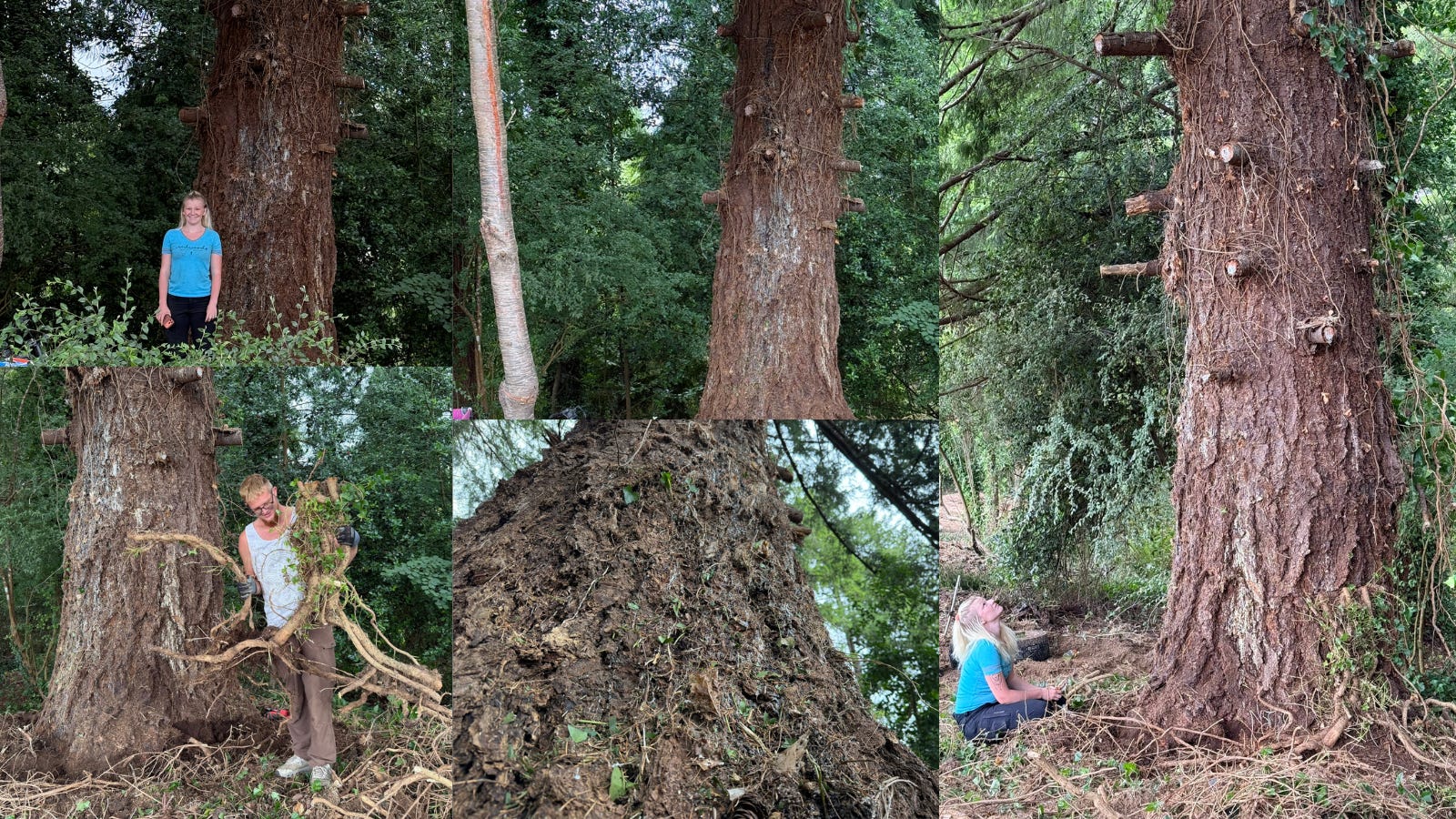
We have a Douglas fir on our property that, by our very rough calculations, may have begun as a seedling sometime around 1750.
We still need exact measurements, and I am trying not to become the kind of person who says “by our rough calculations” about a tree at dinner parties, but the garden has done worse things to my personality than this, so I make no promises. If we are anywhere close, this tree predates the United States. To be fair, it’s entirely possible our calculations are incorrect and it’s a mere 100 years old, but for the point of this metaphor I am choosing the former.
Which means it was already growing before the Declaration of Independence, before the Constitution, before all the powdered men and parchment confidence and national mythology that would later convince a very young country it had invented permanence because it wrote some things down.
The tree was here before America was America in the way we know it today. It was here before this land was divided into deeds, parcels, property lines, tax lots, fences, plats, and all the tidy little paperwork rituals by which a nation reassures itself that ownership is the same thing as belonging.
I don’t own the oldest story of this tree. I hold a deed, which is a very American kind of confidence. But the tree and the land remember farther than paper. The Coquille story reaches deeper than the boundaries drawn around our small piece of it.
So, when I say one of the reasons we wanted this place so badly was because we wanted to preserve the forest, I don’t mean we became its origin. I mean we accepted a responsibility inside a story we arrived to.
That matters here, because this old Douglas fir, this witness tree, this living elder that somehow survived the logging boom, the great burn, development pressure, human hunger, and all the casual violence of a species forever mistaking extraction for destiny, is now being choked by European ivy. It has climbed at least seventy feet up the tree.
The vines are thick enough in places to feel less like vines and more like cables, roots the width of a Coke bottle gripping the bark as if the tree were not a living thing, but infrastructure. The ivy is everywhere.
It is up the trunk, across the ground, through the understory, moving with that smug decorative confidence of a plant that was once invited in because someone thought it made things look civilized. That may be the part that bothers me most, the ivy didn’t arrive as a monster, but rather, as ornament.
It covered walls, softened edges, and made old buildings look older and important buildings look educated. It became the aesthetic of courtyards, brick, privilege, and institutional age, the leafy costume of a culture very committed to looking rooted wherever it happened to land. Then it escaped the role assigned to it.
English ivy, or Hedera helix, is a European forest vine that became invasive in the United States after years of being recommended as a landscape staple, and Oregon State University Extension now describes it as a plant whose spread through seeds causes serious ecological harm. OSU’s forest-land guide says ivy threatens most forest types in the Northwest, dominates understory vegetation, reduces wildlife habitat and biodiversity, and can eventually kill large overstory trees.
That’s the Underground Republic lesson, a thing can enter as decoration and become conquest, a thing can arrive as softness and become pressure, and a thing can make itself look like heritage while slowly strangling the thing that actually has roots.
Which brings me, naturally and unfortunately, to democracy. Before I go any further, this metaphor has to be handled carefully, because I am not interested in turning immigrants into ivy. That is the language of cowards, propagandists, and men who stand on stolen ground with a microphone in one hand and a deportation order in the other, calling other people invasive because history is easier to weaponize when you refuse to remember it. People are not vines, families are not weeds, and children are not infestations.
The mother crossing a border because hunger has become policy where she lives is not English ivy, the father working in a field, a kitchen, a dairy, a mill, a hospital, or the back of a delivery truck is not English ivy, and the asylum seeker, the farmworker, the student, the refugee, the neighbor, the child translating a school form for her parents, or the person who cleans the rooms of people who call him illegal after using his labor, none of them are invasive species.
The ivy in this story is not migration. The ivy is conquest, domination, the ownership fantasy that arrives with documents, weapons, flags, churches, courts, contracts, fences, and the bottomless confidence to rename a world already full of names, and it’s power climbing what it didn’t grow. That’s why the Coquille history belongs in this piece, because the oldest story of the land has to be present if I am going to write honestly about what it means to preserve anything here.
The Coquille Tribe writes that their people have lived in this place “since time began,” and that archaeology has found evidence of human occupation dating back at least 14,000 years, binding the Coquille people to the lands and waters of southwestern Oregon.
That’s older than the fir, the deed, older than America’s entire political imagination, and when the world changed, it changed with devastating speed.
The Tribe’s own history describes European diseases moving through the region after fur traders arrived in the late 1700s, then miners and settlers flooding into Native lands in the 1850s after gold discoveries. It names those newcomers plainly as “trespassers on Indian lands,” and explains that the Coquilles signed treaties under terror and pressure, surrendered lands for promises that Congress never ratified, received no promised compensation, and were forcibly removed from their homelands to be imprisoned on a distant reservation.
There it is. Not migration, but conquest. Not people seeking life alongside other people, but a system arriving to take the land, rename the land, paper the theft, erase the memory, and then call itself native because enough time had passed for the ivy to look picturesque.
This is where the current immigration debate becomes grotesque in a way no serious country should be able to survive without at least blushing. The Trump administration has used the language of “invasion” as official immigration policy language, including in a 2025 presidential action titled “Protecting The American People Against Invasion” and a 2026 White House release celebrating “Ending the Invasion.” A country born of invasion now calls desperate people invaders.
A government built on treaties broken, lands taken, borders drawn over older worlds, and labor extracted from people it refused to recognize as fully human now points at migrants and says the danger is arrival, but the real danger is the kind of power that can’t tell the difference between a person seeking shelter and a system seeking possession. It’s a politics that screams about invasion while standing on stolen ground, wrapped around the trunk of an older living thing, pretending strangulation is tradition.
That is the imported vine. It’s not foreign simply because it came from Europe. There are many things that come from elsewhere and become part of a living system without trying to dominate it.
People do this all the time. Families arrive, adapt, contribute, love, mourn, build, worship, cook, work, teach, learn, intermarry, plant gardens, raise children, pay taxes, start businesses, organize churches, join unions, serve in the military, nurse the sick, harvest the food, and become part of the human ecology of a place.
That is not the ivy in this metaphor. The ivy is foreign to democracy because domination is foreign to democracy, because monarchy is foreign to democracy, because hierarchy disguised as heritage is foreign to democracy, and because a strongman wrapped around the Constitution is still a vine choking a tree.
Trumpism understands this kind of climbing. It climbs the flag, Christianity, the courts, and the military. It climbs “law and order,” “family values,” and “heritage.” It climbs the word “freedom” until freedom itself can barely breathe beneath the weight of men who use it to mean their right to command everyone else.
It didn’t grow the tree, make the roots, survive the storms, or build the living structure it now uses for height. It simply climbed, gripped, thickened, and then began insisting that the grandeur belonged to the vine.
That may be the cleanest political lesson European ivy has to offer. The vine borrows the tree’s height and calls itself majestic, tell me that is not the entire authoritarian project.
Tell me that is not every petty tyrant wrapping himself in the language of founding fathers, border security, Christianity, patriotism, and law while doing everything in his power to hollow out the institutions that make those words mean anything.
Tell me that isn’t Donald Trump, a man who treats the Constitution like a trellis, the presidency like a personal brand extension, the courts like customer service, and the public like a landscaping crew hired to maintain his view.
But this is also bigger than Trump, because the vine didn’t begin with him. He isn’t the first man to use older language as scaffolding for domination. He isn’t the first politician to climb a republic he didn’t love. He isn’t the first American to call somebody else an invader while standing inside the long shadow of invasion. He isn’t the first to mistake possession for belonging.
He is simply the least subtle specimen, which is saying something in a country that once invented manifest destiny and then had the nerve to call it providence. The vine has been climbing for a long time. It climbed through slavery, removal, broken treaties, and Jim Crow. It climbed through exclusion acts, internment camps, redlining, union busting, voter suppression, privatization, deregulation, and every polished legal mechanism that turned living people into obstacles before turning their dispossession into paperwork.
It climbed through polite society too, which is always the part that makes people uncomfortable. Not every vine arrives shouting; some arrive through committees, zoning boards, and bank loans.
Some arrive through school boards, court appointments, think tanks, newspaper editorials, donor conferences, corporate foundations, and very concerned men explaining that cruelty is unfortunate but necessary for order.
Some vines wear suits, some quote scripture, and some say they are just here to restore greatness, which is an interesting thing for a vine to say while tightening around a tree older than the nation itself.
In our forest, the work is physical, there’s nothing abstract about it. You can put your hands around the ivy and feel how long it’s been there. You can see how it has fused and thickened and learned the shape of what it’s strangling. You can look up seventy feet into the fir and understand that a problem can be enormous without being original.
The ivy didn’t create the forest’s beauty; it used it, it didn’t make the ecosystem strong; it found a living structure and turned that structure into a ladder. Removing it is slow work, and it has to be done carefully. OSU Extension recommends a “Life Saver” method for ivy removal from trees, cutting vines around the trunk, clearing ivy three to five feet from the base, peeling vines downward where possible, and allowing the ivy left higher in the tree to die over time rather than recklessly tearing it from the canopy.
That detail matters to me. You don’t save the tree by becoming violent with the tree or by ripping at everything attached to it. You don’t heal a living system by confusing urgency with care, you cut the connection that feeds the strangler, you clear the base, you return for the resprouts, and you accept that the work will take time because the vine has had time.
That is democracy too. The work is not to hate the ivy, it’s to save the tree. The work is not to build a politics around hating migrants, hating foreigners, hating the new, hating the different, hating every arrival that unsettles the fantasy that America has always belonged to the people who currently hold the deed, it’s to recognize domination, wherever it comes from and whatever flag it wraps around itself. It’s to cut away the systems that use democracy as scaffolding while slowly choking democracy out and to protect the roots from the people who only admire the canopy because it gives them something tall to climb.
This is why the Douglas fir feels like a witness to more than the forest. It feels like a witness to the difference between inheritance and possession. Inheritance is responsibility; possession is appetite. Inheritance asks what you owe the living thing that was here before you; possession asks what the living thing can do for you now that you have paperwork.
Democracy, at its best, is supposed to be inheritance, not possession. It’s supposed to be a living system received imperfectly from the past, corrected by the present, and protected for people we will never meet. It’s not supposed to be a dead object one faction can own, it’s not supposed to be a tall thing for authoritarian vines to climb while calling their grip tradition, and it’s certainly not supposed to be a trunk wrapped so thoroughly in nationalism, oligarchy, Christian supremacy, militarism, fossil fuel money, billionaire vanity, and grievance that the living tree underneath becomes almost incidental.
And yet here we are; the vine is everywhere, and now it points at immigrants and calls them invasive. This is the kind of projection only a strangling vine could admire.
The country that arrived as conquest, called it settlement, wrote deeds over older stories, and then spent centuries congratulating itself for civilization now wants to pretend the problem is the person arriving with a backpack, a child, a court date, a prayer, a work permit, a fear of being sent back, or no papers at all because desperation doesn’t always wait for bureaucracy to become humane.
I’m not naive about borders, I’m not pretending immigration policy is simple, I’m not saying every law is illegitimate or every enforcement question is cruelty by definition. I am saying a democracy loses the right to speak clearly about law when it refuses to speak honestly about history, that a country unable to distinguish migration from conquest will keep building policy out of its own guilty conscience, and the people most eager to call human beings invasive are often the people most devoted to the systems that invaded first.
And more simply, I am saying that a republic cannot be preserved by vines that only know how to grip. The Douglas fir doesn’t need ivy to be majestic, it was majestic before the ivy arrived. The Coquille story didn’t need American recognition to be real, and democracy doesn’t need authoritarianism to make it orderly. The tree doesn’t need the vine, you see, the vine needs the tree. The imported vine always needs something older, stronger, and more legitimate than itself to climb. It needs the tree because it can’t become a forest.
This is why preservation matters. Not preservation as nostalgia, and not preservation as the fantasy that the past was pure before the wrong people arrived. The past was not pure, the tree grew through violence, the land holds grief, and the forest survived human beings who took and burned and cut and mapped and sold and renamed.
Preservation can’t mean pretending the old story is simple. It has to mean refusing to let the living thing be strangled further, protecting what remains while telling the truth about what was lost, understanding that care is not innocence, and stewardship is not ownership, and love for a place does not erase the fact that others belonged to it before you knew its name.
That is the part I want to carry carefully. My family wanted this place for the memories, but also because we wanted to preserve the forest. Neither the forest or the story begin with us. The tree’s life doesn’t become meaningful because we noticed it.
The best we can do is arrive humbly, tell the truth, cut what is choking it, protect what is living, and teach our children that love is not possession. And maybe that is the democratic lesson too, we don’t own the oldest story of this country.
No party, no president, no court, no billionaire, no man in a red hat, and certainly no administration using the language of invasion while standing in the long aftermath of conquest does. We hold, at best, a temporary responsibility inside a story older and deeper than our paperwork. The republic isn’t ours because we can possess it, it’s ours only insofar as we are willing to preserve what keeps it alive.
That means cutting away the vines that use democracy as a trellis for domination, refusing to let authoritarianism call itself heritage, refusing to let white nationalism call itself border security, refusing to let cruelty toward immigrants become the costume a guilty nation wears to avoid looking at the conquest beneath its own feet. It means knowing the difference between people who arrive seeking life and systems that arrive demanding ownership. It means remembering that not everything green is growth, not everything old is native, not everything wrapped around the trunk belongs to the tree, and not everything that calls itself American is loyal to democracy.
The work is slow, the ivy will resprout, the vines higher in the canopy may take time to die, the forest floor will need clearing, the roots will need room, the tree will need years, but the tree is still alive.
That is the fact I keep returning to. After everything, the tree is still alive. Older than America, rooted in Coquille land, scarred by history, and wrapped by an imported vine. It’s still standing, still worth saving, still carrying a canopy large enough to remind us that survival is not the same thing as surrender.
So, we will keep cutting, keep clearing, keep coming back for the resprouts, we will try not to damage the bark in our urgency, and we’ll remember that the point is not to hate the ivy. The point is to save the tree.
And if this country has any future worth preserving, that future will not come from the people calling their neighbors invasive while wrapping themselves around a republic they don’t intend to keep alive.
It will come from the people who know the difference between arrival and conquest and the people who understand that democracy is not a deed; it’s a living thing.
And living things, if we love them, require more from us than ownership. They require care.
Most difficult part of discovering this incredible piece of pure Truth is realizing that I don't have a clue how to get this disseminated in a way that it will eventually reach 60 million voters in the next 3 months, at least half of them thinking the "Party of the Vine" was a solution to whatever personal problem they had with the government.
This is a stellar essay. I wish everyone could read and share it.