


Good morning! On Saturday in Georgia, Donald Trump bragged that his war with Iran has America “making a freaking fortune” on oil. On Sunday in Michigan, he returned to a consolation he’s offered before: he’d expected gasoline prices to double or triple. We’re supposed to be grateful that the catastrophe he imagined was worse than the one we’re living through.
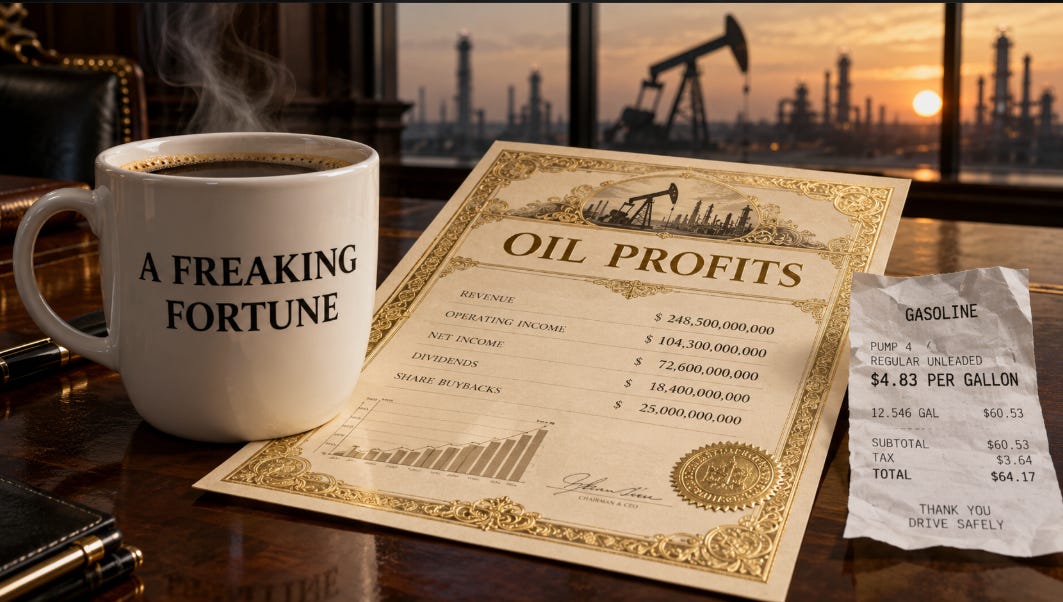
It’s a classic Trumpotato: take a real cost, compare it to a much bigger catastrophe that never happened, and declare the difference a victory. Instead of comparing today’s prices with what Americans paid before the war, Trump measures them against a disaster of his own imagining. And by admitting he expected gas prices to soar, he concedes the pain at the pump was a foreseeable cost of his decision, one he calls a “small price to pay” and says he doesn’t regret.
The oil producers are making a fortune. The drivers are paying for it. And somehow both have been folded into the same “we.”
Start with the pump. Before the war began in February, a gallon of regular averaged about $2.98 nationally. It’s now about $4.28, and in Michigan, where Trump spoke Sunday, closer to $4.83. The country has just set a record for the most days in a calendar year with gas above $4. For a family filling a 15-gallon tank once a week, the increase works out to roughly $20 per fill-up, or about $1,000 a year if prices stay where they are. No economist is needed to see it. The gas station, at least, has the decency to post the damage in foot-high numbers.
Tariffs are less courteous. They rarely appear as a separate charge on your receipt; they’re folded into the price of the part, the appliance, the truck. In April 2025, Amazon’s bargain-shopping division considered showing customers how much import tariffs were adding to certain products. The White House called the idea a “hostile and political act.” Trump personally called Jeff Bezos to complain, and Amazon announced that the proposal, which it said had never been approved, wasn’t going forward. Apparently, paying the tariff was acceptable. Knowing you were paying it was another matter.
Michigan importers incurred an estimated $23 billion in tariffs from Trump’s executive orders through June, equivalent to $5,619 for every household in the state, the highest per-household figure in the country. That’s a measure of the state’s import burden, not a literal bill paid by each Michigan family. Some costs are absorbed by businesses, and others spread through national supply chains to customers elsewhere. But the money is being collected, and American buyers bear a significant share of the expense. The figures also predate the 50% tariffs on certain Canadian goods that took effect in August, in a state that shares a border, a bridge and an auto industry with Canada.
Which brings us to the $5,000.
Trump has promised a “Trump dividend” of $5,000 to every adult citizen if Republicans hold both the House and the Senate. Asked how he’d pay for it, his answer in Port Huron was that “we’re taking in massive amounts of money through tariffs.” Translate the pronoun and the arrangement becomes clearer. American importers pay the tariffs, businesses pass along some of those costs, and consumers encounter them in higher prices. Now Trump is offering to give Americans some money back, provided they return his party to power.
It’s a customer loyalty program with an unusual set of rules: first management raises the prices, then it promises cash back if the customers vote to keep management.
The rebate isn’t guaranteed either. The checks would cost roughly $1.2 trillion, far beyond projected tariff revenues. Congress would have to approve them, and some Republican lawmakers have already questioned the cost and the financing. It follows the DOGE dividend and the $2,000 tariff checks, earlier promises that never materialized.
So here’s the deal on offer, eight days out: higher bills at the pump, higher prices at the register, and a possible $5,000 rebate after the election.
Terms and conditions apply. Congress hasn’t agreed to them, and the previous checks are still in the mail.
If the pump is where Americans meet the bill, the rally is where Trump avoids it.
Over the past week he held seven rallies in seven states, from Wichita on Monday to Port Huron on Sunday, and spoke for more than eleven hours. The Wall Street Journal had reporters at every stop. Their account reads less like campaign coverage than like a portrait of a man taking shelter.
The official rationale is turnout. Back on October 1, a Republican official told Semafor that the red-state itinerary was built to reach several media markets at once and coax out the infrequent Republican voters who show up for Trump but skip midterms. Someone close to the White House offered a shorter explanation: “I think they want big rallies.”
Both can be true. The itinerary serves the campaign; the format serves the president. According to the Journal’s reporting, his advisers see the rallies as a security blanket, a break from the job, the coverage and an approval rating lower than any president’s heading into a midterm in the paper’s polling since the 1990s. After the shows, he asks aides which parts they liked best. The Journal even contemplated whether the Trump show was appearing for perhaps the final time, with his decade-long political dominance beginning to sunset. That’s a notable observation from a newspaper eight days before an election.
What fills those hours says the rest. In Wichita he told the crowd at least ten times that nobody appreciates him. He keeps returning to the cognitive test he says he aced. In Georgia on Saturday, he declared Barack Obama’s Detroit rally “empty.” In Michigan on Sunday, it became “sparse.” More than 4,300 people attended Obama’s event. Trump wasn’t among them, but apparently felt qualified to take attendance.
Even longtime allies are commenting on the grueling schedule. Mike Lindell told other Trump supporters that the president looked “the tiredest I’ve ever seen him.” Sen. Tim Scott’s reassurance was that perhaps Trump was “a little cyborg.” Apparently we’ve reached the science-fiction portion of the campaign.
And when dissent breaks through the applause, the atmosphere can turn uglier. At Clemson, a rallygoer struck a protester in the middle of Trump’s speech. The president’s response from the stage was “That was incredible! Wow, that was unbelievable.”
Some Republicans worry the spectacle will motivate Democrats as much as their own base. In Michigan, you could watch that tension play out live. Mike Rogers and John James have both called for an end to the Iran war and a resolution of the trade war with Canada, two issues weighing heavily on Michigan families and businesses. Yet on Sunday, they stood alongside Trump while he defended higher gasoline prices as a “small price to pay.”
For two candidates trying to put some distance between themselves and the president’s policies, the distance on Sunday was measured in inches.
The crowd was enthusiastic about Trump’s economic promises. But in Michigan, he offered something more consequential than another promise about money. He offered his own definition of who deserves to be called an American.
Eleven hours is a lot of airtime, and not all of it survives contact with the record. A few examples from Port Huron alone:
Inflation. Trump told the crowd inflation has run at 1.7% for the last three months. The most recent consumer price report, for September, put annual inflation at 3.7%, up from 3.4% the month before, with prices rising 0.6% in a single month. Even core inflation, which excludes food and energy, was 2.6%. None of those figures resembles the number Trump offered.
The clinic. Trump called Abdul El-Sayed “a fake doctor” who runs “the worst clinic in the entire country of America.” El-Sayed holds a medical degree from Columbia and a doctorate in public health from Oxford. He chose public health over clinical practice, which is why he never completed a residency or obtained a medical license. He served as health director for Detroit and Wayne County. Bridge Michigan found no evidence he has ever run a clinic anywhere. Apparently, the worst clinic in America has no address.
The name. Trump repeated his demand that Rep. Ilhan Omar resign for being sworn in under a “fake name,” after federal prosecutors referred to her in a court filing as “Ilhan Nur Said Elmi, a/k/a Ilhan Abdullahi Omar.” The filing gave no explanation for the alternative name. The federal investigation is real, but Omar has not been charged, and a name appearing in a court document is not a finding of identity fraud. Omar says her name has always been Ilhan Omar. Trump’s accompanying claim that she married her brother remains an allegation she has repeatedly denied and that has not been established by evidence made public.
Then came something more consequential than a false number or an unsupported accusation.
The birth certificate. Trump had compared stopping El-Sayed’s election to the resistance aboard United Flight 93 on September 11, 2001. He told voters to cast their ballots “for Todd Beamer,” the passenger who helped lead that resistance, then invited Beamer’s father, David, onto the stage.
David Beamer called members of Democratic Socialists of America “local terrorists” and described them as enemies among us. Then he went further. El-Sayed, he said, has a birth certificate showing he’s a citizen, but a birth certificate doesn’t make you an American. He has red blood, Beamer told the crowd, but has chosen to remove the white and the blue.
That’s an argument that a native-born citizen, born in Michigan, running for office in Michigan, can be declared a foreign presence in his own country because of his politics and insinuations about his faith. Beamer even warned that Americans must not allow El-Sayed to “invade and occupy” their country.
This was delivered at a presidential rally by the father of a September 11 hero. When Beamer finished, Trump thanked him and told the audience that his son was looking down, proud of his parents.
In Michigan, a birth certificate wasn’t enough. In Brazil, neither was a completed vote count.
Luiz Inácio Lula da Silva won a fourth term Sunday night, beating Sen. Flávio Bolsonaro 51.79% to 48.21%, a margin of about 4.4 million votes. Bolsonaro told supporters it was “impossible to recognize the election result” and said he would ask the courts to annul it, pointing to a Supreme Court justice’s decision to extend voting by two hours. An inconvenient detail: Bolsonaro’s own campaign had also requested extended voting hours in areas affected by severe weather.
If the script sounds familiar, it’s a family heirloom. In 2022 his father, Jair Bolsonaro, lost to Lula and his party went to court claiming faulty voting machines. Brazil’s electoral court threw the challenge out and fined the party roughly $4.3 million for bad-faith litigation. The elder Bolsonaro is now serving a sentence of more than 27 years, currently under house arrest, for plotting a coup.
Watching from Paris, France 24’s international affairs commentator Douglas Herbert drew the line straight to Washington. Bolsonaro’s refusal, he said, mirrors what many fear is coming in the U.S. midterms, and much of it is arguably already underway.
The evidence is on the record. In July, Trump claimed a DHS review had identified approximately 278,000 noncitizens on the voter rolls of four states. Nevada’s share was supposedly “as many as” 15,903. Weeks later DHS described that number as a ceiling and supplied the state with 185 voter identification numbers. Nevada officials examined the corresponding registration records and found that all indicated American citizenship. They asked DHS for the underlying identifying information needed to verify its allegations. The department didn’t provide it.
California got the sequel. Over the summer the administration alleged that some 190,000 noncitizens were registered in the state. This month, with ballots already being mailed, the Justice Department delivered a password-protected thumb drive to Los Angeles County, accompanied by a handwritten password on a sticky note. It said the drive contained names of suspected noncitizens, gave state officials 48 hours to investigate, and demanded that ballots associated with unverified registrations be set aside. Then it sued to stop roughly 20,000 ballots from being counted pending citizenship verification.
That’s about 0.09% of California’s 23.2 million registered voters. The earlier allegation involved nearly ten times as many people. The scale of the claim changed considerably. The urgency only increased.
On Sunday, two judges on a federal appeals panel questioned the government’s authority to demand that California segregate the ballots.
And in Alaska, the Justice Department has already asked a federal judge to delay certification of the Senate election under certain circumstances if Republican incumbent Dan Sullivan loses. The administration claims that another candidate named Daniel Sullivan could confuse voters. Alaska’s Supreme Court previously allowed the second Sullivan to remain on the ballot. Trump has acknowledged ordering the federal lawsuit.
Trump supplied his own narration in Port Huron. He warned the crowd about “cheating vote counters,” told them to “watch it” with Jocelyn Benson, and said “you got to watch all of those Detroit votes.” His previous allegations about Michigan’s 2020 election failed to establish fraud sufficient to overturn the result.
Federal Justice Department monitors observed voting in four Michigan cities during August’s primary, without significant disruptions reported by state officials. Seven cities will have federal monitors on November 3. Monitoring itself is a longstanding practice, but those observers are not permitted to interfere with voters, ballots or election equipment.
Election experts have warned that the days after polls close may be particularly vulnerable to misinformation. Stephen Richer, the Republican former recorder of Maricopa County, has explained how close elections and slow vote counting create opportunities for conspiracy theories. California, with its lengthy ballot-counting process and competitive congressional districts, presents an obvious target.
Retired federal judge J. Michael Luttig has warned about a later, hypothetical chokepoint: January 3, 2027. He argues that an outgoing House speaker could attempt to replace the clerk responsible for preparing the roll of members-elect, potentially excluding duly elected representatives before the new House chooses its speaker. No such plan has been established, but Luttig is urging lawmakers to commit publicly to honoring certified results.
Here’s what Brazil demonstrated on Sunday. A defeated candidate can reject the result, announce a court challenge and insist that the rules were unfair. But allegations still have to survive contact with the evidence.
Brazil’s electoral data show that roughly 34,000 votes were cast after the original closing time. Lula won by more than 4.4 million. Even if every one of those late votes had gone to Lula, they would account for less than 1% of his margin. Both campaigns had sought additional voting time in affected areas, and the country’s electoral authorities have recognized the result.
None of that prevents Bolsonaro from filing a challenge. It makes the particular argument he’s advancing extremely difficult to reconcile with the arithmetic.
And that’s the distinction worth carrying into November. A decisive margin can make allegations of outcome-changing irregularities harder to sustain, but numbers alone cannot prevent an attempt to challenge an election. The safeguards also depend on officials following the law, courts requiring evidence and the public understanding how votes are counted.
Americans have a role in that process. Early voting is underway in many states, and November 3 is eight days away. Check your registration, know your state’s voting rules and make sure your ballot is cast and counted. And when the count runs long, as California’s often does, remember that a slow count isn’t a stolen one. Election Night projections are not certified election results.
Trump has spent the week asking Americans to believe his promises and distrust the people who count their votes.
Whatever happens on November 3, the count is not his to call.
Excellent summary! Thank you. 🙏