


When we last checked on the president in the high chair, he was clutching a bipartisan housing bill in one sticky fist and demanding that Congress fetch his voting bill binky. The binky never arrived. The housing bill, through the quiet constitutional intervention of adults who anticipated this sort of behavior several centuries ago, is escaping anyway.
On Friday, Donald Trump announced that he would allow the 21st Century ROAD to Housing Act to become law without his signature. He won’t veto it, because that would require taking responsibility for killing it. He won’t sign it, because the Senate refused to pass the SAVE America Act, his preferred bundle of proof-of-citizenship requirements and voting restrictions. Instead, he will stand several feet away from a bill passed 85 to 5 in the Senate and 358 to 32 in the House and pretend that withholding his autograph constitutes an act of statesmanship.
Trump has called the housing bill “a yawn” and “so unimportant” compared with the election legislation he wants. That was the tantrum we covered the first time. But we spent so much time watching the spoon fly across the room that we never looked closely at what was sitting on the tray.
So, let us examine the supposedly unimportant object the imperial baby was willing to hold hostage. The 21st Century ROAD to Housing Act is the broadest federal attempt in decades to address the American housing crisis. It’s not a miracle, a revolution, or a government-built subdivision waiting to appear behind every Walmart. It won’t lower mortgage rates tomorrow, freeze rent, erase anyone’s down payment, or place a charming cottage with mature hydrangeas directly into your online shopping cart.
What it does is far less cinematic and considerably more useful. The bill attempts to make housing easier to build, finance, repair and preserve. It rewards communities that create more homes, simplifies overlapping federal reviews, expands financing for manufactured and modular housing, protects certain rural rental properties, improves access to small mortgages, and supports home repairs and restricts some purchases by large corporate investors.
In other words, it is made almost entirely of the boring administrative work that keeps people from falling through the floorboards. White House economists have estimated that the United States is short approximately 10 million homes. Meanwhile, the median sales price of an existing home reached $440,600 in June, the highest figure recorded in data extending back to 1999.
Behind those numbers are young families discovering that a starter home now requires the income of a minor European monarchy. There are renters whose annual lease renewal has become a recurring medical event. There are elderly people living in houses they own but cannot afford to repair, rural families who can find an inexpensive property but not a lender willing to write a small mortgage, and workers commuting farther from the communities where their labor is needed because the people who pour the coffee, teach the children and staff the hospitals can no longer afford to live nearby.
The bill begins with supply, because the country can’t make housing broadly affordable while treating the construction of new homes as a suspicious activity requiring twelve hearings, three environmental reviews and the personal blessing of every homeowner within shouting distance.
One provision creates a competitive fund for local governments and tribes that measurably increase their housing supply. Communities could qualify by accelerating permits, allowing greater density or changing zoning rules that prevent new homes from being built. Another provision links portions of federal community-development funding to housing production, rewarding places that build faster and applying modest penalties to those that continue treating scarcity as a treasured local tradition.
The federal government is not marching into town halls and replacing every single-family neighborhood with a Soviet apartment block. HUD is being directed to develop guidelines and best practices, while money is used to encourage state and local governments to reconsider policies that make new construction unnecessarily difficult.
There is also a delightfully practical idea buried in the bill: preapproved housing designs. The government could help communities select standard plans for accessory dwelling units, duplexes, townhouses and other modest homes, allowing builders to use designs that have already been reviewed instead of beginning the same bureaucratic pilgrimage from scratch every time. Ten percent of that funding would be reserved for rural areas.
It is essentially a pattern book for housing, which may not stir the blood at a campaign rally, but neither does waiting eighteen months for permission to build a duplex. The bill also directs HUD to establish guidelines for apartment buildings with a single internal staircase of up to six stories. This may sound like a niche architectural debate because it is one, but the two-staircase requirements common in much of the United States can consume valuable space and make small apartment buildings difficult to construct on narrow lots. The point is not to remove fire safety. The point is to determine whether safety can be maintained without requiring every modest apartment project to contain the circulation system of a regional hospital.
Then there are the houses already standing. The Whole-Home Repairs pilot would support state, local and tribal programs offering grants and forgivable loans for significant repairs and modifications. That means roofs, electrical systems, heating, accessibility improvements and the other unglamorous necessities that separate a home from a structure slowly surrendering to the weather.
Another pilot would help communities convert vacant commercial and industrial buildings into affordable housing. Community Development Block Grant funds, long available for various neighborhood projects, could also be used for the direct construction of affordable homes.
These provisions recognize something national housing debates often miss. Not every housing problem begins with an empty lot. Sometimes the home already exists, but the roof leaks, the wiring is unsafe, the heater is failing and the family living inside cannot persuade a bank that preventing collapse is a profitable investment.
The rural provisions deserve particular attention. Many affordable rental properties financed through the Department of Agriculture receive rental assistance connected to the building’s federal mortgage. When that mortgage reaches the end of its term, the assistance can disappear with it, even though the tenants have not suddenly become wealthier and the town has not produced a fresh supply of affordable apartments overnight.
The bill allows that rental assistance to continue after the original mortgage matures. It also permanently establishes a preservation program for aging rural rental housing and directs HUD and USDA to coordinate reviews instead of subjecting projects to duplicative processes. This is what the president called a yawn: keeping rural families from losing affordable homes because a document reached its expiration date.
The legislation also attempts to repair a peculiar failure in the mortgage market. A home can be inexpensive enough for a family to afford and still be nearly impossible to finance. Lenders often avoid mortgages under $100,000 because the labor and regulatory costs are similar to those of a much larger loan, while the revenue is not. The bill authorizes an FHA pilot for small-dollar mortgages, directs regulators to study fee structures that may discourage lenders from offering them and reforms appraisal rules that can create additional barriers.
That matters in rural America, where the housing conversation is not always about a million-dollar bungalow in California. Sometimes it is about a $90,000 home in a small town that a working family could purchase if anyone were willing to write the loan.
Manufactured and modular housing receive similar attention. The bill eliminates the permanent chassis requirement for manufactured homes, raises certain federal loan limits, supports repairs in manufactured-home communities and directs HUD to identify barriers facing modular construction. It also expands the possible use of FHA-backed property-improvement financing for accessory dwelling units.
Again, none of this produces the commanding television image of a president signing his name in the fattest black marker available. It merely makes less expensive forms of housing easier to build and finance, which is perhaps why the subject couldn’t maintain his interest.
The bill also restricts large institutional investors from purchasing additional single-family homes if they control at least 350 of them. This provision is meaningful, but it is not the triumphant expulsion of Wall Street from the neighborhood. Corporations won’t be forced to sell the homes they already own. The bill includes exceptions, including purchases or construction intended specifically for the rental market, and it doesn’t abolish build-to-rent developments. It places a barrier between families and some of the largest corporate buyers competing for existing homes, but it doesn’t end corporate landlordism.
That distinction matters because the bill deserves to be understood. It won’t solve every cause of the housing crisis. It doesn’t lower interest rates, resolve construction-labor shortages, control insurance costs or make stagnant wages catch up with decades of rising rents and home prices. Some of its pilot programs and grants will depend on future funding, competent rulemaking and local governments choosing to participate, because even good legislation must survive contact with the agencies and officials responsible for carrying it out.
This is not the housing equivalent of penicillin. It’s a well-stocked repair kit delivered to a building that has been allowed to decay for years.
That’s precisely why Trump’s contempt is so revealing. The bill is not a socialist seizure of the suburbs. It was assembled from dozens of proposals supported by Republicans and Democrats, including Senate Banking Committee leaders Tim Scott and Elizabeth Warren, along with House Financial Services Committee leaders French Hill and Maxine Waters. It cuts regulations, relies heavily on private construction, preserves existing programs and uses federal incentives rather than direct national control of local zoning.
This is the sort of market-oriented, bipartisan legislation a Republican president would ordinarily sign beneath a banner while claiming that nobody had ever built a house before he arrived.
Instead, Trump tried to use it as leverage for an election bill that serves his political mythology. When the Senate refused to comply, he decided housing was “a yawn.” Of course it’s boring to him.
Democracy is full of boring things. Inspection rules, rural rental contracts, appraisal standards, environmental-review coordination, manufactured-home financing and grants for local permitting offices are all spectacularly boring. They are also the small structural beams holding up ordinary life.
Government is not only the dramatic moment when a president points at an enemy, signs an order or promises national resurrection beneath stage lighting. Much of government is maintenance. It’s preventing a disabled veteran’s benefits from disqualifying him for housing assistance. It’s helping a family repair a dangerous electrical system. It’s allowing a renter to move into an inspected apartment without waiting for the government to inspect the same apartment again. And it’s keeping an affordable rural building affordable after the original mortgage expires.
These things don’t chant a president’s name, salute him, or appear on television and thank him for his tremendous courage.
They only help people live. That’s why the imperial baby couldn’t see their value. The bill addressed an emergency outside his own body, one that would continue whether he was pleased or not. It asked him to perform the most basic presidential task, to recognize that other people’s needs remain real even when Congress has declined to fetch his favorite toy.
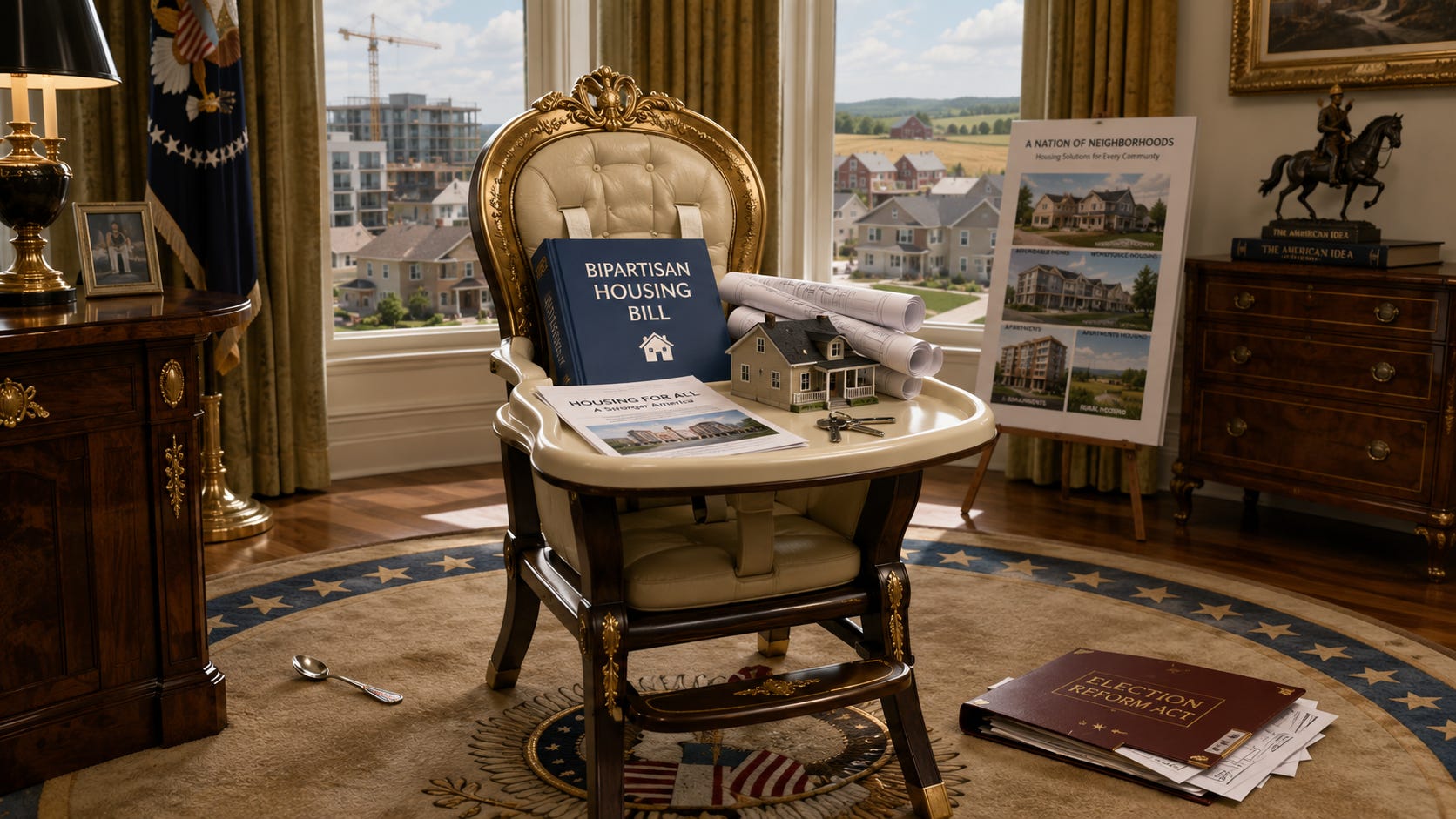
This time, the country got lucky. The bill doesn’t require his signature to become law. The larger problem remains seated in the high chair.
A republic cannot rely forever on constitutional furniture designed to contain one man’s moods. It can’t treat every bipartisan accomplishment as a hostage negotiation, or every public need as a bargaining chip in the president’s private struggle for obedience.
The housing bill escaped his fist, but the rest of the country is still waiting for someone to take away the spoon.
Thank you for the details on the bill.
Thank you, Shanley. Unfortunately, for trump, it has never been about the country he signed on to lead. It has always been about him, and it always will be. "A yawn," indeed.