


A claim hits the air at noon, by dinner it is in the group chat, by midnight it has a slogan, and by morning it is “just common sense.” That is the part most people notice, the speed. The stranger part is what you notice after you have watched it happen a few times. The claim does not have to be true, and it does not have to match itself from one day to the next. It only has to travel. Once you start paying attention to how it travels, you stop thinking of misinformation as a freak accident and start seeing it as logistics. The modern information environment is a freight system for messages that survive compression. Short enough to repeat, hot enough to feel, and clean enough to pass hand to hand without anyone having to open the box and inventory what is inside.
In a functioning democracy, persuasion is supposed to compete on the terrain of reality. Candidates argue over values and priorities, but they do it with one hand touching the same rough ground, shared facts. We can disagree because we are at least loosely looking at the same world. But the system that delivers political information now rewards a particular kind of speech, the kind that arrives intact after being folded into a meme, a clip, a chant, or a caption. That handhold slips, not because citizens changed species, but because the incentives changed.
The first trick is embarrassingly simple and surprisingly powerful.
People do not carry the world around in verbatim form. They carry a bottom line. Literal accuracy, the exact claim, the digit by digit thing that can be audited, competes against gist, the meaning you can hold in your mouth and pass to someone else. The gist is what you feel the statement is doing. The gist is what it says about who you are, who they are, and which side of the story you are supposed to be on.
Trump’s political brand has always been unusually legible at the level of gist. It sells a moral universe in which the little guy has been cheated, elites have rigged the system, and he is the one who will restore dignity to “the forgotten men and women” and make the nation “serve its citizens.”
That gist travels because it is not a policy argument, it is a mood with a villain. It does not require the listener to be able to explain marginal tax incidence or the text of a bill, it requires only recognition. Yes, the system feels tilted, yes, the little guy feels ignored, and yes, someone should break the glass.
Once that gist has lodged, it changes how contradictions land. They stop landing as contradictions, instead they land as details, as necessary compromise, as background noise. You can promise a revolt against the insiders while signing a law that permanently cuts the corporate tax rate to 21 percent, and many supporters will still experience the story as consistent because the gist is doing the moral work. The verbatim details become negotiable because the bottom line has already been accepted as reality.
Now add the second ingredient, the one that makes the whole thing feel like a conspiracy even when nobody has to coordinate, the future can be used as a shield.
Beth Anne Helgason and Daniel Effron studied what they call prefactual thinking, imagining how a falsehood might become true later, and their research shows people can give dishonesty a moral pass when they can picture the lie “coming true” down the road. In political speech, that translates into a familiar set of phrases that function like a getaway car. “Just wait,” “You will see,” “It is coming, the truth is about to drop.”
Notice what those lines do, they do not argue evidence, they simply postpone evidence. They turn skepticism into impatience, and accountability into bad manners. They convert a present day question, why are you saying something that is not supported now, into a loyalty test, why are you not willing to wait with us. At that point, the claim is no longer anchored to proof. It is anchored to anticipation.
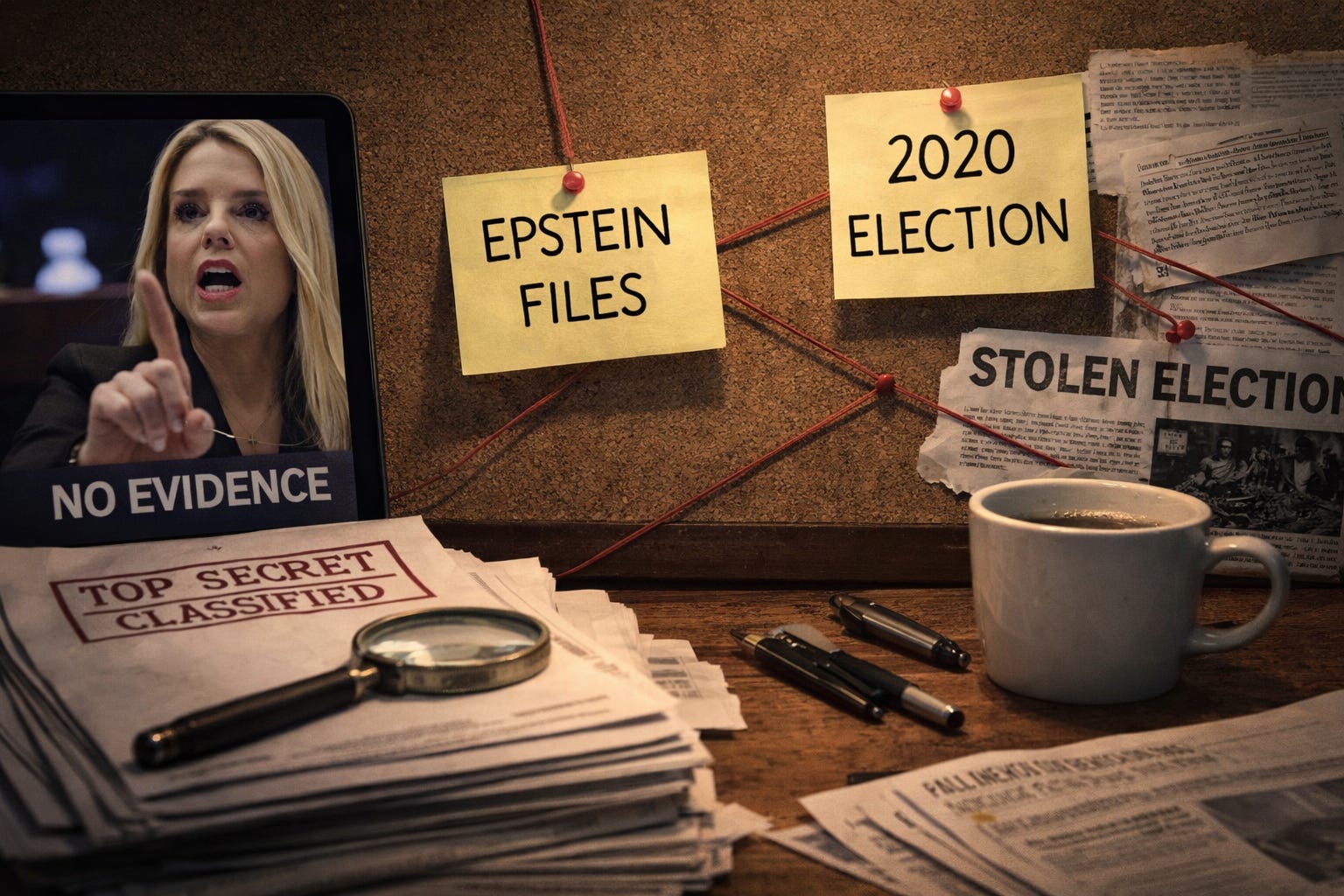
Then the delivery system takes over, repetition. Repetition is not just a rhetorical habit; it is a transport protocol. It turns a claim into background weather and lowers the cost of entertaining it while raising the social cost of rejecting it. It makes the conclusion feel preloaded, like something you already knew. If you want to see repetition working as a machine, the recent Epstein files episode and the 2020 election narrative rhyme in a way that is hard to unsee. They are different stories with the same logistics.
Start with the Epstein files atmosphere. The subject matter is combustible by default, there is a fog of redaction, process, delay, and controlled access. That fog is not itself evidence of wrongdoing, but it is excellent fuel for story making because uncertainty is a renewable resource. In February 2026, the story became even more charged when photos from a House hearing showed Attorney General Pam Bondi holding a document that appeared to be a lawmaker’s Epstein file search history, and the Justice Department acknowledged it logs lawmakers’ searches in the secure review process, prompting bipartisan outrage and accusations of surveillance.
That is not a small detail, it is the kind of detail that creates a mood faster than any PDF can. The process itself becomes suspicious, and the referees start to look like participants. Even if there is an administrative rationale, logging searches to protect victim identities, the visual is what travels: the government is tracking what you look at.
Now watch how repetition functions inside that fog. The public does not receive the Epstein story as a neatly labeled evidentiary file, it receives it as fragments and vibes and competing summaries. In that environment, the most valuable asset is not nuance. It is the portable line that closes the case in one breath.
That is why Trump’s move in the Epstein episode is so revealing. He publicly framed the new release as exculpatory, saying it “absolves” him. “Absolves” is not a legal argument, it is a verdict shaped like a slogan, a prepackaged conclusion that can be repeated even by people who never read a page. Once that verdict is in circulation, every new detail is filtered through it. If something looks bad, it is “taken out of context.” If something looks unclear, “the real proof is coming.” If the promised proof does not arrive, the explanation is already waiting. “They buried it.” “They hid it.” Or “They destroyed it.” That is the self-sealing loop. The claim is protected by the future, and repetition keeps the future feeling close.
Now compare that rhythm to the 2020 election narrative. Election security officials and partners issued a joint statement on November 12, 2020 calling the election “the most secure in American history,” noting no evidence voting systems deleted votes, lost votes, changed votes, or were compromised to change results. Yet the “stolen election” claim persists because it is not trying to win in court, it is trying to win in circulation.
Here is the shared dynamic with Epstein: the more procedural and technical the official response becomes, the less portable it is. Institutions speak in paragraphs and timelines, while the traveling narrative speaks in chants and insinuations. The correction is slow, it requires attention, and it is emotionally thin. While the slogan is fast, it requires no attention, and it feels like belonging.
In both stories, repetition does a specific kind of work. It turns uncertainty into a habitat, makes “maybe” feel permanent, and it keeps the claim alive not by proving it, but by keeping it present.
Now shift the illusory truth effect to where it fits best, not as a repeat of repetition itself, but as the psychological mechanism that helps explain why certain repeated claims begin to feel like settled reality. Research on the illusory truth effect finds that repetition increases perceived truth, often because repetition increases processing fluency and familiarity, and the brain treats that ease as a clue. This is where Trump’s economic claims are the cleanest demonstration because they show how familiarity can start doing the job evidence used to do.
One of his most repeated boasts is a superlative that is engineered for fluency: “the greatest economy in the history of our country.” The Washington Post Fact Checker documented the repetition of that claim and challenged it on historical benchmarks. The point here is not to litigate a single line. The point is to notice how repetition turns a boast into a baseline. After enough cycles, the phrase stops sounding like a claim and starts sounding like a fact you are supposed to already know.
That is the effect in political clothing. The more often the audience hears the line, the more cognitively available it becomes. The easier it is to recall, the less effort it takes to accept. The less effort it takes to accept, the more normal it feels to repeat. And once it is normal to repeat, dissent begins to feel like you are violating a social expectation, not contesting an empirical statement.
This is also why the system can feel conspiratorial without needing a central planner. You can watch the same language migrate. A phrase appears in a speech, then it appears in a clip, then in a caption. Then it appears in a supporter’s mouth, then in an opponent’s mouth, repeated only to criticize it, which still increases familiarity. Repetition does not require agreement; it only requires exposure.
Scale matters here. The Washington Post Fact Checker database counted 30,573 false or misleading claims by Trump while in office from 2017 to 2021, many repeated across rallies, interviews, and posts. That number is not just trivia, it is a hint about the strategy. Volume increases the odds that something sticks. Repetition increases the odds that sticking feels like truth.
The most unsettling part, once you see it, is that the contest is no longer primarily over which claims are correct. It is over which claims become the easiest to hold in the mind and the safest to repeat in public. The claim that wins is often the claim that travels best through social space, through identity, through anger, through humor, and through fear.
Correction competes at a disadvantage because it is not built to travel. It is longer, slower, and less satisfying. It asks you to do the one thing the platform economy punishes, stop and pay attention. It asks you to be a boring person in a system that rewards performance.
That does not mean nothing works. It means the interventions that work often look like friction rather than persuasion. It means making accuracy salient at the moment of sharing, before the vibe takes the wheel, because a lot of misinformation spread is driven not only by belief but by attention and social signaling.
And it means learning a specific kind of investigative literacy. Not just “fact check everything,” because nobody lives that way, but learning to recognize when you are being asked to accept gist over verbatim, when you are being asked to excuse a claim because it might become true later, and when you are being asked to treat repetition as evidence.
Because leader selection is partly reality selection. A democracy does not require perfect truth, but it does require a shared commitment that verbatim reality matters enough to discipline rhetoric, and that no leader is entitled to substitute repetition for proof. Repetition is cheap, while verification is expensive, and if we keep allowing the system to starve the institutions that do verification, we should not be surprised when the cheap thing wins.
If you want to fight a machine built to travel, you do not beat it with one perfect rebuttal. You beat it by changing what you reward and what you refuse to pass along. Support independent media and investigative reporting with what you can, subscribe, donate, share their work, and defend them when they get smeared, because watchdogs are how reality keeps a budget. Keep your voice loud in the places that matter most, the group chats, the meetings, the local elections, the moments where silence gets mistaken for consent. Slow the freight down, ask for the document, ask what would change your mind, and do not let “just wait” substitute for proof. Stay smart, stay stubborn, and do not let a psychological game choose your leaders for you.
Thanks for sharing the research and your brilliant analysis!
Dear Shanley,
Stay smart. Stay stubborn. You said it.
I believe it. Hal