


The federal government appears to be approaching the basic requirements of a functioning country with the energy of a contractor who has removed three load-bearing walls and would now like to discuss the exciting potential of your open floor plan. We are in court over whether ballots will get counted, preparing to weaken power plant climate protections, and asking rural hospitals to imagine a brighter future while they worry about keeping the lights on.
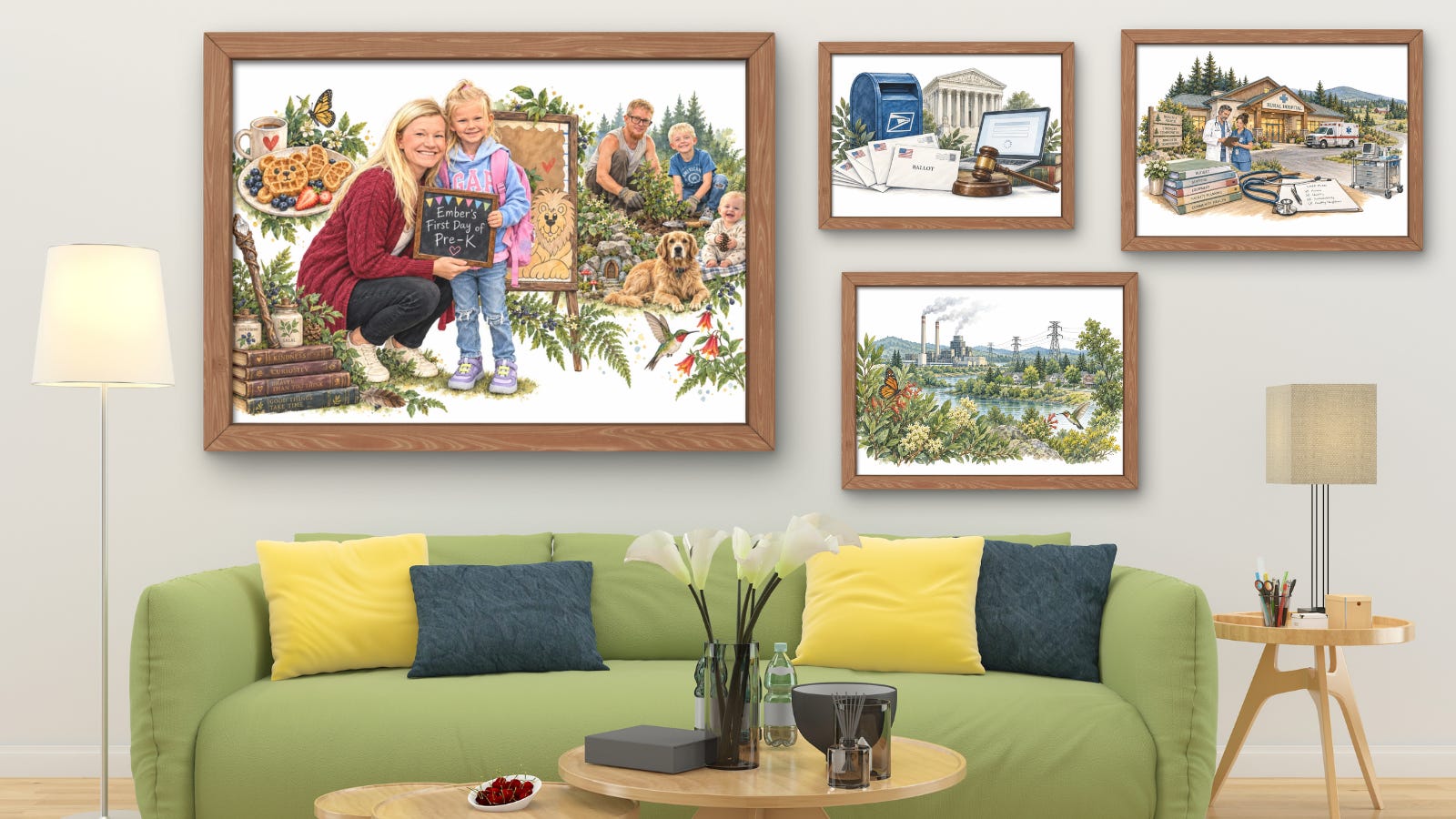
Meanwhile, I’m trying to get a child to Pre-K and establish a small woodland wizard residence, which feels like a fairly reasonable contribution to civilization. This morning was my daughter’s first day of Pre-K, and it was marvelous. I made her waffles with butterflies and bears on them, she woke up excited, got dressed, and let me do her hair with minimal fuss, a level of international cooperation that deserves recognition. There were adorable photos, there was a sign I made, and there was my little girl heading into another chapter while I tried to behave normally about the passage of time.
Ezra was his usual happy self, although he seemed determined to avoid naps and explore the full acoustic capacity of his lungs. He is growing into a boisterous little boy, and apparently part of that development involves checking whether his mother can hear him from a neighboring watershed.
Last night, my husband and I spent some time making room for plants and planting them, expanding the native habitat on our little patch of earth. We put evergreen and red huckleberries, salal, and coyote brush at the top of the hill leading down to the fairy garden, which currently consists of some well-placed rocks, one beautiful bed, and a substantial amount of confidence. It still needs work, but luckily, we have time, and I can’t wait to see what it becomes.
We are learning every day as a family, how to show up for each other in the right ways, how to guide each other, how to help the butterflies and hummingbirds, and, most recently, how to weather parchment so our house can look like a wizard’s secret getaway. I am picturing apothecary jars, carved wooden staffs, leatherbound books, and the general impression that someone in this household knows what to do if a traveling knight arrives under a curse.
My children will grow up full of whimsy if it’s the last thing I do, although I would appreciate the utility companies leaving something in the budget for it. Because the bills keep going up. Electricity, groceries, gas, all of it seems increasingly committed to becoming the main character in our lives. Yesterday’s plant shopping was wonderful and absolutely worth it, but we had to take the truck to transport everything, and the truck consumes gasoline with the enthusiasm I would prefer Ezra bring to his naps.
Apparently, making a happy family memory now requires donating several limbs to the god of the underworld, who has diversified into fuel distribution. I’m grateful that we can do these things. We can buy groceries, school clothes, and plants, and there was a time when that kind of breathing room didn’t exist for us. I remember growing up without much money, and I remember raising my children with very little not so long ago, so being able to say yes to something lovely still means an enormous amount to me.
But remembering that also means I can’t look at our improved circumstances and assume everyone else can simply follow us out. There are families still doing the arithmetic I remember, deciding which necessity can wait, while the price of every necessity appears to be training for the Olympics. I don’t think gratitude requires amnesia, and I don’t think being able to afford your own groceries obligates you to stop asking why somebody else can’t.
Which brings me, naturally, to the people currently responsible for maintaining the country we are trying to raise these children in. According to reporting from the Associated Press, Judge Carl Nichols issued an injunction late Sunday blocking the Postal Service’s new mail ballot rules. The requirements include federal approval of ballot envelope designs and uploading voter information into an online portal that, at the time of the reporting, was still inactive. The Supreme Court is considering the administration’s challenge to another injunction, while election officials warn that the changes can’t realistically be implemented before the midterms.
As an Oregonian, I would prefer my ballot travel through the mail without first completing a side quest through an unfinished federal website. Axios reports that Nichols, whom Trump appointed, concluded that Congress had not authorized the Postal Service to make states enroll mail voters in a federal portal or refuse ballots that fail its checks. There may be authority over envelope design, but the judge found the provisions too intertwined to separate.
I managed to produce a first-day-of-school sign without placing anyone’s constitutional rights behind a software launch, although admittedly my project had fewer stakeholders. Underneath the absurdity is something serious: a person can do everything expected of them and still be failed by the system handling their vote. That possibility deserves attention before an election, while there is still time to prevent it. A blocked rule is a meaningful protection, but with litigation continuing, it’s not a reason to stop watching.
Over at the Environmental Protection Agency, the administration has now finalized the repeal of most of the 2024 carbon pollution standards for fossil fuel power plants, including requirements for existing coal plants and new baseload gas plants. The agency also proposed removing the remaining power plant greenhouse gas standards, arguing that Congress did not authorize it to regulate those emissions to address global climate change. That broader proposal still faces public comment and is not yet final.
Whenever somebody announces that a policy will save an industry billions, I would like the next slide to explain where the costs go. Preferably before the celebratory luncheon. This particular rollback concerns climate pollution, but power plants also produce other pollutants that affect the people living around them. In its original analysis of the carbon standards, the EPA projected health benefits from associated reductions in soot-forming pollution, including fewer asthma attacks, hospital visits, and premature deaths.
Those are families with school mornings, too. They have children whose hair needs doing, parents who need to get to work, and grocery lists that don’t become more affordable because somebody has added a medical problem. My husband and I can plant huckleberries and salal, and I love that we’re doing it, but our little hillside can’t assume the regulatory responsibilities of the federal government. The fairy garden is already operating without a receptionist. There’s something deeply exhausting about trying to teach your children to care for the living world while the people with the greatest power to protect it keep describing protection as an unreasonable expense.
And when people need care, the institutions meant to provide it are being asked to perform their own improbable magic. STAT reports today that hospital leaders are disappointed with the implementation of the $50 billion Rural Health Transformation Program, created alongside last year’s enormous Medicaid cuts. Some had hoped the money would help sustain operations and cover financial gaps, but the program emphasizes new initiatives and restructuring, with restrictions on how the money can be spent.
The fund runs over five years, while the Medicaid cuts, roughly $1 trillion nationally, are projected over ten. Those are different timeframes and different pools of spending, but they still describe a government withdrawing substantial support while offering a smaller, temporary program to help rural communities adapt. KFF’s analysis adds a revealing detail: payments to providers for patient care cannot exceed 15 percent of the fund. Other investments can benefit hospitals, but the program isn’t an unrestricted replacement for the revenue they stand to lose.
There are worthwhile ideas here, including workforce development and better technology, and STAT spoke with providers who see opportunities to improve care. I want those improvements, too, but asking a hospital to reinvent itself while it struggles to survive sounds suspiciously like handing someone a vision board while their kitchen is on fire.
Having worked in healthcare quality and compliance, I care about whether the plan actually reaches the patient. Can someone get an appointment? Is there a clinician available? Can a family get help without adding another long drive, another missed shift, and another tank of gas to a situation that is already frightening? Those questions are harder to put on a ribbon-cutting banner, but they’re the questions that matter.
I keep coming back to what we’re trying to do at home, helping our children grow, making room for living things, and building something we hope will last. None of it happens just because we announce that we value family or nature or the future; it happens because we put time, care, and resources behind those words. We should expect at least that much from the people spending our money and writing our laws.
I’m grateful for the waffles, the first-day photos, the new plants, and the chance to build a slightly ridiculous, deeply loved home with my family. I want more families to have enough breathing room for their own version of that, without being bankrupted by an ordinary life or left wondering whether their vote will survive the administrative obstacle course. My children deserve whimsy, and everyone’s children deserve a future that doesn’t require actual sorcery to survive.
A restack does more than you think! Geddry’s Newsletter is supported by readers. If you value independent reporting that connects Washington’s decisions to the lives happening around our kitchen tables, please consider becoming a paid subscriber or restacking this piece.
Awww, God BLESS you and your family and your fairy garden, and your love of whimsy, Shanley! You can't imagine how emotionally nourishing your articles are. And when you blend your experience into the "big" picture, you're right on.
Thank you!