


The federal government should have to bring something better than an unreliable list before it sends agents to question Americans about their eligibility to vote. Twelve days before the midterms, a judge has put limits on that operation, giving us a concrete example of what it takes to protect the right everyone keeps telling us to exercise.
On Wednesday, U.S. District Judge Araceli Martínez-Olguín issued a preliminary injunction restricting DHS election-related field operations and interviews in nine states involving people the agency knows, suspects, or reasonably should suspect are U.S. citizens. The affected states include California, Pennsylvania, Wisconsin, and Washington. Her order is paused until 5 p.m. Friday, October 23, allowing time for an appeal; its restrictions are intended to run through the close of voting on Election Day.
The judge found that nurses’ unions were likely to succeed on their claim that the operation violated protections against intimidating people who help mobilize voters. Flawed data and fear of being wrongly targeted had already caused union members to pull back from election activities. The ruling concerns DHS field operations, a separate challenge within the broader voting fight we covered last week.
Investigating an actual election crime is a legitimate job for the government. Making people afraid to help their neighbors vote because the government might have mistaken them for somebody else is a fairly serious failure of that job. A database can flag something for further checking. It should not be allowed to develop the confidence of a man with a microphone and no follow-up questions.
People are nevertheless showing up. An Associated Press analysis published today, using data through Tuesday, found early voting in Texas up 74 percent compared with the same point in the 2022 midterms. Kansas had more than doubled its early vote, while Maine, North Carolina, and Ohio were each up more than 30 percent. Democrats are trying to flip Republican Senate seats in all five states.
Early turnout can’t tell us who has won an election still underway, but it does tell us people are finding time to participate. That effort deserves better than a system that keeps putting another obstacle between a person and a meaningful say.
Speaking at Catholic University on Tuesday, Elena Kagan criticized Supreme Court decisions weakening voting protections and campaign finance rules, along with its retreat from policing partisan gerrymandering. Her warning about the Court’s contribution to a less functional democracy belongs alongside those turnout figures. Getting people to the polls matters enormously; the rules determining what their votes can accomplish matter, too.
Sometimes the opportunity to ask those questions is a few minutes at a city council microphone, with a babysitter waiting and somebody trying to explain why the roadside cameras make them nervous.
Wednesday’s Washington Post investigation found at least 11 instances of unauthorized access to Flock’s license plate surveillance databases.
One case is documented by the Georgia Bureau of Investigation. In July, investigators arrested Andrae Wright, a former Effingham County Sheriff’s Office employee who still had access to its Flock account. The GBI said preliminary findings indicated that he used it more than 60 times for purposes unrelated to law enforcement between June 15 and July 5. He was working for a district attorney’s office at the time of the alleged offenses and was charged with stalking, misuse of a license plate reader system, computer invasion of privacy, and violation of oath of office.
The question of who can follow a person’s movements deserves an answer before that person has to discover it through a criminal investigation.
In a separate report published Wednesday, 404 Media obtained a July bulletin from the Orange County Intelligence Assessment Center warning California police about possible risks at council meetings concerning Flock. It said no specific, credible threats had been found, while listing potential issues including emotional confrontations, large crowds, media attendance, and online amplification. The bulletin also acknowledged constitutional rights and said its purpose was planning for public safety.
Of course a crowded meeting needs somewhere for people to stand, and threats deserve attention. But a resident who objects to surveillance should be able to arrive with strong feelings and a reporter without acquiring the atmosphere of a developing security incident. For many people, getting to a council meeting is already a significant act of civic determination. They have found childcare, located their keys, and eaten something over the sink. Let them ask about the cameras.
Meanwhile, the families trying to fit civic participation around work and children have received another number to fit into the household budget.
KFF’s employer health benefits survey, released today, puts the average annual premium for family coverage at $28,303, including both the employer’s contribution and the worker’s. The worker’s own share averages $7,471, up 9 percent, or $621, from last year. That is the premium contribution, before deductibles, copays, and other costs of receiving care.
For covered workers at firms with fewer than 200 employees, the average annual family premium contribution is $9,687, compared with $6,840 at larger firms. Having a job that offers insurance doesn’t mean the cost of using the healthcare system has become a small, manageable detail.
There is something particularly American about paying thousands of dollars to establish a relationship in which you will subsequently be asked for more money. I would prefer my family’s healthcare arrangements to sound less like the opening stages of a ransom negotiation.
These are employer plans, which cover almost 157 million people under 65, so this reaches far beyond the people buying their own coverage. The report gives us a fresh measure of how much it costs to remain insured while working, raising children, and trying to keep the rest of a household upright.
Every dollar committed to a premium is a dollar a family can’t use somewhere else. It’s groceries, a repair put off again, a little less room for whatever the children need next. The people asking for our votes ought to be able to explain how they intend to make that easier, with answers substantial enough to survive contact with an actual bill.
Here on the Homefront, the family part of that equation took over yesterday, which brings me to the report that never quite made it out the door.
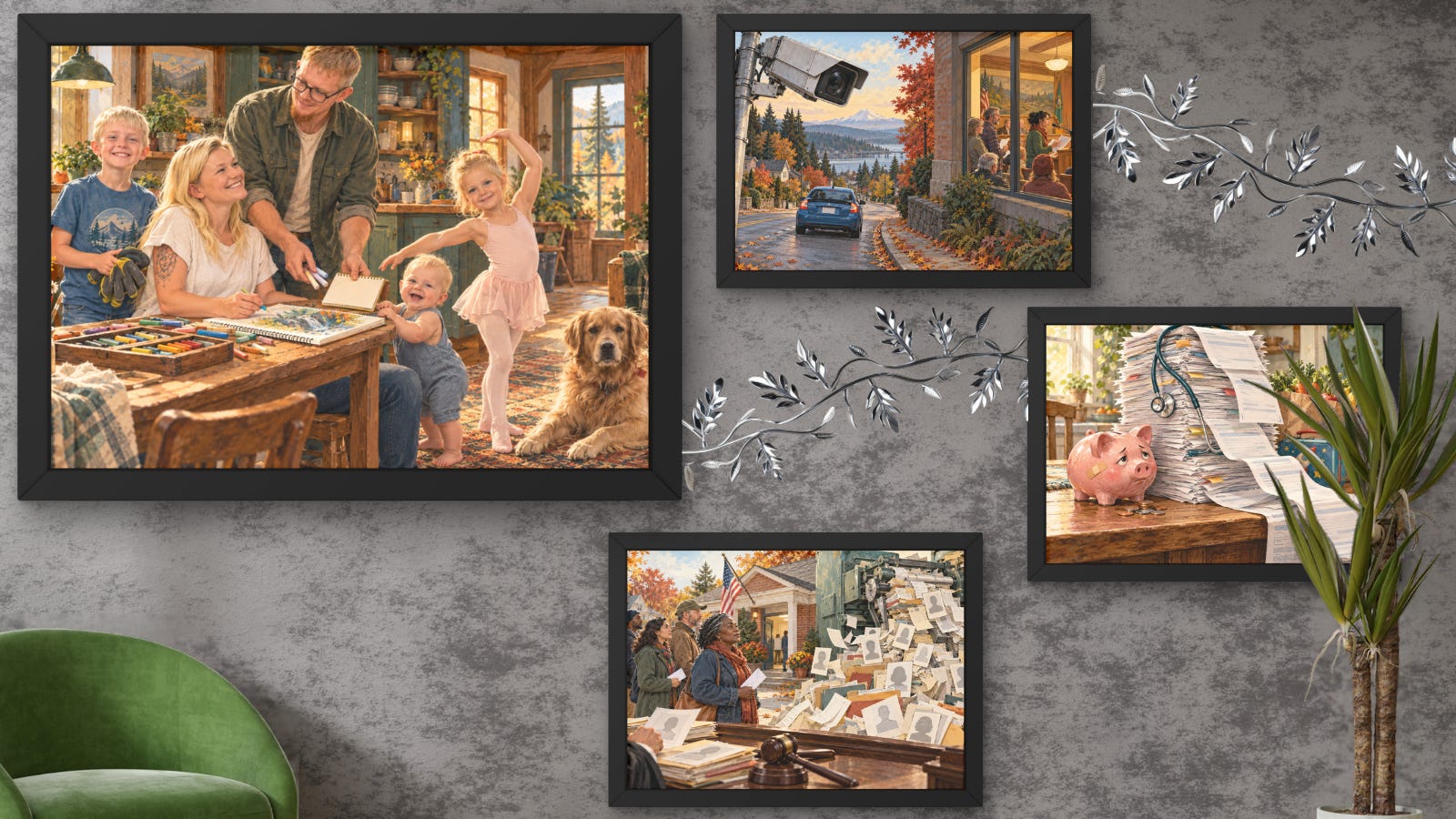
I owe you an apology for yesterday’s missing Homefront Report. The children were fighting, dinner needed making, and somewhere in the general family chaos the evening got away from me. By the time things settled, it was late. I had a report underway and a personal update full of small things I wanted to share, so I’m bringing those along today.
Yesterday was Wednesday. In my brain, it was Thursday, or possibly Friday, or a day that exists only in an alternate dimension where everyone has slept and the laundry folds itself. The pastels have developed a mystical pull. I lie down, close my eyes, and somewhere nearby I can practically hear them whispering, “Shanley, don’t you think this blue would make a beautiful waterfall?”
By the time I have persuaded myself that the waterfall can wait, Ezra wakes up and calls for me in his sweet, adorable, definitely-should-be-asleep voice. Naturally, I come to his aid, because I am apparently available to both babies and art supplies at all hours. Going into Wednesday, it was nearly 3 a.m. before things settled, with a 6 a.m. alarm waiting on the other side. That alarm is very lucky it lives inside an expensive phone. Otherwise, I would kick its ass.
The children were fed, pancakes for one and egg in a basket for the other, and yes, I cut them into cute little shapes. Sleep delirium will not stop me from doing cute things for my children, even if I am the only person at the table appreciating the artistry. My daughter returned to ballet yesterday and loved every minute of it. So did I, although my body would have preferred to express its enthusiasm horizontally.
My bonus son had another encounter that morning with the great bear of responsibility. His gloves were still at his mom’s after switch day, and he didn’t want to ride his scooter to school with cold hands. This information was released to the household at the last possible moment, in keeping with the longstanding childhood belief that adults keep spare time in a cupboard.
Luckily, I had some gloves lying around. His hands were spared the lesson, although we will continue working on the idea that a problem can be announced before departure becomes a sporting event.
As of yesterday, Ezra remained full of snot and congestion, but his eyes were looking much better and he had been without a fever for almost 48 hours. We were moving in the right direction, even if we were bringing a truly unreasonable quantity of tissues with us.
My husband, meanwhile, has been paying attention in that quiet, lovely way of his. I have nearly used up my white pastel stick and kept forgetting to order another. I also mentioned wanting a little sketchpad, something around five by seven inches, for small landscapes. I was simply telling him about a thing I wanted, without expecting him to do anything about it.
Yesterday, four white pastel sticks and the cutest tiny sketchpad arrived.
I had also ordered white pastels two days earlier, unaware that he had already taken care of it, so we are now prepared to depict a considerable amount of snow. The waterfall lobby is delighted.
He has been working away on the exterior of the house, trying to beat the rain, and has been refusing my help because I am exhausted and, admittedly, under the influence of several very persuasive colors. Somewhere between all that work and looking after us, he remembered the small things I had mentioned and made them appear.
I would like to find a way to return that kind of care. If any of you have ideas for a tired woman hoping to surprise a thoughtful man who is trying to finish a house before the weather turns, please let me know. He has earned something lovely.
Overall, the Homefront is happy. We have our problems, our big emotions, our outrageously expensive groceries and gas, and a fairly loose relationship with adequate sleep. But we also have a lot of love, in the little shapes on a breakfast plate, the spare gloves found in a hurry, the baby calling in the dark, and four white pastel sticks ordered by someone who listened.
I would like to see some orange cheese ball try to make that love any smaller. We’ll keep fighting.
If this report gave you something worth thinking about, please share it or restack it so someone else can find us. A paid subscription supports both Mom’s work and mine, including the time it takes to follow a story beyond its first alarming headline. Our newsroom is small, but we maintain a robust division devoted to asking, “Who thought this was a good idea?”
I’m an independent reporter and a mother of three, with a project list the length of our unfortunately green reflecting pool. Between the heat pump, the house exterior, the garden, and the everyday business of raising a family, there is always something competing for the same hours and dollars. Being able to do this reporting independently depends on readers who believe the work is worth supporting.
If you would like to support our family’s projects and adventures, you can chip in here.
Your kindness helps us keep building this home and gives me time to research and write while still being there for my children. I am deeply grateful that you help make room for both. We appear to have the white pastels covered until the next ice age.
Your articles are always a delight, Shanley, and you have NO need to apologize for "missing a day!" Haven't you noticed that some SubStackers only seem to publish once a WEEK? Heavens!
You asked what to give your amazingly thoughtful husband...I bet he just loves your art! Perhaps you could take one of your 5"x7" (I prefer 6"x6", but they've grown hard to find!) sketchbook, and draw something every couple of days, with a few words, (you write so dang well!) like short "prose poems", about how loved it makes you feel when he quietly gives you fresh pastels and new sketchbooks. Or anything he does! Or things you want to always remember, like the kids' quirky thoughts. And give it to him for Christmas. I bet he'd be blown away!
I hope someday you'll share some of your art with us, and also that you are keeping "hard copies" of all your articles. They're as worth publishing as Molly Ivins's were.
And please, take care of yourself!