

America is celebrating Labor Day with an administration that seems deeply committed to honoring workers, provided the honor doesn’t come with enforceable wages or too much say over their working lives. There’s a considerable difference between praising the people who keep a country running and allowing them enough power to protect themselves, and today’s news offers a fairly thorough demonstration.
Yesterday was Sunday, the one day when I at least attempt to take a break from the news and spend some time with my family, and I am pleased to report that the attempt was successful. The sun decided to come out, so my husband and I sat in it while he worked on refinishing a cedar box from my childhood and I broke out the charcoal pencils to try my hand at sketching a waterfall. Ezra supervised from his pack and play, practicing his tossing skills with both balls and any food we made the mistake of assuming he intended to eat. It was wonderful, the sort of ordinary afternoon I wish I could tuck into that cedar box and keep for later.
Today is my oldest son’s last day of summer, although I don’t think that information has fully reached him, considering how happy he appears to be. My daughter, meanwhile, continues her research into the limits of what Mom will tolerate, a field in which she has already accumulated considerable experience. Last night, while I was getting her ready for bed, she told me no, refused to look at me, and launched a vigorous objection to the resulting consequences. Somewhere in the middle of this performance, I noticed the slyest little smile creeping across her cheeks, and I felt several things at once.
The first was fear, because she will clearly rule the world one day; the second was pride, because she is so intelligent and only slightly evil; the third was an urgent need to establish that, while I was both slightly afraid and slightly proud, I remained the boss in this house. So I took her tablet away, a decision she contested through every available level of appeal before finally lying down and falling asleep within moments.
Mommy, 1; baby girl, 5,501, which means the playing field remains uneven, but I am choosing to celebrate the momentum. The important thing is that I teach her to use all that power for good, particularly in defense of people with less of it, rather than taking an entire nation down with her because someone had the audacity to say no. Luckily for us, Donald Trump doesn’t have quite the intelligence of my four-year-old, although his access to resources remains a concern. Which brings me naturally, to today’s news.
Back in the adult world, The Guardian reports that OSHA inspections fell 20% in the months after Trump returned, compared with Biden’s final year. Trump’s March 2025 executive order also sought to exclude broad stretches of the federal workforce from collective bargaining protections, including workers at the Department of Veterans Affairs and the Environmental Protection Agency, invoking national security as its justification.
For home care workers, the Labor Department proposes restoring broader exemptions from federal minimum wage and overtime requirements, including allowing home care agencies to claim exemptions they currently can’t use under the regulations. The department argues that the existing rules make care more expensive, and the proposed expansion remains a proposal, not a completed repeal. Although the regulatory change remains a proposal, the department already instructed its investigators in July 2025 to stop enforcing the expanded home care protections, without changing the underlying legal requirements.
Affordable care is a real and urgent need, but making the person providing it absorb the savings through lower pay is a remarkably convenient definition of solving the problem. The worker helping someone else’s family through the day has a household to support, too, even if that household is less prominent in the administration’s calculations.
For miners, the newer silica protections remain stalled under a federal appeals court’s stay, while MSHA says it continues enforcing the older standards. That distinction matters, because the problem isn’t that every protection has vanished, but that stronger safeguards against dangerous dust have yet to reach the people they were designed to protect. A Labor Day tribute ought to mean that the people doing the work have a better chance of coming home healthy, paying their bills and objecting when something is wrong, rather than simply being thanked for enduring it.
Those bills, meanwhile, continue to feel the pressure of higher fuel costs. AAA’s September 7 national average for regular gasoline is about $4.15 a gallon, the highest recorded for Labor Day, while its September 3 report put Oregon at about $4.98. Diesel has reached an all-time national record of approximately $5.90 a gallon, up about 30 cents in a week. That matters even for families whose cars run on regular gasoline, because diesel fuels much of the trucking and agricultural machinery involved in getting food onto store shelves, and higher operating costs can work their way into the prices households pay. A family doesn’t need to follow maritime security policy to discover that its grocery budget has developed an interest in it.
According to Reuters, Iran said Sunday that it plans to announce a restricted zone outside the Strait of Hormuz, following renewed exchanges of fire, including U.S. strikes on three Iranian tankers. Details remain limited, so this is an announced plan rather than a fully defined new shipping regime. The existing disruption is serious enough without assigning certainty to the next threat.
At home, the administration is also asking the Supreme Court to let it change how mail ballots move through the Postal Service while voting is already getting underway. Reuters reports that the requirements would make states provide recipient lists and put unique barcodes on outgoing and returning ballot envelopes, allowing USPS to refuse delivery of noncompliant ballots or those associated with voters absent from the lists.
The renewed emergency application was filed September 6 after a judge issued a preliminary injunction September 4. Responses are due Wednesday, September 9, at 1 p.m. Pacific, and that deadline isn’t a ruling allowing the restrictions to proceed. Whatever administrative language surrounds this fight, the practical question is whether a voter’s ballot reaches its destination, because a right becomes considerably less useful when the delivery system is permitted to turn it away.
In Ukraine, Sunday’s Kyiv visit by U.S. envoys Steve Witkoff and Jared Kushner hasn’t brought an end to the civilian toll. In Monday’s update, Ukrainian authorities reported at least three people killed and 38 injured in Russian attacks over the preceding day, according to the Kyiv Independent. These are people living through the period being described elsewhere as another opportunity for peace, and their safety remains a more meaningful measure of progress than the description of a meeting.
Germany also caught my attention this morning, although I should be clear that I grew up in the United States and German politics is something I’m still learning about. After reading about Sunday’s election in Saxony-Anhalt, a state in eastern Germany, I spent some time looking into who had won and what they were proposing to do.
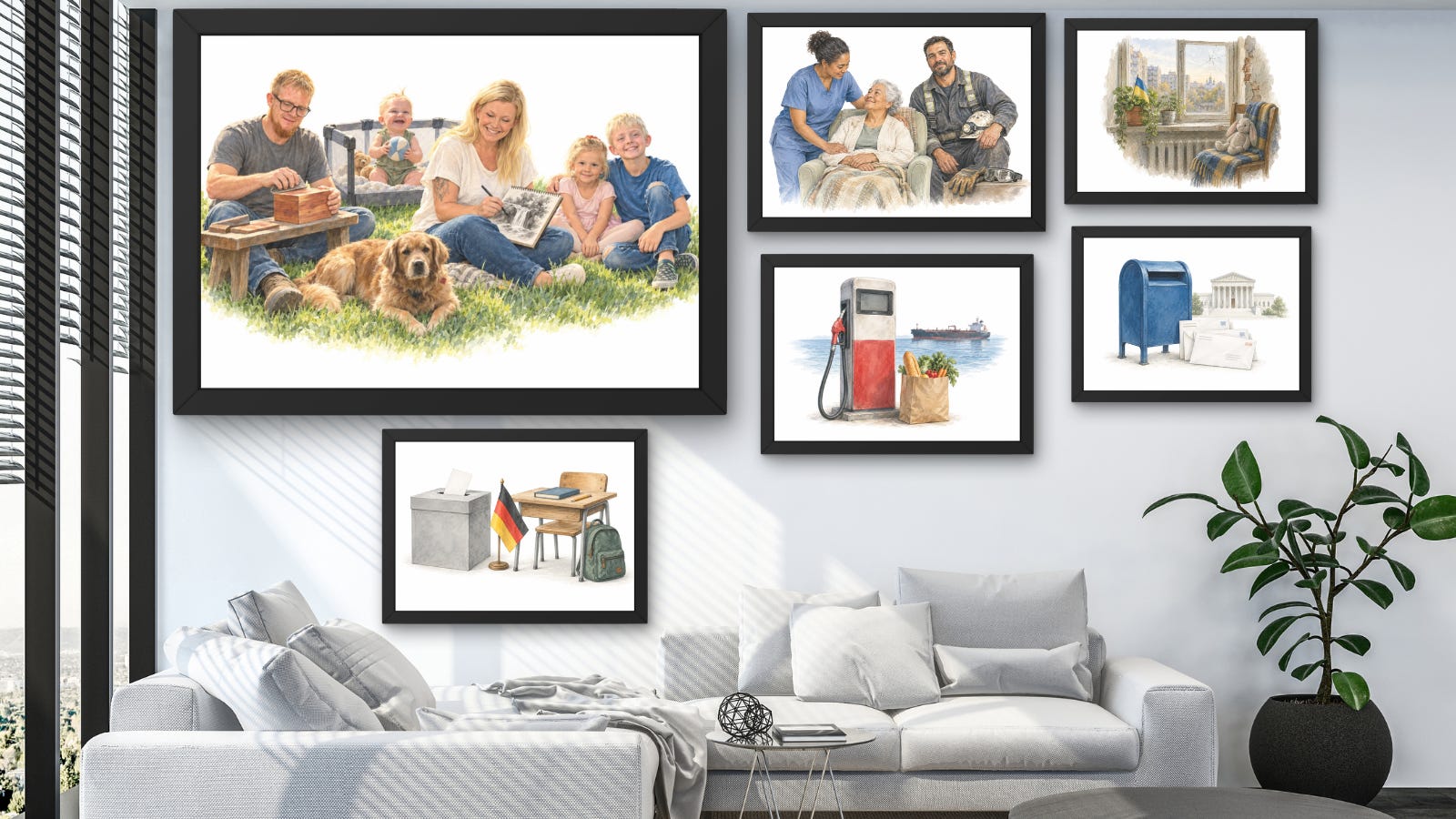
According to public broadcaster MDR, preliminary results give the far-right Alternative for Germany, or AfD, 43.8% of the vote and 39 seats in the state parliament, short of the 42 needed for an absolute majority. Who will form the government remains unresolved, so the result hasn’t yet settled who will actually govern.
Reading further, I found proposals that brought the story much closer to everyday family life: separate classes for refugee and asylum-seeking children, ending shared schooling for children with and without disabilities, and changing history curricula. These are the AfD’s proposed education policies, and legal experts interviewed by CORRECTIV explain that some would face substantial legal challenges, while other changes could be made through the education ministry.
That was where I began to recognize a pattern across the stories I was reading: political power becomes authority over the institutions people depend on, reaching into workplaces, classrooms and family routines. I’m still learning the German context, but following the proposed policies helped me understand what this particular election could mean beyond the vote totals.
These are different countries and different crises, but the question of what power is for keeps returning: whether it protects the people expected to live with its decisions, or simply gives the people holding it more room to get their way.
I don’t want to take the strength out of my daughter, because the world will give her plenty of reasons to need it. I want her to understand that being the strongest person in the room gives her a responsibility to everyone who isn’t, a lesson I intend to keep teaching even when she is smiling through the entire disciplinary process. She has time to learn, but the adults governing nations have people depending on them right now.
Geddry’s Newsletter is reader-supported. If this work helps you make sense of the news, please consider becoming a paid subscriber or sharing it with someone who might appreciate it.
You sound like a wonderful, smart Mom, Shanley! You really see and appreciate those beautiful kids.
Writing as an American living in Germany, it is so upsetting to me to see bigotry and racism rearing its ugly head here, encouraged by the Trump regime. But down here in Bavaria, we are pretty much "gegen Rasismus" and pro-diversity. Our city of Fürth is proud of its multicultural makeup. I so hope we prevail!
Stand strong in your goal of nurturing a strong, thinking woman through to adulthood. Methinks that will be quite a challenge for you both. May you both succeed!