


Donald Trump promised to drain the swamp, but apparently the plan was to replace it with an infinity pool surrounded by people who own several other infinity pools. A new analysis from Public Citizen found that Trump has appointed 57 people worth at least $100 million to positions in his second administration. That includes 17 ambassadors and 40 senior executive officials. Eight of his 23 Cabinet members qualify. Altogether, Trump has appointed more than four times as many people worth at least $100 million as George W. Bush, Barack Obama, and Joe Biden combined.
Nothing says government for the forgotten man quite like assembling a Cabinet that could collectively buy the forgotten man’s town, bulldoze it, rename it after a cryptocurrency, and deduct the entire thing as a business expense. Trump insists that surrounding himself with extremely wealthy people is evidence that he values success. This assumes that having a great deal of money automatically makes someone good at governing, empathetic toward families, or capable of understanding why the price of groceries might matter. By that logic, the best person to manage a food bank would be someone who has never opened their own refrigerator.
Meanwhile, the president is very concerned about a patch of dead grass on the National Mall. Trump posted a photograph of brown turf near the World War II Memorial and blamed vandals, offering no evidence. The damage happens to be in the same location where his massive July 4 celebration placed a stage and welcomed enormous crowds. Still, Trump has concluded that mysterious lawn criminals are likely responsible. It’s impossible to know who killed the grass. It could’ve been vandals, it could’ve been thousands of people, heavy equipment, and an enormous stage, or perhaps it could’ve simply lost the will to photosynthesize.
Yesterday, while the federal government continued its transformation into a members-only country club, my family spent the day inside an oasis built entirely from buy-one-get-one deals on Milwaukee power tools. My goodness, it was glorious.
We wandered the aisles sniffing our homeowner dreams while Ezra drove the racecar cart, looking adorable and steering us confidently toward financial decisions we hadn’t planned to make. There is something intoxicating about a wall of power tools. You begin by looking for a drill bit and suddenly find yourself thinking, “You know what this family needs? A cordless oscillating multi-tool and a backup battery system capable of surviving the collapse of civilization.”
Today, our resident contractor, also known as my brother, is coming over to install a sliding door. This is the same sliding door that has been sitting in our shop for months, patiently waiting while children, emergencies, plumbing, chimneys, illness, and approximately 47 other projects cut in line. But it’s happening, folks. Let the light shine through and brighten our lives.
On the other side of the house, I will be working on stair geometry, or whatever voodoo language people use to determine rise, run, tread, advance, and how many mathematical sacrifices must be offered before humans can safely travel between floors.
One reader suggested that we consider a spiral staircase. I want that reader to know that I have considered it. I have looked, I have looked for hours, I have looked for days, potentially even weeks, I mean who really knows anymore? I’ve designed a blueprint, consulted the stair gurus, and stared into the spiraling abyss and imagined myself gliding gracefully down to the first floor like the mysterious owner of a coastal castle.
Unfortunately, I don’t own a CNC machine, and I can’t bring myself to spend $3,000 on a spiral staircase kit. Think of all the plants that could buy, think of the fertilizer, of the fairy garden decor, the school clothes, and good golly, think of the Milwaukee power tools. At some point, I must behave like a responsible adult and deny myself the staircase I have dreamed about for my entire life. It’s okay, I’ll breathe deeply, pray to the staircase gods of the underworld, and trust that something will eventually work.
My husband remains stubbornly insistent that a ladder and a fireman’s pole are not safe alternatives to stairs for children. Whatever, I guess that’s fine. They’ll never learn if they don’t get hurt a few times, but apparently building codes aren’t interested in my educational philosophy.
Stair battle, here I come. This is one of the small differences between ordinary Americans and the people Trump believes should run the country. Ordinary families stand in hardware aisles calculating whether a staircase is worth sacrificing school clothes, garden supplies, or the next emergency repair. Trump’s collection of centimillionaires doesn’t have to make those choices. They can buy the spiral staircase, the house around it, the company that manufactured it, and possibly the congressman responsible for regulating the staircase industry.
When people are insulated from the consequences of policy, governing becomes theoretical. A cut is a number on a spreadsheet, a lost service is an efficiency, a family choosing between groceries, medicine, and electricity is a data point somewhere below the wine cellar. That distance is important because government decisions aren’t theoretical to the people living underneath them. Neither are the decisions made by corporations.
Four states, California, Colorado, Kentucky, and New Jersey, are taking Meta to trial over allegations that Facebook and Instagram were deliberately designed to keep children hooked. The states accuse Meta of using addictive features to capture young people’s attention while illegally collecting data from children under 13 without parental consent.
Meta denies the allegations and points to the safety features it has introduced. The states argue that the company understood the harm and continued building products around engagement because children’s attention was profitable. In other words, the allegation is that one of the wealthiest companies in the world looked at children and saw inventory.
Our oldest, my ADHD buddy, is with his biological mom this week, which means we miss him terribly, his sister is bored, and I have once again been appointed resident big brother. I am hoping her uncle brings her cousin over today so I can accomplish actual work, but hope is a delicate flower and children are extremely effective lawn equipment.
My daughter is also learning some important lessons about ownership. She’s decided that certain toys are “special toys,” meaning they may only be touched, viewed, admired, discussed, or possibly remembered by her. At first, this category included her American Girl doll and the bunny she sleeps with every night. Fair enough, we all have cherished belongings.
Unfortunately, the category has expanded to include every toy within a ten-block radius whenever she senses that another child might be enjoying it. Yesterday, we had a heart-to-heart. I told her about my childhood best friend, Sam, who protected me from bullies. I told her how heartbroken I was when he moved away in second grade and I never saw him again. I explained that sometimes we have to let people matter more than our stuff because people can’t be replaced, and too often we wait until they are gone to appreciate what they meant to us.
She listened. Then she changed her attitude, went back to playing with her friend, and made her mother cry real tears of pride over her emotional intelligence. A child was presented with a difficult truth, considered how her behavior affected someone else, and changed course. Please alert the federal government that this is possible.
There is something especially grotesque about corporations treating children’s attention, personal information, fears, and insecurities as special toys that belong exclusively to them. A four-year-old can learn that people matter more than possessions, surely a company with billions of dollars, thousands of employees, and entire departments devoted to predicting human behavior could stumble upon the same revelation.
Today also brought a rare appearance from the accountability fairy. The Supreme Court rejected Trump’s request to reconsider its refusal to hear his appeal of the $5 million verdict in the E. Jean Carroll case. A jury found Trump liable for sexually abusing Carroll in the 1990s and later defaming her. Trump has already paid that judgment, although he and the Justice Department are still trying to overturn a separate $83.3 million defamation verdict.
Trump has spent years insisting that accountability itself is unfair. Every verdict is political, every investigation is persecution, every consequence is evidence of a conspiracy, and every patch of dead grass is a crime committed by invisible vandals. Nothing is ever his fault because responsibility, like taxes and commercial air travel, is apparently something reserved for ordinary people.
Here at home, Ezra is preparing for his next great act of independence. My mister boy, my sweetest love bug, my squishy little smiley man, has reached the stage where we all know he could walk if he would simply trust himself. I keep entering the living room and finding him standing freely. Then he notices me, realizes he isn’t holding onto anything, and immediately sits down.
I tried putting something in each of his hands to trick him into believing he was holding onto support, but he has proven too wise for this experiment. I also bought him a push walker, which he enjoys tremendously, especially when he crashes it into household objects and laughs hysterically. He’ll walk any day now.
Part of me can’t wait, another part wants to hold him in this adorable, chubby, smiley stage forever. Unfortunately for the ladder, time always wins. He will take his first steps, then run, then grow into a loving, thoughtful, intelligent young man, no matter how tightly I try to hold onto this moment.
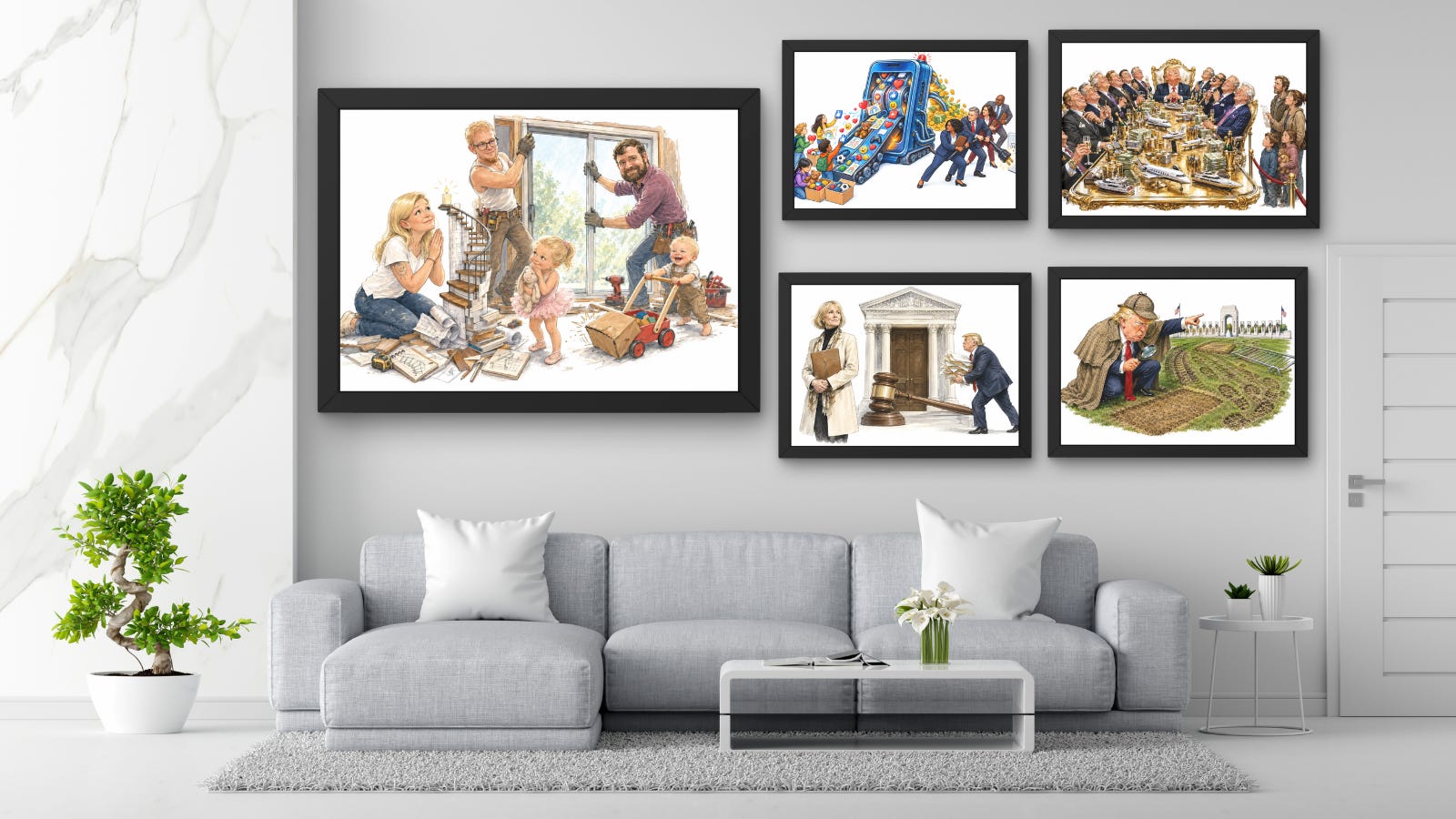
That is a day in the life of an ordinary American family. We watch our children grow too quickly, we miss the son we have to share, we coparent like reasonable adults because his happiness matters more than anything else, we clean, build, budget, compromise, and try to create a safe way for children to reach the second floor without spending their entire college fund.
We also watch Oregon burn. The Grasshopper Fire has consumed nearly 90,000 acres and destroyed six homes. During one wind-driven surge, approximately 12,000 acres burned in a single hour. Firefighting resources are stretched so thin that experienced hotshot crews are becoming unavailable, forcing teams to consider lowering heavy logging equipment down steep slopes to create fire lines.
Those aren’t hypothetical consequences. Those are homes, photographs, animals, livelihoods, and entire landscapes. Those are exhausted firefighters moving from one emergency to the next because another fire is always waiting. Yet the president’s public fury is directed toward a rectangle of brown grass near the National Mall. Perhaps the vandals were billionaires, that would explain why no one can find them.
My daughter learned in one afternoon that people matter more than things. Donald Trump has had 80 years, two presidencies, 57 extraordinarily wealthy appointees, multiple court judgments, and one mysteriously dead lawn, and he still hasn’t figured it out.
Shanley,
If only Trump had had a family like yours, in which he could have grown up experiencing and learning healthy and loving relationships, in order to become an empathetic, fully-functional adult himself. The importance of your family's instinctive, supportive and nurturing care for your children is a great example to us all.
I enjoy your writing, but as a retired Building Contractor I would like to advise against the spiral staircase. Some people love the way they look, that lovely winding geometry of it. But they are dangerous due to the varied side of each tread, and they make it nearly impossible to carry anything up the stairs...furniture, basket of laundry, large suitcase, you name it. Staircases are critical, and they need professional design and build.