


A federal judge in Oklahoma has ruled that an officer’s warrantless search of a woman’s travel history violated the Constitution, and lawmakers in Washington are proposing restrictions on the technology that makes those searches possible. In Morocco, a new investigation describes surveillance used to silence journalists and activists. Tomorrow, Brazilians vote in an election with consequences for the Amazon and the world beyond it. Each story raises a question about the power entrusted to leaders and the power people retain to challenge them.
On Friday, Bernie Sanders, Alexandria Ocasio-Cortez, and Oregon’s Jeff Merkley announced the Ban Flock Act. The legislation would broadly prohibit federal use of automatic license plate readers and their data, with exceptions including tightly limited toll collection and uses specifically authorized by Congress. It would also condition assistance from several federal departments on state and local governments adopting comparable restrictions. The House version was introduced October 1. This is proposed legislation, with a fight ahead of it.
License plate readers capture a vehicle’s plate alongside information about where and when it was seen. Enough records can reveal a history of someone’s movements. In an October 1 ruling, U.S. District Judge Sara Hill examined an officer’s use of Flock and another plate-reader system to investigate Melisa Kyle. The officer initially queried her plate because it was from California. Hill found that the warrantless search of her historical location information violated the Fourth Amendment and ordered the resulting evidence suppressed.
The case involved access to a month’s worth of location information, including more than fifty sightings across states. Flock disputes the ruling and expects it to be overturned. There is a question the case puts before us. How much of an ordinary person’s life should become available for inspection simply because they drove somewhere?
It’s Saturday here, which means it’s cheesecake day, folks. Last week I ordered Brock a pumpkin cheesecake, and he’s happy. Here we have an approval rating that requires very little polling and absolutely no televised debate. Public officials have considerably larger obligations than selecting the correct seasonal dessert, though some seem to believe that pleasing their supporters should settle every subsequent question about their performance.
We give leaders power to make decisions larger than any one household can make alone. We also need to retain the power to challenge them when those decisions threaten our freedom and our future. Excellent campaign photography should never be sufficient collateral for that much trust.
Flock says its technology helps solve crimes and locate missing people. Its website describes a shorter recommended default retention period of seven days, expanded audits, and additional controls over data sharing. Those are relevant changes. They also leave us with questions that deserve public answers: who can search, for what purpose, under whose supervision, and with what consequences when that access is abused?
I’ve spent enough time reviewing access to patient information to know that having a useful system and having a justified reason to open someone’s record are separate things. The permissions and the audit trail matter, and somebody has to take responsibility when the explanation doesn’t hold up.
Our trip to Portland was about a baby’s MRI, a bookstore, plants, and getting home to our daughter. We’re still waiting for Ezra’s results. I don’t know whether any plate-reader system recorded our car, but I do know how much of a family life can be suggested by a list of stops, and how little of its truth a stranger could understand from that list. A database might know where you went without knowing what you were carrying.
Surveillance can also raise the cost of speaking out. If you worry that attending a meeting or visiting an organizer will put you under scrutiny, the freedom to participate starts acquiring conditions nobody mentioned on the ballot. Amnesty International’s October 1 investigation into Morocco describes how serious those conditions can become. Drawing on whistleblower testimony, leaked records, and technical evidence, the organization reports that intelligence services have used spyware, covert recordings, and other surveillance against journalists and human rights defenders. Morocco has repeatedly denied using spyware against its citizens.
The report describes targeting that reaches families and professional networks, as well as people living abroad. It also documents smear campaigns using intimate material, while acknowledging that Amnesty couldn’t independently establish the source of material disclosed by certain media outlets. Its investigation traces surveillance suppliers across Israel, Europe, and the United States. Companies sell tools across borders. The people targeted have homes, relationships, work, and loved ones who can be pulled into the pressure surrounding them. Their freedom to report and organize deserves protection in its own right.
The Oklahoma ruling and Amnesty’s investigation concern different technologies and legal circumstances. What connects them is the need for enforceable limits on the power to inspect people’s lives. Privacy gives people room to think, seek help, build relationships, and disagree. A society needs that room if its citizens are going to hold anybody accountable.
Tomorrow’s election in Brazil brings us to another part of that responsibility: what elected leaders are allowed to do with a future shared by people far beyond their constituency. Brazil holds roughly 60 percent of the Amazon rainforest. President Luiz Inácio Lula da Silva and Senator Flávio Bolsonaro, Jair Bolsonaro’s son, are the leading presidential contenders. AP reports that deforestation fell substantially under Lula after protections were restored, while environmental experts warn a Bolsonaro victory could reverse that progress.
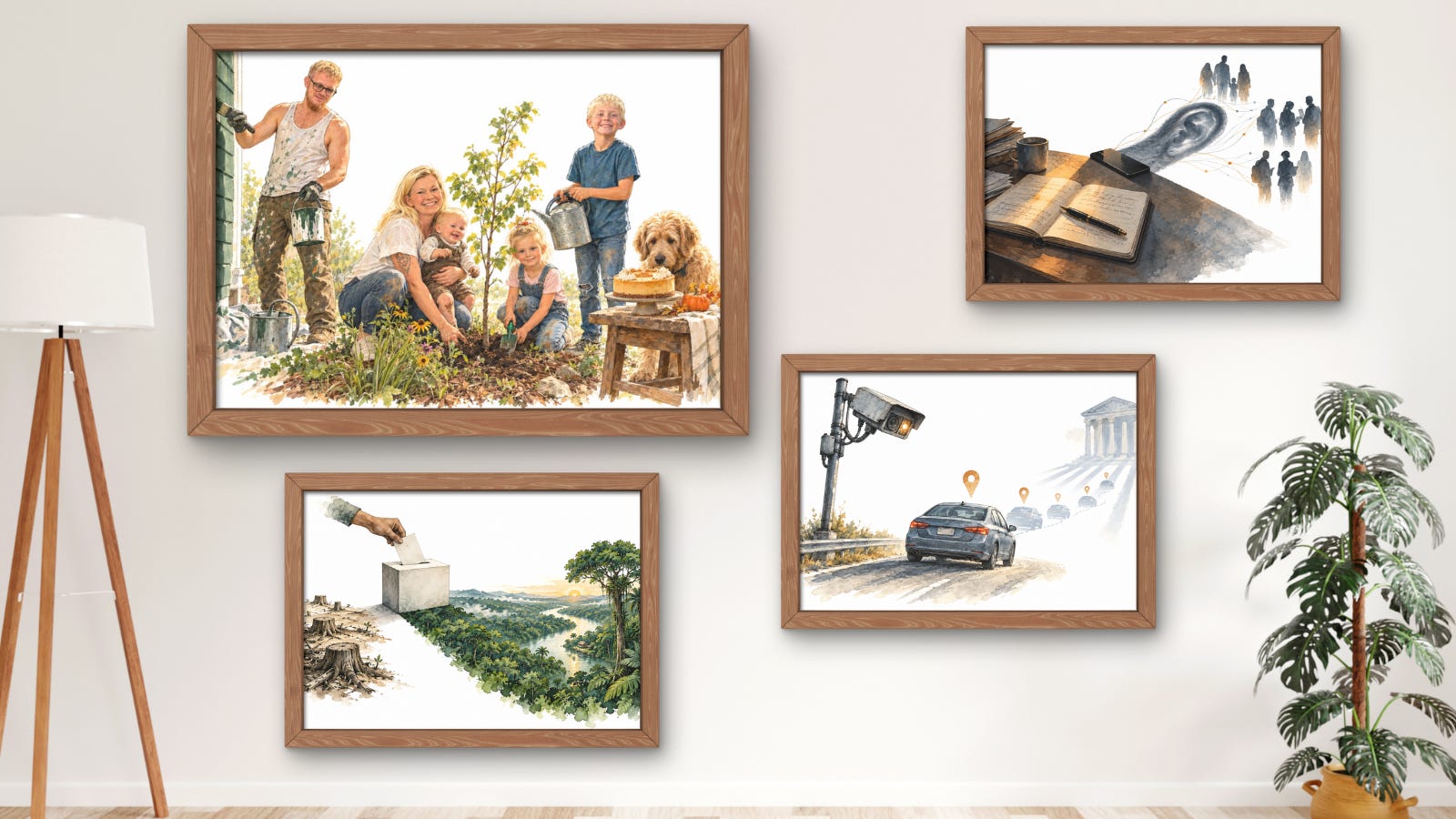
Bolsonaro’s campaign says it would support conservation, restoration, and enforcement. He pledges to end illegal deforestation by 2029; Lula’s goal is zero net deforestation by 2030, covering legal and illegal losses. Critics warn that weakening protections could make additional clearing legal, allowing forest destruction to grow while an administration claims to have honored its promise. That’s a particularly convenient way to improve a record: redefine the damage until the paperwork looks healthier than the forest.
The Amazon stores carbon and helps regulate rainfall. Its protection matters to communities living within it and to the wider climate. An election decides who takes office; budgets, enforcement, and land-use decisions help determine what remains standing afterward. A stronger conservation record is a reason to examine what worked and insist it continue. Every leader still owes the public an accounting.
My husband is finishing the painting today, and the hope is to get some plants in the ground. Things are moving a little more slowly around here, which may be exactly what this weekend needs. We’re trying to enjoy what feels like the last little bit of sunshine the year has to offer. Planting something asks you to believe in the seasons ahead, and I want our children to inherit a world where that faith has somewhere to take root.
The decisions made beyond our yard will help determine that world, too. I want our children to have more than a collection of explanations for why the adults couldn’t save what mattered. That means taking responsibility for the power available to us, beginning with our votes.
If we have the right to vote, we need to use it. We need to learn who is asking for our trust, examine their records, and vote with an understanding that their decisions will reach people who never had a say in choosing them. Our children will live with those decisions. So will communities beyond our borders. The responsibility is larger than our own household, even when our own household already feels like a substantial administrative undertaking.
Check your registration. Check the deadlines and voting options through your state or local election office. Make a plan, and help someone else make theirs. An intention to vote needs to survive contact with a work schedule, a school pickup, and whatever emergency has decided to arrive that week.
Our votes have power, and we need to defend that power against barriers, intimidation, and efforts to disregard the results. We can choose carefully and still be betrayed. The people wielding office remain responsible for what they do, and we remain entitled to challenge them, including the ones we supported. They don’t get to keep our silence as a complimentary campaign souvenir.
Then we keep showing up. We support the reporting, attend the meetings, organize with our neighbors, and challenge decisions that put our rights and our futures at risk. We build relationships that make standing up less lonely and organizations that give our anger somewhere useful to go. Exhausted people need help doing this work, and people excluded from the ballot still deserve a voice and a place in it.
Yesterday, I wrote about people whose resistance helped stop the machinery in Big Bend, preserving something they could still fight to protect. That pause matters, along with the work required to defend it.
We deserve freedom, accountable government, and a world our children can inhabit. Securing those things takes people willing to insist upon them together. Our participation must keep its power after the votes are counted. That begins with casting them, and continues with holding the people we elect accountable for what they do in our name.
If this piece speaks to you, please restack it. Help it reach someone who needs a reminder that their vote matters and their voice still belongs in the room afterward.
Paid subscriptions support The Homefront Report and Mom’s clearly superior pieces, a designation I intend to challenge as soon as I can locate the family election observers. Thank you for helping us keep researching, writing, and showing up.
And if you’d like to send a little extra love our way, you can support the work and the family adventures around it here:
This weekend, we’re tending plants, waiting for answers, and remaining firmly committed to cheesecake.
Thank you, Shanley. I hope the best for your baby. And the country. As do you.