


I have always been an avid supporter of fungi, which is a sentence I realize makes me sound like someone who keeps a tiny altar to mushrooms in the laundry room, but I am willing to accept that risk because fungi have earned my loyalty.
They are strange and ancient and a little witchy, which are all qualities I appreciate in a life form, especially when that life form is quietly helping forests survive while the rest of us are upstairs checking the news and wondering whether the republic has been left unattended near an open flame.
For years, I loved fungi in the broad way many of us love things we haven’t yet learned enough about to become truly annoying at dinner parties, because I loved the mushrooms after rain, the fairy rings in lawns, the shelf fungi growing from old logs, and the whole mysterious kingdom of decay and transformation that makes the forest feel like it is always thinking thoughts too deep for us.
Now, because my husband and I have apparently entered our soil-and-species era, we are journaling the different plant species we find in our woods, paying attention to the composition of our soil, and having the sort of bedtime conversations that make you realize marriage is less about grand passion than finding the person who will lie beside you in the dark while you say, “Do you think the fungi are helping the roots access phosphorus?”
Nothing says true love like lying in bed at night examining soil composition and talking about fungus and nothing says romance like one person scrolling through plant identification notes while the other says, “Wait, go back to the part about hyphae,” as if hyphae are a new Netflix drama everyone at work will be discussing tomorrow.
This is what gardening does to a person, or at least what it has done to me, because once you start paying attention to the life beneath your feet, the whole world stops looking like a collection of separate things and starts looking like a conspiracy of relationships. I mean that in the good way, not in the “skeptical” man-on-Facebook way.
The trees aren’t just trees, because they are also roots, leaves, shade, fungi, insects, birds, soil, fallen branches, microbes, moisture, and time. The soil isn’t just dirt, because it is also habitat, pantry, graveyard, nursery, archive, and a living commons full of creatures that don’t care whether we understand them as long as we stop compacting their entire civilization with our bad decisions. The garden isn’t a stage where humans perform control, although we keep trying to make it one, because the garden is a negotiation among living things with different appetites, timelines, defenses, gifts, and needs.
After writing about earthworms, those humble little workers of repair who turn rot into soil, and after writing about hammerhead flatworms, those false worm pests that prey on the very creatures doing the repair, I found myself pulled toward the next question in the underground republic. Who protects the helpers? Or maybe, because the garden is rarely that simple, what kind of system makes it possible for the helpers to survive?
This is how I ended up thinking about beneficial insects and mycorrhizal fungi at the same time, which is either the natural progression of the series or a sign that I have spent too much time in the worm internet and should be gently escorted back to a normal hobby like bread baking, minor tax fraud, or recreational despair.
Beneficial insects are the easier part to see. They are the lady beetles, lacewings, hoverflies, parasitic wasps, ground beetles, bees, butterflies, decomposers, and tiny garden patrol units who pollinate, hunt pests, recycle organic matter, and help hold the visible world together without ever demanding naming rights to the cucumber bed.
Like the worms, they aren’t perfect or sentimental, which is important because the garden is not a Disney movie and many beneficial insects are beneficial because they eat other insects in ways that would cause a children’s book illustrator to request reassignment.
Still, they are part of the living defense system, they help the garden resist imbalance, and they remind us that not every bug is an enemy, not every bite is a crisis, and not every living thing that unsettles us should be met with poison and a homeowner’s association tone of voice.
Mycorrhizal fungi are harder to see, which is part of why they feel almost mystical. They live in relationship with plant roots, sending fine threadlike structures through the soil, extending the plant’s reach for water and nutrients while receiving carbohydrates from the plant in return.
This isn’t charity, because nature is rarely as pure or as simple as the inspirational posters want it to be, but it is relationship, exchange, dependence, negotiation, and a kind of underground mutual aid that makes individual survival look, frankly, a little overrated. The plant is where the hidden network and the visible defenders meet.
The roots are connected to the fungi, the flowers feed the pollinators, the leaves host insects, the insects feed birds, the dead matter feeds the worms, the worms feed the soil, the soil feeds the roots, and somehow we are still walking around pretending the highest form of intelligence is a man in a suit insisting that he alone can fix it.
Donald Trump would not understand a mycorrhizal network if one colonized his golf course and started quietly improving the phosphorus uptake. That may be because mycorrhizal networks represent almost everything Trumpism hates. They are cooperative, quiet, and reciprocal. They depend on healthy relationships and make life possible without constantly announcing that life was a disaster before they arrived and everyone should be saying thank you.
There is no king of the fungal network, no golden escalator descending into the rhizosphere, no one giant mushroom shouting that the other mushrooms are vermin and only he can make the forest great again.
There is just relationship, which is not the same as purity and not the same as peace, because the forest is full of competition, appetite, death, and struggle. This isn’t to say that nature is gentle, but rather, that living systems survive through connection.
Trumpism is, at its root, a politics of severance. It wants people cut off from one another, because isolated people are easier to frighten, easier to flatter, easier to radicalize, easier to sell things to, and easier to convince that the neighbor is the enemy while the man picking their pockets is a savior.
It wants workers severed from unions, voters from facts, children from history, citizens from institutions, and everyone from the quiet memory that survival has always been a group project. Trumpism doesn’t build healthy soil, it clear-cuts the relationships, sprays distrust over the ground, poisons whatever beneficials remain, and then stands in the sterile dirt insisting the problem is that the earthworms were woke.
The garden has become so emotionally charged to me lately. It isn’t just that gardening is calming, although sometimes it is, and it isn’t just that soil gives me something to focus on besides the doom-scroll carnival of American politics, although it certainly does that too. It’s that the garden keeps teaching the opposite lesson from the one being screamed at us by authoritarian men with microphones.
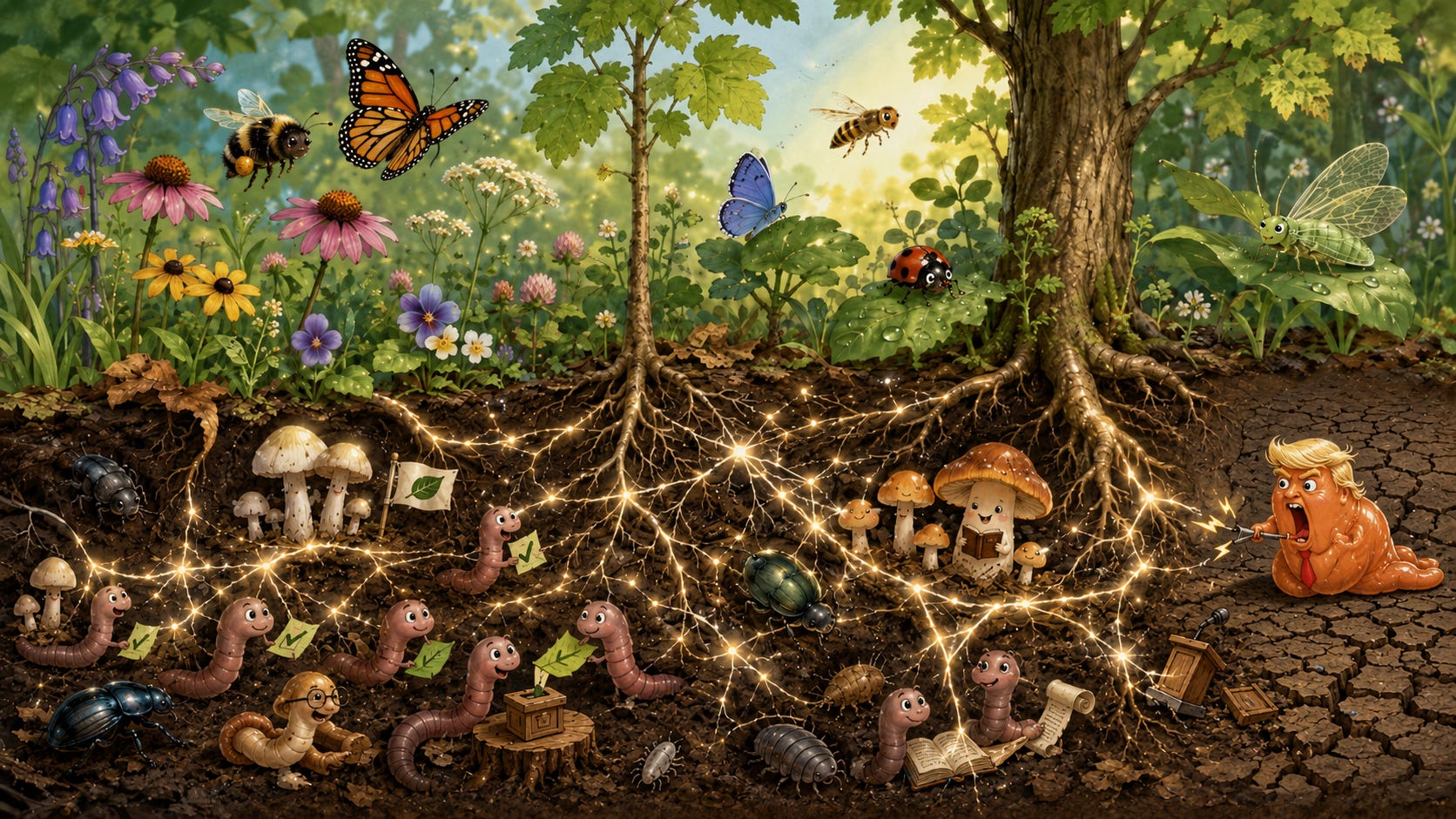
The garden says interdependence is not weakness, that diversity is not disorder, and that health isn’t achieved by purging every creature you don’t immediately understand. The garden says that if you kill the insects, compact the soil, strip the leaves, break the fungal networks, and poison the living system in the name of control, you should not be surprised when nothing grows but resentment and crabgrass. In other words, you cannot save the roots by declaring war on the soil.
This is where the beneficial insects and the mycorrhizal fungi come together for me, because they answer the flatworm question in different layers of the same living world. The beneficials are the visible defenders, the fungi are the hidden connectors. One patrols the leaves and flowers and stems, while the other extends through the soil in threads so fine and intricate that the ground beneath us becomes less like a pile of particles and more like a living correspondence.
Together, they suggest that the answer to predation is not one larger predator, one heroic organism, one self-appointed savior standing on a stage promising that he alone can defeat the aphids, the immigrants, the judges, the journalists, the trans kids, the librarians, the windmills, and whatever else has offended him by existing outside his control.
The answer is a system alive enough to resist collapse. Which is what fascism never understands, because fascism is spiritually bad gardening. It looks at a meadow and sees a mess, because it can’t understand that the mess is habitat. It peers out at a network and sees a threat, because it can’t imagine power that is not hoarded at the top. It lays it’s eyes on beneficials and sees disobedience, because every helper that doesn’t kneel is treated as a pest. This is why Trump and his entire ecosystem of professional grievance merchants have always been so hostile to the actual workers of repair.
They attack teachers because teachers connect children to history, language, and each other, librarians because librarians connect people to knowledge without requiring loyalty oaths or subscription fees, journalists because journalists, at their best, connect facts to public understanding, public servants because functioning institutions connect citizens to the idea that government can be more than a spoils system for the loudest and cruelest men in the room, and finally, they attack immigrants, queer people, Black history, women’s autonomy, science, universities, courts, and anyone else who reminds the country that democracy is not a lonely white man standing on a balcony with a flag behind him and a persecution complex in his pocket.
Democracy is a network. It’s roots and fungi and pollinators and worms. It’ the election worker, the school secretary, the nurse, the public defender, the local reporter, the city clerk, the union steward, the scientist counting soil cores, the teenager registering voters, and the exhausted parent showing up to the school board meeting even though nobody had time to make dinner.
Democracy isn’t always tidy or polite, and it most certainly not optimized for television. It’s alive because it’s connected, it’s the bridge between the people and policy. That is the third lesson of the underground republic, at least as I understand it from my current position as a woman who has become emotionally invested in fungal networks and may soon be asked by her family to discuss anything else. It’s that the helpers cannot survive alone.
This is both comforting and terrifying. It’s comforting because it means none of us has to be the whole garden, which is good news for those of us who are already tired and would prefer not to become the sole lacewing, mycorrhizal network, earthworm, mulch layer, pollinator strip, election protection team, constitutional scholar, and morale committee for the entire republic. It’s terrifying because it means the network can be damaged, and because the invisible things that hold us together are often the first things we neglect until the collapse becomes visible enough to frighten us.
You don’t always see the fungal network break, until you see the plant struggle, and you don’t always see the beneficial insects disappear, until you see the pests explode. The same is true for our nation today. You don’t always see a democracy losing its living connections, first you see the loneliness, then the fear, then the strongman stepping into the cleared ground. This is why care has to become more attentive than panic.
In the garden, that means we don’t simply wait for pests and then drench everything in chemicals like suburban warlords with spray bottles. We plant more diversity, leave some leaf litter, reduce broad-spectrum pesticides that kill the helpers along with the pests, make room for flowers across the seasons so pollinators and beneficial insects have food before and after the crisis, and we learn what is living around us before deciding what must be removed.
In politics, the same lesson applies with less compost but more screaming. We strengthen the connections before the pest overwhelms the system, support local journalism before the information soil is completely depleted, protect libraries before the shelves are stripped, defend election workers before the threats become normal, join unions, mutual aid groups, neighborhood networks, school communities, and civic organizations before the strongman convinces everyone that they are alone.
We stop treating democracy like a machine that should keep running without maintenance and start treating it like a living system that needs care, diversity, replenishment, defense, and time. I know this may sound a little mystical, but I think the mysticism is part of the point. Not mystical in the sense that mushrooms are sending us secret horoscopes, although honestly, I would trust a chanterelle before I trusted most members of this administration.
Mystical in the sense that there are forms of intelligence we have been trained not to recognize because they don’t look like domination, in the sense that a forest can know things through relationship, that soil can remember what we have done to it, that a root can be stronger because it’s not alone, and that the world beneath us is alive with forms of cooperation so old and complex that our politics looks very young and very stupid by comparison.
This is the light that mycorrhizal networks have sparked in me. They make the hidden visible, make the individual seem incomplete, make survival feel less like a heroic performance and more like a web of obligations, and they make me wonder what else we have dismissed because it was quiet, what else we have endangered because it was underground, and what else we have called weakness because it refused to behave like a man demanding applause.
Of course, this is where Donald Trump comes shambling back into the garden, because apparently my brain has become a compost tumbler for horticulture and fascism. Trumpism is hostile to the network because the network is how ordinary people survive powerful predators.
It’s hostile to public knowledge, public trust, public goods, public service, and public memory because those are the mycorrhizal threads of a democratic society. It’s hostile to anything that helps people find nourishment outside the leader.
That’s why the answer can’t simply be to stare at the pest. We already know the pest is there. We already know he is destructive, vain, grotesque, and somehow still treated by too many people as if he were a weather event rather than a choice made repeatedly by human beings who should know better.
The work now is to feed the network, to protect the beneficials, to make the soil harder for fascism to colonize, and to become less lonely, less severed, less easily panicked into reaching for whatever political pesticide promises immediate control and leaves everything living weaker in the end.
A garden doesn’t need a dictator. It needs roots, fungi, and worms. It needs pollinators, predators, parasitoids, decomposers, microbes, leaves, shade, water, patience, mess, and a caretaker humble enough to understand that control is not the same as care. A democracy doesn’t need a man who says he alone can fix it. It needs citizens connected enough to remember that no one ever has.
So yes, I remain pro-earthworm, anti-false-worm, and increasingly fungus-pilled, which is not a phrase I expected to write when this whole garden fixation began. I am pro-the underground republic and all its strange allies. Because the garden has been trying to tell us something; the soil needs the living things that move through it, bind it, loosen it, nourish it, and remember how to turn wreckage into growth. The underground republic is no different from the republic Benjamin Franklin talked about, only as strong as it’s citizen’s ongoing participation.
i love this essay and I have already sent it on to my garden helper who will also love it. She has written a book about the inner garden and the outer garden. I am going to remember trusting a chanterelle before anyone in the regime. Whenever I see the arrival of bulldozers where they don't belong, I want to cry. Kudos to the Albanians for raising hell about this sort of thing. I have gardened for a very long time and have seen the problems wrought by climate change. I also respect my garden including that which I cannot see and try to keep tilling at a minimum. It is an organic garden which means a lot more work. I often stop to watch a bee at work. I also keep in mind that I am gardening on stolen land and try to keep Native American cultural values regarding nature in mind. Brava Shanley!!
As a biologist who is fascinated by fungi, and as a plain old American citizen who is horrified by our politics, THANK YOU for this essay.