

Donald Trump went to Versailles for a dinner celebrating the 250th anniversary of American independence and left having signed an Iran agreement in the one European palace most associated with postwar settlement, defeat, humiliation, and reparations.
No one had to stage the irony. Trump supplied the signature,
Emmanuel Macron didn’t set a trap. The French government didn’t arrange some exquisitely perfumed diplomatic prank in which the American president was lured beneath the chandeliers of Louis XIV and tricked into cosplaying a defeated empire. That version is tempting, because it is delicious, and because sometimes history deserves a pastry cart. But the known facts tell a cleaner story, and a more damning one.
The dinner at Versailles was billed as an honor to the United States, part of the commemoration of the 250th anniversary of American independence. Macron hosted Trump in a palace long associated with monarchy, grandeur, diplomatic theater, and the kind of gold-leaf atmosphere that Trump has spent his adult life trying to reproduce in lobbies, bathrooms, ballrooms, and whatever psychological crawlspace contains the phrase “the real deal.” The occasion was not publicly framed as a Treaty of Versailles reenactment. Macron did not need to smirk into a sleeve. There is no need to imagine some French official whispering, “Mon Dieu, he has no idea,” while sliding the document across the table.
The simpler explanation is worse.
Trump saw Versailles and thought: beautiful room, flattering host, cameras, history-flavored grandeur, excellent lighting, probably very expensive. He did not grasp that Versailles is not just décor. It is a historical argument with mirrors.
Versailles already means something. It means monarchy and revolution, spectacle and collapse, elegance and rot. It means Louis XIV building a palace to make himself the sun around which political life revolved, only for the monarchy that inherited his mythology to end beneath a blade. It means the Hall of Mirrors, where the German Empire was proclaimed in 1871 after France’s defeat in the Franco-Prussian War. It means the Treaty of Versailles in 1919, the postwar settlement after World War I, remembered for surrender, reparations, humiliation, and the catastrophic political consequences of a peace that carried the seeds of future disaster.
None of this requires saying that Trump’s Iran memorandum is literally the Treaty of Versailles. It is not. History does not repeat itself that neatly, and columnists should be legally required to surrender one adjective every time they claim otherwise. But it does mean that Versailles is not just a shiny place to sign a thing. It is not a Mar-a-Lago ballroom with better provenance. It is a room where postwar settlements come with ghosts.
The room came with all of that. The man did not.
A leader with historical literacy might have hesitated.
A leader with self-awareness or even a passing interest in history might have asked whether signing a controversial Iran agreement at Versailles could create awkward echoes, especially if the agreement contained concessions, reconstruction financing, sanctions relief, or anything that enemies, allies, historians, cable news producers, or literate people with Wi-Fi might plausibly compare to reparations.
A leader with competent staff might have been protected from himself.
Trump, instead, appears to have thought Versailles was impressive because it looked impressive. This is his gift and his curse, though for the rest of us it is mostly the curse portion. He experiences power visually. Gold means power. Height, long tables, lots of generals mean power. Flattery and palaces, and plenty of cameras mean power. Saying “I’m the boss” at the G7 means power, but only as a joke, obviously, except in the way that all Trump jokes are jokes until someone fails to treat them as instructions.
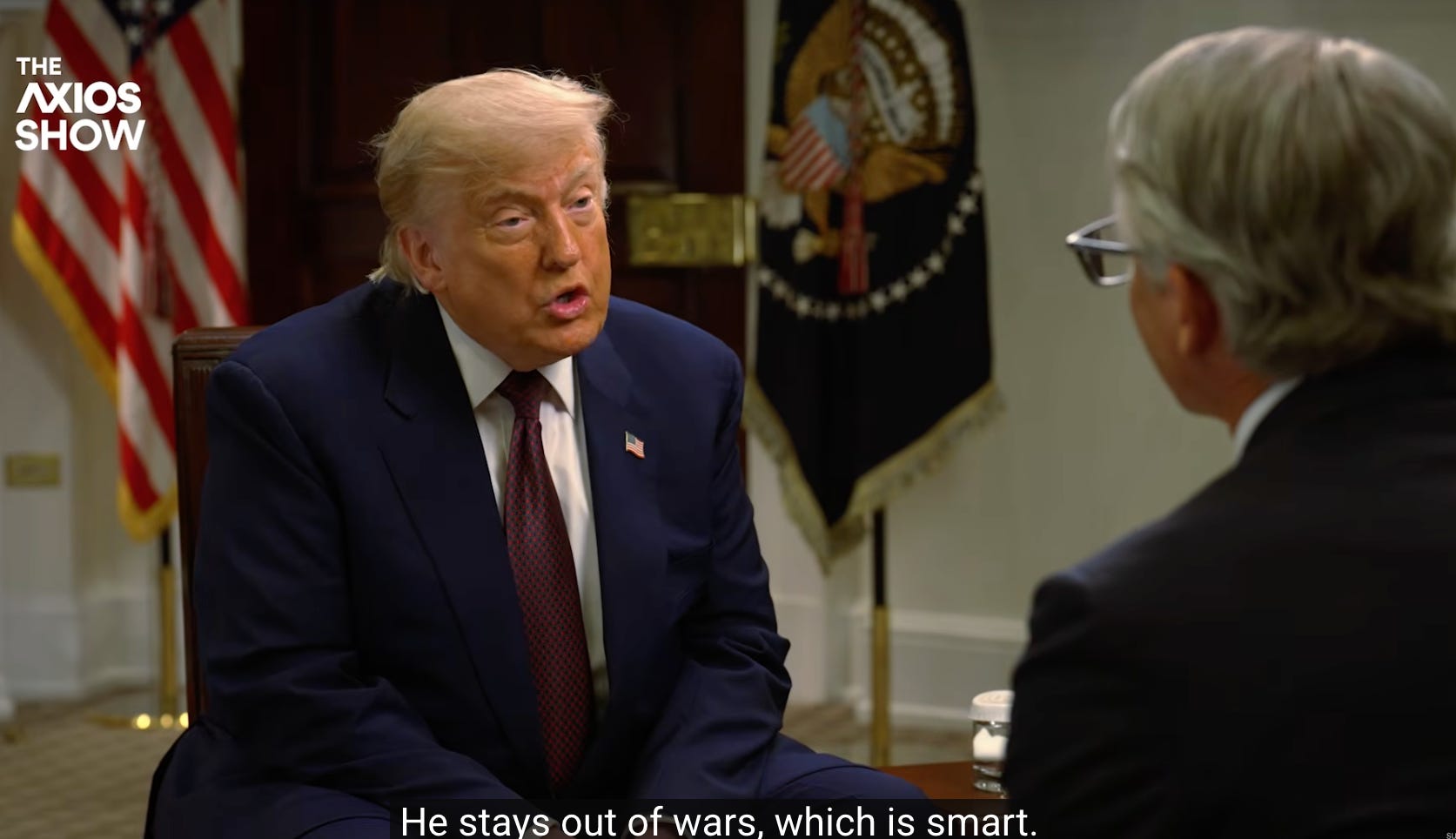
In his Axios interview, Trump was asked directly about power. Not policy, history, or constitutional authority. Power. How he thinks about it. How he wields it. And what followed was one of those Trumpian x-rays in which the bones are somehow also yelling.
He said this administration is more powerful than his first. He said experience matters, but “potential” matters more, which is Trump’s way of saying that knowing things is nice, but not as nice as feeling destined to do them. He said he had a “very dominant G7.” He said he walked into a room of world leaders and told them, “I’m the boss,” which he later explained was a joke, because the modern presidency now requires us to distinguish between authoritarian declaration and table-based banter.
When asked about the limits of his power after the Iran conflict, Trump answered: “There are no limits.” Then he briefly acknowledged that, yes, there are probably limits, in the way one might concede there are speed limits while doing 94 through a school zone in a gold-plated golf cart. But the psychic truth of the answer had already arrived. There are no limits. That is how Trump wants power to feel. Limitless.
That word is the key to the whole thing.
Trump’s idea of power is not the patient, often tedious work of aligning means and ends. It is not understanding allies, adversaries, institutions, treaties, appropriations, inspection regimes, maritime law, congressional authorization, or the fact that the War Powers Act is not a decorative napkin. Trump’s idea of power is personal force. Dominance as atmosphere, being seen to dominate. It is other people looking at him and understanding, preferably without being asked, that he is the biggest figure in the room.
This explains why his praise for foreign leaders so often sounds less like diplomatic analysis than casting notes for a prestige miniseries called Strong Men With Great Stature. Xi Jinping is smart, strong, tall, all business, no games, great look. Modi is tough, respected, a “tough cookie.” Leaders are admired for solidity, volatility, menace, stature, and the ability to make Trump feel that he is dealing with a worthy alpha in the global cigar lounge.
Power as atmosphere produces a particular kind of document. It produces this one. A document designed less to settle reality than to furnish a victory set.
Instead of unconditional surrender, the memorandum he signed reads like a very expensive exit ramp.
Trump has insisted that Iran was defeated, that its military was wiped out, that its navy is at the bottom of the sea, that its nuclear ambitions are finished, that the deal is “probably” unconditional surrender. “Probably” is doing some extraordinary calisthenics there. One imagines unconditional surrender entering the sentence, looking around, and asking whether it should call a lawyer.
The reported provisions appear far messier and far more costly. The agreement reportedly recognizes the conflict as a current war, which is awkward for an administration that has tried to avoid the legal consequences of calling it one. It ends or suspends major sanctions, lifts the blockade of Iranian ports, restores Iran’s access to the global financial system and its frozen assets. It contemplates massive reconstruction financing, and asks Iran to use its “best efforts” to keep commercial vessels moving through the Strait of Hormuz, which is not exactly the same as securing freedom of the seas unless one believes “best efforts” is a phrase naval powers should trust with the world economy. It reportedly lacks the kind of rigorous verification architecture that made the JCPOA a serious diplomatic instrument, whatever one thought of its politics.
Perhaps an exit ramp was necessary. Trump, having created or escalated a crisis that threatened oil flows, global markets, and regional stability, needed to find some way out. Presidents do sometimes have to climb down from ledges. The shame is not always in the exit. Sometimes the shame is in the climb.
But Trump cannot tell that story, because it would require admitting limits. It would require saying that force created consequences force could not solve. It would require acknowledging that a blockade, bombing campaign, and swaggering threat posture did not produce the clean victory he promised. It would require conceding that Iran retained leverage, that markets mattered, that maritime chokepoints mattered, that allies mattered, that Congress mattered, that law mattered, that reality, that stubborn and very unfair institution, had once again failed to behave like a Trump-branded press release.
Instead, the story becomes victory. Total victory. Tremendous victory. Victory with B-2 bombers. Victory with ships. Victory with leaders gone, planes gone, Navy gone, everything gone. Victory so complete that it somehow required immediate concessions, financial relief, reconstruction mechanisms, and a memorandum whose best defense is that perhaps some of the language was badly drafted.
Then he signed it at Versailles.
The sheer symbolic incompetence is breathtaking. It is like announcing a fiscal responsibility plan from a casino bankruptcy hearing.
Again, the point is not that someone tricked him. That would be an easier story, and in a way a more flattering one. A trap implies an adversary skilled enough to spring it and a victim merely unlucky enough to step into it. This was not that. This was Trump’s own operating system producing the inevitable output.
He saw splendor and mistook it for validation.
He saw a palace and mistook it for authority.
He saw a flattering occasion and mistook it for history bending toward him.
He saw Versailles and thought backdrop.
That is the deeper danger. Trump does not merely lack historical knowledge. Many people do. The presidency is not supposed to be a one-man graduate seminar in European diplomatic history, although it would be nice if the president could occasionally clear the bar marked “aware that Versailles is loaded.” The real problem is that Trump does not know that he needs to know. He does not respect the existence of meanings he did not create. He treats history as décor, law as inconvenience, expertise as disloyalty, alliances as applause lines, institutions as props, and symbolism as something that can be overpowered by branding.
When a man who believes power is image is given power over substance, this happens. Power cannot make ignorance intelligent. It can only make ignorance consequential.
A president can be surrounded by symbols of power and still fail to wield power wisely. A president can command the military and still misunderstand war. A president can sign the agreement and still misread the settlement. A president can stand inside Versailles and still not understand where he is.
That is the image that should endure from this episode: not Macron outsmarting Trump, not France humiliating America, not some elaborate diplomatic joke with better catering. The lasting image is Trump, in the glow of Versailles, holding a Sharpie and believing that the room made him look powerful.
It did not.
It did, however, make visible the precise limits of his power.
Power can get you into Versailles. It can summon cameras, clear a room, flatter a host and frighten a party and silence a cabinet and make nervous men applaud. It can put your signature on a document and your name on a building and your face on every screen. It can turn a diplomatic dinner into a personal performance. It can even, for a time, convince millions of people that incompetence is strength if it arrives loudly enough.
Power cannot read the room for you. At Versailles, the room read him.
Both of you have blown me away with essays several times. This is another wonderful read. I have forwarded it to my pals. Thanks for it.
When Macron spoke at the White House a few months ago, he was a perfect diplomat ... he's sharp and willing to step up in the 'fight' ... but he can sure deliver the charming BS convincingly. He did it again at the G7 and Versailles. My compliments to him that he conducted himself flawlessly. Macron and King Charles ... true gentlemen. But the fears and hopeful gains that drive this 'homage to trump' must be wearing thin. Reality is becoming so clear. Will it soon be time to say 'you're not invited', 'you can't have the stage and mic bc you prattle on endlessly about nothing', 'we don't like you or trust you'. The message that trump doesn't have all his marbles and certainly doesn't have the respect he seems to think he has or deserves finally seems to be reaching the world and is being reported on openly. What does he still have that other leaders are still letting him in? What's the tipping point for other global leaders saying 'go take a long walk off a short dock you loser'.
And now I find myself cheering for the algae! Go multiply you little microbes!!!
While I'm writing I just want to add that I am SO proud of Ukraine and their President Zelenski. Wow!!! They are AWESOME!!!