

Good morning! Barack Obama spent Saturday afternoon in Cleveland getting laughs at Donald Trump’s expense without making it sound like a personal grievance. Before a packed crowd at Cleveland’s Public Auditorium, at his first campaign rally of the fall midterm season, the former president mocked his successor’s renovation spree. The ballroom bigger than the White House, the paved-over Rose Garden, the helipad, and the gold everywhere, he said, had the place “looking like Saddam Hussein opened a Cheesecake Factory.”
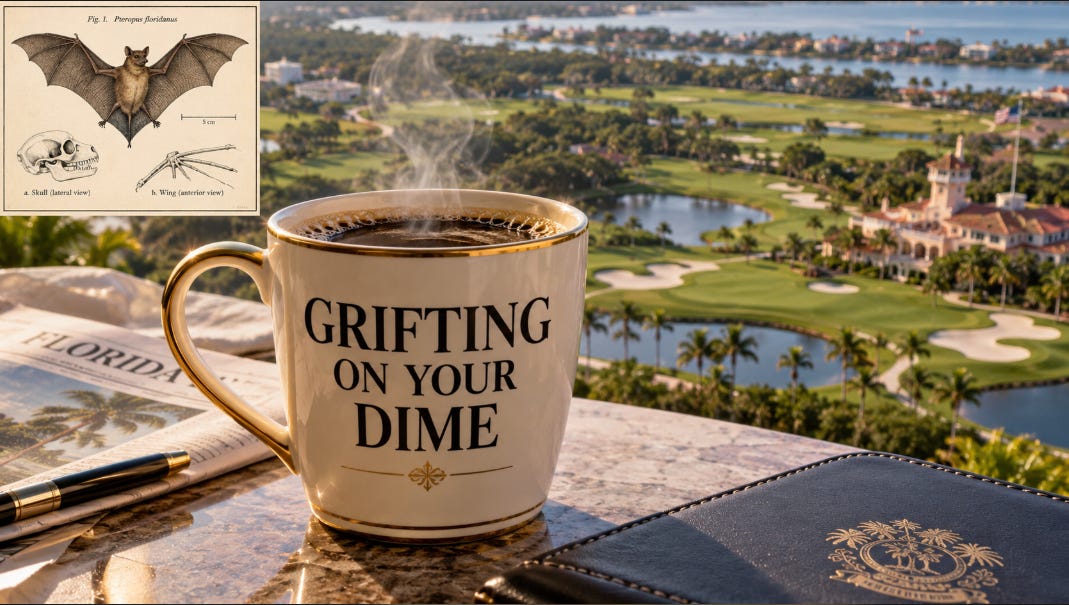
Then he turned the joke into an indictment. Obama pivoted to what he called the president’s real focus besides home improvement: enriching himself, his family, and his cronies. He accused Trump of “straight-up grifting on your dime” and said no president had ever been “so intent on selling favors and shaking folks down.” Anticipating the usual dismissal, he added, “This is not disputed. I’m not making this up. It’s all there.”
Obama was right that it’s all there. Start with the ambassador. Before her Senate confirmation in September 2025, Kimberly Guilfoyle, Trump’s pick for Greece and Don Jr.’s former fiancée, asked Republican donor Eric Deters to wire $100,000 to cover her American Express bill, according to The Wall Street Journal. “Honey please I need you to get this done for me today,” she texted, with a prayer-hands emoji, and helpfully noted that a wire to Amex “won’t show up anywhere.” Deters said she offered to be his Trump-world “ride or die, forever and ever.” He never sent the money. The White House asked her to resign on October 13. Guilfoyle denies wrongdoing, and her financial disclosures, as it happens, reportedly list no credit-card debt at all.
Then the pardon. Julio Herrera Velutini, a Venezuelan banker, had pleaded down from felony bribery charges to a misdemeanor and wanted the slate wiped clean. A former Trump lawyer had lobbied on his behalf without success. His daughter had also contributed $3.5 million to a pro-Trump super PAC. What came next, according to The New York Times, was a job for Trump’s former personal lawyer Alina Habba as general counsel of Concord Partners, a Florida company the daughter had established weeks earlier. The arrangement guaranteed Habba $10 million annually for four years, with additional guaranteed bonuses bringing the total above $50 million. She finalized the deal while still serving as a senior adviser to the attorney general. Weeks later, Herrera received a full and unconditional presidential pardon. Habba and the White House deny any connection between her employment and the pardon. The contract, the timing, and the pardon are documented. What remains disputed is the relationship between them.
The wedding was smaller money but awkward optics. Umar Kremlev, a Russian businessman with close ties to Vladimir Putin, paid hundreds of thousands of dollars for Don Jr.’s post-wedding festivities in the Bahamas, including a private island and fireworks. The president called it “totally allowed” and suggested his son perhaps “didn’t do a background check.” He then said Don Jr. had paid Kremlev back, was paying him back, and would pay him back, all in the same press session. On October 6, Kremlev himself said he had been reimbursed. That clarifies the repayment story, though not why a Russian businessman with Kremlin connections picked up the tab in the first place.
Forbes saved the most elegant for last. In September 2025, an environmental nonprofit spent three days at Trump National Golf Club in Jupiter, Florida, cataloging birds and bat calls for a 180-page report. In December, the Trump Organization donated the course’s development rights to that nonprofit while keeping the property, the members, and the greens fees. Forbes estimates the resulting tax deduction could reach approximately $825 million, give or take a couple hundred million, potentially saving Trump around $300 million in taxes. The arrangement came in a year when his cryptocurrency and real estate earnings had reportedly pushed his projected tax liability above $500 million. Among the owners of property adjoining the golf course are Eric Trump and Frank Bisignano, who became chief executive of the IRS while the easement arrangement was being developed. Forbes reported no evidence that Bisignano participated in arranging it.
A month after the donation, Trump sued his own IRS, promising that “anything I win, I’m giving 100% to charity.”
Fox News found something similar from a different direction. In its poll this month, government corruption drew more expressions of extreme concern than any other issue, narrowly ahead of inflation, which is a remarkable finding in an electorate paying more than $4 a gallon for gasoline. Eighty-eight percent said they were very or extremely concerned, including 60% who were extremely concerned. The partisan split is real, with 72% of Democrats extremely concerned, but so are 47% of Republicans. That’s a little harder to dismiss as fake news when Fox is doing the asking.
Democrats have noticed. According to The Wall Street Journal, they’ve spent $182 million this year on ads about corruption, more than the previous four election cycles combined. Trump’s longtime pollster, John McLaughlin, argues that the allegations are mostly reaching voters who already disliked Trump, while undecided voters are focused on their pocketbooks. That may be partly true. It’s also a hard argument to make when the pocketbook and the grift keep showing up in the same story.
Marc Short, who served as Mike Pence’s chief of staff, put it more plainly. Voters wanted an outsider who would drain the swamp. “Now it looks like they’re feeding on the swamp.”
Remember Trump’s promise to give any proceeds from his $10 billion IRS lawsuit to charity? The pledge turned out to be free. When the Justice Department settled the case on May 18, the president, his sons, and the Trump Organization received no payout, only a formal apology. A proposed $1.776 billion fund for other alleged victims of government “weaponization” was subsequently abandoned after bipartisan objections.
The more consequential arrangement appeared a day later, in a separate order signed by Todd Blanche, then acting attorney general and formerly Trump’s personal defense lawyer. It declared that the government “forever” released Trump, his family, his trusts, and affiliated companies from an extraordinarily broad range of claims and examinations. In August, after Republican senators objected, Blanche clarified that the protections applied only to the original plaintiffs and claims open when the case settled. He has assured Congress that the deal doesn’t cover Trump’s 2025 returns, the ones on which that golf-course deduction could be claimed. Forbes reads the original order’s “could be pending” language differently, and so does a tax attorney who told the magazine the whole maneuver finally made sense.
A federal judge was considerably less charitable. In July, Judge Kathleen Williams found that Trump’s lawsuit had been filed for an improper purpose, that the plaintiffs had acted in bad faith, and that the parties had used the courts to lend legitimacy to a settlement between a president and his own government. She barred them from treating the settlement as a judicially validated agreement, although she did not invalidate the tax protections themselves. Trump is appealing.
Blanche, now confirmed as attorney general, has stopped pretending there’s a wall between the department and the president. He told an interviewer that the supposed separation was a “misperception” and declared, “I work for President Trump.” Asked whether he was investigating the Russian businessman who financed Don Jr.’s wedding festivities, Blanche replied, “Am I investigating what?”
His department has, however, found time to ask a federal court to block certification of Alaska’s Senate race if the Republican incumbent narrowly loses, and to send California election officials letters threatening “significant federal scrutiny” unless they identify suspected noncitizens and set aside their mail ballots pending verification. The department maintains that its actions are intended to protect election integrity. Asked about the Alaska lawsuit, Trump didn’t bother with deniability: “I’m the one that said do it.”
On Thursday, the president offered his own definition of corruption. Asked about allegations involving longtime adviser Corey Lewandowski, Trump said dishonest aides were “stealing from me as president.”
The rest of us, it seems, are on our own.
A Financial Times/Focaldata poll published this morning found that 69% of registered voters are very or somewhat concerned about corruption, self-dealing, or conflicts of interest in the Trump administration. That includes nearly half of the people who voted for him in 2024.
Trump made the point himself in Georgia on Saturday night. A president with a lot of power, he told the crowd, makes “a big difference,” especially when he likes the people calling him. Republican Senate candidate Mike Collins could call anytime about farmers. But if Sen. Jon Ossoff, whom Trump calls Pee-wee Herman, called asking for money for Georgia, Trump said he wouldn’t care what Ossoff wanted. That was a sitting president telling a state that its federal help depends on whether he likes its senator. He paused to concede he probably shouldn’t have said it, then said it anyway.
He did the same with the war. Trump claimed the Iran war was bringing American oil producers hundreds of billions of dollars in additional revenue. His aides had urged him not to mention it since Americans are paying more at the pump, and he knew how the headline would read. “I don’t give a damn,” he said. “We’re making a freaking fortune.”
Trump also insisted Americans were paying less for gasoline than under Biden and Obama. AAA’s figures tell a more complicated story. The national average was $4.36 on October 8, compared with $3.12 a year earlier. Record prices for that point in the calendar, although still below the peak reached in 2022.
Somebody is making a fortune. Somebody else is paying for it.
In Cleveland, Obama had already named who pays. We won’t fix anything, he said, if we think it’s acceptable to cut programs for the aged and infirm “so the powerful can get whatever they want.”
Here is what that looks like in numbers. Between July 2025 and July 2026, SNAP enrollment fell from 41.6 million people to 36.1 million, a loss of 5.5 million Americans, or 13%, according to USDA data. The decline began before all the new restrictions took effect, but the administration has tightened eligibility and expanded work requirements to adults through age 64, with exemptions. Agriculture Secretary Brooke Rollins celebrated moving 5 million people off food stamps as “a pretty big win.”
The administration presents falling enrollment as evidence that people are working instead of relying on assistance. It hasn’t demonstrated that millions of former recipients found jobs. The economy added just 776,000 jobs during Trump’s first 20 months, compared with 2.6 million during Biden’s last 20. Meanwhile, Michigan’s food assistance helpline saw calls triple before temporarily shutting down under the volume. In Houston, 26 schools lost eligibility for universal free meals as fewer children qualified through public assistance programs. Children who never faced a work requirement are feeling the consequences.
Consider the week’s ledger. Sandra Scott, a 58-year-old Louisville woman who has survived homelessness and six back surgeries, now falls in the age range where SNAP recipients have to prove they’re working to eat. Trump’s Jupiter golf course could generate an estimated $825 million tax deduction by proving it has birds and bats.
How LOW will Trumpians GO❓
Every timeI think they’ve reached “bottom,” they prove me wrong…
How can anyone with an ounce of decency and empathy justify voting for Trump and his regime? Oh, sorry - my mistake - we are talking about MAGA here.