

Over the past few days, the question has stopped being what is Trump doing now? and become why is anyone still pretending this is normal?
The immediate provocation is absurd enough to sound like parody: the President of the United States sending what amounts to a grievance-soaked text message to Norway, furious that he did not receive a Nobel Peace Prize, and hinting, explicitly, that Denmark should hand over Greenland or face economic and possibly military consequences. This is not satire, this is where we are.
Anne Applebaum was right to say the letter should be the last straw, not because of its grammar or its historical illiteracy, but because it makes unmistakably clear that Donald Trump is no longer operating in a shared reality. Norway does not award the Nobel Peace Prize. The Norwegian government has no control over it, and even if it did, which it does not, Norway and Denmark are separate sovereign countries. Denmark’s “crime,” apparently, is owning territory Trump wants and existing within the blast radius of his grievance.
Denmark has sovereignty over Greenland, recognized for centuries, including by the United States itself. None of this matters to Trump, because facts have never mattered to Trump. What matters is grievance, humiliation, and the endless need to redirect attention away from the things that would land him in courtrooms, or prison cells, if he ever lost power.
Pete Buttigieg put it bluntly in a recent vlog: Trump’s behavior toward Norway, Denmark, and Greenland is both a dangerous international crisis and a deflection from his domestic failures. The key example is healthcare. Millions of Americans saw their health insurance premiums spike this month. The House voted under pressure to extend tax credits that would lower those premiums. All it would take is one phone call, one tweet, one command from Trump for Senate Republicans to pass it. They would obey instantly.
He hasn’t done it, and he won’t do it. Lowering healthcare costs would calm people down. Trump does not survive in stillness, he thrives in chaos.
There is another reason, just as powerful, and far more personal. Any meaningful action on healthcare would inevitably echo the one achievement Trump has never been able to erase: Barack Obama’s. Lower premiums. Expanded coverage. Stability in the insurance markets. These are not neutral policy outcomes in Trump’s mind; they are symbols. And symbols are where his deepest wounds live.
Obama is not just a predecessor Trump despises. He is the embodiment of everything Trump believes was stolen from him: legitimacy, respect, historical stature. Obama passed a landmark healthcare law that survived Trump’s first term despite years of sabotage. Obama left office admired abroad. Obama is, not coincidentally, a Nobel Peace Prize laureate, an honor Trump has fixated on obsessively and failed to obtain.
To lower healthcare costs now would feel, to Trump, like conceding that Obama built something real and durable. It would mean acknowledging continuity instead of rupture, governance instead of grievance. For someone whose identity is built on negation, undo Obama, humiliate Obama, erase Obama, that would constitute a catastrophic narcissistic injury.
Chaos is safer. Chaos can’t be compared to a predecessor’s success. Chaos doesn’t invite charts, metrics, or historians, and chaos allows rage to mask humiliation and grandiosity to paper over failure. Greenland is useful to Trump in a way healthcare never will be: it keeps the spotlight on fantasy victories instead of inherited realities he cannot psychologically tolerate.
This is where the question keeps circling back: why do voters still support this, and why does the Republican Party continue to stand behind him?
For voters, the answer is emotional, not rational. Trump offers grievance validation, not solutions. He tells people they were cheated, mocked, erased, and that he will punish the people they blame. That feels more immediate and satisfying than the slow, technocratic work of governance. Healthcare premiums are abstract, while humiliation is visceral. Trump never asks his supporters to sacrifice anything except reality itself, and that bargain has proven seductive.
For the Republican Party, the answer is colder. Trump is not a leader they follow; he is a weapon they deploy. For years, he delivered voters, enforced discipline, and generated just enough chaos to make accountability impossible. He punished defectors ruthlessly and rewarded obedience lavishly. As long as his poll numbers held, this arrangement felt cynical but manageable.
Then the numbers started to tank, and instead of recalculating, the party doubled down. By the time Trump became more liability than asset, the GOP had already reorganized itself around fear, loyalty tests, and grievance management. Breaking with him no longer meant losing an election cycle; it meant excommunication.
Over time, this transformed the party into something less like a political organization and more like what my daughter Shanley aptly described in a recent piece: a cult. In cults, the leader’s weakness doesn’t loosen control, it tightens it. Decline triggers escalation, and doubt becomes treason. Followers cling even harder, not because the leader is strong, but because leaving would require admitting how much they surrendered along the way.
The signs are all there. Total loyalty demanded, and independent institutions framed as enemies. Fear is used as enforcement, while moral inversions are normalized. In a cult, rules are provisional, truth is whatever the leader says it is, and responsibility drains upward until no one below feels authorized to act at all. That’s why Republicans who privately know this is dangerous remain silent. Acting independently would mean breaking the spell.
Europe sees this clearly. And that’s why European leaders are no longer waiting for the GOP to save the alliance.
I was reminded of this the other night watching a French talk show, 24H Pujadas, from January 15, my high school French being admittedly rusty, but not rusty enough to miss the tone. Trump’s behavior was not treated with awe, fear, or even much outrage. It was met with ridicule. The panel mocked him openly over Greenland, over Iran, over Palestine. The pundits’ laughter wasn’t nervous, it was incredulous. The underlying assumption was unmistakable: this is not serious statecraft, and it is not coming from a serious leader.
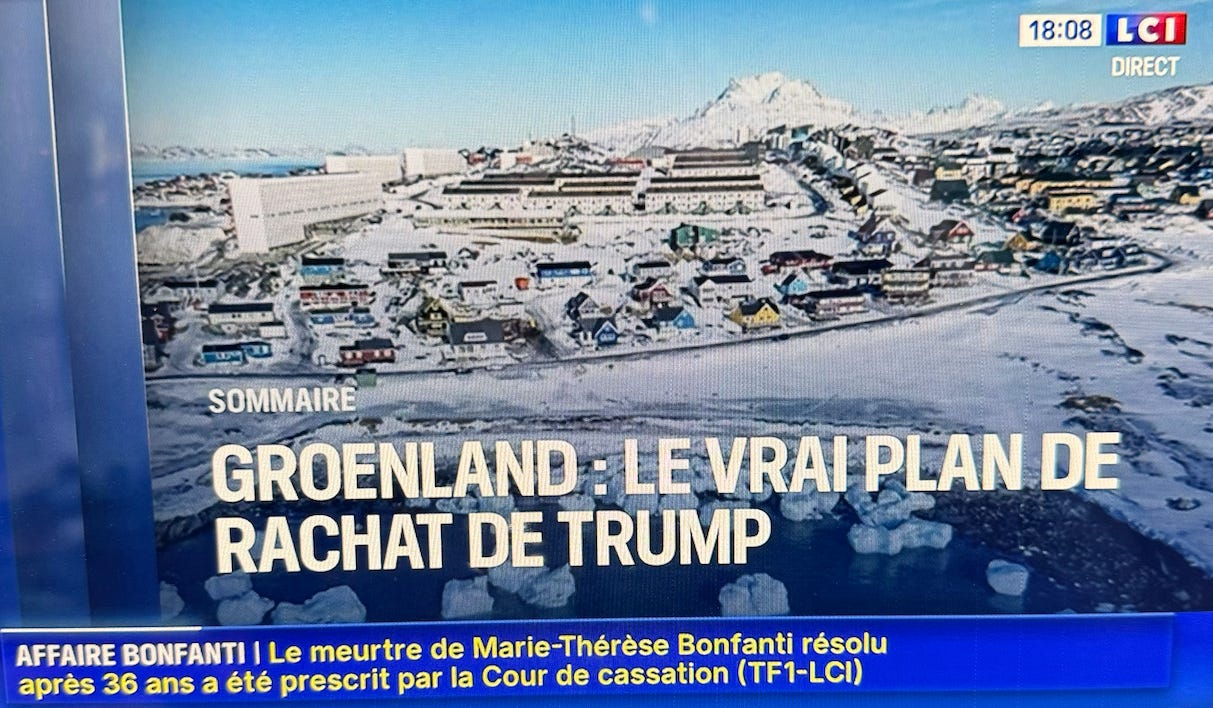
Europe isn’t confused about what it’s watching. It doesn’t see a hard-nosed negotiator or a misunderstood nationalist. It sees a man governed by grievance, indulged by a party that no longer restrains him, and dangerous precisely because no one on his side appears willing, or able, to say no. So Europe is recalibrating accordingly, not out of spite or ideology, but out of common sense.
The New York Times reported this week that European capitals are openly questioning whether the 80-year-old U.S.–Europe alliance can survive a leading power that threatens to invade a member, wages economic war on allies, and vows to cultivate far-right political movements to undermine their governments. This is not about Trump’s personality anymore; it’s about ideology. As one analyst put it, the attack on Europe “has been turned into an ideology.” Trust, once broken at this level, does not snap back. It takes generations to rebuild, if it ever does.
During a nap this morning, my subconscious apparently decided subtlety was overrated. I dreamed I was speaking to a European leader, (he looked suspiciously like Macron), and urged him to help arrange some sort of international intervention, because the U.S. president desperately needed one and no one at home was doing their job. I woke up amused, then unsettled, then annoyed at how little that scenario actually felt like fantasy.
That’s the real humiliation here. Not that Trump is behaving this way, but that Americans are increasingly imagining foreign leaders as the grown-ups because our own institutions have abdicated that role.
Europe is not counting on the GOP to intervene. Neither, increasingly, are Americans. We’re now hearing chatter,]tested casually, like a trial balloon, about canceling or undermining the midterms. Authoritarian systems don’t usually announce the end of elections outright. They soften the ground first to normalize the idea that rules are optional when the leader feels threatened.
Which brings us back to the beginning. Trump could, with a word, lower healthcare costs for millions of Americans. He chooses not to. Instead, he threatens allies, fixates on imaginary slights, and manufactures crises big enough to blot out reality itself. The Republican Party enables this not because it can’t stop him, but because stopping him would require breaking with a cult that now defines their power.
The dikes keep springing leaks. Each day requires a new plug, another distraction, and greater escalation. Power for Trump is not freedom in this context; it’s life support. Voters, allies, and institutions must keep the machine running, regardless of the cost.
All of this brings us to the only place responsibility can land now: the Republican Party. Europe isn’t waiting for the GOP to act. Voters are losing faith that it will. And Trump, increasingly cornered by his own failures and grievances, is escalating precisely because no one on his side is stopping him. That makes this moment not abstract, but urgent.
We have been here before. On January 6, 2021, the republic held not because of a sweeping bipartisan uprising, but because one Republican did his job. Mike Pence did not act heroically; he acted constitutionally. He followed the law. And that was enough, barely, to stop a catastrophe. The bar was low, and he cleared it.
That is all that is required again. Just a handful of Republicans willing to say no, to reject threats against allies, to insist on elections, to lower healthcare costs instead of inflaming chaos, to reassert that reality exists and rules still apply. History does not demand perfection in moments like this, just courage in small numbers.
This is the GOP’s moment to shine if it chooses to. To prove it is still a political party and not a personality cult, and to show allies that the United States is more than one man’s grievances. Most importantly, it can show Americans that democracy still has defenders inside the system.
Pressure matters. It worked in the House on healthcare, and it has worked before, when Republicans felt watched, judged, and unable to hide behind silence. That pressure must not let up now, on senators, on leadership, on anyone still pretending this will resolve itself. We only need to turn a handful to end this decline.
If this moment passes unanswered, it won’t be remembered as Trump’s failure alone. It will be remembered as the moment when the people who could have stopped him chose not to, and let everyone else pay the price.
I come close to badgering my Democratic representatives in Congress with various means of communication. I ask them the same questions.
Why do you defer to your institutional leaders (Schumer and Jeffries) when they are manifestly unsuited to this moment of constitutional crisis? They certainly have a role to play, but it isn’t as the default voices of the Democratic Party.
Why are you unwilling to unite around effective messaging - especially for the 2024 non-voters and those with regrets for buying Trump’s snake oil? MAGA faithful are a minority. Many others are focused on their bubbles, but even most can tell something is seriously wrong.
Americans generally grow up primed to believe in the Bill of Rights and to reject tyranny and lawless brutality by federal agents.
We’re not primed for torrential lies, betrayals of the Constitution, and provocations from the President and his operatives. That’s where adaptive, astute opposition leadership makes a difference. This need is still largely unmet.
We need a real-life Horton the Elephant who can hear the cries of the people saying, "We are people too", but in reality it's up to us to take that chant to every street in every city while demanding our elected official's do their appointed jobs however impossible they seem. Today, Martin Luther King Day, it's important to keep working toward the dream instead of the nightmare we're currently in.