


Good morning! By the time Donald Trump finished his Wednesday campaign marathon, he had traveled from Arizona to Montana, solved the nation’s economic problems, defeated Iran several more times, reinvented artificial intelligence, and explained why accepting a luxury 747 from Qatar was simply good manners. As golfer Sam Snead supposedly advised, when someone gives you a putt, you say thank you. The same etiquette, it seems, applies to a jumbo jet from a foreign monarchy, particularly one with room for a little gold trim.
The rallies were a traveling production of MAGA’s Greatest Hits, with a few new verses. Coal must always be called “clean, beautiful coal.” Artificial intelligence is now “super intelligence,” presumably because the technology wasn’t sufficiently impressed with itself. The planet is cooling, and the president is 53. Then came his demonstration of how difficult cognitive testing supposedly gets: “15. Triple it. Divide by four. Add 37. Add another 293. Subtract 12. Multiply by two. Divide by three.” Trump declared, “I got it right,” without ever providing the answer. For anyone playing along at home, it’s 219.5.
Somewhere between Bullhead City and Kalispell, his claimed total of new American investment grew from $21.2 trillion to $22.2 trillion. A trillion dollars accumulated during the flight. At this rate, he could retire the national debt by adding a stop in Idaho.
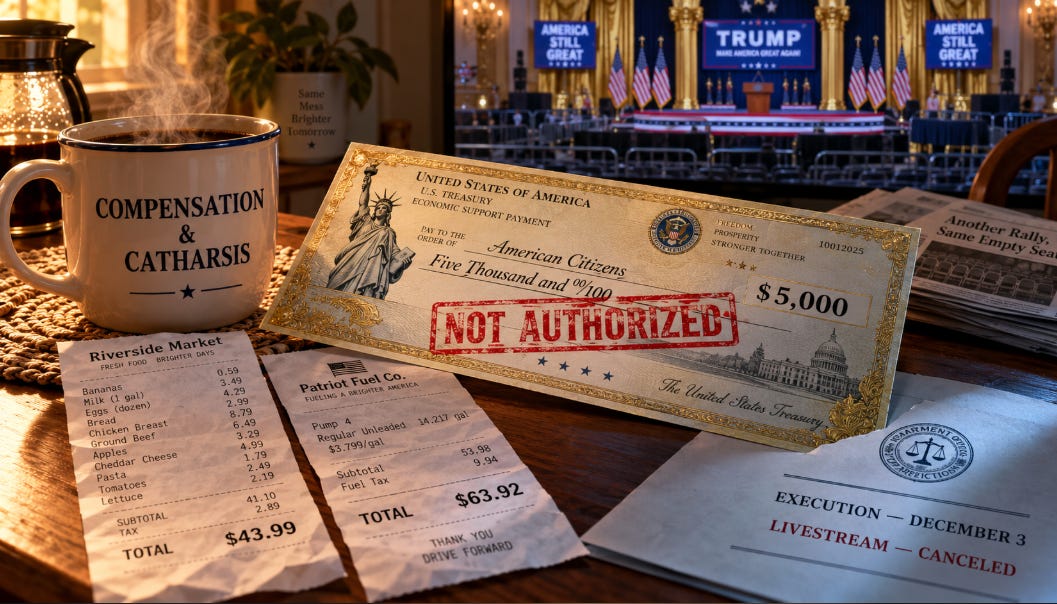
The promised $5,000 checks now come with fine print: citizens only, money spent in America, and a voter ID requirement Trump threw in for good measure in Arizona. No legislation authorizes them. The check is in the mail, provided voters first deliver the election, Congress supplies the money, and somebody eventually locates an envelope. Montana also heard about a new weapons-testing range, which Trump said he granted “just to get them to stop calling me,” and a $3 billion mortgage program for the state. Details about where the weapons range will be built, how much it will cost, or how the mortgage initiative will work were conspicuously scarce.
Trump isn’t on the November ballot, so he begged audiences to pretend he is, citing an unsourced claim that turnout jumps 49 percent when he runs.
Beneath the boasts and the inventive arithmetic were two subjects that deserve more attention. One is an economy Trump insists has never been better. The other is his growing emphasis on punishment, including today’s reversal on livestreaming Nidal Hasan’s execution. This morning, The Guardian published polling that helps explain why the economic victory lap is stalling.
It turns out that telling people they’re rich doesn’t persuade them when they’re struggling to pay the bills.
Trump’s economic message has the virtue of simplicity. Incomes are at record highs, poverty is at a record low, inflation is “1.7 percent,” and the only people worried about affordability are reporters, whom he mocks for saying the word. In Kalispell he went further: “We don’t have inflation and tariffs don’t cause inflation.”
The Bureau of Labor Statistics had weighed in that same morning. Consumer prices rose 0.6 percent in September alone and 3.7 percent over the year. Gasoline jumped 9.1 percent in a single month. The Guardian notes that it’s the highest inflation reading heading into a midterm since 1990, setting aside the pandemic. Core inflation, which excludes food and energy, also rose faster than expected.Inflation-adjusted hourly earnings have been lower than a year earlier for six consecutive months. That’s a lot of “no inflation” for one Wednesday.
Voters didn’t need the report. A Harris poll for The Guardian, conducted September 24 through October 3, before the new numbers arrived, found Americans had already reached their own conclusions.
The most striking shift is among Republicans. This past February, just before the U.S. began striking Iran, 49 percent of Republicans said the economy was getting better. Today, 28 percent do. Two-thirds of independents say it’s getting worse, up from 48 percent during the 2024 campaign. And 96 percent of Republicans agree the country faces an affordability crisis. When Trump ridicules reporters for asking about affordability, he’s ridiculing nearly his entire party.
Rural America, the bedrock of his coalition, looks shakier still. Four in ten rural Americans describe themselves as living in “survival mode,” where one surprise bill could sink them. That’s a higher share than urban or suburban residents. Asked who is most responsible for gas prices, 46 percent of rural respondents pointed to the U.S. government. Only 28 percent of Republicans said the same, preferring to blame oil companies, the Iranian government, or natural economic fluctuations. Nearly half of rural respondents seem less inclined to let Washington off the hook.
Gas costs about $1.20 a gallon more than a year ago, and Californians are paying an average of $6.20. Two-thirds of respondents name gas and grocery prices as their top issues.
Trump, for his part, has been unusually candid about the pump. In Bullhead City he admitted he knew gasoline would spike when he went after Iran, and said he thought it would go “much higher.” He then observed that “our country is making more money than it’s ever made because of the fact that oil is so high.” He’s right that someone is making money.
None of this hands Democrats a victory. Half of independents say neither party has a solution. Just 14 percent believe Democrats have one, while 10 percent say Republicans do. But it explains why Democratic candidates keep returning to groceries and gas. Abdul El-Sayed, the Michigan Senate candidate Trump insists on calling “Muhammad,” put it plainly: “My name is not the reason your gas prices are through the roof.”
Which brings us back to the $5,000. A president presiding over the greatest economy in human history wouldn’t need to promise every adult a check for keeping his party in power. The dividend is the tell. Trump insists there’s no inflation problem while promising voters who aren’t feeling his economic miracle a giveaway with no legislation, no funding mechanism, and a price tag he puts at $1 trillion.
The checks remain a slogan. The firing squad has a date.
Trump announced this morning that Nidal Hasan, who murdered 13 people at Fort Hood in 2009, “will die, as scheduled, by firing squad, but this event will not be streamed.” Victims’ immediate families will be allowed to watch. The rest of us will have to make do with the announcement.
It took a week to get there. Pete Hegseth announced on October 8 that the execution, set for December 3, would be livestreamed so people would understand the consequences. The next day Trump told reporters, “Did I approve? Absolutely I did.” Later that same day he told a Syracuse TV station he “wasn’t involved in that decision.” By Saturday he was weighing “two thoughts: Don’t show it and show it.” According to CNN, Trump hadn’t realized Hasan was paralyzed from the waist down and used a wheelchair. Learning that reportedly made the spectacle less palatable to him, even as bipartisan objections mounted. Broadcasting soldiers shooting a man in a wheelchair has limits as a recruiting video.
Even in reversing course, Trump insisted streaming “might have been a strong deterrent.” The first military execution in roughly six decades was nearly a webcast.
That sensitivity to the appearance of suffering is difficult to reconcile with Trump’s social media feed on Tuesday, the same day CNN’s report appeared. He shared footage of William Chapman being mauled by a tiger at a British wildlife park, an attack that killed him. The White House’s official Rapid Response 47 account then shared the footage on X, giving it another government megaphone. Chapman’s family, who said he had struggled with serious mental illness, pleaded for the circulation to stop, describing the material as deeply offensive and distressing. Trump subsequently posted an AI-generated video of himself wrestling with a tiger before embracing it. The prospect of broadcasting one man’s execution apparently required reconsideration. Broadcasting another man’s fatal ordeal didn’t even give the White House’s communications team pause.
At both rallies, Trump closed with a promise that a Republican Congress would pass the death penalty for large-scale drug dealers, human traffickers, and anyone who kills a police officer. In Bullhead City he added that leakers “should be shot,” reminiscing that “in the old days we used to shoot leakers.”
Much of this plank already exists. Murdering a federal officer can carry the death penalty, and federal law already authorizes executions for certain major drug-trafficking offenses. Expanding capital punishment to nonfatal human trafficking would face serious constitutional questions under Kennedy v. Louisiana, although the Supreme Court left some other non-homicide offenses unresolved. The whole riff is more about creating a mood than explaining a legislative program.
The administration, meanwhile, took a different approach to firearms oversight. After an August Texas court ruling limited to the plaintiffs, the Justice Department declined to appeal and extended the decision nationwide. On October 9, ATF stopped enforcing registration and advance-approval requirements for suppressors and certain short-barreled firearms. Trump told the Montana crowd he “took a little heat” over the change. In 2019, after a gunman using a suppressor killed 12 people in Virginia Beach, Trump said, “I don’t like them at all.”
Suppressors have legitimate uses, including hearing protection, and rarely appear in firearm crimes. There’s no established evidence that this rollback will increase gun deaths. But firearms killed 44,447 Americans in 2024. Homicides declined, while gun suicides reached a record 27,593. Firearms remained the leading cause of death among children and teenagers ages 1–17. Those deaths are absent from rally speeches celebrating record-low murder rates.
The administration is loud about punishment after the fact and considerably quieter about prevention. Executions get press releases and near-livestreams; the firearms rollback attracted far less fanfare. Unlike Trump’s promises to expand the death penalty, that policy change has already taken effect.
Trump spent Wednesday describing a country many Americans don’t recognize: richer than ever, safer than ever, its problems solved and its enemies on the run. The rally crowds cheered. Outside, according to the Guardian poll, Americans were checking grocery receipts and worrying about the next unexpected bill.
The campaign pitch combines compensation and catharsis: a promised $5,000 check and promises of expanded executions. Neither explains why gasoline costs roughly $1.20 more per gallon than a year ago. Meanwhile, September inflation accelerated and real hourly wages fell. The execution broadcast was canceled. The execution wasn’t.
Trump keeps asking Americans to pretend he’s on the ballot. But there’s no need to pretend about the grocery bills, the economic data, or what his administration has actually done.
Blessedly, Trump has no campaign rallies scheduled today, giving us what may be the closest thing to a national day of rest. The microphones could use a break, and frankly, so could I. Marz and I are off for a little personal care this morning, after which I hope to tackle some genuinely heavy subjects that have been waiting patiently while the president toured the country adding trillions to the economy between airports.
Those stories deserve more than a hurried paragraph squeezed between another $5,000 promise and the latest announcement that the war will end very shortly. Thank you, as always, for sharing your morning with me, and for helping keep this daily expedition through the extraordinary grounded in reality.
There’s a great deal happening in this country that deserves our attention, even when Donald Trump isn’t demanding it.
My Dear Mr. President:
Having countermanded Defense Secretary Hegseth’s vile order to livestream an execution, your next step should be to fire the son of a bitch.
You’re good at that.
Regards,
Thank you