

President Trump’s “Great Healthcare Plan” arrived the way so many modern policy announcements do, as a video posted on social media, and a promise that the details will totally show up later, which I suppose is slightly better than announcing a military strike on Venezuela via Truth Social. The White House framed it as a broad initiative that will slash drug prices, cut premiums, boost transparency, and “deliver money directly to the people.” Critics, meanwhile, have been characterizing it less as a plan and more as a grab bag, a framework, an assemblage of vibes, and in probably the most charitable reading, a policy mood board. And the annoying part, annoying for supporters, satisfying for skeptics, is that the available facts really do give critics a lot to work with.
One of the loudest critiques is the simplest, it’s vague. The Washington Post reports “the administration offered no legislative text and no clear strategy for getting it through Congress,” describing the rollout as “broad architecture” which is Washington for “we didn’t bring the homework.” The vagueness isn’t just aesthetic. It’s structural. When you propose rewriting how millions of people get help paying for coverage, the difference between “framework” and “bill” is the difference between “I’m thinking of buying a house” and “here is the mortgage I signed.” A non-trivial chunk of this plan is basically, “Congress, you figure it out.” Which is a bold approach in a Congress that famously cannot agree on whether water is wet.
The plan’s centerpiece is a big shift, and critics say it could hit low-income people hardest, reports say the plan would replace ACA insurance subsidies with direct payments into individuals’ health savings accounts (HSAs). That’s the beating heart of the framework, instead of subsidizing premiums through the Affordable Care Act structure, you route money into an account and let consumers spend it. Critics argue that this shift is likely to work best for people who already have the slack in their budgets to make “shopping” for care feel empowering rather than like a scavenger hunt in a hurricane. With some reports noting criticism that the move could be more harmful than helpful to lower-income Americans, potentially pushing them toward high-deductible or short-term plans.
This is where the critics’ argument gains traction from plain arithmetic and lived reality. HSAs are great if you have spare money. But if you’re living closer to the margin, “Here’s an account” can sound like “Here’s a jar, good luck filling it.” Critics don’t even have to invent a villain; the villain is the deductible.
Another critical characterization, this is political theater timed to pain. Reports are pointing out the subtly obvious, the announcement landed as ACA open enrollment ended and highlighted a sharp premium jump, reporting an average premium increase from $888 in 2025 to $1,904 in 2026. Which kind of makes the point that rolling out a “Great Healthcare Plan” right as people discover their premiums are doing parkour off a cliff is like unveiling a “Great Umbrella Plan” during a hurricane, with no umbrellas and a note that Congress will knit them later.
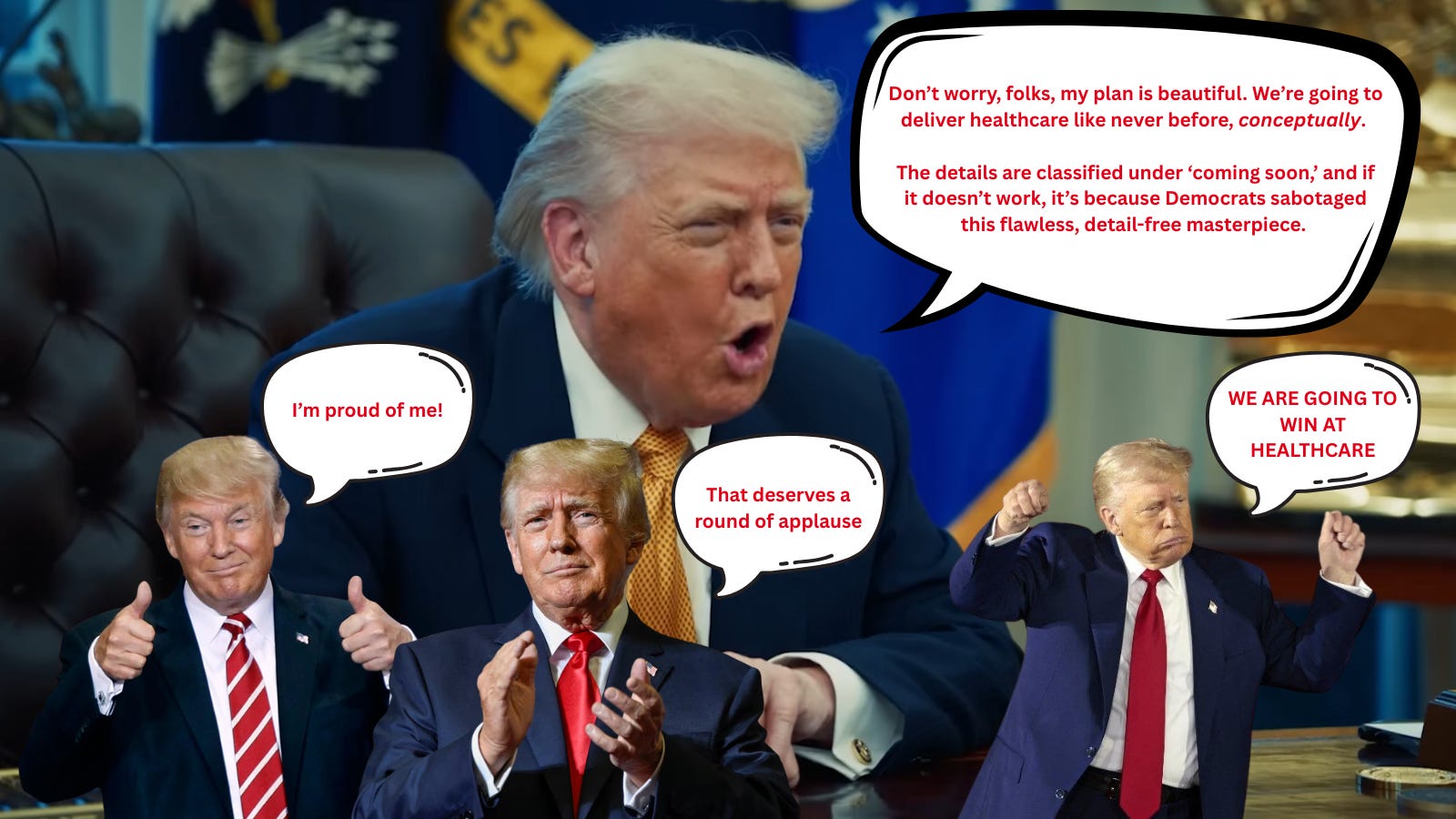
But perhaps the greatest piece of irony, the plan calls for fully funding the ACA Cost Sharing Reduction (CSR) program, a set of payments that help insurers provide reduced out-of-pocket costs for eligible enrollees. The rhetorical whiplash is gold, the plan attacks the ACA as “Unaffordable,” yet leans on a core ACA mechanism to claim premium relief. That doesn’t automatically make it bad policy, but it makes the branding sound like someone yelling “I hate this restaurant!” while ordering the chef’s special.
The framework leans heavily on Trump’s “most-favored-nation” approach, tying U.S. drug prices to those paid in other countries, and promises dramatic cuts. Critics don’t have to oppose the goal of lower drug prices to question the sales pitch. The NY Mag/Intelligencer piece calls the rollout a repackaging of assorted ideas and highlights the video’s wild claims, including an instance of boasting about lowering prices by “more than 100 percent,” which is, to borrow the technical term “not how numbers work.” Even if you like the direction, international reference pricing, cracking down on pricing power, leveraging negotiation, the rollout’s rhetorical style is exactly what critics mean when they call it more marketing than machinery. Policy can be ambitious without claiming it will produce negative prices, at which point Pfizer pays you to take Lipitor and everyone gets a free yacht.
One of the more concrete planks is transparency. Trump says insurers would be required to disclose pricing, profit margins, claims data, rejection rates, and average wait times, and there are transparency expectations for providers/insurers receiving Medicare/Medicaid funds. The response is basically, “transparency is good, but it’s not a parachute” knowing you’re about to hit the ground does not reduce the impact.
But wait, it gets better, and this is where the “vague framework” label becomes more than a punchline. If you replace ACA subsidies with HSA deposits, the key questions are, “how big are the deposits? How are they adjusted for income, age, region, family size? What happens if premiums or out-of-pocket costs exceed what’s in the account? What about people who can’t front costs, even temporarily?” The public-facing documents described by major outlets don’t answer those in bill-like detail; they present a set of goals and levers. This is not a minor omission, it’s the omission. Because without those answers, the plan can be simultaneously “great” and “catastrophic,” like a restaurant review that says “Amazing food, prices, and atmosphere” but doesn’t mention that the restaurant is actually located on the bottom of the ocean.
Even sympathetic coverage of the announcement acknowledges a basic reality, the plan faces serious hurdles. Some reports note challenges in a divided Congress and that the plan was developed without consulting insurers. Others report uncertainty among Republican leaders and note Democrats’ attacks on the lack of substance. Which characterizes the rollout as performative, partly because it appears to lack a plausible legislative path. A framework without a coalition is like hosting a ribbon cutting for an empty lot. Which doesn’t mean every element is useless or that every criticism will hold if details emerge. Transparency can help. Drug pricing reforms can matter. CSR funding has real effects in the marketplaces. But a list of intentions is not the same thing as a plan, and “Great” is doing a lot of heavy lifting here, like a moving company with one intern and a motivational quote.
In the end, the “Great Healthcare Plan” reads as a political object first and a legislative object second, a signal, a headline, and a challenge to opponents, delivered at the exact moment the public is most likely to notice healthcare costs. Maybe this is the most honest way to summarize the announcement, it’s not that the plan has no ideas. It’s that it has ideas arranged like a fireworks show, big, loud, and best appreciated from a safe distance. And like fireworks, you aren’t there to watch a dark sky after the big show, you’re there for the moment you’re told to look up. The timing is the point, a bright, booming spectacle launched right as the administration most needs everyone’s eyes on the sky instead of on the fine print, the vote count, or the bills landing in people’s inboxes.
It’s bullshit.
The puppeteer eschews anything except spun 24 c gold for the strings that he uses to run the show. Problem now, he’s got the strings all tangled up but no one dares to correct him.