


Trump reached into the goodie bag again Wednesday. He rummaged past the $5,000 dividend, the $500 refund, the $90 payment and the $21 trillion in promised investment and pulled out an old favorite: Trump Accounts for America’s children.
This particular goodie was not new. Congress created the accounts in Trump’s signature tax-and-spending law last year. Treasury launched the app in May and the full program over the July Fourth weekend. Trump held a White House event on July 6 to celebrate the launch, complete with the ringing of the New York Stock Exchange and Nasdaq opening bells from the Oval Office.
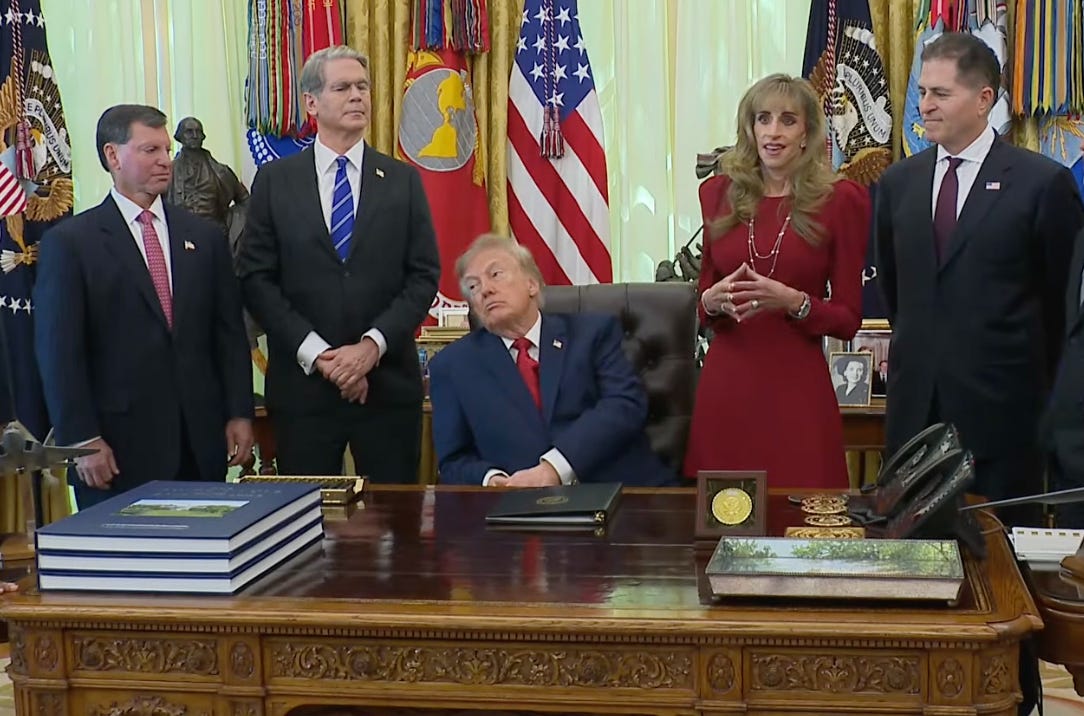
Even some of the sales pitch had been pulled from storage. Senator Ted Cruz returned today to remind children that their Trump Accounts made them tiny shareholders in companies such as McDonald’s. The next time they went for a burger, he said, they could look around and announce, “I own this place.”
This time Cruz added Aunt Susie, an ugly birthday sweater and a QR code. Instead of buying the sweater, he suggested, Aunt Susie could scan the code and put $50 into the child’s investment account. Keep investing, Cruz said, and eventually there could be hundreds of thousands or even millions of dollars.
What was new was scale. Treasury says it has now completed automatic enrollment, adding more than 60 million eligible children to the system, while Michael and Susan Dell have committed $6.25 billion to put $250 into accounts for 25 million children.
Less than a month before the midterm elections, the White House plainly wanted Americans thinking about what the administration was giving children.
They left some dirty details in the goodie bag. The same enormous law that created Trump Accounts also rewrote the rules for the Supplemental Nutrition Assistance Program, the federal program millions of Americans use to buy food.
ABC News reported last week that more than five million Americans had disappeared from SNAP over the past year. More recent estimates from the Center on Budget and Policy Priorities suggest well over 1.5 million of them were children.
October 1 brought two very different developments.
For people who remain on SNAP, the program’s ordinary annual inflation adjustment modestly increased the maximum benefit. A single-person household in most states went from a maximum of $298 per month to $306. A family of four went from $994 to $1,023.
That is $29 more a month for groceries.
At the same time, another provision of the law began shifting substantially more of SNAP’s administrative cost onto the states. The federal government’s share fell from 50 percent to 25 percent, leaving states responsible for 75 percent.
Beginning in 2027, states with payment-error rates above 6 percent will also have to pay a portion of the food benefits themselves. Stateline reports that analyses of USDA data suggest those costs could eventually total more than $9 billion across the states. Importantly, the federal “error rate” includes overpayments and underpayments; it is not a measure of fraud.
So while one arm of the federal government is building a polished app to make it easier to put money into children’s investment accounts, another is making states spend considerably more money administering a program that helps families put food into children’s stomachs.
Stranger yet, Treasury did not merely establish Trump Accounts and wait for parents to discover them. On October 1, it automatically created accounts for every eligible child under eighteen with a Social Security number. Parents must still claim the accounts before they can manage them or accept ordinary contributions, but the federal government did the enrollment work first.
Friction, in other words, was treated as the enemy. There is an app, a website and QR codes, and Treasury can reach families by text, e-mail or automated call to help activate the accounts. If Grandma wants to put $50 into a child’s future, Washington wants to make it painless.
SNAP is moving in the other direction. The law expanded work requirements, raised the age through which they apply and removed some previous exemptions. Families with older children can now face requirements from which they were previously excused.
States are simultaneously being told to administer this more complicated system with a much larger share of the bill landing on their own budgets.
Because future financial penalties depend on payment-error rates, states have a powerful incentive to scrutinize applications and renewals more aggressively.
Arizona offers a preview. As Brittany Page highlighted this week, reporting from the New York Times found that roughly 440,000 Arizonans had disappeared from SNAP in less than a year. Many were still potentially eligible for assistance. But Arizona, facing the prospect of enormous future federal penalties for payment errors, increased the paperwork applicants must provide even while cutting the staff available to process it.
The result, according to recipients and officials quoted in that reporting, was bureaucratic chaos.
Even the administration’s fraud narrative becomes considerably messier when examined closely.
Page highlighted reporting from Politico in which Ohio and Georgia challenged federal findings that had classified large numbers of questionable SNAP payments as potential fraud. Former USDA specialists said the department appeared to be sweeping ordinary administrative mistakes and otherwise proper payments into a much broader category of suspected wrongdoing.
An error is not necessarily fraud, an overpayment is not necessarily theft, and a shrinking caseload does not necessarily mean fewer people need food. Sometimes it means fewer people made it through the paperwork.
For the Susan Dell section:
At Wednesday’s event, Susan Dell offered perhaps the most humane explanation of what the accounts are supposed to accomplish.
“It’s not just the money that matters. It matters, but knowing that someone believes in you and your future, that matters just as much.”
Economists have asked almost exactly the question her remark raises: Is helping poor families feed their children itself an investment in those children’s future?
The answer, according to one major study, is yes.
Martha Bailey, Hilary Hoynes, Maya Rossin-Slater and Reed Walker used the staggered county-by-county introduction of Food Stamps between 1961 and 1975 as a natural experiment. After decades of follow-up, they found that children who gained access before age five went on to have better outcomes as adults: more human capital, greater economic self-sufficiency, better neighborhoods, lower incarceration and longer lives. The researchers concluded that Food Stamps were a highly cost-effective investment in young children, estimating a marginal value of public funds of roughly 62.
That makes the contrast harder to dismiss as merely a difference between “investment” and “assistance.”
Groceries get eaten. There is no account statement showing the return twenty years later.
But the return can still be there.
A child does not suddenly acquire a future when an investment account matures. That future is already being built at breakfast, in the lunch packed for school and in the refrigerator at the end of the month when rent has been paid and the utility bill is still sitting on the counter.
The difference may have as much to do with accounting and branding as economics. Washington scores programs over relatively short budget windows, while many of SNAP’s benefits appear decades later and in entirely different ledgers: higher earnings and tax receipts, lower public-assistance needs, lower incarceration costs and better health.
Trump Accounts look like investment on day one: a child’s name, a balance, an app. SNAP leaves no visible asset and no account statement showing the return twenty years later.
Trump Accounts can help children build assets, particularly those eligible for the federal $1,000 seed contribution or additional family, employer or philanthropic support. But an investment account is not household income, and families struggling to buy food are the families least able to redirect $50 from today’s groceries into an index fund for 2044.
There is no contradiction in helping children build assets while also helping families buy food. The revealing difference is in how the two systems are designed: investment is made easy, automatic and inviting, while food assistance comes with more scrutiny, paperwork and penalties for states.
Then cut the later owner/stigma repetition entirely and go straight into the closing:
But legislation is not a goodie bag, and the shiny thing pulled out for the cameras is only part of what Congress packed inside.
The children at the White House spent the afternoon learning about compounding: small advantages, given time, can become much larger ones.
So can hunger, instability and childhood poverty.
The lesson about compounding was right. It was simply incomplete.
The $250 in each account is not going to pay to feed these children between birth and 18 years old. We have our priorities backwards here (we don’t it is Trump and his minions as usual).
Does anyone else find it a bit creepy that the federal government created and is tracking a bank account for everyone under the age of 18 in this country?
This administration is so cruel! How can they live with themselves knowing that children are going hungry?