


Good morning! If one man’s love life can move markets on three continents, we didn’t stumble into this. We built the trap, then walked right into it.
That is the real lesson of Nvidia’s past two weeks. Jensen Huang resigned as chief executive on Nov. 12 after reports of at least two extramarital affairs, one of them with a woman U.S. officials believe was working with Chinese intelligence. Eleven days later he was back, after the president of the United States leaned on the company’s board.
In between, Nvidia shed more than $1.5 trillion in market value. Regulators in China, Taiwan and South Korea rushed out measures to steady their own markets. Then Monday’s reinstatement handed the S&P 500 its biggest one-day gain since April 2025, sent Taiwan’s TSMC up nearly 10 percent and lifted South Korea’s Kospi more than 6 percent overnight.
By Tuesday morning, the hangover had set in. Nasdaq futures slid 2.4 percent, Nvidia gave back about 5 percent before the opening bell, and one trader told the Financial Times that Monday’s surge “looked very much like a short squeeze.” A balcony full of employees chanting his name makes for nice video. It isn’t a succession plan. And an economy that needs one executive back to keep its footing is a hostage situation with a ticker symbol.
When that executive’s private life is entangled with a suspected Chinese intelligence asset, the fragility stops being merely financial. It becomes a potential national-security vulnerability. That is precisely when a president should be asking whether the country’s interests are protected, not simply whether investors are happy.
Trump didn’t merely root for Huang’s return. He arranged it. “I convinced them … I made the deal,” he told CNBC on Monday. Over the weekend, he had enlisted Vice President JD Vance to speak with Huang and Nvidia’s board.
He also had money riding on the outcome. His financial disclosures indicate he may have owned as many as 370,000 Nvidia shares as of Sept. 30. If he still held them Monday, the rally could have added as much as $15 million to their value. The Washington Post estimated his stake at between $13 million and $62 million at the end of August, up from roughly $1 million at the end of 2024. The White House says outside managers handle his investments. Jimmy Carter put his family’s peanut business into a blind trust.
The New York Times reported that the episode divided Trump’s administration between officials concerned about China’s access to advanced AI chips and those worried about the stock market. Trump, the paper concluded, “clearly sided with the stock market.” His advisers, including Secretary of State Marco Rubio, had briefed him at least twice about the national-security concerns surrounding Huang’s relationship with a suspected Chinese intelligence asset. Trump claimed nobody had briefed him.
The Nvidia rescue wasn’t the week’s only intersection of presidential power and personal profit. On Sunday night, Trump hosted his third Trumpcoin gala at his Northern Virginia golf club, where the biggest holders of his meme coin qualified for invitations. CBS News found that more than half the qualifying wallets had used exchanges that prohibit American customers, raising questions about foreign participation without establishing who actually owned the wallets. Trump’s financial disclosures show more than $600 million in cryptocurrency-related royalties, while the token itself has lost nearly all its peak value. He told 60 Minutes his sons handle the crypto business. He was the one on stage.
Democrats preparing to take control of Congress in January are already being warned not to spend too much time investigating at the expense of lowering costs. They can do both, and as this week shows, they’re often the same job.
Across the Atlantic, Europe has been getting on with the less glamorous business of reducing its dependence on Washington’s whims. In Berlin, German Chancellor Friedrich Merz reiterated a collective commitment of €70 billion a year for Ukraine in 2026 and 2027. NATO Secretary General Mark Rutte offered a straightforward response to Russian provocations: “more support for Ukraine, not less.” The chandeliers in Shenzhen were lovely, I’m sure. Ammunition is more useful.
Ukraine hasn’t been waiting for another diplomatic photo opportunity, either. Its forces collapsed a road span of Putin’s prized Kerch Bridge and sank a Russian corvette in Benghazi, Libya, using Ukrainian-built sea drones. The Black Sea is no longer the limit of Ukraine’s reach.
Western intelligence agencies warn that Russia could launch a nuclear-armed antisatellite weapon within weeks, threatening the communications and navigation systems on which modern societies depend. Moscow denies the allegation, and no launch has been confirmed. Yet another reminder of what happens when critical infrastructure can be held hostage.
Back at Nvidia, the board had managed a remarkable feat of its own: reaching two opposite but unanimous conclusions in six days.
It is worth keeping the chronology straight, if only because Nvidia’s board managed to reach two opposite but unanimous conclusions in six days.
Huang resigned the morning after an emergency board meeting over his affair with an employee, a violation of Nvidia’s own code of conduct. The other relationship was with Alice Huang (no relation), a former executive at Megaspeed, a Singapore cloud company that has bought more than $4 billion in Nvidia chips since 2024 and is now the subject of a Justice Department criminal investigation into whether those chips were smuggled to China. U.S. intelligence had her under surveillance. Despite the intelligence concerns, the administration never gave Huang a defensive briefing warning that he might be the target of a foreign intelligence operation.
Last week, board chair Harvey Jones said the board had unanimously accepted Huang’s resignation and did not intend to bring him back. On Sunday, it voted unanimously to do exactly that. In between, according to the Financial Times, a small team of Huang’s Silicon Valley allies, including Travis Kalanick, Marc Andreessen and the investors Gavin Baker and Brad Gerstner, lobbied the White House. One of them arranged a 45-minute call in which Huang defended his Megaspeed dealings directly to Vance. Treasury Secretary Scott Bessent, who a week earlier had accused Nvidia of inflating its revenue through illicit China sales and called for a leadership shake-up, softened his stance on Sunday. By Monday, Baker was celebrating on X: “This is why America is the greatest country on earth.”
Corporate governance experts were less enchanted. Harvard Business School’s David Yoffie, a former Intel board member, told the Times, “It neuters the board.” Harry Broadman, a former assistant U.S. trade representative who has worked extensively in Russia and China, said on Times Radio that Nvidia isn’t a state-owned enterprise but is “certainly behaving like one.” Even Newt Gingrich found something “profoundly wrong” with the situation and demanded a congressional investigation, although he somehow neglected to mention the president who arranged the reinstatement.
Trump, meanwhile, called Huang a “Great Patriot and National Treasure” and declared that “we have to protect our geniuses.” He also claimed the attorney general had exonerated Huang. Nvidia and Huang still face FBI and SEC probes, and the board’s own investigation, which it skipped waiting for, is still open.
The trap was built long before any of this. Huang had more than 60 executives reporting directly to him. His daughter was his de facto chief of staff, his son-in-law handled major deals, and after 33 years at the helm, the company apparently had no succession plan for its 63-year-old founder.
When the man is the system, the system can’t fire the man.
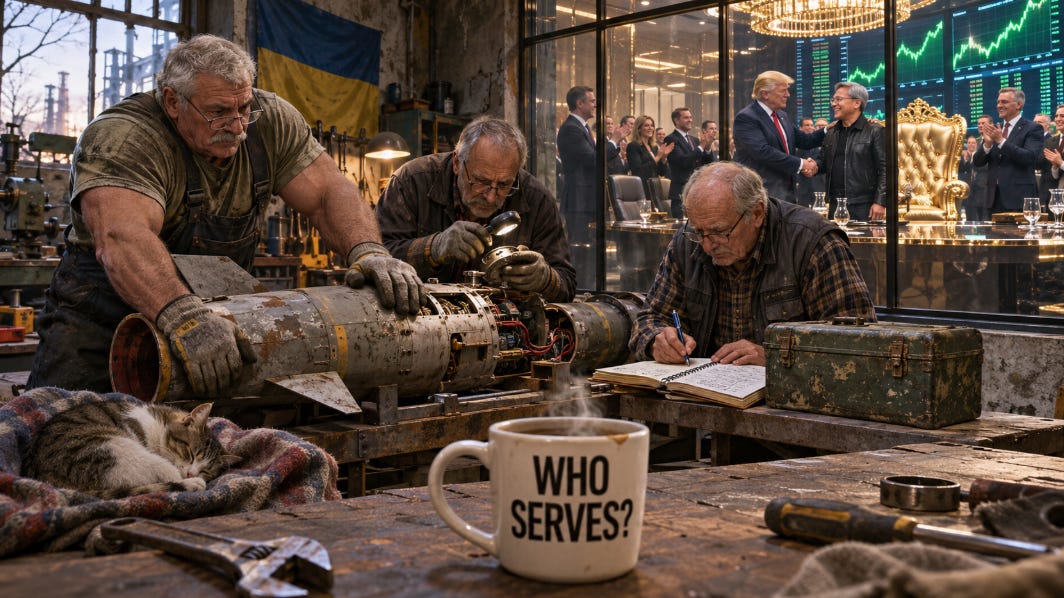
In the Zaporizhzhia region of Ukraine, a dozen men in their sixties call themselves pioneers, because it sounds better than pensioners. When Russia invaded in 2022, the army turned them away for being too old, so they formed their own unit, the Steppe Wolves. They repair broken rockets for other units in exchange for keeping some to fire themselves. One special operations commander told The New York Times he would gladly bring them into his unit officially.
For most of the war, they did it without pay. Petro, 68, a former weightlifter who still trains because the rockets are heavy, pointed out that if he were killed, his family would receive nothing. He said it without bitterness. Eventually, after President Volodymyr Zelensky signed a decree opening service to volunteers over 60, the men received one-year military contracts.
Arsen, 66, was a welder making boilers in Kharkiv when a recruiting office told him he was not needed. His son enlisted in January 2024 and was killed six months later. Arsen spent half a year in grief before joining the Steppe Wolves.
He explained his decision to The New York Times:
“My son fought for me. Now, I fight for him.”
Not sure even SNL could make this funny. Thank you, Mary, for keeping me informed. Some days it's only you and JVL I take time to read. Don't want my head to explode.
"And an economy that needs one executive back to keep its footing is a hostage situation with a ticker symbol." A classic sentence, Mary!