

The Trump administration would like you to know that everything is going beautifully.
The talks with Iran are productive. The president is patient. The deal, when it comes, will be a great deal, because the man making it makes “nothing but great deals,” a phrase Pete Hegseth delivered with the solemnity of a monk guarding a holy relic and the evidentiary support of a timeshare brochure. Iran knows what it needs to do. The United States is stronger now than it was on day one. The Strait of Hormuz will be open. The blockade is working. The stockpiles are fine. The allies are reassured. The drones are coming. The submarines are coming. The missiles are coming. The factories are coming. The “War Department,” a name that still has all the legal standing of a child declaring the couch a pirate ship, is ready if diplomacy fails.
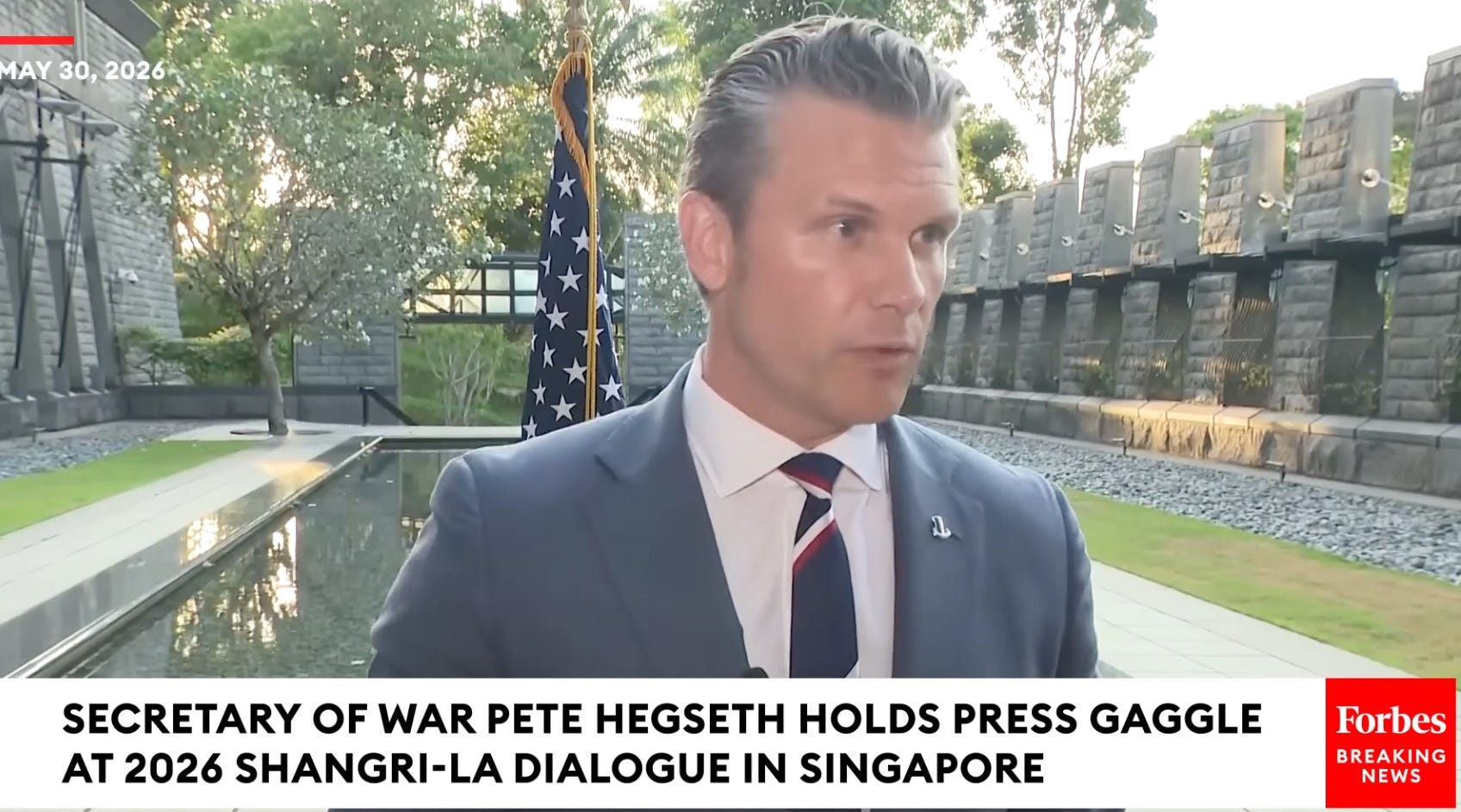
That is the war as Hegseth sold it to reporters in Singapore.
The war as the rest of the world is watching it looks somewhat different.
It looks like a Gambia-flagged commercial vessel disabled by a U.S. Hellfire missile in the Gulf of Oman after it tried to sail toward an Iranian port. It looks like U.S. Central Command boasting that American forces have now disabled five commercial ships and redirected 116 others to enforce a blockade that Washington insists is leverage and Tehran calls proof that Trump is “betraying diplomacy.” It looks like Oman warning ships about a suspected object that may be a naval mine in the Strait of Hormuz, a threat the administration keeps invoking even as U.S. officials admit they have searched the waterway and cannot confirm Iran actually mined it. It looks like maritime monitors calling the threat level in the strait “critical.” It looks like Iran warning commercial and military vessels that they must follow Iranian rules, use designated routes, and obtain permission from the IRGC Navy, while Hegseth tells reporters that Iran wants to claim it controls the strait, “but we do.”
To recap the official position: America controls the strait, Iran controls the strait, nobody can confirm whether the mines everyone keeps invoking are even real, and the commercial vessels in between are apparently expected to enjoy the clarifying experience of being hailed, warned, redirected, boarded, disabled, or used as props in a sovereignty argument with missiles.
Strong. Quiet. Clear.
This is the central trick of the Trump administration’s Iran war. It is not merely that officials are saying things that are untrue, although that is, as always, a load-bearing beam in the architecture. It is that every sign of failure is being renamed as proof of success. Escalation becomes leverage. Uncertainty becomes patience. A blockade becomes diplomacy. A shrinking set of war aims becomes strategic discipline. A temporary framework becomes a great deal. A closed strait becomes an American energy opportunity. A munitions squeeze becomes industrial renewal. A president who went into the Situation Room promising a final determination and emerged with no public decision becomes, in the official telling, a master negotiator waiting for the perfect moment.
It is foreign policy as a gaslight with a flag pin.
Hegseth’s press gaggle was a near-perfect specimen of the genre. Asked about Iran, he said Trump wants a deal, that talks are productive, and that Iran is “coming in our direction.” But he also said the United States is prepared to “re-engage” if necessary and is “postured even stronger today than we were on day one.” The administration’s peace strategy, in other words, is a two-item menu: sign here, or meet the Department of War’s emotional-support sledgehammer.
This is supposed to sound like strength. It sounds more like a man standing in front of a burning garage explaining that the flames are actually part of the home-security system.
The problem is that the foreign press and outside analysts are no longer pretending to see the same movie. Niall Stanage, the Hill’s White House columnist, put it plainly after Trump’s much-teased Situation Room meeting. Trump had said there would be a final determination about whether to move forward with a possible deal or memorandum of understanding. Then very little happened. There was no public determination. No signed framework. No clarity on scope. No clear language. No certainty that Iran had agreed to whatever Washington said was on the table. Stanage said Trump had, in effect, “played the media again,” spending weeks claiming that the parties were on the brink of a deal, that the Iranians were begging for one, that the United States might bomb them if they refused, while the actual specifics remained invisible.
This is diplomacy as cliffhanger content. Every day is the season finale. Every announcement is coming soon. Every deal is imminent until it isn’t. Every lack of detail is treated as evidence that the details must be too brilliant for civilians to behold.
But the details matter because the war’s stated purpose has changed so often that it now requires a dramaturg.
The war began, according to the administration’s early posture, as a regime-change operation. American and Israeli forces struck Iran on February 28. Iran’s supreme leader and several of its top security officials were killed. The implied promise was decapitation, collapse, the old fantasy that if you hit the right building hard enough, history will obediently change costumes.
Then Iran did not collapse.
So the objective became the nuclear program, except that one had supposedly been achieved already. When U.S. and Israeli forces bombed Iran’s nuclear sites at Fordow, Natanz, and Isfahan in the twelve-day war the previous June, Trump announced he had “obliterated” the country’s uranium stockpile. He had not. Iran is still believed to hold roughly 970 pounds of highly enriched uranium, close to weapons-grade, by the IAEA’s reckoning, dispersed and buried at underground sites. The deal now reportedly on the table defers the question of that material to later talks. Trump is negotiating to destroy the thing he already told the world he destroyed.
From there the goal kept moving. The Strait of Hormuz. Then the blockade. Then the reopening of the strait. Now, according to the reporting Stanage and others describe, the near-term deal may focus mainly on Hormuz: Iran reopening the strait and the United States lifting its blockade, with a sixty-day ceasefire extension and the nuclear question pushed down the road.
That is quite a journey. Regime change to nuclear disarmament to maritime access to “let’s agree to keep talking” is a strategic shrink-ray.
The Guardian’s Robert Tait described the same arc in terms the administration would never permit itself: a three-month odyssey that “threatens to take him back to where he started.” The experts Tait gathered were blunter still. Robert Kagan, the hawkish Brookings fellow, wrote in The Atlantic that “Trump’s endgame is surrender” and that the president “no doubt hopes that he can slip away without Americans noticing the magnitude of this defeat.” When the people accusing you of retreat are the ones who wanted a harder war, the “secret genius” defense gets difficult to sustain.
This is the part the administration cannot say out loud. A war launched with maximalist ambitions is now being negotiated down to conditions that look suspiciously like an attempt to restore the world Trump helped break. The Strait of Hormuz was open before the war. Oil markets were not in their current state before the war. U.S. forces were not enforcing a naval blockade against Iran-linked ports before the war. Washington was not negotiating over how to unwind its own blockade before the war. Trump did not need to explain why a temporary framework and deferred nuclear talks were actually a spectacular victory before the war.
Before the bombing, he had pressure, ambiguity, and options. After months of war, he has a closed or contested strait, energy markets balanced on a knife edge, reported injuries to Americans at a base in Kuwait, commercial vessels being disabled, munitions questions, anxious allies, and a possible deal whose most immediate achievement may be clawing back the status quo ante with extra wreckage.
The US is negotiating from the consequences of having mistaken strength for strategy.
Even the claim of strength does not survive contact with the inventory. Hegseth insists America’s stockpiles are fine and that reporting on shortages is false and ill-motivated. Yet in the same breath he describes a frantic plan to build two, three, four, five times the munitions, to stand up hundreds of new production lines, to coax fifty billion dollars in private capital into new factories, the kind of mobilization no one undertakes when the cupboard is full. The adversary he claims to have hollowed out has, by the assessment of Sina Toossi of the Center for International Policy, kept most of its arsenal intact: something like 70 percent of Iran’s ballistic missiles and 70 to 80 percent of its drones survived the war the White House described as devastating. An arsenal you destroyed does not fire more than eighteen hundred missiles across the region, and it does not put a Reaper out of commission in Kuwait this week.
Nader Hashimi of Georgetown described the underlying problem with unusual bluntness. Trump, he argued, appears to have realized that he failed to advance his war objectives against Iran. The regime survived the attempted decapitation strike. It fought back. It remains in control. Now Trump’s challenge is not how to win the war, but how to find an off-ramp from it and present that off-ramp as victory. That is the job Hegseth has been assigned: narrating damage control as dominance.
Robert Litwak of George Washington University framed it as a trap of Trump’s own making. The president, he said, is “in a box because a transformational outcome is not possible,” forced toward “a transactional deal that would be essentially a variant” of the 2015 nuclear agreement Barack Obama signed and Trump tore up in 2018, and he “may not even get similar terms, because the Iranians have been adept at playing their hand.” The stockpile Trump now wants destroyed exists in the quantity it does precisely because he abandoned the deal that had been capping it. The man who spent a decade deriding Obama’s agreement as a catastrophe may end up begging for a weaker copy of it, a possibility his own hawks have noticed. In the past week, Lindsey Graham, Ted Cruz, Senate Armed Services chair Roger Wicker, and former secretary of state Mike Pompeo have all warned against exactly that, even as Trump called the deal “95 percent negotiated.”
It is a harder job than it looks, although that has not stopped him from applying the full Fox Green Room confidence filter. When asked about the Strait of Hormuz, Hegseth said the blockade was “very much still in place,” but that regional leaders were reassured once the American position was explained. This is a marvelous sentence if you enjoy diplomacy written by people who have never had to buy cargo insurance. The countries whose economies depend on a stable Hormuz just needed to hear that everything had been accounted for from the beginning. The suspected mine, the critical maritime threat level, the disabled commercial ship, the Iranian warnings, the U.S. blockade, the oil shock, the risk of wider war, all very reassuring once you understand that the people who created the emergency have prepared a PowerPoint titled “Emergency Successfully Managed.”
Hegseth also assured reporters that the future of energy is “an American future,” citing Texas and Venezuela and Trump’s plans for production. This is the administration’s preferred domestic translation of the crisis: yes, there may be a war-driven energy shock, but have you considered that it proves we should drill harder? The gas pump is now deployed as a branding opportunity.
Here is where the optimists will object: oil is actually falling. Brent dropped nearly a fifth over the month of May, its worst stretch since the early pandemic, and gasoline has eased with it. So where is the catastrophe?
The catastrophe is the reason the price is falling. Crude is dropping for one reason: traders are betting the deal gets signed and the strait reopens. The entire reprieve at the pump is a wager on the same announcement Stanage thinks is theater and Iran says has not happened. The market has priced in a peace nobody has agreed to. Which means the relief lasts exactly as long as the fiction does. Citi already warns the market is underpricing a long disruption and sees Brent climbing toward $120; Wood Mackenzie sketches a path to nearly $200 if the strait stays shut through the year. The spring is coiled, not sprung.
Even the falling price has not undone the bill already run up. By Moody’s Analytics’ accounting, the war has cost the average American household roughly $447 in added fuel-related expenses since the fighting began on February 28, close to $60 billion drained out of consumers’ pockets collectively over three months, in gasoline and airfare alone. That is the part the “American energy future” framing politely omits: before a single barrel of the promised energy dominance has materialized, Americans have already paid for the war at the pump. If prices simply hold where they are, Moody’s projects the tab approaching $2,000 per household by the war’s first anniversary.
Mark Zandi, the Moody’s economist, walked through what happens if it gets worse. If the strait does not reopen and oil climbs toward roughly $125 a barrel for two or three months, gasoline reaches about $5 a gallon, enough, by his simulations, to tip an already fragile economy into recession. And the fragility is not hypothetical. The government’s own figures, released the same week Hegseth was reassuring the cameras in Singapore, show real disposable income per capita falling 1.4 percent over the past year, a year-over-year decline that has historically sat at or below the level recorded at the start of every U.S. recession since 1959. Households are already losing ground before the $5 gas arrives.
If it arrives, Zandi does not see the cavalry coming. Congress cannot move fast enough with relief. And the Federal Reserve, the institution that might ordinarily cut rates to cushion a downturn, is boxed in by inflation, and freshly remade in Trump’s image. He spent months attacking Jerome Powell for not cutting fast enough, pressured the central bank through a confirmation fight so bitter it set a record, and watched the Justice Department open and then conveniently abandon a criminal investigation of the Fed in the very stretch his nominee needed clearing. Kevin Warsh, sworn in just over a week ago, was installed to deliver lower rates. A supply-driven oil shock is precisely the thing that takes lower rates off the table. Trump engineered control of the one institution that could rescue him from his war, for the express purpose of having it do a thing his war would forbid it to do.
This is the part where the war comes home without asking permission. Not as ideology. Not as a think-tank panel. Not as a cable-news chyron about “regional tensions.” As grocery arithmetic. As a tank of gas. As airfare. As a lower-income household already losing ground and now told to absorb the cost of a war whose objective has been revised more often than a bad wedding toast.
The economic gaslight works the same way as the military one. Higher prices are not fallout; they are transition. A supply shock is not a consequence; it is proof of the need for energy dominance. A recession risk is not the bill for a failed war; it is the unfortunate turbulence before Trump’s great deal lands on the runway, assuming the runway is open, not mined, and not currently being disputed by the IRGC Navy.
The regional war is not staying politely inside the administration’s preferred frame. Al Jazeera’s live coverage shows the conflict bleeding across the map: Israeli operations expanding in southern Lebanon, Hezbollah claiming drone and missile attacks, forced displacement orders issued to Lebanese villages, Gaza’s ceasefire fraying under continuing attacks, and Egypt scrambling to salvage negotiations there as well. Lebanon’s government says Israeli attacks have killed thousands and displaced roughly 1.2 million people. Gaza’s death toll keeps climbing. The live blog reads less like a contained pressure campaign than a regional shrapnel machine.
In Hegseth’s telling, the United States is managing escalation, reassuring partners, and using force to bring Iran to the table. One might call this optimistic if optimism had recently suffered a head injury.
The Abraham Accords angle may be the most revealing salvage operation of all. According to the discussion with Hashimi, Trump has pushed Gulf states to join the Abraham Accords and normalize relations with Israel when the war ends. Hashimi’s interpretation is that Trump is looking for something else he can call a win if the war fails to achieve its stated objectives against Iran, and he cannot claim regime change, perhaps he can claim normalization. If he cannot claim the destruction of Iran’s leverage, perhaps he can host a signing ceremony. If the war did not produce victory, maybe a new backdrop and a row of pens can be made to look like one.
This is very on-brand. When the objective fails, change the metric. When the metric fails, change the lighting. When the lighting fails, rename the building.
The regional politics are not waiting around to be choreographed for Mar-a-Lago. Hashimi argued that the likelihood of Arab states joining the Abraham Accords under current conditions is effectively zero, because doing so would associate them with Benjamin Netanyahu amid Gaza, Lebanon, and the Iran war. Arab leaders may privately want U.S. favor, but their publics are watching the same devastation everyone else is watching. They do not live inside Trump’s victory montage.
That is the deeper problem. The administration is not just trying to convince Americans that the war is going well. It is trying to convince the world to participate in the fiction. Allies are supposed to believe that U.S. commitments in the Indo-Pacific remain rock solid even as Taiwan arms sales are paused or obscured behind incompatible explanations. Gulf states are supposed to believe Washington can stabilize Hormuz by militarizing it. Markets are supposed to believe an oil shock is temporary. Iran is supposed to believe Trump is negotiating from dominance. Americans are supposed to believe a possible ceasefire framework is a triumph, not an off-ramp. Everyone is supposed to admire the choreography and ignore the smoke.
That is why foreign commentary matters so much here. It is not trapped inside Washington’s narrative machine. It does not need to pretend that every Trump contradiction is a hidden tactic. It does not need to sanewash a war whose objectives keep mutating. It can say the obvious thing: Trump is trying to negotiate from a weaker position than the one he occupied the day before he started bombing Iran.
And it is not only commentators saying it. Friedrich Merz, the chancellor of Germany, a NATO ally, not a critic Trump can wave away as a partisan, said flatly that “an entire nation is being humiliated by the Iranian leadership,” that the Iranians have proven “very skillful at not negotiating,” and that he could not see what exit strategy Washington was pursuing. He reached, as outside observers keep reaching, for Afghanistan and Iraq. When your own allies start invoking your last two unwinnable wars to describe this one, the reassurance has stopped reassuring anyone.
Before February 28, he had not yet failed to topple the regime. He had not yet failed to force Iran to capitulate. He had not yet turned Hormuz into a chokepoint the global economy now watches by the hour. He had not yet hung the price of American gas on whether a deal nobody has signed gets signed. And he had not yet created the need for an agreement that may defer the nuclear question while reopening the strait and unwinding the blockade. He had not yet injured American credibility by promising force would produce clarity and delivering a fog machine with a carrier group.
Now he has. And so the gaslight intensifies. Hegseth says Iran is coming in America’s direction. Iranian officials say they will not move until Washington does. Hegseth says the talks are productive. Iranian voices accuse Trump of betraying diplomacy. Hegseth says the United States controls Hormuz. Iran says it controls Hormuz. Hegseth says allies are reassured. The live blogs are full of disabled ships, forced displacement, and economic alarm. Hegseth says the president is patient. Stanage says the president has spent weeks playing the media with deal suspense and no specifics.
There is a simpler explanation than secret genius, and that is there is no great hidden design. There is a war that did not achieve what it was supposed to achieve, an administration trying to salvage a political story from strategic failure, and a president who needs the final scene written before he can sign the ending.
That is why the Situation Room meeting produced no public breakthrough. The deal may be difficult, yes. The language may be complicated, yes. Iran may be hard to move, yes. But the larger problem is narrative. Trump cannot simply accept a deal that returns him to roughly where he began, only poorer in leverage and richer in consequences. It has to look like victory. He needs the strait reopened without admitting the closure became Iran’s leverage. He needs sanctions relief or frozen assets handled without looking like ransom, which is reportedly why the administration has floated having Qatar unfreeze Iran’s money, so that Washington need not be seen handing it over directly. He needs the nuclear issue managed without admitting the war did not settle it. The blockade must be lifted without admitting the blockade became an unanticipated part of the problem. He needs to step backward while facing the cameras and calling it an advance.
Instead of strategy, it is choreography for retreat.
Vali Nasr of Johns Hopkins put his finger on why even the choreography keeps stalling. Iran’s reluctance, he argued, has nothing to do with ideology or fractured leadership or the midterms. It is about trust. “One thing is agreed with the Pakistanis,” Nasr said, “and then he comes out on Truth Social and walks it all back again.” Tehran suspects any pause is just a setup for the next round of strikes, a chance to coax the leadership out of hiding to be killed again. So the Iranians stall, and Trump floats shiny objects, the Abraham Accords chief among them, to keep everyone looking somewhere other than the question Nasr leaves hanging in the air: the man who built a brand on the art of the deal, can he actually close one?
The administration’s defenders will insist this is all madman theory, four-dimensional bargaining, the art of making adversaries uncertain. But there comes a point where unpredictability stops being a tactic and becomes a confession. A strategy that looks exactly like the absence of a strategy is not entitled to endless benefit of the doubt. If every failure is proof of hidden success, analysis has been replaced by astrology with defense contracts.
The war they are selling is clean, controlled, muscular, and nearly resolved. The war the world sees is costly, unstable, economically dangerous, regionally contagious, and diplomatically unresolved. In the administration’s version, Trump is patiently waiting for a great deal. In the foreign press version, Trump is trying to find a deal small enough to reach and large enough to sell. In Hegseth’s version, America is stronger than it was on day one. In the analyst version, America is negotiating from a worse position than it occupied before the first bomb fell.
That is the gap this whole performance is designed to hide, and it is failing.
A war reveals itself not in the adjectives attached to it but in the position it leaves you in. Trump began with threats of dominance and the promise that force would bend reality. He now faces a possible temporary framework to reopen a strait, ease an oil shock, manage frozen assets, defer the nuclear question, and persuade the world that the climbdown is actually a summit.
The gaslight is not working because the flames are way too visible.
Hegseth can call it leverage. Trump can call it patience. The press operation can call it a great deal in progress. But outside the camera frame, ships are being disabled, the strait sits under a “critical” threat warning, allies are hedging, households are losing ground, analysts are warning, and Iran is still standing.
That is the war the world sees. The rest is just smoke with a podium.
The one positive of all this is that interest in renewables is increasing greatly.
I've been reading Paul Krugman's substack and I think the talk of $125 Brent crude is very optimistic. The countries with stocks of crude have been bleeding them down to reduce the impact of Hormuz, but those stocks will be depleted perhaps as soon as two to three weeks. When that happens, oil will be priced to make a significant reduction in demand. Brent crude at $160? $200? Gasoline demand is not very elastic, diesel demand even less so, so the price impact will be steep.