


Good morning! Donald Trump has found the cheap gasoline he promised Americans and it is located somewhere on the other side of victory in Iran.
“Oil prices will fall precipitously” after the United States wins, Trump announced Monday night. Gasoline will fall to $3 a gallon, he said, and eventually below $2.
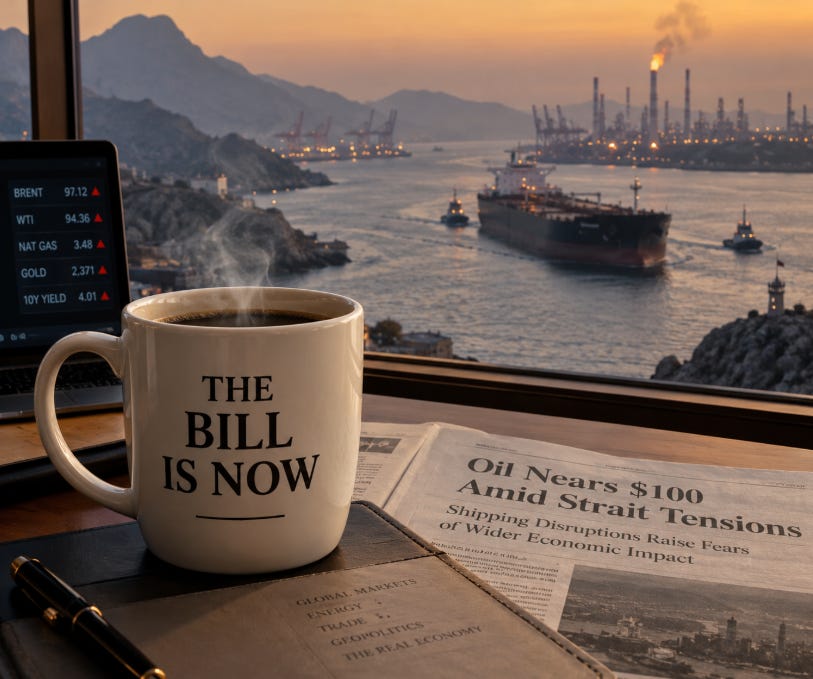
The future tense is doing some quiet work there. For all the declarations of strength and progress, Trump’s own formulation acknowledges that the victory on which those cheaper prices depend has not yet arrived.
Qatar, in the meantime, is warning that continued disruption of the Strait of Hormuz could produce an “industrial catastrophe.” An average of just ten commodity ships a day crossed the strait over the past ten days, the lowest level since May, according to Kpler. Brent crude has climbed to roughly $97 a barrel, near a six-week high, amid continuing American and Iranian strikes in the waterway.
A magnificent filling station awaits somewhere just beyond victory, where Iran has been defeated, the strait is open, oil is plentiful, and the numbers on the pumps begin with a two.
The current bill may substantially understate the eventual one.
Satyajit Das, the veteran financial analyst who warned about systemic risks before the 2008 financial crisis, told ABC Business Daily that focusing on the headline price of crude misses much of what an energy shock actually does to an economy.
Das estimates that diesel costs on an energy-equivalent basis are already closer to $190 a barrel, and argues that much of the inflationary pass-through from the present energy shock may not become fully visible until sometime in 2027.
Energy costs ripple through trucking and shipping, fertilizer and plastics, factories and distribution networks, eventually reaching everything from industrial inputs to grocery-store shelves.
By the time the price at the wellhead has worked its way through all of those things, the original headline has disappeared and the higher cost has acquired several aliases.
Trump’s $2 gasoline, by contrast, requires no such supply chain. It exists after victory.
If the energy shock were arriving in an otherwise placid global economy, this might be less concerning. The world’s governments spent more than $2 trillion servicing their debts last year, according to the Financial Times. The United States reached roughly $40 trillion in federal debt last month. OECD countries are expected to borrow another $18 trillion this year. The average benchmark 10-year government bond yield across the G7 has reached 4 percent for the first time since 2008, and borrowing costs in several major economies are at their highest levels in almost two decades.
The United States, Britain and France now spend more servicing their national debts than they spend on defense.
Rates in several large economies, Das warns, have risen by only around half a percentage point recently. What has changed is the enormous quantity of debt sitting underneath them. Governments, corporations and households spent years adapting themselves to extraordinarily cheap money, while borrowing continued to grow. Apply even a modest increase in rates to a much larger pile of debt and modest stops being the operative word.
It is into this financial terrain the Iran war has dropped an energy shock. And, because one inflationary experiment at a time would lack ambition, there is another one running alongside it. Das calls it the parallel economic war: tariffs, trade restrictions, strategic decoupling and the effort to bring manufacturing back onshore. He is careful about the distinction that often gets lost in the political argument. There can be entirely legitimate reasons for a country to decide that buying the cheapest rare-earth mineral, semiconductor or critical component from a geopolitical rival is no longer a sensible national-security strategy.
Economic resilience has value, and a price. If the secure supplier costs more than the cheapest supplier, choosing security means choosing the higher cost. That may be a perfectly defensible decision, but economics does not waive the charge because the reason was good.
Eventually, somebody pays it.
Canada began collecting its portion shortly after midnight. At 12:01 Tuesday morning, Canadian retaliatory tariffs covering roughly $20 billion worth of American imports came into force. The duties range from 15 to 50 percent and hit products across steel, dairy, appliances, agricultural equipment, pulp and paper, electronics and other sectors. Ottawa says they are a dollar-for-dollar response to the 50 percent tariffs Washington imposed on roughly the same value of Canadian goods last month.
The economic effect of this round may remain relatively contained because the goods affected represent only a fraction of the enormous volume of trade crossing the border.
Trump, of course, has threatened additional tariffs. Canada has promised to retaliate. No formal negotiations are planned this week. U.S. Trade Representative Jamieson Greer told the Financial Times that additional response options have already been presented to Trump.
Trump spent the hours before the Canadian tariffs took effect demonstrating precisely how quickly a trade dispute can broaden.
“BUY AMERICAN. FLY ON AMERICAN AIRLINERS. ENJOY AMERICAN LIQUOR AND BEVERAGES. SAIL ON LAKE AMERICA,” he posted.
He also announced there should be “NO MORE SELLING BOMBARDIER IN THE UNITED STATES!” because, he argued, the Canadian aircraft manufacturer should build in America if it wants access to the American market. The White House did not clarify whether the president was proposing another government trade restriction or encouraging Americans to boycott the company.
There is one small complication.
Bombardier already builds in America.
The company employs more than 3,000 people at nine American facilities and buys from approximately 2,800 American suppliers. Its American supply chain extends across 47 states.
Trump sees a Canadian company, but Bombardier’s supply chain reaches roughly 2,800 American companies, which is why there is no simple button marked CANADA to press without hitting U.S. workers and suppliers too.
Modern economies are inconvenient that way. They contain parts made here and assembled there, contracts signed in one country and fulfilled in another, financing from somewhere else entirely, and workers whose jobs depend on companies headquartered on the other side of a line on a map.
A tariff can cross that line instantly, and so the cost keeps traveling.
Trump also accused Canada of preventing American aircraft maker Gulfstream Aerospace from doing business there. A spokesperson for Canada’s transport minister told the Financial Times that Gulfstream aircraft “is and can be freely sold and operated in Canada.”
Reality, once again, neglected to check Truth Social before opening for business.
The rhetoric surrounding the dispute increasingly bears only a passing resemblance to the mundane work of trade negotiation. Trump posted an image depicting Canada and Greenland beneath the American flag. Prime Minister Mark Carney said last week that Canada remained prepared to negotiate but that Washington needed to “stop doing memes, stop throwing shade, stop trying to be tough and start being serious.” Greer, meanwhile, described Trump’s attitude toward the confrontation somewhat differently.
“President Trump actually loves this kind of thing,” he told the FT.
That may be fine when “this kind of thing” means negotiating over a discrete commodity. When both sides possess retaliatory tools and the products being taxed belong to supply chains that do not respect the neat national categories used to describe them, it becomes much more interesting.
This morning provided a useful reminder that trade restrictions themselves are not inherently one thing.
Britain announced that it will ban imports from Israeli settlements in the occupied West Bank, with France and Canada announcing corresponding national measures. Twelve countries; Canada, Denmark, Finland, France, Iceland, Ireland, Norway, Poland, Portugal, Spain, Sweden and the United Kingdom, said they intend to introduce, support or consider restrictions on trade with settlements they regard as illegal under international law.
The mechanism is unusually specific. The governments point to settlement expansion and settler violence as threats to a two-state solution and say the trade restrictions are intended to apply economic pressure to activities directly associated with the settlements. Britain is also preparing sanctions against companies and individuals providing construction, financing, infrastructure or real-estate services supporting settlement expansion.
Trade policy can be a scalpel or a club, depending upon what behavior the restriction is meant to change, how closely the economic pressure is connected to that behavior, and what outcome would cause the restriction to be lifted.
Then there is the Trump version, in which tariffs have become an all-purpose instrument for manufacturing policy, trade deficits, retaliation, foreign regulations and even individual companies, with potentially dozens more countries next as the administration prepares new duties aimed at what it calls foreign “excess capacity” and persistent U.S. trade deficits.
Trump has even threatened to block trade with countries that sell more goods and services to the United States than they buy from it, an action the New York Times notes could have enormous economic consequences given the number of major trading partners with which America runs deficits.
Trade deficits may look simple on a spreadsheet, but supply chains are not, and neither are the consequences. The shooting war and the economic one now feed the same system: Iran pushes energy costs higher, tariffs raise imported and intermediate costs, inflationary pressure persists, borrowing becomes more expensive, and that higher cost lands on governments already carrying enormous debt loads that must be refinanced continuously.
The Financial Times describes sovereign borrowers refinancing enormous debts at increasingly expensive rates while investors demand more compensation for lending long term. Global public debt reached 94 percent of world GDP last year, according to figures cited by the paper, and the IMF expects it to reach 100 percent by the end of the decade.
The $2 trillion interest bill is therefore not merely another large number to place beside the $40 trillion debt number until everybody’s eyes glaze over. It is money that cannot simultaneously be spent somewhere else.
Britain’s government offered a useful way of visualizing it: if debt interest were a government department, it would be the second-largest department after health, larger than defense, the Home Office and justice combined.
That is what Das means when he talks about stress points. Government borrowing costs form the foundation underneath mortgages, corporate borrowing, investment decisions and asset prices. As they rise, households and businesses eventually reduce spending and investment. The most stretched borrowers begin to fail. Lenders absorb losses. Governments discover that more of each tax dollar is already spoken for before they start deciding what they want to accomplish with it.
None of this means a global financial crisis arrives tomorrow; Das is describing a process, not a date. The point is that the system has less slack. A heavily loaded bridge does not collapse because one more truck crosses it, but each additional load matters more when the structure is already strained. Right now those loads include an energy shock, war around the world’s most important oil chokepoint, a parallel trade war, record government borrowing, higher refinancing costs, expensive strategic reshoring and, in the background, an enormous AI investment boom resting on revenues that may or may not arrive. That last subject deserves its own morning.
For now, the common feature is the enormous distance between promises made about the future and costs being incurred in the present.
Oil will be cheap after victory. Manufacturing will flourish after the tariffs work. Trade partners will concede after enough pressure is applied. Growth may eventually make the debt manageable. Perhaps some of those things happen.
But the future does not finance itself. The present does.
Das closes his interview by describing the past two decades as a period of “pseudo reality,” built in part on the unresolved legacy of the global financial crisis and years of extraordinarily cheap money. Then he invokes science-fiction writer Philip K. Dick: “Reality is that which when you stop believing in it does not go away.”
Hormuz does not go away. Ten ships a day is ten ships a day. Twenty-eight hundred American Bombardier suppliers do not disappear because the company headquarters are in Canada. Two trillion dollars in annual sovereign interest payments cannot also be spent on hospitals, defense, infrastructure or tax cuts.
None of this is an argument for doing nothing; governments sometimes have good reasons to accept higher costs for security, or to use trade restrictions to change specific conduct. But necessary costs remain costs. Tradeoffs remain tradeoffs. Somewhere in the Strait of Hormuz, another ship’s captain is deciding whether today is a good day to make the crossing.
The future may indeed contain victory, $2 gasoline, and booming growth. The future is wonderfully accommodating that way.
Today, Qatar is warning of an industrial catastrophe. Canada is collecting the tariffs. Bombardier still employs Americans. Governments are paying $2 trillion a year in interest.
Reality keeps sending the invoice.
On August 26 I paid 4.39 for a gallon of gas. I noticed over the weekend that it was 4.19 per gallon but I didn't have time to stop so I waited until this morning when it was 4.59 per gallon. Yeah. Thanks Donald.
Hello! $6.15 in Friday Harbor, WA. Elections are coming!