


Good morning! “Pretend I’m running.” Donald Trump said it Friday on the White House grounds, pausing to admire the new stonework (“the finest stone you could buy anywhere in the world”) and Marine One, on his way to a rally in Alabama. He isn’t on the ballot in November. He would like voters to behave as though he were, and he has given October over to making it happen, on the theory that “when I go there we win.”
Republicans fighting unexpectedly close races in Iowa, Ohio, Texas, Alaska and Kansas may hope he’s right. What they can’t control is what he brings with him.
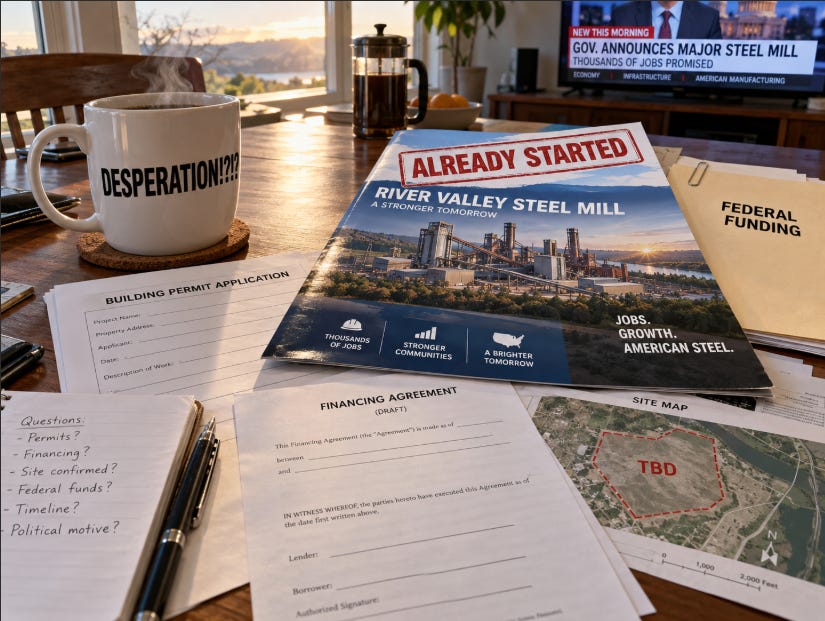
The country voters are living in has gas above $4 a gallon, a war in its eighth month, and a cost of living they now rank above every other concern. The country arriving from the campaign trail is a different place. It has a $15 billion steel mill, an Alaskan pipeline financed by South Korea and a prosperity that, to hear the president tell it, has already arrived.
On Monday, flanked in the Oval Office by Iowa Republicans facing tough re-elections, Trump announced the largest steel plant in American history, to be built in Lee County by Mesabi Metallics. As the company’s chairman spoke, the president’s eyes drifted shut. When he came to, he offered the room something new: “They’ve already started building.”
They hadn’t. A local station went through Lee County’s land records and found no major property purchases tied to the project. No permits had been filed. County officials said the company hadn’t shared its plans. The mill isn’t expected to produce steel until 2030.
That small gap between “already started” and “nothing filed” is the grammar of this October. The future is being conjugated in the past tense. A proposal gets announced as an investment, a memorandum gets described as a deal, and prosperity is declared delivered before anyone could possibly have felt it.
Iowa is too new to show where that grammar leads. For that you need a project old enough to have a history, one where promise, money and outcome can be laid side by side.
Middletown, Ohio, has one. In 2024, Middletown was promised a different kind of future.
The town’s steelworks, founded as Armco in 1900, is the plant JD Vance wrote about in Hillbilly Elegy, the place that carried his grandparents out of the Kentucky hills and into the middle class. Under a $500 million Department of Energy grant, Cleveland-Cliffs planned to replace the plant’s coal-fired blast furnace with a hydrogen-ready direct reduced iron plant and two electric melting furnaces. The project was expected to eliminate roughly one million tons of greenhouse-gas emissions a year, create 170 permanent jobs and 1,200 construction jobs, and secure about 2,500 existing ones. A man who had worked at the plant for 30 years told the Guardian it felt like an answered prayer.
The money came from the Inflation Reduction Act, which Vance had dismissed as a “green scam.” Middletown hadn’t gotten the memo.
Then Trump took office. In April 2025, CNN reported that the administration planned to cut the grant, with Elon Musk’s DOGE team weighing in on which programs would go. That summer, Cleveland-Cliffs abandoned the hydrogen project, telling the Energy Department it “would not be pursuing the project” because the hydrogen wouldn’t be available.
The story should have ended there, but it didn’t, because $500 million is a terrible thing to waste.
In July, Cliffs CEO Lourenco Goncalves said the company hoped to redirect the grant to align with the Trump administration’s priorities. This August, it did. The Energy Department announced the same $500 million would now help rebuild Middletown’s existing coal-fired blast furnace, with Cliffs matching it for a $1 billion project. Vance came home for the occasion, standing alongside Energy Secretary Chris Wright to celebrate the administration’s commitment to American steelworkers.
The money survived, and so did the blast furnace. What didn’t survive was the plan to replace it.
It’s worth giving the administration its best case, because it has one. DOE says Cliffs concluded that customers wouldn’t pay a “green premium” for low-carbon steel, so the original project no longer made business sense. The revised plan upgrades the furnace’s efficiency and captures its blast furnace gas to generate electricity and steam on site. The plant keeps producing roughly three million tons of steel a year, and people keep their jobs.
Now lay the two versions side by side.
Under the 2024 proposal, coal-fired ironmaking in Middletown would have ended. The 2026 version instead commits federal money to rebuilding the blast furnace, with completion expected in 2030 and years of operation presumably following. The employment promise has narrowed as well: where the earlier project projected 170 new permanent jobs while securing 2,500 existing ones, the latest announcement speaks only of “protecting 2,300 American jobs,” with no new permanent positions identified. Gone, too, is any mention of the roughly one million tons of annual emissions the original project was designed to eliminate.
There’s also the small matter of the law. Congress wrote this grant program to fund technology designed to accelerate emissions reductions toward net zero. Whether making a coal furnace more efficient qualifies is a question someone in Washington should be asking. So far, the people with the authority to ask it have been busy holding a press event.
So here is what an accomplishment looks like in October 2026. A town promised cleaner air, 170 new permanent jobs and protection for 2,500 existing ones gets a renovated coal furnace, no new permanent jobs identified and a promise to protect 2,300. The federal money awarded to retire that furnace now pays to rebuild it.
Middletown didn’t get its future. It got its past, refurbished, with a ribbon on it.
On September 19, two things happened at the White House. CNN, MS NOW and Politico were barred from the grounds, a ban readers here have followed since Trump announced it. And the Office of Management and Budget quietly moved $20 million in Customs and Border Protection funds into an account called “One Big Beautiful Bill Commemorative Events.” By the next morning, the money was headed to a Maryland ad firm.
One move narrowed who could report on the president. The other paid to broadcast what he wanted said.
The ban lasted five days before Judge Timothy Kelly, a Trump appointee, ordered access restored. It was the second time he’s had to: in 2018 he returned Jim Acosta’s press pass.
The White House responded on Friday with a video. It’s a montage of Trump calling CNN “a very corrupt organization,” “a gutless group of people” and “fake news,” interspersed with clips of him berating its reporters, including Kaitlan Collins. “Do you ever ask a positive question at CNN?” he asks in one. It offers no evidence of corruption, but it does offer the claim that “nobody watches CNN anymore,” which would come as news to Nielsen: CNN’s August primetime audience was up 41 percent from a year earlier.
There’s a quieter piece of leverage underneath. CNN’s parent company is on track to be absorbed by Paramount, putting the network under David Ellison, whose ties to Trump have drawn scrutiny, and Trump has said repeatedly he’d like CNN under new ownership. To settle the states’ antitrust suit, Paramount agreed to an editorial independence board for CNN and CBS News, an unusual safeguard that tells you how seriously the risk is taken. The board’s members will be appointed by Paramount’s own board, which leaves open how independent it can be.
The $20 million, meanwhile, is on the air. The ads have run on Fox News and CNN, on the network morning shows, on football broadcasts and on “Meet the Press,” which the president is known to watch. According to the New York Times, Trump personally told his budget director to find the money. One ad sets images of the president to a song called “Love Me.” Another is identical to a 2024 Trump campaign video. Every one closes with the tagline “Paid for by the U.S. government.” Yes, the ads ran on CNN, so the network the White House calls corrupt is cashing taxpayer checks to air the president’s self-praise.
Federal law has banned spending appropriated funds on “publicity or propaganda” since the 1950s, including in the spending bill Trump signed in February. The White House calls the ads public service announcements. Trump, pressed on Wednesday, offered the defense: “I’m not promoting myself because I’m not running for office.”
Two days later, he told supporters to pretend he was.
Some Republicans aren’t buying it. Senate Majority Leader John Thune said the ads shouldn’t be paid for with taxpayer money. Sen. John Kennedy of Louisiana said no public official should spend public money on private ads for themselves. Trump has said he’d gladly pay the money back if someone said it was wrong. Plenty of people have, and his super PAC entered the fall with $400 million. So far no check has been written.
None of this requires an adjective. Reporters he dislikes were removed until a judge he appointed put them back. The network he calls corrupt is attacked with a government-produced video while airing government-funded ads praising him. The legal mechanisms differ, but the pattern is familiar: money Congress had already appropriated winds up buying something substantially different from what taxpayers were originally told it would buy.
The administration isn’t racing to produce results before November so much as to produce the appearance of them, turning announcements, appropriations and unfinished projects into a record of accomplishment before voters have had a chance to experience any of it.
Middletown shows the mechanism with enough history to see it work. The rest of the October tour shows it running at speed.
Start back in Iowa, where Commerce Secretary Howard Lutnick assured reporters that private money would build the steel mill. That’s true in the way a mortgage is private money. The Iowa mill may ultimately be privately financed, but Mesabi’s broader American expansion is hardly proceeding without federal help. EXIM has already approved $770 million for its Minnesota operation and has floated support of up to $10 billion. Mesabi went through bankruptcy in 2016, and until this summer its lobbyist was longtime Trump adviser Jason Miller, who has since joined the administration and recused himself from the event. It’s a private investment with a public safety net and a familiar face at the door.
Then Alaska. Trump spent the week touting a natural gas pipeline from the North Slope, a project Alaskan politicians have been promising for decades, and explaining that South Korea is paying for it. “They paid to get them reduced,” he said of Seoul’s tariffs, “and part of that money is going into this project.” South Korea did agree to invest in the United States. It has never agreed to put that money into this pipeline, and its officials have spent more than a year politely saying they’re still studying it. Asked Friday whether he’d jumped the gun, Trump said he hadn’t, because the Koreans “were there and they were represented.” And if they don’t sign? “I’ll just charge them more.” The deal that wasn’t a deal now comes with a threat attached, aimed at an ally.
Then Mobile, where Trump flew Friday night for a rally timed to the groundbreaking of the new I-10 Mobile River Bridge. One Alabama Republican had already floated naming it after him, and Trump obligingly floated the idea himself from the stage. The bridge has been talked about for 30 years. Its largest federal grant, $550 million, was awarded in 2024 under Joe Biden, then held for months in the Trump administration’s review of Biden-era grants before his Transportation Department released it. To be fair, his first administration contributed $125 million, and his current one helped clear the way to construction. But most of the $3.2 billion project will be paid for with a federal loan backed by tolls, by the drivers who will cross it. A plaque with his name would at least be honest about one thing: it’s the only part of the bridge he’d be paying for in full.
Each of these stories is the Middletown mechanism in a different form: a proposal, a conditional agreement, an inherited grant or a decades-old project, recast as an accomplishment of this October. They’re delivered from podiums flanked by Republicans on the ballot, a month before the vote.
If the record is this strong, why does it need so much selling?
One answer may be found in the country outside the press release.
The latest Times/Siena polling finds Republicans defending unexpectedly close Senate races in five states Trump carried every time he was on the ballot. Ashley Hinson leads Josh Turek by a single point in Iowa, Kansas is tied, and Sherrod Brown is up three on Jon Husted in Ohio. Democrats hold wider leads in Alaska and Texas. Each state’s margin of error is large enough that none of these numbers should be read as a prediction, but the mood beneath them is harder to wave away. Voters across all five states now trust Democrats more on the cost of living, and about half of Republicans in Iowa and Ohio disapprove of Trump’s handling of gas prices.
Then there’s the question Trump himself put on the ballot. Across those states, 49 percent of likely voters want a senator who will check the president, while 27 percent want one who will support him. In Iowa, home of the steel mill that hasn’t started construction, the split is 53 to 23, and nearly one in five of Trump’s own Iowa supporters are in the check column.
His answer has been to tell voters to pretend he’s running.
October will be spent making the case. Expect factories that haven’t broken ground, foreign investments that haven’t been committed, bridges whose biggest grant was awarded under somebody else and appropriations that found new purposes somewhere between Congress and the ribbon-cutting. Government-funded ads will explain how well everything is going, a government-produced video has already explained which reporters not to believe, and at every rally proposals will mature into accomplishments before the motorcade leaves town.
A few of those projects will eventually be built, and some may even deliver the jobs being promised. That isn’t the point. Voters are being asked to judge them now, which makes the paperwork unusually important.
Every spectacular announcement this month deserves a few boring questions. Has the contract been signed and the financing closed? Is there land, a permit, a shovel in the ground? Was the money appropriated for this purpose or rerouted from another? And did this administration create the project, inherit it or simply rename it?
Those questions won’t fit on a rally sign, which is probably why we’ll need them.
Trump says that when he goes somewhere, Republicans win. Between now and November 3 he means to test that across the country, carrying a version of America where the deals are done, the factories are rising and prosperity sits just over the horizon. Voters will decide what to make of it.
The rest of us can at least check whether the permits have been filed.
I should probably admit here that I am not looking forward to the assignment.
If the past few days are any indication, the next month will bring a firehose of claims, numbers, announcements, grievances and superlatives, each demanding to be chased back through government documents, local records and whatever agreement supposedly became a “done deal” before breakfast. Keeping up with it will be exhausting. Even if I can muster the energy, I’m not entirely sure I have the stomach for a month of listening to it.
But exhaustion is useful to people who depend on nobody checking.
So I’ll keep the coffee brewing, the documents open and the antacids within reach, and we’ll see how much of October’s promised America survives contact with the paperwork.
Well, I'm sure all of us appreciate the results of you abusing your stomach lining--and I would never tell you stop shining a light on Trump's bullshit because it's bad for your physical and mental health. But, if there's anyway you can ease up after the mid-terms (assuming and hoping there will be mid-terms)--then do it; give yourself a break and stay healthy for the long haul.
Long ago (a phrase which now covers a large portion of my life), Joni Mitchell sang, "To pave paradise, put up a parking lot..."
It's perfect, and inevitable, that Trump, who is dead and rotting inside, tries to do everything he can, legal and illegal, to destroy every growing thing in the world. He paves over the Rose Garden, puts up stone helicopter landing pads where grass once grew, and promotes "clean coal"--whatever fantasy/greed machine turned that phrase out! ...It's interesting that he's putting himself on the ballot. This midterm will therefore be an up and down vote on whether all the lies and fantasies he churns out will still motivate his zombie-MAGA base to vote for him. ...Trump is torn between his desperate desire to be loved (voted for) and having ICE shut down the polls to prevent voting entirely.
Keep up the good work!!