


I know how much you’ve all missed my Underground Republic series, well lucky for you my husband sent me a link about a tree. He thought I would find it interesting, which I did. What he didn’t understand was that sending me an unusual fact about the natural world is no longer a casual marital gesture, it’s an inciting incident.
Or, probably more likely, he knew exactly where my brain would take me and was offering a hand to my imagination. This is romantic, but also mildly alarming, because I had assumed my weirdest brain secrets were securely encrypted. Apparently marriage comes with administrative access.
My husband believed he was showing me a peculiar forest in Utah. Several hours later, I had opened more research tabs than our internet service could reasonably support, estimated the carbon stored inside a twelve-million-pound organism, and developed fresh concerns about the regenerative capacity of American democracy.
He really should know better by now. Then again, I am beginning to suspect he knew exactly what he was doing. I thought he had casually sent me a tree, while he had quietly rolled a small intellectual grenade into my brain and stepped back to watch democracy come out.
The tree is called Pando. From a distance, Pando looks like an ordinary grove of quaking aspens. More than 40,000 pale trunks rise across 106 acres of Utah’s Fishlake National Forest, their leaves moving independently in the wind. Except they’re not independent. Every trunk emerged from the same enormous root system. What appears to be a forest is a single organism, genetically identical and physically connected beneath the soil. Pando began with one seed and spread by sending new shoots upward from the roots. Its name means “I spread.”
Each visible stem has its own scars, branches, seasons, and eventual death, but none of them is the whole tree. The trunks are temporary expressions of something older living underground. Pando may be thousands of years old. Nobody knows exactly how many because the organism doesn’t preserve itself by keeping the same trunks alive forever. Old stems die, new ones rise, and the forest remains itself through continual replacement.
Pando doesn’t confuse continuity with permanence. Naturally, this made me think about Congress. We have a habit of mistaking the people standing above the ground for the country itself. Presidents, senators, judges, governors, billionaires, and cable news personalities rise into the light and begin behaving as though the entire forest exists to frame their silhouette. Their faces fill our screens, their names appear on buildings, and their every partially formed thought receives a breaking-news banner and a panel of six adults paid to discuss what it might mean.
Pando offers a useful correction. The visible trunks are not the organism, a president is not the republic, a party is not the republic, and congress is certainly not the republic, although it does share Pando’s ability to remain in one place for an astonishing length of time while appearing to accomplish very little aboveground. The republic is the deeper inheritance that allows generations to rise, serve their season, and leave something living behind.
It’s the law and the memory beneath the law. It’s public education, civic trust, constitutional protection, local journalism, libraries, courts, unions, elections, public service, neighborhood organizations, and the quiet agreement that the future should belong to people who aren’t yet tall enough to reach the canopy. No current leader created those roots and no generation owns them outright. We inherit their shelter for a while, draw from what they’ve stored, and accept some responsibility for what will emerge after us.
Pando weighs nearly 13 million pounds. Using the conventional rough estimate that dry tree material is about half carbon, its living mass could contain something on the order of 3,000 metric tons of carbon, although that is only a broad calculation rather than a formal inventory of Pando itself. It would not fully capture the carbon held in the surrounding soil, forest floor, deadwood, and the vast underground system that makes the visible grove possible.
For thousands of years, Pando has been taking something invisible from the air and turning it into substance. Roots, bark, leaves, and stored life. The carbon isn’t entrusted to one magnificent trunk. It is distributed across a living body so large that a person can stand inside it and mistake connection for separateness. Democratic strength is stored much the same way. It lives in millions of ordinary places that rarely make the national news. It’s held by the teacher explaining history accurately, the county clerk protecting a ballot, the reporter attending a meeting everyone else ignored, the librarian refusing to let fear determine what other people may read, and the neighbor who still believes public life is something we do together.
The strongest parts of a republic are often invisible until somebody tries to cut them. Pando isn’t healthy simply because it’s enormous and old. Its mature trunks are dying, which is normal, but too few young stems are surviving to replace them. The root system continues sending up tender shoots, yet mule deer repeatedly browse them before they can grow tall enough to escape. Insects, disease, and other pressures affect older stems, but research has identified browsing as a major obstacle to successful regeneration. The organism is alive, but it’s future keeps getting eaten.
There is something haunting about an ancient living system that still knows how to produce new growth but can’t protect that growth long enough for it to mature. The roots haven’t failed, new shoots still appear. They simply cannot reach the canopy. A republic can remain technically alive under the same conditions. The Constitution can still exist, the courthouse can still stand, and the flag can still rise every morning. Elections can be held, procedures followed, speeches delivered, and patriotic merchandise manufactured overseas in sufficient quantities to assure everyone that freedom remains economically vibrant. Meanwhile, the system can lose its ability to produce a future. Young organizers burn out before they can build durable movements.
Local newspapers disappear, taking decades of institutional memory with them. Election workers are threatened for counting votes correctly. Public servants are driven out and replaced by loyalists who understand that expertise is useful only when it agrees with the person in charge. Young people are told that politics is corrupt, participation is pointless, government is incompetent, and their generation is lazy. Then everyone looks around in bewilderment when they don’t line up to inherit the institutions that spent years humiliating them.
The old trunks remain standing, so the forest looks complete. Below them, renewal is being consumed at ground level. The deer eating Pando’s shoots aren’t evil, they’re not meeting beneath the moon to discuss the eradication of aspen-based civilization. They are hungry animals eating available food, and that’s what makes the danger so familiar. Sometimes a living system collapses because too many ordinary appetites are permitted to feed without restraint.
Corporations want profit, platforms want attention, politicians want power, and donors want access. Media companies want every event to become an emergency dramatic enough to keep us watching through the pharmaceutical advertisements. Older generations want the benefits of the systems they inherited without always preserving the conditions that made those benefits possible. Each appetite can explain itself, together, they consume the future. Nobody has to announce a plan to kill the republic. They only have to keep feeding on every new possibility before it grows beyond their reach.
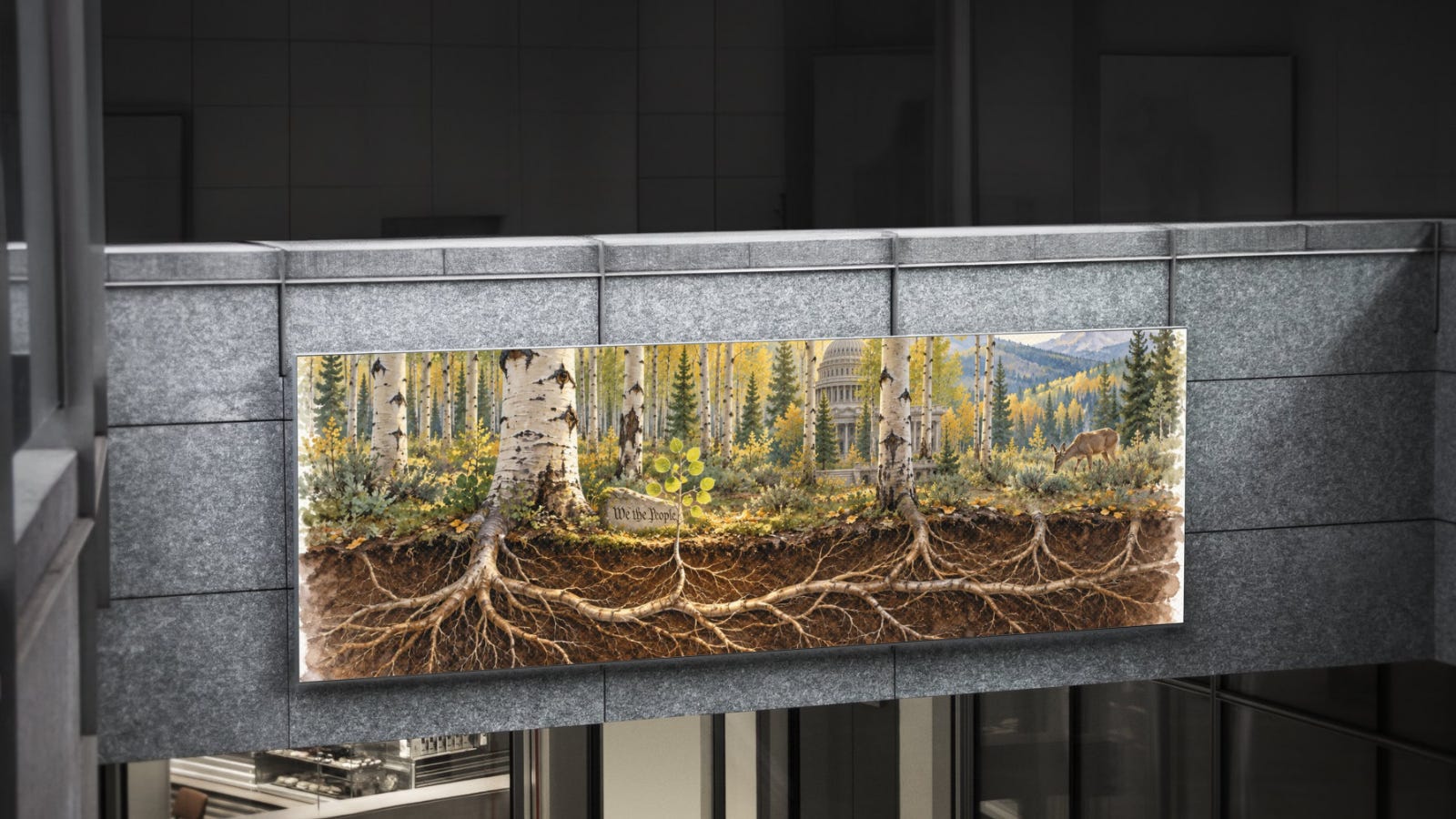
At Pando, the clearest regeneration has occurred where young shoots received meaningful protection from browsing. Fencing alone hasn’t worked equally well everywhere, especially where deer found ways through it, but the successful areas revealed something important: the ancient root system still knows how to make a forest. The future isn’t absent, it’s vulnerable. That difference is important. It’s easier to declare a generation apathetic than to ask what has been eating everything it tries to build, to blame people for failing to rise than to notice how little protection they received while they were tender, and it’s easier to celebrate resilience than to stop creating conditions that require so much of it.
Sometimes freedom needs protection while it’s still too young to defend itself. That means funding the newspaper before the corruption scandal, teaching history before someone discovers that national mythology is cheaper to produce and easier to weaponize, and supporting new leaders before they become useful to a national party. It means making public service survivable, defending voting rights before the outcome is close enough for everyone to suddenly remember they matter, and giving young people enough stability, time, education, and belonging to imagine themselves as participants in public life rather than spectators watching powerful people eat it.
Protection isn’t the forest and it shouldn’t become permanent control over the forest. It’s simply the breathing room that allows vulnerable growth to become strong enough to join the larger organism. Pando survives by maintaining a living relationship between what came before and what has not yet fully arrived. That’s the difference between continuity and nostalgia. Nostalgia points toward the old canopy and insists the forest was perfect before the new shoots appeared. Continuity understands that the old trunks mattered because they sustained roots capable of producing something beyond themselves.
A republic fails when it mistakes its current leaders for the organism. It also fails when one generation consumes so much light, wealth, water, trust, and possibility that nothing beneath it can rise. The lesson isn’t that human beings are identical stems who should think, vote, worship, speak, and live in the same way. Any political movement promising that kind of unity should be treated with the same caution we reserve for a man approaching an ecosystem with a barrel of herbicide and excessive confidence.
The lesson is that separateness can hide dependence. Our lives rise in different places. We carry different histories, beliefs, wounds, responsibilities, and relationships to the light. Still, no part of the forest can poison the roots and remain safely independent. No trunk can consume the future and call itself strong. No generation can inherit a living system, strip it for parts, and congratulate itself because a few ancient stems remain upright.
The hopeful fact is that Pando’s roots are still alive. They’re still sending up new growth. The organism hasn’t forgotten how to become a forest. It’s trying, again and again, to place something tender into the light. Our job is to protect the conditions that allow renewal. My husband thought he was sending me an interesting link about aspens. Instead, he introduced me to an ancient organism that stores its strength beneath the surface, survives by allowing its visible leaders to pass away, and now stands in danger because ordinary appetites keep consuming every new possibility before it can grow tall.
He knew exactly what he was doing. He dropped Pando into my brain, quietly stepped aside, and waited for me to discover what he apparently already knew was in there. I’m beginning to realize that the man has mapped my weird little brain far more thoroughly than I have, which is both deeply romantic and, from a security standpoint, concerning.
Oh, this is genius! Yes, I remember being enthralled when an artist friend told me about Pando, the largest and oldest living thing here on Earth. And so beautiful!
What you've written here is a great extended metaphor, Shanley. Thank you!
Don’t really appreciate the sideways swipe at boomers. Just another version of the blame game.