


There are days when the news arrives like a normal civic update, and there are days when it arrives like a terms-of-service agreement written by a man who keeps trying to sell you a commemorative coin during the collapse of the warranty. Today is one of the latter.
The country is not dealing with one clean scandal, one clean policy fight, or one clean absurdity. That would be too generous. Instead, the fine print is spreading. It’s in the speech, the passport, the health insurance bill, the grant requirement, the air-quality rule, the ballot measure, the detention camp afterlife, and the Epstein file still sitting in some federal drawer wearing its little black bars like formalwear.
The day began, or at least found its theme, with Donald Trump previewing what appears to be the Republican midterm pitch, which is that Democrats are not simply wrong, misguided, irritating, smug, coastal, urban, progressive, or bad at messaging. No, that would be far too restrained. They are, in his telling, “godless communists.”
At the Faith & Freedom Coalition’s Road to Majority conference, Trump seized on progressive wins in New York and warned that the left wants to “completely destroy the traditional American way of life.” He claimed Democrats are “becoming a Communist party,” adding, with the usual restraint of a man who discovered self-awareness only as a prop, “I think I’d be the greatest communist in history.”
There it is, the campaign strategy, neatly folded inside a red scare and handed to the faithful like a church bulletin. This is the old trick, of course. When rent is impossible, groceries are up, insurance is brutal, and voters keep asking why the promised affordability renaissance has not arrived at their kitchen table, you don’t answer the question. You turn the question into treason. You don’t explain why life costs too much; you warn that someone in Queens may be planning to nationalize your toaster. It’s not subtle, but subtlety has never been the house wine of this operation.
Then, as if the universe sensed the rhetoric needed a prop, Trump shared images of a limited-edition America 250 passport featuring his own portrait, his signature in gold, and the phrase, “Welcome, but be good!”
A passport… With his face on it… This is where even satire has to sit down for a moment and drink some water. A passport is supposed to be a sober little document proving citizenship and identity, not a souvenir program from a dinner theater production of The Founding Fathers Meet the Gift Shop. The interior reportedly includes Trump’s portrait over the text of the Declaration of Independence, because apparently the Declaration had been missing only one thing all these years, and that thing was a stern presidential glamour shot hovering over it like a nightclub manager inspecting the velvet rope.
“Welcome, but be good!” is especially rich because U.S. passports are for citizens, not foreign guests being scolded at the door by an overconfident maître d’. It’s a sentence that belongs on a hand-painted sign outside a vacation rental with too many rules about towels, not inside the document Americans use to move through the world.
Still, in its own ridiculous way, the passport tells the truth. The fine print of this presidency is that public things keep being treated as personal stages. The country becomes a backdrop. The anniversary becomes an accessory. The Declaration becomes decoration. Citizenship itself gets a little note tucked inside it reminding everyone who would like credit for allowing the republic to continue existing.
Meanwhile, outside the commemorative booklet, people are losing health insurance. The Associated Press reported that about 3 million fewer people in the United States had Affordable Care Act plans in February compared with the same month last year. Federal data showed enrollment dropping from 22.1 million in 2025 to 19.2 million this year, a 13 percent decline. The Department of Health and Human Services suggested that the drop could be tied to a crackdown on fraudulent or “phantom” enrollment, but health analysts pointed to the much more obvious suspect, which is that federal subsidies expired on January 1 and premiums surged.
“We know that real people lost their health insurance coverage,” Cynthia Cox of KFF told the AP. “This coverage loss happened at the same time millions of people faced double or even triple digit increases in their premium payments.”
There is the sentence that should be stapled to every campaign podium in America. Real people lost coverage. Not imaginary fraud ghosts padding a spreadsheet in a back room, people. Gig workers, farmers, hairstylists, ranchers, self-employed families, and the people who exist in the vast American middle where you make too much for one kind of help and nowhere near enough to survive without another.
The fine print said the subsidies expired, the bill said the premium went up, the politics said someone else was to blame, and the mailbox said pay or disappear. And while that was happening, the administration was also moving public health policy further away from the things public health experts say actually work. The Guardian reported that federally funded health programs were told they must agree by July 1 to new priorities from the Trump administration, including an emphasis on “parental authority” in education and a move away from proven overdose-prevention strategies such as harm reduction.
Nabarun Dasgupta, a street-drug researcher and senior scientist at the University of North Carolina at Chapel Hill, called the move “a warm-up” and “a warning shot.” Dorit Reiss, a vaccines expert and professor at UC Law San Francisco, said some of the policies “are in tension with public health,” adding that “housing programs and harm reduction programs save lives and promote health.”
This is the part where the cruelty becomes procedural. Nobody has to stand at a podium and say the plan is to make overdose prevention worse, the memo simply arrives, the grant language shifts, and the priorities are rearranged until evidence is moved to the basement and ideology gets the office with windows.
There is always a respectable folder for it. There is always a phrase like “align with priorities” or “meaningful outcomes” or “parental authority,” polished smooth enough to slide past the obvious question, which is whether a person is more likely to survive an overdose crisis because a bureaucrat in Washington made public health sound more like a school board meeting.
In the middle of all this, a federal appeals court did something almost startling. It told the administration no. The U.S. Court of Appeals for the D.C. Circuit unanimously rejected the Trump EPA’s attempt to abandon a Biden-era rule setting stricter standards for deadly soot pollution. The rule lowered the annual limit for fine particle pollution from 12 micrograms per cubic meter of air to 9. The EPA had argued that the prior agency exceeded its authority and failed to consider business costs. The court said those arguments “lack merit.” That is a beautiful little phrase, “lack merit.” It has the clean snap of a ruler on a desk.
The rule applies to pollution from power plants, factories, vehicles, industrial sources, and wildfires. The Biden EPA had said the tighter standard would avoid more than 800,000 cases of asthma symptoms, 2,000 hospital visits, and 4,500 premature deaths. Patrice Simms of Earthjustice put it plainly after the ruling: “Clean air is not a luxury.”
No, it is not. But it is amazing how often America has to re-litigate whether breathing should be classified as an unreasonable burden on someone’s quarterly projections.
That’s one of the quieter patterns of the day. The administration can find energy to design a passport with Trump’s face on it, but the courts had to remind it that tiny particles lodged deep in human lungs are still part of governing. Apparently, the fine print of deregulation needed a judge to read it aloud.
Then there is California, where the billionaire tax fight is heading toward the ballot like a limousine with hazard lights on. A proposed initiative would levy a one-time 5 percent tax on California residents whose net worth exceeded $1 billion at the start of this year. According to CalMatters, the tax would hit roughly 200 people, and proponents estimate it could generate $100 billion, with 90 percent reserved for healthcare spending and 10 percent for education and food assistance. The measure is backed by SEIU United Healthcare Workers West, which argues California needs the money to offset deep healthcare cuts.
Naturally, the wealthy are alarmed. There are legal concerns, political concerns, relocation threats, valuation questions, and the usual fainting spell that occurs whenever democracy wanders too close to the net-worth column with a clipboard.
To be fair, wealth taxes are complicated. They raise real questions about enforcement, liquidity, state competitiveness, and whether billionaires can simply hire enough lawyers to turn “one-time tax” into “please hold while we appeal this for the next decade.” But it is also worth noticing the larger moral comedy here. Millions can lose health insurance and be told the marketplace is simply adjusting. Billionaires are asked to pay 5 percent once, and suddenly the republic has wandered into dangerous territory.
In Florida, the fine print is still being hauled out of the Everglades. “Alligator Alcatraz,” the migrant detention center in the Everglades, is closed, but environmentalists, immigrant-rights advocates, and members of the Miccosukee Tribe are calling for an independent investigation into the damage left behind. Friends of the Everglades executive director Eve Samples condemned the facility as “a failure, an obscene waste of taxpayer dollars and an abuse of the Everglades.”
The Guardian reported that advocates cited 20 acres paved without required permits, new fencing, high-intensity lighting affecting Florida panther habitat, and ongoing movement of hazardous materials and human waste at the site even after closure. Governor Ron DeSantis rejected the criticism, saying, “They did a really good job of keeping this contained so that it didn’t have that impact on the surrounding environment.”
This is, one supposes, the official argument. It was contained, except for the waste trucks. It did not harm the surroundings, except for the habitat. It was self-contained, except for the people and the swamp and the lights and the lawsuits and the tribe and the advocates still standing outside the gate asking why a wetland had to absorb a political performance.
Closed is not the same as accounted for. A facility can shut its doors and still leave damage behind. A policy can end and still leave bodies, bills, records, trauma, pavement, and water to tell the truth after the press conference moves on.
And finally, because the day had not yet provided enough documents behaving suspiciously, a federal judge ordered the Justice Department to release additional unredacted Epstein records or explain by July 2 why it cannot.
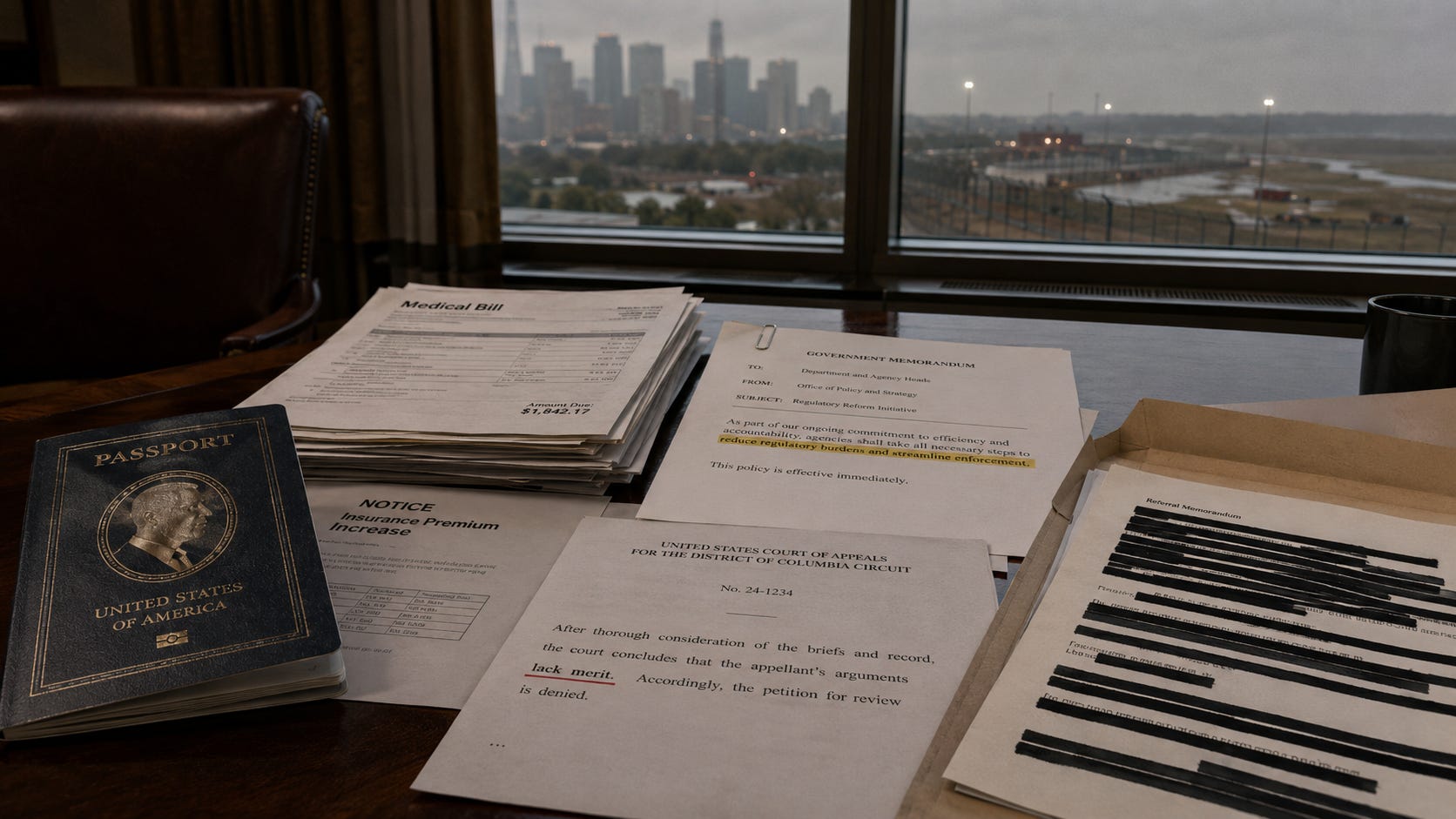
Axios reported that the department has already released 3.5 million pages under the Epstein Act, but media legal analyst Katie Phang alleges DOJ improperly withheld or redacted additional material. Judge Emmet Sullivan gave the department until July 2 to comply with a preliminary injunction. The Justice Department said it would appeal. A spokesperson argued, “This judge is suggesting DOJ violate the law by un-redacting victim names,” while Trump has denied wrongdoing and has not been charged with a crime related to Epstein.
This is where the story must be handled carefully, because there are victims involved, and because the difference between disclosure and spectacle matters. But the larger point remains unavoidable. The public was promised transparency, the public received millions of pages, many redactions, another lawsuit, another deadline, and another explanation due.
That is how the fine print presidency works; nothing is ever simply what it says on the front page. The administration would like everything to be judged by the headline. Strong borders, clean government, lower costs, public safety, religious freedom, and American greatness. The words are always large, glossy, and arranged for maximum applause. But the truth is usually underneath, in the smaller type. The fine print is where they put the consequences, and today, as usual, it’s doing most of the governing.
“This is where satire…” thank you for your writing—amid the horror, you make me laugh! 🙏😄
I love the image of documents acting suspiciously. Thank you for another fine piece of writing.