


I regret to inform you that my garden research has now moved from worms and fungi to vines, which means my husband and I have entered the stage of marriage where one of us can say, “I think that might be bindweed,” and the other understands this is not a casual observation but the opening scene of a psychological thriller.
This isn’t theoretical for us. We have been fighting bindweed for years, which is to say that we have been locked in a slow, intimate, deeply annoying relationship with a plant that seems to believe our garden, our fence, our house, our floor, our patience, and possibly our souls are all available trellis space.
Bindweed is often mistaken for morning glory, and I understand why, because it has the nerve to produce little trumpet-shaped flowers that look almost charming if you don’t know what’s happening beneath and around them. That’s how it gets you.
It looks like a flower while behaving like a hostile takeover. It twines around whatever it can reach, climbs fences, creeps into beds, snakes along siding, disappears under structures, and returns with the persistence of a political consultant who has smelled donor money.
In our garden, it’s everywhere, in the beds, around the fence, climbing the siding of the house, trying to go under the house, it has made moves toward the floor, which is not something I expected to say about a plant unless I was living inside a fairy tale written by a homeowner’s insurance adjuster.
It’s the bane of our existence, and I do not mean that in the dramatic way people say a slow internet connection is the bane of their existence. I mean that every day, we go outside and find it again. Every day, there it is, creeping into something beautiful and healthy and wrapping itself around the life we are trying to grow.
Every day, my husband and I spend at least an hour in the garden removing it as carefully and humanely as possible, because even when you are fighting the plant equivalent of a cursed ribbon, you still have to care about what else is living nearby. That’s the part people sometimes miss about responsible garden work. It’s not simply war, rage with gloves on, or ripping everything out because one bad thing has entered the bed.
The work is careful because the garden is connected, and if you are too careless in your fight against the invader, you can damage the very plants you are trying to protect. We learned that lesson most painfully with our New Zealand cabbage tree.
Its roots grow out horizontally, and for a while it was on the verge of death because bindweed had worked itself through and around those roots, choking the tree in a slow underground grip that felt almost personal once we understood what was happening.
We had to dig it up carefully, trying not to disturb its roots more than necessary, and move it to a new location where it could breathe, recover, and have a chance to become itself again. Now it’s thriving.
I don’t want to overstate the emotional arc of a cabbage tree relocation, but there is something genuinely moving about watching a plant come back once it’s no longer being strangled by something that only knew how to take.
There is a lesson there, of course, because at this point my garden refuses to let me have a hobby without also handing me a political metaphor and asking whether I would like that in a reusable bag.
After writing about earthworms, those humble little workers of repair, then hammerhead flatworms, the false worms that prey on the helpers, then mycorrhizal networks and beneficial insects, the hidden allies and visible defenders of the underground republic, bindweed arrived as the next obvious chapter.
The false flower, the pretty invader, the thing that looks delicate while it strangles everything around it. Bindweed is not frightening in the dramatic way a pest can be frightening. It doesn’t arrive with fangs, announce itself as a villain, or stomp into the garden wearing a little sash that says, “I am here to drain the nutrients and make your cabbage tree question its will to live.” It comes softly. It curls, climbs, wraps, and uses the structures that are already there.
It doesn’t build the fence, or the bed, and it doesn’t grow the tree, it simply uses and invades them. It doesn’t make the garden healthier, stronger, or more alive, but it can cover itself in flowers and pretend that its presence is growth.
This is where Donald Trump comes wandering back into the garden, because apparently he has become the invasive perennial of my imagination and there is no respectful way to keep him out of the mulch.
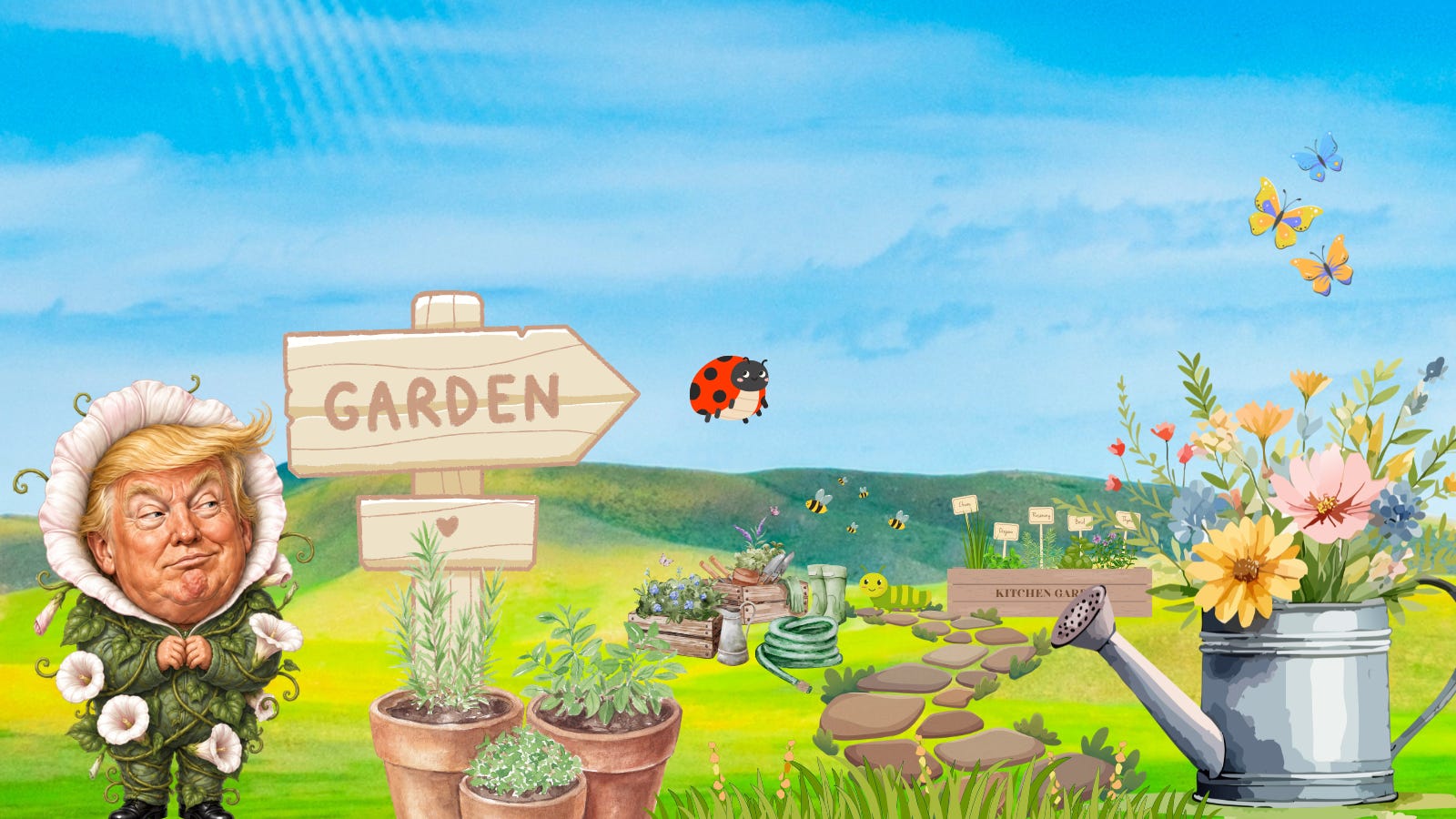
Trumpism is bindweed politics. It doesn’t build the trellis, it climbs whatever is already standing. It climbs the courts, the press, the Republican Party, evangelical institutions, public fear, civic exhaustion, social media, cable news, the flag, the White House, and every norm that was supposed to support something healthier.
It wraps itself in patriotic language while choking the public good. It flowers in words like freedom, family, law, order, faith, children, and country, while tightening around the very roots of democracy.
It calls the strangling “strength,” the takeover “growth,” and the damage “winning.” Which is why bindweed feels like such a responsible metaphor for this moment, because the danger is not only ugliness.
Sometimes the danger is the pretty little lie or the thing that seems familiar enough to ignore, charming enough to excuse, and persistent enough to become structural before anyone admits what it’s been doing.
A responsible gardener learns that not everything with flowers belongs in the garden and a responsible citizen learns that not everything wrapped in a flag belongs in a democracy.
This is especially hard because bindweed is not a one-day problem. You don’t pull it once and become free or make one heroic afternoon of it, wipe your hands on your pants, and declare the garden liberated. Bindweed has deep roots, up to 30 feet deep to be specific, spreads aggressively, and can return again and again from what you failed to remove.
That’s the maddening part. You can spend an hour doing careful work, feel almost proud of yourself, and then the next day find a new little vine curling around the base of a plant as if yesterday’s labor was merely a suggestion.
If that doesn’t sound like the last decade of American politics, I envy the peace of your inner life. Trump loses an election, and the lie grows back. Trump is impeached, and the grievance grows back. Trump is indicted, convicted, exposed, mocked, fact-checked, humiliated, and somehow the vine keeps finding another structure to climb.
A donor network, a congressional enabler, a social media algorithm, or a voter so hungry for someone to punish that he will let the vine strangle his own garden as long as it reaches the neighbor’s fence first.
This is why I don’t find the usual calls to “move on” especially persuasive. Nobody who has fought bindweed says, “Have you considered simply not giving it attention?” Nobody looks at a vine creeping under the siding of the house and says, “Maybe if we stop being so negative, it will become a hydrangea.”
Attention alone doesn’t solve the problem, but denial is how the problem becomes architecture. You have to see it, name it, keep removing it, and do that without destroying the garden in the process.
This is the hardest part, both in soil and in politics, because fighting an invasive force can tempt people toward a kind of reckless purity. It’s easy to want a dramatic solution, it’s easy to want to rip, scorch, poison, flatten, and be done. It’s easy to confuse force with care when you are tired, angry, and standing in a garden bed holding another handful of the same vine you swear you pulled yesterday.
But a living system can’t be protected by treating everything around the problem as disposable.
The cabbage tree, the soil, the nearby plants, and the roots we couldn’t see mattered. The work had to be patient because the point was not to win a symbolic battle against bindweed, the point was to help the tree live. That sentence matters to me.
So much of our politics gets trapped in a performance of opposition, where the pest remains at the center of every thought, every sentence, every reaction, every hour of attention. I understand this because the pest, the damage, and the stakes are real.
But the deeper work cannot only be hating the vine, the deeper work has to be protecting what the vine is trying to strangle. The local papers, public servants, immigrants, vulnerable communities, the truth-tellers, and the exhausted ordinary people still trying to keep something alive in a country where too many powerful men have discovered that destruction gets more airtime than care.
Trumpism, like bindweed, thrives on entanglement. It wants to make itself inseparable from everything around it. It wants people to believe that removing the vine would kill the fence, that cutting the strangling growth would damage the garden, that the plant it has wrapped itself around somehow depends on the thing suffocating it.
That is the lie of every abusive system. It says you need me, you can’t survive without me, I’m not choking you, I’m holding you together, my grip is proof of love, strength, patriotism, order, and destiny.
The garden knows better, it knows the difference between support and strangulation, that a vine can look alive while stealing life from everything it covers, that roots need room, that leaves need light, and that healthy growth doesn’t require everything else to bend around one hungry thing.
This is where the New Zealand cabbage tree becomes more than a personal detail to me. It’s not just that we moved it, it’s that moving it worked, care, attention, gentleness, and daily effort gave that tree its first flowering season.
A plant that looked like it might not make it is now thriving because we took the strangling thing seriously and acted with enough care not to destroy the patient while treating the injury.
That feels like achievement. Not easy, quick, or satisfying in the cheap way spectacle is satisfying. But achievement, nonetheless. The bindweed still comes back, because of course it does. I still find it creeping into the garden beds, curling around the fence, testing the siding, and making its little green argument for despair.
But the cabbage tree is alive, the garden is alive, and the work continues because life is still there to be protected. That’s the part authoritarianism never understands, because authoritarianism is spiritually incapable of gardening, as stated previously.
It can clear, flatten, punish, dominate, and wrap itself around a living thing while calling the grip protection; but It cannot cultivate. It can’t steward and it can’t tell the difference between a garden and a conquest.
Trumpism looks at public life and sees trellis. It sees the flag, faith, and suffering as something to climb. It sees institutions as structures to wrap itself around until everyone forgets what those structures were supposed to hold. It sees people not as roots, not as citizens, not as living beings in relationship with one another, but as supports, props, marks, hosts, and nutrients.
This is why the metaphor of bindweed feels so much more precise to me than ordinary language about corruption. Corruption sounds like something that happens behind closed doors, but bindweed shows how the damage happens in contact. It touches, twists, and uses intimacy as strategy.
It doesn’t merely take from a distance, it wraps itself around what is living and asks the living thing to carry its weight. If we are going to survive this particular false flower, we have to become better gardeners of democracy. That means persistence without panic, daily attention without obsession, removing what strangles without harming what heals, refusing to be seduced by the flower when the vine is choking the roots, and understanding that no single afternoon, no single election, no single indictment, no single article, no single speech, and no single perfect sentence will end the work.
The work is cumulative and seasonal, it’s one more root carefully freed, one more institution kept from being wrapped in the vine, and one more beautiful, living thing given enough room to breathe.
I wish the metaphor were less exhausting, but I also think there is a kind of mercy in its honesty. Bindweed doesn’t ask us to believe in instant victory, it asks us to believe in persistent care, that the garden is worth the hour today, even if the vine returns tomorrow, and to understand that a plant can be saved, that roots can recover, that the thing on the verge of death can thrive again if we stop pretending strangulation is just another kind of growth.
That is where I am today, standing in the garden with my husband, both of us slightly dirty, slightly tired, and spiritually prepared to identify bindweed at a distance that would concern our younger selves.
I am pro-earthworm, anti-false-worm, fungus-pilled, pro-beneficials, and I am now, with the full force of my body and soul, anti-bindweed. Not because I hate flowers, vines, or because I think every unwelcome thing should be destroyed without thought.
I am anti-bindweed because I love the garden, the cabbage tree, the healthy beds, and even the fence when it’s not being used as an accomplice. I love the soil, the roots, the worms, the fungi, the insects, the leaves, the shade, the whole living tangle that is not the same thing as being strangled.
A living system is not healthy because nothing grows wildly, it’s healthy because the wildness doesn’t all belong to one thing, and a democracy is not healthy because nobody fights, it’s healthy because no one hungry vine is allowed to wrap itself around every structure and call the suffocation unity.
So yes, the false flower is pretty, yes, it’s persistent, yes, it will be back tomorrow. But so will we.
Bravo, Mary!!! You have fed my soul with your marvelous metaphor…I am a gardener, retired English teacher, and frustrated Democrat! Your wonderfully prosaic column is a joy to read!! Thank you for your elegant, analytical thoughts about the crazy regime we are enduring!!
,
This is the best article I have read about where we need to go without destroying our physical and mental health in the process.
As I was taught as an apprentice: “it is not a race, it is a marathon”. Deliberate does not necessarily mean slow but it is focused. It is also necessary.
Thank you!