


The view from abroad can be especially illuminating, particularly when it sharpens and deepens domestic reporting. What Middle East Eye saw with unnerving clarity, and what The New York Times has now documented in a more institutional register, is that this administration is not merely pursuing war. It is indulging in it, aestheticizing it, and draping it in the language of divine purpose. Put those two pieces together and the picture becomes harder to dismiss. This is not just another round of American militarism wrapped in the usual dead-eyed euphemisms about stability, deterrence, and the convenient looting of foreign resources. It is something more fevered than that, more theatrical, more openly intoxicated by force, and more willing to cast violence not as a burden reluctantly borne but as a righteous expression of power.
Middle East Eye’s American Crusade transcript understood the emotional truth of the moment before much of the political press was willing to say it out loud. Donald Trump, sitting behind the Resolute Desk and admiring a model B-2 bomber like a child hugging his favorite Christmas toy, was not speaking about war the way statesmen have traditionally pretended to speak about war. There was no solemnity, no sense of loss, no acknowledgment that bombs do not simply go “right down the chute” into the abstract, but into human lives and human cities. Pleasure was the point, they suggest, and spectacle. He spoke of destructive force the way a man in a showroom talks about marble finishes and custom lighting. Empire as home renovation, and atrocity as set design.

The usual class of professional minimizers might have dismissed it as just Trump being Trump, one more grotesque performance from a man who has spent his life confusing cruelty with strength. But the NY Times reporting on Pete Hegseth adds something even more revealing and more dangerous. It shows that the administration’s war posture is not merely juvenile or macho. It is being moralized. Sanctified and blessed into legitimacy by a Defense Secretary who seems determined to fuse military violence with a distinctly Christian civilizational narrative.
Hegseth is not just talking about overwhelming force or American superiority. He is explicitly asking for prayer “in the name of Jesus Christ” while bombs fall on a majority-Shiite Muslim country. The Secretary is describing U.S. military action as operating under the providence of Almighty God. He is hosting Christian worship services at the Pentagon and speaking in terms that blur any remaining line between spiritual warfare and actual warfare. It is not some passing flourish or a little culture-war garnish on top of defense policy; it is a worldview. Middle East Eye caught it in the symbolism, the tattoos, the crusader language, the open relish for domination. The Times came along with the receipts and confirmed that, yes, the Secretary of Defense really is this far gone.
What makes the Middle East Eye perspective so strong, is that it does not sanitize what is happening by pretending the emotional and ideological content of these men’s words is irrelevant. Too often, establishment reporting treats affect as a side note, as though posture and language are somehow secondary to policy. But posture is policy when the people running the war machine are telling you exactly what thrills them, exactly what they believe, exactly how they see the world. Trump talks about bombing runs with glee, and we should flinch. Hegseth invokes Christian providence while celebrating “death and destruction from above,” and that alone should set off every alarm. Add Marco Rubio musing about western civilization and Christian faith as binding political categories, and it becomes impossible to pretend these are random slips. They are disclosures.
The old rules of respectable commentary would tell us to be careful here, to avoid overstatement, to keep things measured and technocratic. But measured and technocratic language is part of how the American press has spent decades laundering the moral obscenity of U.S. violence into something that sounds regrettable but basically normal. Middle East Eye refuses that laundering. It looks directly at the delight, the vanity, the civilizational chauvinism, and the sense of license coursing through this administration and says: no, this is not normal. This is the rhetoric of men who want to dominate, who enjoy dominating, and who increasingly sound as though they believe domination itself is evidence of divine favor.
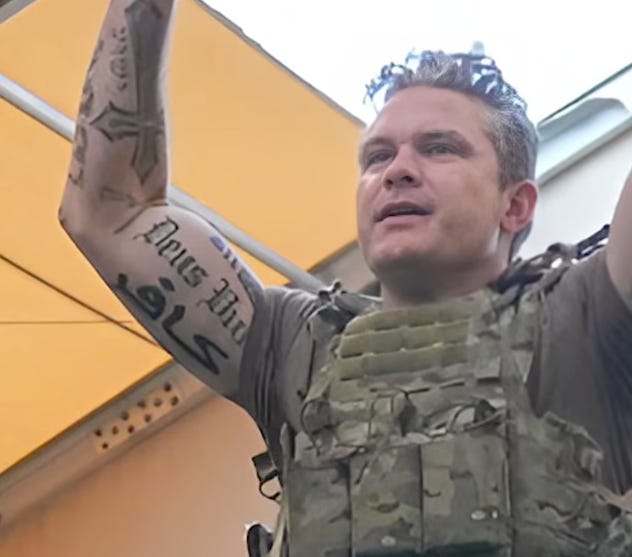
That last piece is the crucial one. Trump treats violence as performance. Hegseth treats it as liturgy. Trump is the showman, marveling at the hardware, basking in the imagery, turning state violence into another prop in his ongoing pageant of self-worship. Hegseth is the chaplain of the blast radius, coating the same violence in the language of providence and holy struggle. One is a narcissist drooling over the bomb bay doors; the other is there to inform us that heaven is apparently very impressed. Put them together and you get something worse than ordinary militarism. You get militarism with a grin and a benediction.
That is why the Nero comparison lands so hard. Not because it is melodramatic, but because it captures the moral rot at the center of all this. Recently, I made a graphic with the line that Nero fiddled while Rome burned, while Trump picks grout colors. That image stuck with me because it gets at his particular form of detachment: not tragic grandeur, just vulgar vanity, a man treating catastrophe like a luxury renovation project. Trump isn’t weighed down by the suffering his violence creates; he is decorating around it. But even that image is no longer enough, because beside him stands Hegseth, solemnly assuring the audience that the flames are not merely acceptable or useful, but somehow righteous. The emperor admires the blaze, and the priest blesses it. Together they call it civilization.
What The New York Times adds, perhaps without fully intending to, is confirmation that this is not simply an aesthetic problem or a messaging problem. It is a way of understanding American power as not merely strategic but ordained, not merely dominant but morally superior by definition. The racial and civilizational undertones are hard to miss, and not exactly unprecedented. Trump has spent years circling the iconography and language of strongman politics; in that light, the old reports that he kept a book of Hitler’s speeches by his bed read less like bizarre footnotes and more like early warning flares. Once that framework takes hold, restraint becomes weakness, diplomacy becomes appeasement, pluralism becomes decadence, and anyone on the receiving end of American firepower becomes part of a cosmic morality play they never agreed to audition for. That is how imperial violence always wants to see itself: not as violence at all, but as order, destiny, or salvation. Same bomb, new branding.
The strength of Middle East Eye’s commentary is that it names the psychological and ideological reality without flinching. The strength of the Times reporting is that it supplies the institutional validation establishment readers often require before they allow themselves to believe what is already sitting in plain sight. Put together, they tell a story that should terrify anyone still attached to the fantasy that these are merely rough-edged patriots using a little extra swagger. No, this is a power structure in which war is enjoyed by some, sanctified by others, and sold to the public as civilizational duty.
Oh Holy Hell.
YES!!! I agree 100% with what you wrote and in my mind we are being confronted with pure evil. I was happily doing my 7th decade in a seniors' community with my 2 cats. I don't have much but I don't need much. I'm always grateful that I have enough. Gotta feed the squirrels and birds and kitties and donate to the needy in my community. I use only 1 tank of gas per month. My big worry has been the environment ... I won't even get started on losing hope for that. Now I see this evil unveiling itself daily to the whole globe and it scares me to the same point that an earlier commenter wrote ... I don't feel anymore that I want to live to a ripe old age. I'm very frightened and fear is the root of my 'eye for an eye' anger in a previous comment. I don't want fear or anger inside me. Global warming already had me way outside of my comfort zone. What you wrote in this essay, Mary, is what I see, think and feel and there are no guarantees that the future will be even tolerable. "The only thing necessary for the triumph of evil is that good men look on and do nothing" (Edmund Burke and, earlier, John Stuart Mill)