

This is part two in my series on the extractive economy, see part one here:

The climate crisis doesn’t always arrive looking like the end of the world.
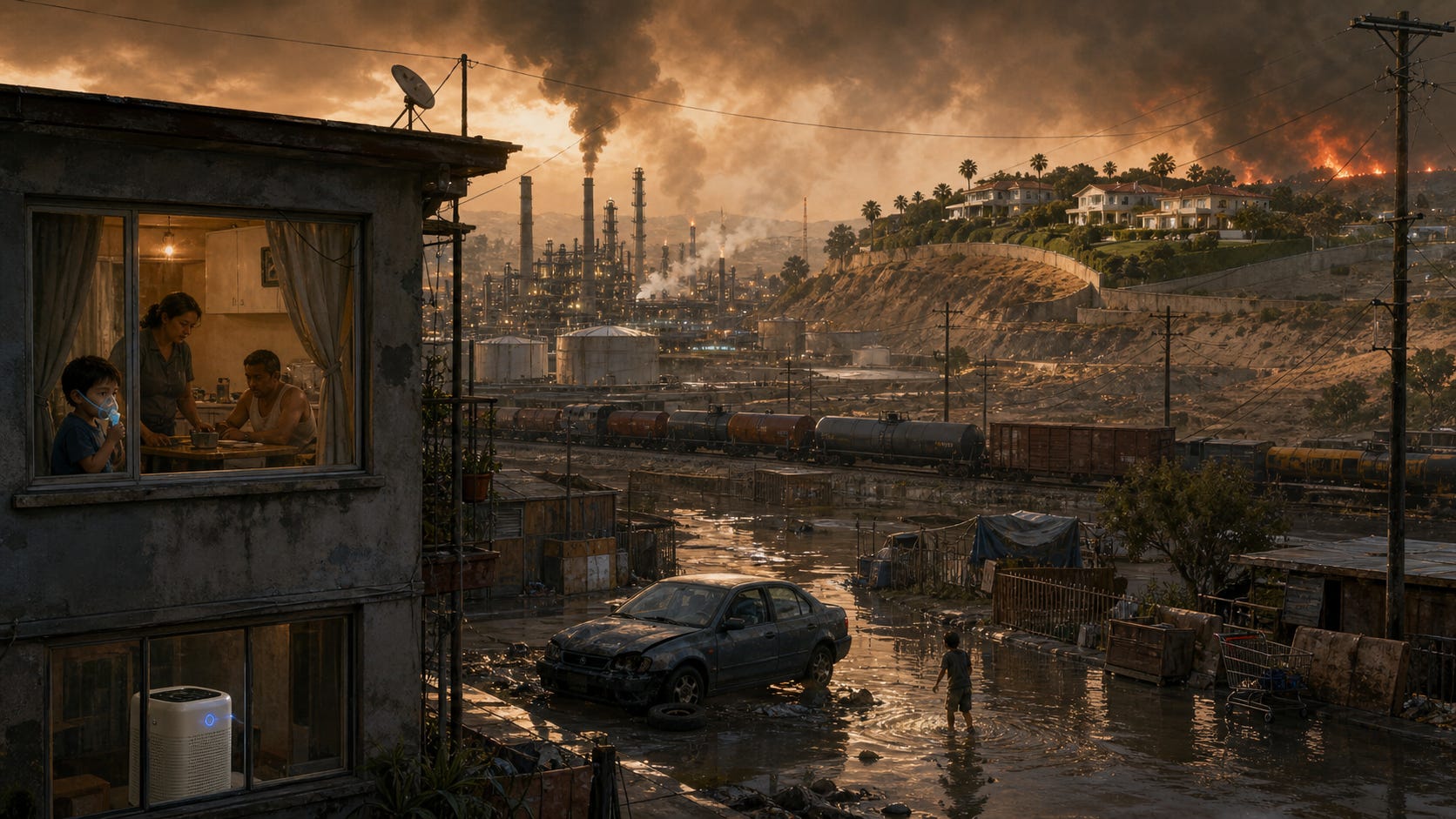
Sometimes it arrives as the smell of smoke in a child’s bedroom, even though the fire is burning hundreds of miles away. Sometimes it arrives as a wet towel pushed under a door, an air purifier running all night, and a mother checking the air quality app before deciding whether her child can play outside. Or maybe it arrives as a higher electric bill during a heat wave, because the apartment is too hot to sleep in and the body can only take so much.
Sometimes it arrives as a ruined car, a missed shift, a denied insurance claim, or the quiet realization that the place a family could barely afford to live in has become harder to survive in. This is how climate collapse becomes ordinary. The numbers are no longer abstract either. NASA found that 2024 was the warmest year in its global temperature record, 1.28 degrees Celsius above its twentieth-century baseline, and the last ten consecutive years were the ten warmest on record. Not everywhere at the same time, and not equally. It comes first for the people with the least money, the fewest exits, the weakest protections, and the smallest political voice. It comes as pressure, and pressure is something America already knows how to monetize.
In the first part of this argument, I wrote about poverty and the economy of almost. The question was why poverty persists in a country wealthy enough to reduce it, and the answer was not that poverty is good for the country. Poverty is terrible for the country, but poverty can still be profitable for specific people and specific institutions.
The climate crisis follows the same logic, only the scale is larger and the damage is harder to escape.
What pollution does to the air, extraction does to the worker. What debt does to the household, carbon does to the future. What rent does to the paycheck, fossil fuels have done to the atmosphere. The pattern is the same: someone takes the profit now, and someone else receives the bill later.
This is the deeper logic of an extractive economy. It does not merely extract from poor people, workers, renters, borrowers, patients, and consumers. It extracts from land, water, air, forests, oceans, animals, neighborhoods, and generations not yet old enough to object. It treats the living world the way it treats the poor, as something useful, overdrawn, under-protected, and expected to keep absorbing harm without finally breaking.
A company can profit from oil, gas, plastics, shipping, mining, deforestation, industrial agriculture, or endless consumption while the true cost is pushed outward into the public world. The asthma goes somewhere else, the flood goes somewhere else, and the cancer cluster goes somewhere else. The dead river, the poisoned groundwater, the heat trapped in a city without trees, the family choosing between cooling the house and paying the rent, all of it is sent somewhere else.
For a long time, “somewhere else” has been the business model. It is not only an environmental crisis, but also the revenge of hidden costs. It’s what happens when an economy becomes very good at moving damage off the balance sheet and very bad at asking who has to live inside that damage.
Pollution is not simply waste; it’s often a business decision with the consequences removed from the price. Carbon isn’t just an emission; it’s unpaid debt. A disaster isn’t merely a natural event; increasingly, it is the moment when the bill for private profit arrives in public life. And as always, the bill doesn’t arrive evenly. The IPCC says this in less poetic language: approximately 3.3 to 3.6 billion people live in contexts that are highly vulnerable to climate change, and that vulnerability is shaped by inequity, marginalization, governance, and development.
A wealthy family can buy distance. They can move away from the refinery, install air filtration, leave during the fire season, rebuild after the flood, replace the ruined car, absorb the insurance hike, or retreat to a second home when the first home becomes temporarily unlivable. They can purchase insulation from consequences, at least for a while. A poor family is told to be resilient.
Resilience is a beautiful word when it means courage, community, preparation, and care. It becomes an ugly word when it is used to describe people being forced to survive what they didn’t create. There is nothing noble about asking the most vulnerable people to become endlessly adaptable to harm that powerful people were paid to produce.
A renter in a badly insulated apartment doesn’t experience climate change as a political debate, they experience it as heat pressing down through the ceiling at midnight. A child with asthma doesn’t experience climate change as an atmospheric model, they experience it as a tight chest, a missed school day, an inhaler, and a parent listening carefully to every breath. A recent Carnegie Mellon study estimated that smoke from wildfires and prescribed burns caused more than $200 billion in health damages in the United States in 2017, associated with approximately 20,000 premature deaths. A farmworker doesn’t experience climate change as a distant projection, they experience it as laboring through dangerous heat because the crop still has to be picked and the paycheck still has to come. The poor experience climate change as a bill, a body, a warning, a delay, and as a choice that isn’t really a choice.
Which brings us to the part of the climate story that America still struggles to tell honestly. We talk about individual responsibility because it is easier than talking about concentrated power. We ask ordinary people to recycle, drive less, buy better products, install better appliances, make better choices, and shrink themselves into moral purity. Some of those choices matter, and none of them should be mocked. People want to do right by the world they live in.
But the central problem has never been that ordinary people loved destruction too much. The central problem is that powerful systems were allowed to profit from destruction while calling it growth.
The same economy that tells a poor person to budget better tells a warming planet to absorb more. The same economy that blames a family for falling behind blames consumers for a crisis designed around consumption. The same economy that asks why a worker didn’t save enough asks why a flooded town didn’t prepare enough.
Responsibility keeps being pushed downward, while profit keeps moving upward. That is the trick.
If a company can make money producing the harm, then the public can be asked to pay to clean it up. If a corporation can make money burning the fuel, then the family can be asked to pay the higher insurance premium. If an industry can make money from plastics, chemicals, extraction, and disposal, then the community can be asked to live near the landfill, the incinerator, the refinery, or the poisoned water. In 2024 alone, NOAA counted 27 separate U.S. weather and climate disasters that each caused at least $1 billion in damage, with at least 568 deaths and approximately $182.7 billion in costs.
The gain remains private, while the cost remains social. The wound is local, while the profit is distributed to people who may never have to see it. Which is why the climate crisis belongs in the same conversation as poverty, debt, housing, wages, monopolies, and power. They are not separate problems floating around the edges of American life. They are simply different expressions of the same moral failure. We have allowed too many necessities to become profit centers and too many consequences to become someone else’s problem.
The fence was always there, of course. We just pretended it wasn’t. It was around the poor neighborhood where the highway was built, the rural community where the waste was buried, and the island told to rebuild after another storm. It was around the workers breathing chemicals, the children breathing soot, the families drinking water they were assured was safe until suddenly everyone agreed it wasn’t.
Sacrifice zones are not accidents, no, they are places where the powerful have decided the damage can be tolerated because the people living with it have been given too little power to refuse. Extraction begins where the ability to refuse ends.
That is true in the economy of almost, and it’s true here too. A family can’t refuse a polluted neighborhood if clean air has been priced into neighborhoods they cannot afford. A town can’t refuse a destructive industry if the industry is one of the last employers left. And the earth, of course, cannot refuse us at all.
It can’t negotiate with the company, it can’t sue the shareholder, it can’t leave the abusive relationship and start over somewhere safer. It can only respond according to the laws of physics, chemistry, biology, and time.
For centuries, the living world has been treated as a silent partner in human prosperity, except it was never really a partner. It was treated more like collateral. Forests could be cut, rivers could carry waste, oceans could absorb heat, soil could be depleted, mountains could be opened, animals could disappear, and the atmosphere could be used as a storage unit for the byproducts of growth.
The assumption was not always spoken, but it governed everything. The world would keep absorbing it, keep producing, and keep forgiving. That assumption is ending.
The smoke is no longer staying somewhere else, the heat is no longer staying in the future, and the floods are no longer rare enough to be called once in a lifetime with a straight face. The insurance companies, which are very good at math when math protects money, are beginning to say what political leaders have tried not to say. The risk, the map, and the cost are changing.
And still, so much of the conversation asks ordinary people to absorb the panic individually. Buy the generator, the filter, the bottled water, the higher ground if you can afford it, and the insurance if anyone will sell it to you. Buy the new car, the new system, the new subscription, the new device, the new emergency kit, the new private solution to the public collapse.
Even adaptation becomes a market. This is how an extractive economy survives its own disasters. It sells the cause, then sells the temporary protection from the cause. It profits from instability, then offers premium services to those who can afford a little shelter from instability. It turns every crisis into a marketplace and every fear into a product.
There is something especially cruel about that. The same system that helped make life more dangerous then asks families to pay more to survive the danger, that weakens public goods then sells private substitutes, that cuts down the shade then sells the air conditioner. At some point, resilience becomes another word for abandonment. The IPCC has also warned that adaptation progress is unevenly distributed, with adaptation gaps already observed across sectors and regions.
And yet, the answer cannot be despair. Despair is too useful to the people who benefit from the present arrangement. Despair tells us the machine is too large, the damage too deep, the politics too broken, and the future already lost. Despair turns citizens into spectators, and spectators are exactly what an extractive economy prefers.
The real answer is not despair, it’s power. The opposite of climate collapse is not a poorer life for ordinary people. It’s power returned to the public, to workers, to communities, to future generations, and to the living world that has been treated as disposable for too long.
It’s the power to breathe clean air without buying it, to drink clean water without doubting it, and the power to survive a storm because the public infrastructure was built for human beings, not neglected until private contractors could profit from rebuilding it badly.
The opposite of extraction is repair, which isn’t glamorous in the way growth is glamorous. It doesn’t always ring bells on Wall Street or produce a heroic founder on a magazine cover. Repair looks like insulation, transit, shade trees, wetlands, clean energy, public health, disaster preparation, worker protection, housing policy, utility regulation, and the slow, unsexy work of making life less fragile.
But making life less fragile may be the most radical thing a society can do. A fragile person is easier to exploit, a fragile town is easier to poison, a fragile democracy is easier to buy, and a fragile planet is easier to strip for parts because everyone is too busy surviving the last emergency to prevent the next one.
That’s why stability isn’t boring, stability is freedom. The people who profit from extraction understand this, even if they don’t say it plainly. They understand that people with options are harder to control, communities with resources are harder to sacrifice, public systems that work are harder to replace with private tollbooths, and a country that refuses to abandon people is harder to farm.
The climate crisis asks whether we are willing to stop treating both people and the planet as things to be used until they break.
That question is not sentimental. It’s practical, economic, political, and moral. A society can’t remain healthy if its business model depends on exhaustion. It can’t build a future by burning through the conditions that make a future possible. It can’t call itself prosperous while its people are overdrawn, its towns are flooding, its children are breathing smoke, and its leaders are still asking whether repair is affordable.
Of course repair is affordable, what we cannot afford is the lie that extraction is cheap. Extraction has never been cheap, it simply looked cheap because the full price was hidden. It was hidden in the lungs of children, in the bodies of workers, in the debt of families, in the flooded basements, in the burned towns, in the poisoned wells, in the species that vanished, in the forests that no longer stand, and in the years stolen from people who were told this was simply the cost of doing business.
The planet is not collapsing because ordinary people needed too much. It is collapsing because powerful people were allowed to take too much, waste too much, hide too much, and call the wreckage growth.
People need homes, food, medicine, energy, transportation, safety, beauty, and joy. Those needs aren’t the problem. The problem is an economy that turns every need into a site of extraction, then blames the less fortunate for the damage done in their name.
The problem is not that human beings want to live. The problem is that powerful institutions have confused living with consuming, consuming with growth, growth with profit, and profit with the public good. The climate crisis breaks that illusion.
It reminds us that there is no private atmosphere, no gated ocean, no luxury version of rainfall, no premium subscription that can permanently separate the wealthy from the world that keeps them alive. Money can buy distance for a while, and distance is not the same as escape.
Eventually, the bill comes due somewhere, eventually, the smoke crosses the line, and eventually, even the people who built the tollbooths discover that a burning road is not much of an asset. The question is whether we learn this through wisdom or through disaster.
A better world is still possible, but it won’t be built by asking the most vulnerable people to carry more. It won’t be built by telling poor families to sacrifice while the powerful continue to extract. It won’t be built by replacing public obligation with private shopping lists. And it won’t be built by confusing individual virtue with structural change.
It will be built when we decide that no person, no town, no river, no forest, no coastline, no worker, no child, and no future should be treated as disposable. That is the moral line.
The earth, like the worker, like the renter, like the debtor, has been forced to carry a burden it did not create. For a long time, the powerful mistook that carrying for consent, they mistook silence for permission, and they mistook endurance for proof that the system could go on forever. But endurance is not the same as peace.
A body under enough pressure begins to break down. A family under enough pressure eventually loses the ability to absorb one more bill, one more emergency, one more demand. And the earth, pressed hard enough for long enough, begins to answer in the only language left to her.
Fire, flood, storm, heat, smoke, water where water should not be, and no water where life depends on it. This is not revenge in the simple sense. The earth is not cruel. She is not punishing a child in a hot apartment, a family in a flooded home, or a town breathing smoke from a fire they did not start. That is part of the horror. The people hit first are so often the people who had the least power to stop the harm.
The atmosphere is answering what was put into it, the forests what was taken from them, the rivers what was dumped into them, and the soil what was stripped from it. The climate is answering an economy that believed the living world could be treated as a warehouse, a sewer, a fuel source, and a sacrifice zone without consequence.
For centuries, the powerful treated the earth’s abundance as something owed to them, and her wounds as something someone else would live with. Now the bill is moving through the weather.
That is the edge of this crisis. The earth doesn’t need to hate us to become dangerous. She only has to stop being able to protect us from what we have done. She only has to respond according to the laws we tried to ignore while profit was being made. And maybe that is the truth an extractive economy fears most, nothing can be pressed forever; not a worker, a family, a town, a river, a forest, an atmosphere, and most certainly, not a planet.
Eventually, what has been forced to carry too much begins to push back, and eventually, what has been treated as disposable begins to remind us that it was alive all along.
Wow. Very powerful and insightful. Thank you for this.
Thank you