


A reader raised a fair objection to my essay “The Economy of The Burning Planet,” and I think it deserves more than a comment-section answer.

The objection was this: I was very specific about the abuses and very general about the fix. If the poor suddenly became wealthy and powerful, wouldn’t they do the same thing? Isn’t the flaw endemic to mankind? And can anyone name a period in human history when wealth and power were evenly distributed and there were no poor?
The answer is, no. I can’t name that period, because it doesn’t exist. There has never been a clean, shining age when human beings distributed wealth perfectly, power behaved modestly, nobody exploited anybody, and everyone agreed to stop being weird about status, money, land, God, borders, and whose turn it was to control the grain supply.
I am not arguing for a lost paradise. I don’t think poverty makes people morally pure, or that rich people are born with some special cruelty gene, or that if we simply swapped the people at the top with the people at the bottom, history would finally relax and become decent.
Human beings are complicated, we are capable of cooperation, sacrifice, tenderness, courage, and astonishing acts of care. We are also capable of greed, fear, domination, hoarding, violence, and turning almost anything into a hierarchy if left alone with it long enough. This isn’t news, Shakespeare knew it. Every homeowners’ association in America knows it. The question isn’t whether human beings can be made flawless, we simply can’t be. The question is what kind of systems we build around flawed people.
Because systems, incentives, rules, ownership, public goods, and power all matter. An economy is not just a machine that produces goods and services, it’s also a moral instruction manual. It tells people what will be rewarded, what will be punished, what will be ignored, and what can be gotten away with.
If an economy rewards extraction, people will extract. If it rewards hoarding, people will hoard. If it lets corporations’ profit from pollution while communities absorb the sickness, then pollution becomes not a moral failure but a business model. If it lets landlords turn housing into a private tollbooth on human survival, then rent becomes less about shelter and more about leverage. If it lets employers treat workers as disposable, then disposability becomes efficient.
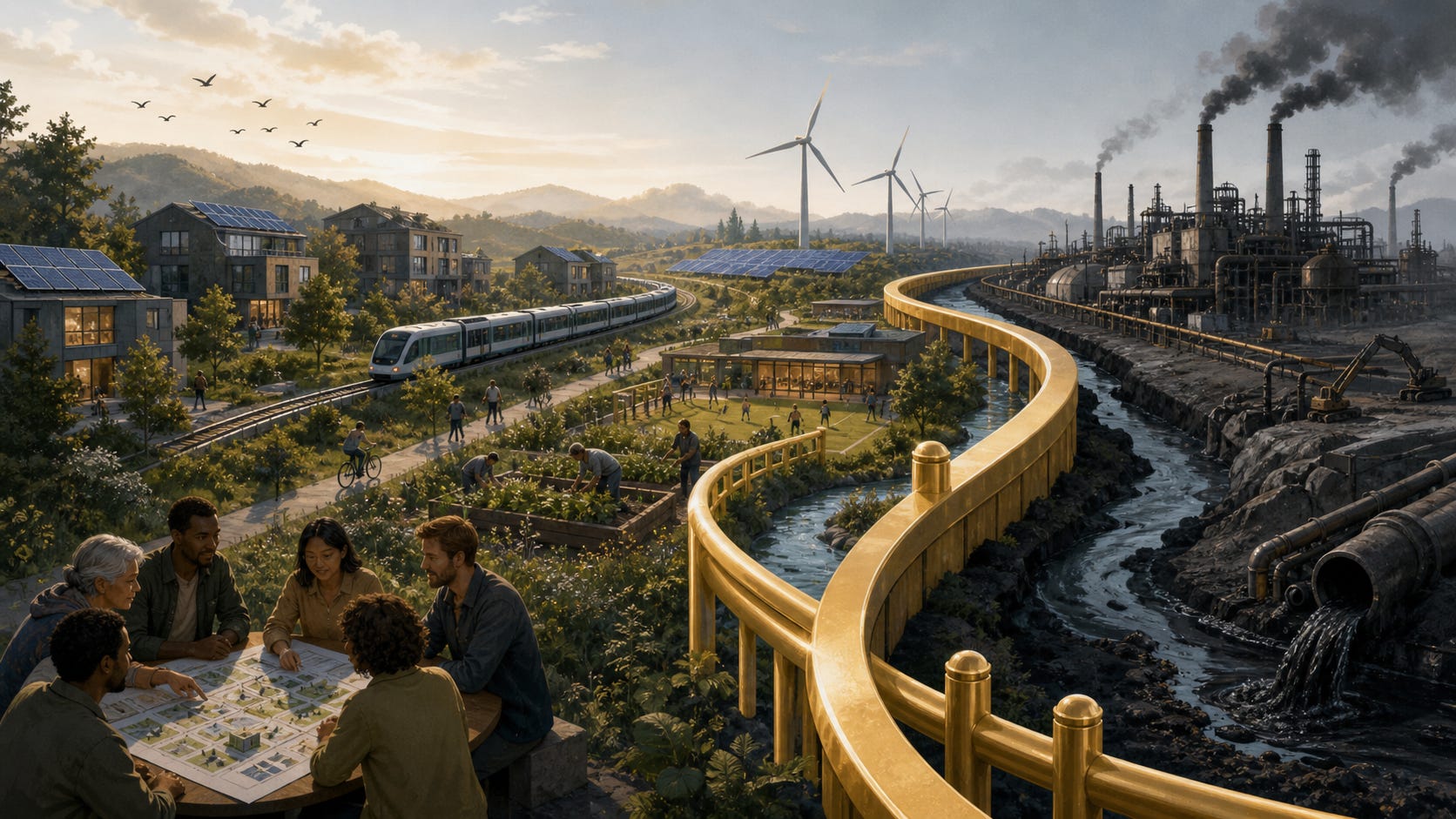
The answer to human selfishness is not to pretend it can be abolished. The answer is to stop building an economy that turns selfishness into policy, extraction into growth, and cruelty into shareholder value. That doesn’t require utopia, it requires guardrails.
And the good news, if we are still allowed to use that phrase carefully, is that we do not have to invent all of this from scratch. There are already institutional models, imperfect but real, that show how power can be distributed differently, how necessities can be protected from speculation, and how public life can be organized around repair instead of extraction.
None of them are magic, they don’t eliminate conflict, and none of them make human beings angelic. Which is precisely why they matter.
A better economy wouldn’t depend on better people, but rather, on better arrangements. Start with work. In most American companies, workers are treated as a cost to be managed, not as people with a democratic claim on the place where they spend so much of their lives. They may create the value, maintain the relationships, train the next person, absorb the stress, and hold the institution together through sheer competence and caffeine, but when the real decisions are made, they are usually outside the room. That is a design choice, and it’s not the only possible design.
Germany has a law, not a manifesto, an actual law, that requires workers to sit on the boards of large companies. It is called codetermination, and it has been around since 1976, which means it predates the iPhone, the fall of the Soviet Union, and most of the think pieces explaining why such a thing could never work. This system gives employees formal representation on supervisory boards in larger companies. In companies with 500 to 2,000 employees, workers get one-third of the seats. In companies with more than 2,000 employees, they get half. This isn’t exactly Star Trek, this is labor law.
It doesn’t mean German corporations are little monasteries of kindness. It doesn’t mean workers always win, or that companies never pollute, outsource, lobby, or behave badly. But it does mean that the people whose lives are shaped by corporate decisions have a formal place inside those decisions. The premise is different; a company isn’t treated as though only capital has a legitimate voice.
That matters because the structure of power shapes the behavior of power. If workers have no seat, the business can treat their injuries, wages, schedules, families, and futures as variables. If workers have a seat, the business at least has to look them in the eye.
Worker cooperatives push this further. Mondragon, the famous cooperative network in Spain’s Basque Country, is not a small sentimental bakery with nice aprons and a chalkboard sign about community. It is a large federation of cooperatives with more than 70,000 workers and over €11 billion in sales. Its own description of the model is simple: people participate in capital, management, and profit.
Again, not paradise. Mondragon has had failures, tensions, global supply-chain problems, and all the pressures that come with competing in the real economy. But that’s part of why the example matters; the question isn’t whether worker ownership produces perfection. The question is whether ownership rules can make a business accountable to more than outside investors. They can.
The same is true with housing. If housing is treated primarily as an investment vehicle, then scarcity becomes profitable, a community’s stability becomes someone else’s asset class, and a family’s need for shelter becomes a monthly opportunity for extraction. The worse the shortage gets, the more valuable the thing becomes for those who already own it.
Community land trusts offer another model. A community land trust takes land out of the speculative market and holds it for long-term public or community benefit. People can still buy homes, build equity, and pass something on. But the land underneath the home is held by the trust, and resale rules keep the housing affordable for the next buyer too.
This isn’t perfect. It doesn’t solve the whole housing crisis, and it doesn’t erase the need for tenant protections, public housing, zoning reform, wages, and serious investment. But it does something important. It refuses to treat land as nothing more than a chip in the casino.
That is the kind of distinction a less extractive economy would need to make again and again. Some things can be bought and sold like ordinary commodities, some things can’t be treated that way without eventually deforming the society around them. Housing is one of those things, health care is one of those things, and water is one of those things. Energy, increasingly, is one of those things, and clean air has always been one of those things, even when we pretended otherwise because the invoice hadn’t yet reached the nicer neighborhoods.
This is where democracy has to mean more than voting every few years and hoping the least alarming person survives the primary. Participatory budgeting gives ordinary residents direct power over part of a public budget. The most famous example is Porto Alegre, Brazil, where residents helped decide public spending priorities beginning in 1989. In the first decade, water and sewer connections rose from 75 percent of households to 98 percent, participation grew to about 40,000 people a year, and public investment shifted toward poorer neighborhoods.
That doesn’t mean participatory budgeting fixed Brazil; It didn’t. It doesn’t mean every process stayed pure, every meeting was noble, or every outcome was beyond criticism. Human beings, again, remained human beings, which is very inconsiderate of us.
But it showed something important. When ordinary people are given structured power over public decisions, they often choose the boring things that make life livable: water, sewers, roads, schools, clinics, drainage, transit, lights, safety. Not because they are saints, but because they know what neglect feels like.
This is one of the lies of extraction: that ordinary people can’t be trusted with power, but corporations can be trusted with the atmosphere. The climate crisis makes that lie impossible to defend. If the last essay argued that extraction hides the cost, then a better economy has to make the cost visible. That is the basic idea behind the polluter-pays principle, which the OECD has described as a fundamental principle for allocating the costs of pollution prevention and control.
In plain English: if you make the mess, you pay for the mess. Radical stuff, apparently, which must be why it is still so hard to convince my oldest son that he is not cleaning the living room because he made the mess, but because he is helping me.
But this principle matters because extraction depends on a very old trick. The profit is counted immediately. The damage is deferred, dispersed, denied, litigated, renamed, and eventually handed to the public. The shareholder gets the return, and the town gets the poisoned water. The industry gets decades of subsidy, and the taxpayer gets the cleanup.
A serious polluter-pays system wouldn’t be a polite suggestion. It would require regulation with teeth, liability that cannot be escaped through bankruptcy games and shell companies, environmental enforcement that doesn’t depend on whether a community is wealthy enough to hire lawyers, and public investment in repair paid for by the industries that profited from the harm. That is not anti-human, it’s anti-free riding.
The same logic applies to the clean energy transition. A society can move away from fossil fuels in a way that repeats the old pattern, or it can move away from fossil fuels in a way that breaks it. Solar panels built through exploited labor, mines dumped on Indigenous communities, utility costs pushed onto poor households, and fossil fuel workers abandoned with a brochure about retraining are not a just transition. They are just extraction with a marketing plan.
The International Energy Agency has used the phrase “people-centred clean energy transitions,” and the phrase matters because the transition will not be just merely because the energy is cleaner. A transition that protects workers, lowers bills, builds public infrastructure, invests in communities, and gives people a voice is different from one that simply creates a new set of winners and losers with a greener logo.
Climate repair can’t mean asking poor people to pay more for survival while wealthy people shop for better insulation from consequences. That’s the whole point. A less extractive economy wouldn’t promise that no one will ever seek power, abuse power, or try to get more than their share. It would assume they might, then it would design institutions accordingly.
It would give workers power inside firms, because managers and investors should not be the only people who count. It would protect certain necessities from pure speculation, because a society can’t remain free when survival is always up for auction. It would let communities help decide what repair looks like, because people who live with the consequences shouldn’t be treated as decorative stakeholders after the plan has already been written. It would make polluters pay, because a business model that depends on poisoning other people shouldn’t be called efficient. It would build public goods strong enough that private desperation becomes less profitable, and it would remember that the future isn’t a dumping ground just because it doesn’t yet have lobbyists.
None of this requires a belief that human beings are naturally good. In fact, it requires the opposite kind of seriousness. It requires admitting that people and institutions will often take what they are allowed to take. So, the question becomes: what are they allowed to take? Who gets to say no? Who has the power to enforce the no? And who pays when the answer was ignored for too long?
This is where the human-nature argument often becomes too convenient. Yes, greed, domination, and inequality are old. There has never been a perfect society without poverty or hierarchy. But that doesn’t mean every system is equally cruel, every arrangement is equally destructive, or every future has to be a reenactment of the worst parts of the past.
Disease is also old, we still built sanitation systems and created vaccines. Fire is old, we still built fire departments. Theft is old, we still made laws against it, though admittedly with varying enthusiasm depending on the size of the theft and the quality of the thief’s suit. Human nature is not an argument against institutions, it’s the reason institutions exist.
The IPCC has warned that there is a “rapidly closing window” to secure a livable and sustainable future. That sounds terrifying because it is. But a window is not the same thing as a wall, a closing window means there is still something to do, and what we do matters.
We don’t need to prove that human beings can become angels before we build a society that stops rewarding devils for quarterly growth. We don’t need a perfect model; we just need a direction. That’s a sufficient answer to the original question. No, there has never been a golden age. But there have been better arrangements and worse ones, and we are always, whether we admit it or not, in the middle of choosing.
Applause, Applause ... this is your best yet in my opinion, Shanley! To my knowledge, the country of Bhutan is the closest to idyllic life that humankind has achieved. And now they're threatened to be wiped out by climate change. I just watched 2 hours of Ken Burns' documentary about the American Revolution on PBS. The USA was still fighting for independence and Congress was already a useless bunch of greedy men fighting amongst themselves and doing nothing worthwhile. The war was merciless and horrible and years long. Toward the end the Indians were literally burned down ... their nice homes, successful communities, healthy crops & orchards all burned ... Washington ordered that absolutely nothing of theirs be spared for any reason ... and it was done. The USA began 250 years ago with elitism, racism, and unconscionable violence. Definitely not a history to hearken back to. Rather, one to learn from and improve on. When I was employed in the field of industrial quality assurance, we talked about root cause and corrective action. It's a premise that I still believe in. I agree with you Shanley, we'll never get it exactly right ... nothing is static and people are inconsistent and untrustworthy ... but with goals of peace, fairness, justice, basic human rights for all, etc, we should be striving for better. We need a Bill of Rights and/or a Constitution ... didn't I just read that somewhere? Definitely too much money taints and corrupts people ... that's a root cause that needs corrective action!!
One of your best pieces I’ve read! A must read for every city manager, CEO, mayor, and governor. I love Germany’s codetermination law.