


Good morning! Turns out Pete Hegseth is not only the Dumb McNamara, he is also stupid. Not cunning-stupid in the interesting way, not diabolical-stupid in the Dick Cheney way, but plain old Trumpworld stupid: arrogant enough to think the rules do not apply, sloppy enough to leave fingerprints, and vain enough to imagine nobody will notice the smell. The latest revelation is almost too on-brand. According to the Financial Times, Hegseth’s Morgan Stanley broker reportedly contacted BlackRock in February about making a multimillion-dollar investment in its Defense Industrials Active ETF, a $3.2 billion fund explicitly marketed around companies expected to benefit from rising defense and security spending amid geopolitical fragmentation. Its holdings include the usual Pentagon-friendly names RTX, Lockheed Martin, Northrop Grumman, and Palantir, which is to say this was not some vague market flutter but an alleged attempt to buy directly into the very sector most likely to cash in on war. The investment apparently never went through only because the fund was not yet available for Morgan Stanley clients to buy, which somehow makes the story worse rather than better: the obstacle was logistical, not ethical. So even if the trade failed, the essential fact remains grotesque. While Hegseth was helping sell and steer a war, someone in his orbit was allegedly trying to place a bet on the industry most likely to profit from it. It is the kind of story that perfectly captures the moral grammar of this administration, in which public office is never just public office. It is always also a side hustle, a grift opportunity, a chance to turn geopolitical catastrophe into portfolio strategy.
Because no Trump scandal is complete without the usual blend of menace and idiocy, this comes as the administration continues to talk about Iran in the language of a protection racket and a war crime rolled into one. Trump has threatened to “obliterate” Iran’s power plants and desalination facilities if Tehran does not come to heel fast enough, which is to say he is openly threatening civilian infrastructure as a bargaining chip. It is collective punishment as a negotiating tactic, the language of coercion stripped of even the pretense of legality. Trump’s idea of diplomacy is apparently to tell an entire country: nice water supply you’ve got there, shame if something happened to it.
At the same time, the administration’s mixed priorities continue to reveal themselves with all the elegance of a raccoon tearing through an open trash bag. One of the more telling reports this morning details how Iran’s cyber operators have intensified attacks and probes against Israeli and American targets while U.S. cyber defenses have been left weakened, understaffed, and leaderless. So there you have the full kakistocratic equation: plenty of appetite for military escalation, very little interest in the dull but necessary work of protecting the country from retaliation. Trumpworld always wants the action movie version of government, all bombs and swagger and chest-thumping, while dismissing the cybersecurity staff, the institutional maintenance, and the boring competence as optional. They are forever eager to start a fire and forever annoyed by the existence of fire departments.
This same moral inversion is visible at home in the pardon spree, where Trump keeps using clemency not to correct injustice but to harden it. ProPublica’s account of nursing home operator Joseph Schwartz is especially foul. Here was a man convicted in a massive fraud case linked to the collapse of a nursing home empire, while families who won multimillion-dollar civil judgments over deaths and neglect in his facilities have been unable to collect. Then Trump stepped in and pardoned him, wiping away the federal sentence and helping close off one of the few remaining avenues those families had to trace his assets and perhaps recover a fraction of what they were owed. It is the same rotten pattern readers saw in the George Santos pardon, where clemency did not simply rescue a connected fraudster from consequences but also deprived the people he harmed of one of their last realistic chances to recover damages. The connected get absolution; the victims get dead ends. That is the real theory of justice in Trump’s America.
Because insult must always be added to injury, the same rotten hierarchy now extends to January 6. A proposed class action in which Jan. 6 participants seek to portray themselves as victims of police excess, characterizing the mob as a peaceful crowd and themselves as the injured party. The people who attacked the Capitol, then received pardons and political rehabilitation, are now reportedly trying to send the bill to the public. First they are absolved, then they are compensated, and all the while the rest of the country is expected to pretend that up is down and sedition is just another consumer grievance. In Trumpism, even insurrection comes with a refund policy.
The Iran war itself is drifting toward one of those grim, grubby outcomes that strongmen hate most: not triumph, not surrender, but the possibility of a shameful peace dressed up as genius. The reporting out of the Financial Times and elsewhere shows an administration talking out of both sides of its mouth at once. Hegseth blusters that the coming days will be decisive and threatens more intensity if Iran does not “cut a deal,” while Trump snaps at allies to “go get your own oil,” complains about overflight support, and acts as though a war Washington helped ignite is someone else’s logistical inconvenience. Imperial swagger without imperial discipline, empire as a tantrum. Trump wants all the prestige of alliance leadership with none of the obligations, all the theater of force with none of the cost accounting.
Costs have a way of arriving whether the president acknowledges them or not. The New York Times reports that average U.S. gasoline prices have now hit four dollars a gallon, up sharply since the war began, while diesel has surged as well. So the consequences of Trump’s adventurism are no longer confined to maps and briefings and cable-news graphics. They are arriving in kitchen-table math, in the price of filling a tank, in shipping costs, groceries, and the broader inflationary squeeze. Trump may call it a small price to pay, but like all elites who discover a sudden fondness for sacrifice, he means other people’s sacrifice. The administration sells war as strength and then treats the higher grocery bill as a character-building exercise for everyone else.
The Associated Press adds the wider regional picture, and it is not the picture of a controlled campaign but of a fire spreading through every corridor that matters. U.S. strikes in Iran, attacks on shipping in Gulf waters, missiles and drones reaching neighboring states, more troops moving into the theater, more deaths in Lebanon, more instability everywhere, and now the Houthis threatening to make Bab el-Mandeb as dangerous as Hormuz. Trump has managed, in a matter of weeks, to turn one strategic bottleneck into a possible two-front maritime crisis. Yet he still talks about diplomatic progress as though a widening regional economic shock were just another set of codes, covenants, and restrictions buried in the closing documents. Menace marketed as strategy, escalation narrated as stability, and chaos sold with the smugness of a product launch.
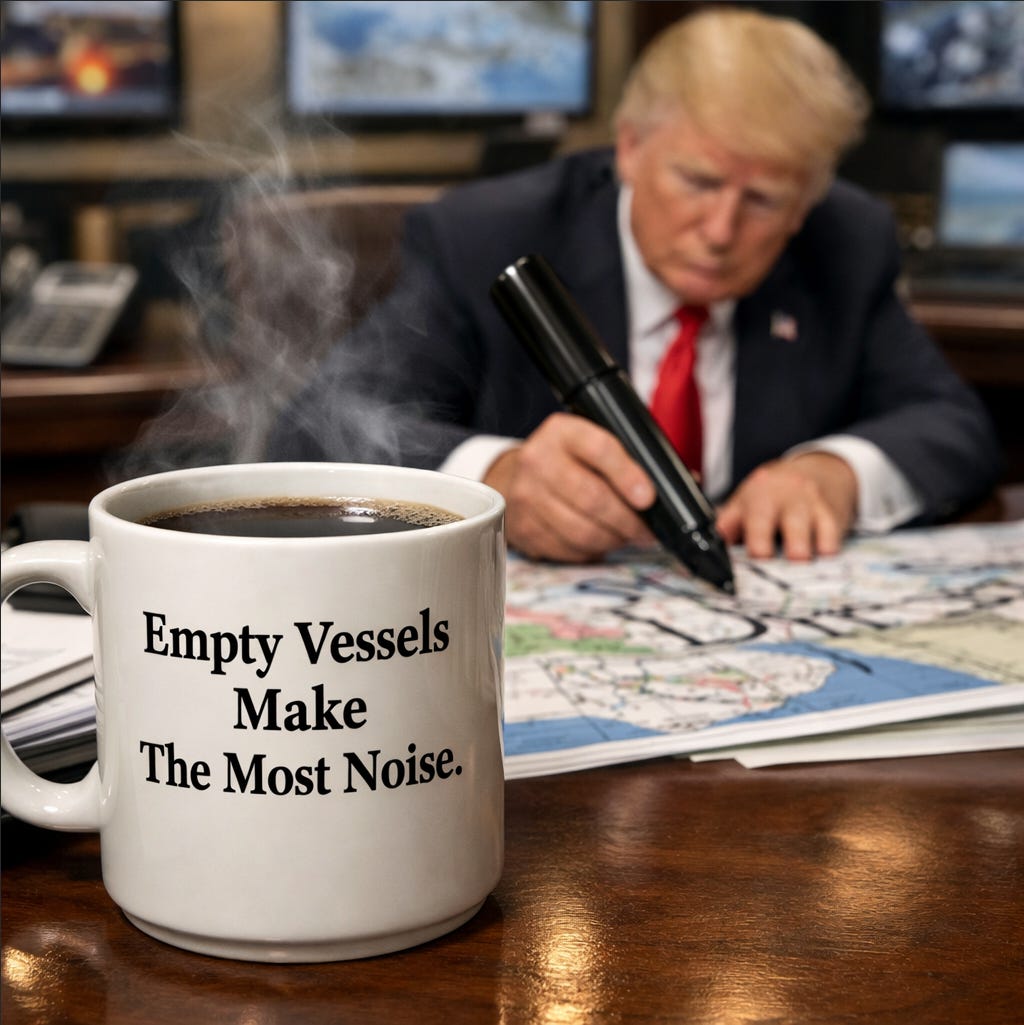
Trump’s supposedly charming little cabinet-meeting detours are starting to look like something darker than mere bullshit. In a roughly six-and-a-half-minute digression during the cabinet meeting, he spun a self-flattering tale about how the “head of Sharpie” supposedly made him special pens for signing executive orders, boasting that he had replaced the White House’s imagined $1,000 pens with custom Sharpies that cost about $5 each. The problem is that the reporting does not back him up. Sharpie’s parent company reportedly said it had no record of the conversation Trump described ever having happened, and older reporting on presidential signing pens undercuts his price theatrics too: the ceremonial Cross pens associated with White House use were priced at a bit over $100 each, not $1,000. Critics like Dr. John Gartner say that if the anecdote was indeed invented, it fits a pattern they associate with confabulation, though that still falls short of proving dementia. Still, it is hard not to notice the broader pattern: the endless made-up stories, the flattering fables in which Trump is always the uniquely brilliant dealmaker, the magical center of every anecdote, the hero of every scene. The lies are getting lazier, more intimate, more weirdly pointless. Even the pen stories have to be about how extraordinary he is. Reality is no longer enough for him; he must embroider it, gold-plate it, and sell it back as legend.
There was at least one small sign of institutional pushback this morning, and it came from the American Heart Association, which issued dietary advice directly contradicting the administration’s crank nutrition messaging. While RFK Jr. and the broader Trump health apparatus flirt with steak-and-beef-tallow fantasy politics, the AHA is still out there doing the dreary but noble work of reminding the public that evidence matters, plants are good for you, and cardiology is not a branch of ideological theater. It is oddly reassuring to see at least one major medical institution decline to treat public health as an improv exercise for crackpots.
Alas, even abroad, where one might hope for a little dignity, the old institutions seem all too willing to lend Trump their robes and chandeliers. King Charles and Queen Camilla are now set to visit the United States on Trump’s invitation, a choice no doubt defensible in the chilly language of constitutional obligation and bilateral continuity, but still dispiriting in practice. Trump has spent years degrading democratic norms, bullying allies, and turning diplomacy into something halfway between extortion and professional wrestling, and now the monarchy appears ready once again to wrap him in ceremonial respectability. Nothing says special relationship quite like sending a king to flatter the man who thinks alliance management is for suckers. It is a reminder that old institutions are often less a bulwark against vulgarity than a finishing school for it.
So that is the morning tableau: The Trump administration remains exactly what it has always been: a government of grifters, blowhards, sadists, and fantasists, held together by propaganda, appetite, and the stubborn hope that spectacle can outrun consequence. One of these days it may even discover that reality, unlike the head of Sharpie, is not taking its calls.
GeneralStrikeUS makes a simple argument: if 3.5 percent of the population, about 11 million Americans, are prepared to strike, then working people have the power to force change. Their strike card exists to measure that readiness, to make solidarity visible before the moment arrives. Marz and I plan to take part. Compared with the lives already being ground up by this administration’s cruelty and chaos, it is a very small price to pay.
Indeed. I would venture that we suffer daily the "Price to pay", but, there is NO price to pay for a general strike day. It's not a small price . The pain will not be ours.
My Dear Mr. President,
I recall that as a child, I would often dream about one day becoming an airline pilot. Alas, that was never to be.
That recollection prompts me to ask: As a child, did you dream about one day becoming a war criminal?
Yours truly,