


There are days when the news doesn’t arrive as a series of separate stories, but as a system. A deportation plane lands in Eswatini. Oil markets twitch because the ceasefire with Iran has apparently reached the decorative portion of its life cycle. NATO leaders smile for the cameras while quietly checking whether the American floor is still beneath them. Chemical accidents rise while safety rules are rolled back. The Weather Prediction Center warns of dangerous heat. The Lincoln Memorial Reflecting Pool, painted blue by presidential preference, begins peeling in public like the set of a patriotic school play left out in the rain.
At first glance, these stories seem unrelated. Immigration, war, markets, alliances, deregulation, climate, and civic maintenance. But look again and the pattern becomes hard to miss. We are living in the Downstream Republic.
This is what happens when power stops solving problems and starts rerouting them. The pressure isn’t relieved, it’s redirected, the people upstream make the decisions, hold the press conferences, rename the institutions, issue the threats, sign the agreements, and then the consequences begin their long, faithful journey downhill.
They always land somewhere. This week, they landed in Eswatini, a small southern African kingdom formerly known as Swaziland, which has now received its fourth group of people deported from the United States under an arrangement to temporarily host third-country nationals who can’t be sent back to their countries of origin. The latest group included 11 people, predominantly from African nations, and they are expected to be housed at Matsapha Maximum Security Prison. The government of Eswatini said their rights would be protected “in accordance with Eswatini’s laws and international obligations,” which is one of those official assurances that doesn’t become more comforting when followed immediately by the phrase maximum security prison.
This isn’t immigration policy as a functioning moral system; this is immigration policy as drainage. The United States can’t make its own system humane, lawful, or coherent, so the human beings are moved somewhere else. Not home, not free, elsewhere. The suffering isn’t eliminated; it’s exported. The legal limbo isn’t resolved; it’s relocated to a place most Americans couldn’t point to on a map, which is, of course, part of the point. Distance is one of the great inventions of modern cruelty. It allows a policy to keep its hands clean by making sure the people harmed by it are held far enough away that no one has to hear them.
That’s the downstream logic. If the mess is visible, move it. If the pain has a face, obscure it. If the paperwork becomes uncomfortable, send the body across an ocean and call the arrangement temporary.
The same logic is now playing out in foreign policy, where the ceasefire with Iran appears to have been treated less like a diplomatic achievement than like a coupon with blackout dates. The U.S. launched new airstrikes against Iran after Trump said the ceasefire was “over,” following Iranian attacks in the Strait of Hormuz. Iran then responded by targeting U.S.-allied Kuwait and Qatar, while accusing the U.S. of striking near its only nuclear power plant.
Here again, the people upstream get to speak in clean verbs. Strike, respond, escalate, reopen, secure, negotiate. Everyone downstream gets the nouns. Oil, inflation, shipping, bases, sirens, funerals, risk.
The markets understood the assignment before the public had even finished reading the headline. On Wednesday, the Dow fell more than 576 points, the S&P 500 closed down 0.3 percent, and Brent crude surged 5 percent to more than $78 a barrel after Trump cast doubt on the Iran truce.
This is the part of war that never fits cleanly into the podium language. A missile leaves one country and arrives, eventually, in the price of diesel. A statement made in Washington becomes a grocery bill in Oregon. A naval crisis in the Strait of Hormuz becomes a little more math at the kitchen table, where ordinary people are already performing advanced household economics with the confidence of someone disarming a bomb using coupons.
That is the Downstream Republic too. The violence doesn’t remain where it begins. It travels through markets, fuel lines, shipping lanes, and interest rates until it reaches someone who had no vote in the decision and no cushion for the consequence.
At NATO, the same pattern wore a nicer suit. Trump left the summit declaring there was “a lot of love” with allies, while NATO leaders reaffirmed Article 5 and approved a major Ukraine aid package. The alliance also discussed Iran, and Trump announced that Ukraine would be permitted to manufacture U.S. Patriot air defense systems.
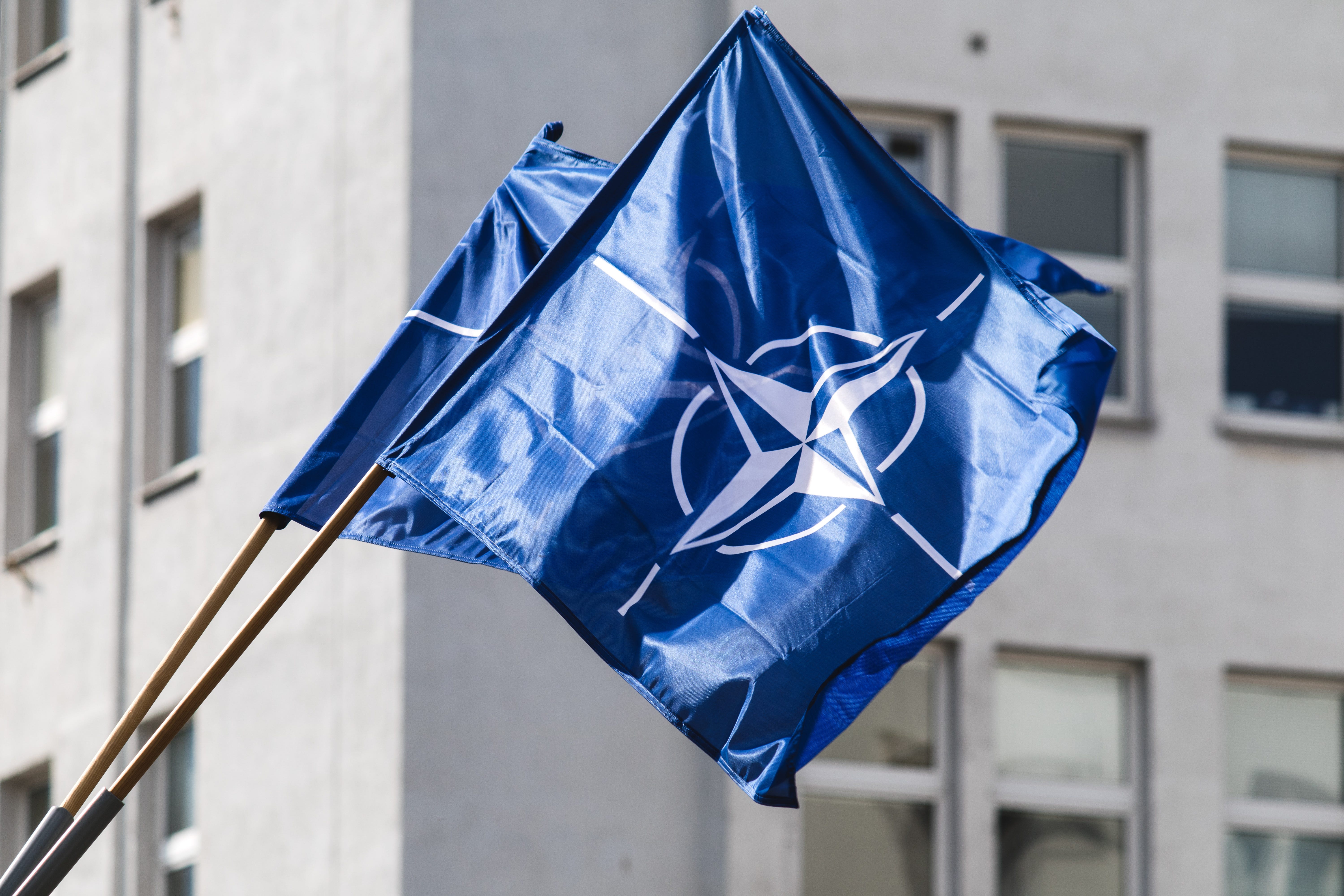
There is always a lot of love in rooms where everyone is privately counting the exits.
Europe is learning what it means to live downstream from American volatility. For decades, the transatlantic alliance was built around the assumption that the United States was the anchor. Now the anchor occasionally gives interviews about how much it resents the boat. The result isn’t immediate collapse. Institutions rarely collapse with the theatrical courtesy of doing it all at once. More often, they rot while the flags are still arranged correctly.
That is what makes the moment so dangerous. The leaders still stand in rows and smile as if civilization can be preserved by synchronized chin angles; but underneath it all, the burden is shifting. Europe must spend more, plan more, hedge more, and quietly imagine a future in which American protection has become a subscription service with unstable terms.
Downstream, the water keeps rising. At home, deregulation follows the same riverbed. A new analysis from Public Employees for Environmental Responsibility found that U.S. chemical accidents have increased by at least 51 percent since 2021, while deaths and injuries have increased by at least 20 percent. The report comes as the Trump administration moves to roll back safety rules, including protections tied to high-risk chemical facilities.
This is where the phrase “cutting red tape” performs its usual magic trick. Upstream, it sounds efficient; downstream, it smells like smoke.
A regulation is very annoying when you’re the person who has to comply with it. It is considerably less annoying when you’re the person who lives near the plant, breathes the plume, drinks the water, sends your kid to the school within the hazard zone, or waits for the siren to explain whether today is a shelter-in-place day. The rule disappears from a spreadsheet first. Then the consequences appear in a neighborhood.
That is the Downstream Republic in its purest form: industry keeps the savings, the public inherits the risk, and everyone is invited to admire the economic growth from a safe distance, assuming one is available.
Even the weather has become a civics lesson. The Weather Prediction Center is warning that dangerous heat will build across the North-Central United States this weekend and into early next week, with temperatures 15 to 25 degrees above average and heat indices between 100 and 110 degrees. The agency also warns that warm overnight lows will limit relief, increasing the risk of heat-related illness.
Climate change is often discussed as if it’s a future condition, something approaching from the horizon with a dramatic soundtrack. But most people encounter it as a bill, a body, a burned lawn, a flooded road, a child who can’t sleep because the house won’t cool down, or an elderly neighbor whose apartment turns into a box of held heat.
Here too, the upstream decisions have names. Fossil fuel lobbying, regulatory sabotage, captured agencies, court rulings, and campaign donations. The downstream consequences have other names. Asthma, heat stroke, mold, crop loss, insurance denial, fire season, and the slow humiliation of realizing the forecast has become a political document whether anyone admits it or not.
And then, because history has a sense of humor dark enough to require supervision, there is the Reflecting Pool.
Ahead of the 250th anniversary of American independence, the Lincoln Memorial Reflecting Pool was painted blue at Trump’s direction. Then came algae, peeling, questions from experts, and Trump’s attempt to blame “vandalism” without offering substantiation. PBS reported that experts cast doubt on whether vandalism alone explained the pool’s problems.
This is almost too perfect to use, which means, naturally, we must use it. The president took a reflecting pool, a national symbol literally designed to mirror back the republic to itself, and painted it a more flattering color. Then the surface began to fail, the blue came loose, the image distorted, and the maintenance problem became a metaphor before anyone could stop it. There is something painfully American about trying to renovate reflection itself. The appearance of patriotism, applied like makeup over a white head.
And when the surface fails, the question isn’t “what’d we do wrong?” The question is “who can we blame downstream?” A vandal, a migrant, or maybe a foreign enemy?
This is the governing philosophy of the moment. Not strength, exactly. Not competence. Not even chaos, though chaos is certainly employed as a seasonal contractor.
It’s displacement. Move the person, the cost, the risk, and the blame. Move the war from the map to the market, the prison beyond the horizon, the safety burden from the corporation to the town, the alliance burden from Washington to Europe, and the moral injury onto someone else’s paperwork. Then stand upstream and tell everyone it’s all for love.
But downstream is still the republic. The people downstream are still the country. A republic can’t keep treating consequences as something that happens to other people and still call itself self-governing. Eventually the water returns, the spill reaches the house, and the pool reflects exactly what was done to it.
And perhaps that is the real terror of this moment. That it’s working exactly as designed by the people upstream. The flood isn’t an accident; it’s their new policy.
"The legal limbo isn’t resolved; it’s relocated to a place most Americans couldn’t point to on a map..."
I confess I'd never heard of Eswatini until your article. I knew Swaziland was in Africa, and I think I could've found it on a pre-Eswatini map. Maybe. 😳
Good article was not aware of the deportations to Eswatini.
May call it an Autocratic Regimes with (Scapegoating)… The Authoritarian or in a heavily polarized government that reroutes problems by deflecting blame away from the state. Often using propaganda, censorship, or scapegoating to divert public frustration toward external enemies, minorities, or other branches of government..
Maybe that Downstream Republic is starting to get to some because fear that flood is going to get even worse… it’s unfortunately inevitable because he and this regime are getting even more desperate and will pull out everything possible to halt, rig or put off midterms…