


Trump chose to unveil his new hemispheric security project at Trump National Doral, because if you’re going to reboot the Monroe Doctrine in the year of our lord 2026, you might as well do it somewhere with banquet packages and a gift shop. The setting matters: foreign leaders filed in, shook hands, posed for photos, and the whole thing had the vibe of a very expensive wedding where the groom owns the venue and the taxpayers are the open bar. CBS and the Guardian both describe the summit as being held at Trump National Doral in the Miami area.
The headline was not subtle: Trump announced a new military coalition he called the Americas Counter Cartel Coalition, packaged inside the broader “Shield of the Americas” banner. The stated mission is a coordinated, Western Hemisphere partnership targeting cartels and transnational gangs, with intelligence cooperation and joint operations, but with a new, unmistakably escalatory twist: Trump didn’t pitch this as training and advisories; he pitched it as lethal force. He flat-out says, “The heart of our agreement is a commitment to using lethal military force to destroy the sinister cartels,” which is the kind of line that takes you from “security cooperation” to “welcome to the missile menu” in one breath.
Then he makes the escalation grotesquely literal. Trump tells the assembled leaders that if they want help, the U.S. can surgically delete cartel leadership from existence: “If you want us to use a missile, they’re extremely accurate. Right into the living room. That’s the end of that cartel person.” That’s not a metaphor. That’s a president openly musing about cross-border strikes in the hemisphere as if sovereignty is a mild inconvenience and due process is something you do to a steak.
He also names names, and the lineup says a lot about who this coalition is built around. The Guardian reports roughly a dozen Latin American leaders were present, and the speech itself name-checks a familiar cast: Argentina’s Javier Milei, El Salvador’s Nayib Bukele, Paraguay’s Santiago Peña, Ecuador’s Daniel Noboa, Panama’s José Raúl Mulino, Honduras’s Xiomara Castro (mangled in the transcript), Guyana’s Irfaan Ali, and others, plus a “president-elect of Chile,” because in Trump’s world endorsements apparently function as a form of foreign policy. Rubio later describes it as a gathering of 12 allies/friends, and the event is framed as a bloc of willing partners aligning with the U.S. on a hard-security agenda.
Then Pete Hegseth steps up and does everyone the favor of saying the quiet part out loud with the added bonus of calling it the wrong name. He declares that “President Trump has established the Trump corollary of the Monroe Doctrine,” and then promptly mangles it into “the Donroe doctrine,” which somehow manages to be both historically menacing and comically on-brand. He frames the whole thing as a civilizational crusade: “We share a hemisphere and geography… we share cultures, Western Christian civilization.” He reassures everyone this isn’t some polite multilateral club that “holds conferences and… releases white papers.” None of that “woke crap, because don’t worry, this is an “action coalition,” where “with American leadership at the forefront” they’ll “go on offense against the cartels” and “they will know that we’re just around the corner.” Hegseth delivered his remarks like he’d just jogged over from a ‘Western Christian Civilization’ CrossFit class, where the warm-up is pushups and the cool-down is talking about intervention like it’s a video game: pick a target, hit ‘start,’ and brag about how quickly you cleared the level.
Trump then detonates diplomacy with a single sentence: Mexico. He calls it “the epicenter of cartel violence,” and claims “the cartels are running Mexico.” That is not just an insult; it’s a predicate. It’s how you tee up justification for unilateral action, and he basically confirms it by pairing it with that “missile in the living room” line. Even if the administration tries to dress it up as “coalition operations,” Trump is openly floating the kind of cross-border strike talk that Mexico has historically rejected because it’s, you know, a sovereign country.
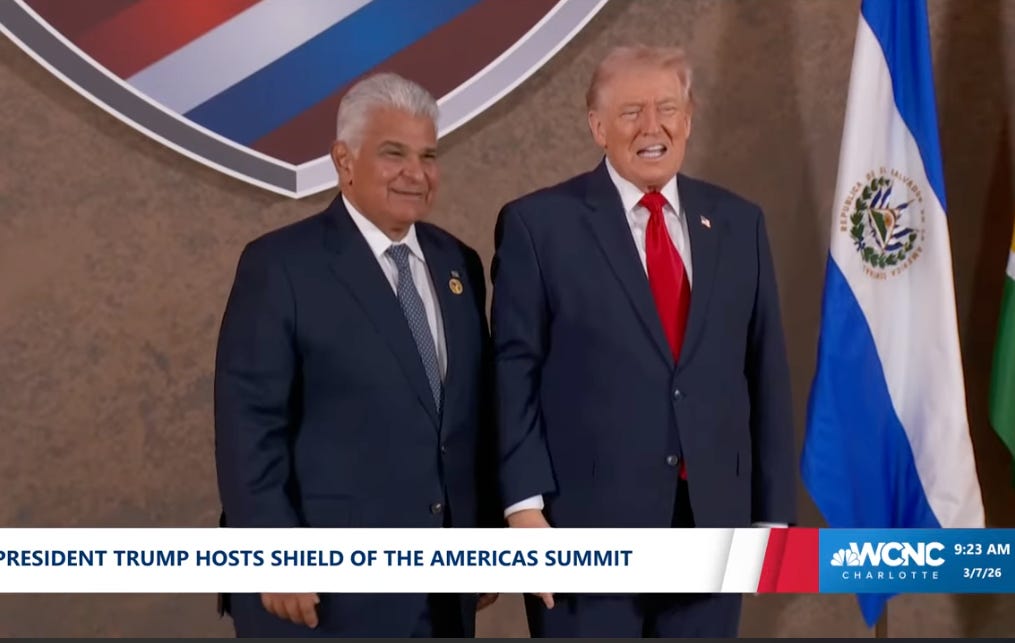
Trump opens the whole summit by bragging about the Iran war in a way that’s half chest-thumping and half alternate-reality monologue. He claims the U.S. “knocked out 42 Navy ships” in three days, wiped out Iran’s air force, and erased communications. Axios reports the “42 ships” line directly from the summit, but the public numbers being cited in reporting have been inconsistent and appear to evolve fast: as recently as March 1, Navy Times reported Trump saying nine Iranian naval ships had been sunk, which makes “42 in three days” sound less like a verified ledger and more like a number that grew in the telling. The Guardian also notes there are serious questions and doubts around the broader Iran campaign and its real outcomes despite the administration’s sweeping claims.
In this speech, Trump uses Maduro’s capture in Venezuela like a glossy case study to sell the bigger pitch: a hemispheric cartel-war coalition that normalizes U.S. offensive action in Latin America. He’s basically saying: you’ve already watched us do the big version of this, now sign up for the franchise.
He tells the room that in January the U.S. “ended the reign” of Maduro “in a precision raid,” and he leans hard on the action-movie detail to make it feel inevitable and repeatable: “about 18 minutes of pure violence” and “we lost nobody.” Then, crucially, he pivots right back into the coalition and starts talking about how the new alliance is built around “lethal military force” and how partners just need to “tell us where they are,” right before he offers the “missile… right into the living room” line. In other words: Maduro becomes the proof-of-concept for a doctrine of hemispheric intervention-by-invitation.
And then there’s the Kristi Noem piece, which is exactly the kind of narrative tell that gives away the internal power structure. If the administration’s line is that Noem is now “running” Shield of the Americas, you would expect her to be presented as the architect, the operator, the point person, the designated closer. Instead, in Trump’s actual remarks she’s barely present: he name-drops her once in a list (while misnaming other people too) and never once says she’s leading the initiative. The visible ownership belongs to Rubio (“Marco’s been working on it very hard”) and Hegseth, who gets to frame it as doctrine. Axios, in fact, highlights the tension by reporting Noem as the special envoy / leading the event even as the president’s own spotlight barely lands on her.
So yes: the chaos is part of the story. the endorsements-as-extortion daydreaming, the interpreter rant, the random detours into battleships and tariffs, but the backbone is even more important. This is Trump trying to sell a militarized hemispheric order: a cartel-war coalition, a Monroe Doctrine reboot by another name, and an open normalization of strike language in the Americas… all launched at his own resort, where history and profiteering get to share the same ballroom.
"Shield of the Americas" sounds like a name for a deodorant to me.... something to cover up things that stink?
Am I alone in thinking his king complex has graduated to a god complex? This reads like it's time for the padded cell.