

Ireland is currently pricing the security operation for Donald Trump’s two-day visit, official meetings in Dublin followed by an overnight stay and Irish Open appearance at his own golf resort in Doonbeg, at more than €20 million, roughly $23.2 million at current exchange rates. That is an estimate, not yet a final audited bill, and the Irish government has not broken out how much of it belongs specifically to the Doonbeg leg.
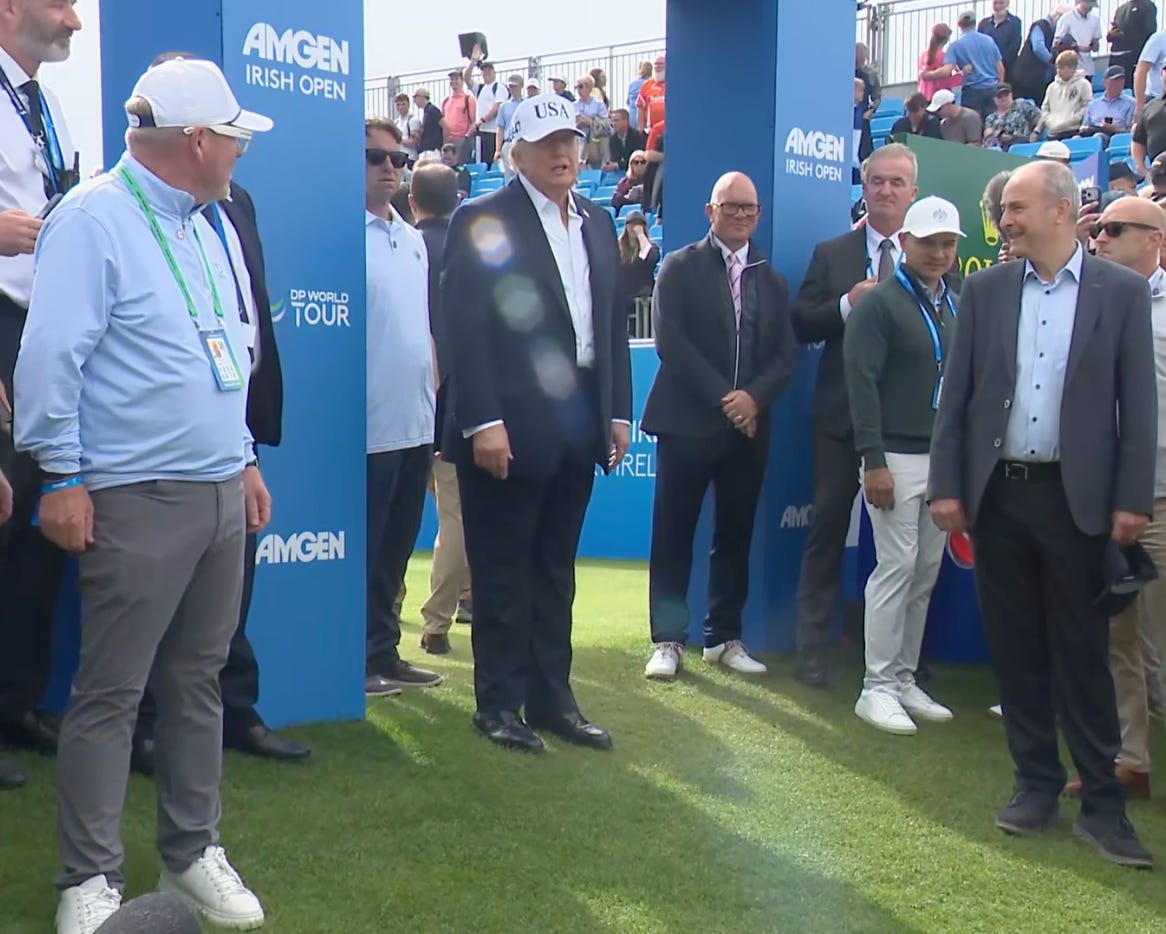
The Associated Press’s own framing of the trip matches that ambiguity. Darlene Superville and Jill Lawless described the whole weekend as a visit “more about” the golf tournament than the meetings in Dublin that were nominally its occasion. Trump’s own words, early in the Doonbeg gaggle, back that characterization up. Having already praised Shane Lowry, the course, and the hotel, he told reporters: “I’m going to wait around here. I’m going to wait here... I’ll leave a little bit late. Get back in Washington a little later, but we’ll be... hanging around.” That is a president describing, unprompted, a decision to extend his stay at his own resort and push back his return to the capital. The security and transportation apparatus runs on his clock. What that specific extension added to the bill isn’t a number we have, but it establishes that the length of the operation, and therefore its cost, was his choice to make, not a fixed itinerary he was working around.
We do know what the machinery looked like.
Gardaí declared Trump’s arrival an “extraordinary event,” allowing leave and rest periods to be curtailed. Officers were scheduled to work 10,000 twelve-hour shifts between Friday and Sunday, totaling 120,000 hours of policing. Roughly 4,000 Irish and American security personnel were expected to participate, including about 1,000 Americans. Planning for the trip contemplated an entourage approaching 1,000 people and as many as 200 Secret Service officers.
There were Garda command centers in Dublin and Clare under Operation Far Sunrise. Armed Special Detective Unit, Emergency Response Unit and Armed Support Unit personnel were deployed. Snipers were part of the plan. So were signal jammers and new counter-drone systems designed to knock unauthorized aircraft out of the sky. Army bomb-disposal teams and the Ranger Wing were among the military resources available. Irish security officials described protecting a sprawling coastal golf course, with beach access and tens of thousands of spectators, as one of the most complex operations they had faced.
Then there was the presidential aviation package.
Chinook helicopters spent days rehearsing approaches over west Clare. A fortified helipad was constructed beside the third tee for Marine One. Residents around Doonbeg were issued passes and told to carry photo identification and proof of address. Roads were restricted and diverted. Golf spectators went through airport-style security screening.
When Trump actually arrived, Air Force One performed a flyover of the course before landing at Shannon. Marine One then came into Doonbeg accompanied by two military Chinooks, one carrying the White House press pool, and another U.S. helicopter.
That is the Irish side of the rate card.
The American side has not been totaled yet: Air Force One, the supporting military airlift required to move helicopters, armored vehicles and equipment across the Atlantic, Marine One and its support aircraft, Secret Service travel and lodging, State Department logistical support, staff travel, ground transportation and whatever federal agencies may ultimately pay directly to Trump-owned businesses.
History suggests we should resist inventing a number until the records arrive, because the real numbers have been large enough on their own.
Before Trump ever landed in Ireland, the United States had mounted a military airlift to put his presidential machinery in place. More than 20 U.S. military aircraft transported armored vehicles, mobile command centers and other equipment into the country; aviation trackers ultimately logged 27 C-17 movements associated with the visit. The Pentagon’s FY2026 C-17 reimbursement rate is $32,639 per flying hour, meaning the airlift alone runs into the millions before Air Force One, Marine One, Secret Service travel, lodging or ground operations are counted.
When Mike Pence stayed at Doonbeg during an official Ireland trip in 2019, despite his government meetings being 181 miles away in Dublin, State Department transportation contracts reviewed by CREW totaled $599,454.36 for limousine service alone. The subsequent Secret Service records showed another $15,144.94 paid directly to Trump’s Doonbeg resort for agents’ lodging. CREW also reported that the same transportation company had received nearly $1 million for ground transportation during Trump’s own two-day Doonbeg visit three months earlier.
For another benchmark, the Government Accountability Office examined Trump’s first four trips to Mar-a-Lago in 2017. The federal bill was $13.568 million: roughly $10.6 million to operate government aircraft, boats and other equipment and another $3 million in travel expenses for government personnel. Even that total excluded classified expenditures and the salaries and benefits of the people traveling with him.
So that’s the rate card.
And it is worth remembering what kind of presidential trip required all of it.
This wasn’t simply my characterization after looking at the itinerary. Before Trump arrived, RTÉ described the trip as personal rather than an official state visit and reported that he would spend most of the weekend at his golf course. Its headline was even more succinct: “Presidential talks wedged within Trump’s golf appearance.” After those talks actually took place, Irish Times political editor Pat Leahy summed up what each side had gotten from the visit. The Irish government maintained its relationship with Washington. President Catherine Connolly made her points about peace.
“And Trump got to promote his resort and watch some golf.”
The Dublin meetings were real presidential business, but they were fitted into a trip whose center of gravity was Doonbeg, the privately owned Trump resort hosting the Irish Open.
In the UK, the official-versus-private distinction has repeatedly shaped the fight over who ultimately pays. When Trump visited Britain as president in 2018 at the UK government’s invitation, the Treasury agreed to reimburse Scotland for the policing operation; Police Scotland had initially estimated the cost at roughly £5 million, but the final Treasury transfer was £3.2 million. In 2023, when Trump returned to Scotland as a private citizen, Police Scotland again deployed resources to protect him, although the Scottish government treated the policing decisions as an operational matter for the force rather than part of an official state visit. And when Trump and JD Vance made largely private visits to Scotland in 2025, Scottish public bodies provisionally put their combined costs at £24.493 million; £21.352 million for Trump and £3.141 million for Vance. Scotland sought reimbursement from London, but as late as December the Scottish government said cost-recovery negotiations with the Treasury were still ongoing; it also confirmed that no reimbursement discussions had taken place with the United States. The distinction between an official visit and a private one can determine which government is expected to pick up a very large bill.
Ireland doesn’t have Scotland’s devolved-versus-Westminster seam, so there’s no obvious second government to bill internally. The underlying question of how much of this weekend was diplomacy and how much was a golf trip wearing a state visit as cover is the same one Leahy and RTÉ had already answered before the final euro of the security estimate was tallied. A visit that independent political correspondents describe as substantially personal doesn’t carry the same claim on a state’s hosting obligations as a genuine head-of-state visit does. Whether any Irish official is willing to say that as plainly as their own press corps already has remains to be seen.
Now consider what all that public expenditure helped place in front of the cameras this weekend.
Trump International Golf Links & Hotel Ireland is not simply a sentimental family retreat. Trump’s latest financial disclosure says the business generated almost $19 million in income for him last year: $14.15 million through the company managing the golf course and another $4.78 million through the company operating the hotel.
Standing on the grounds of that business, in the middle of a presidential press gaggle, Trump opened with what was essentially advertising copy.
“Great course,” he said.
“Nice hotel.”
He would return to the subject. Asked by an Irish reporter about a possible referendum on a united Ireland, Trump began his answer not with the Good Friday Agreement or the constitutional question but with the property under his feet: “I’m somebody that owns fantastic property here.” He called it “one of the greatest golf courses anywhere in the world” and said players were describing it as one of the best they had ever played.
This wasn’t the detachment of a man enduring a ceremonial obligation. Asked whom he’d want to play a round with, he named Rory McIlroy and “about 40 others” before circling back to Lowry specifically: “Shane had nine one-putts in a row yesterday. I watched it.” That is the level of attention of someone following the leaderboard, not someone who dropped in for a ribbon-cutting.
The order of the gaggle is its own piece of evidence. The tournament and the property weren’t a coda after the real business of the presidency; they were the opening subject, aired before a reporter got him onto interest rates, and well before Iran, China, Venezuela or Ukraine came up. Even the one question that might have forced him onto more solemn footing, a possible referendum on a united Ireland, became another occasion to mention that he is “somebody that owns fantastic property here.”
Strip the transcript down and a four-line sequence carries the whole argument:
“Great course. Nice hotel.”
“I’m going to wait around here.”
“I’ll leave a little bit late.”
“I watched it.”
All four are about the property, the tournament, or his decision to linger there.
Only then, without much of a seam, did he move through the business of the presidency.
Iran’s nuclear program. Israel. China. Artificial intelligence. Venezuela. Ukraine.
He said Volodymyr Zelensky should stop attacking Russian diesel refineries because the resulting shortages were “hurting the world,” adding that he had spoken to Zelensky about it.
He said jobs in Venezuela were being created “by the thousands,” that American oil companies were moving in, and that the United States was taking “millions of barrels of oil” from Venezuela to Houston for refining.
He discussed whether Iran would make a deal, what the United States should do in the North Sea, whether the UK could become wealthy from drilling, whether Scotland had squandered its oil advantage and whether China would continue dealing fairly with Washington.
All from the grounds of a business that reported nearly $19 million in income to him last year.
That is the overlap worth examining. Presidential travel necessarily requires security, aircraft, communications, staff and logistical support wherever a president goes. But when the destination is a commercial property owned by the president, the same publicly financed machinery required to conduct and protect the presidency also creates extraordinary exposure for the private business.
The fortified helipad sits beside the third tee.
The military helicopters land on the course.
The presidential press corps follows.
The White House distributes the transcript.
And the owner of the property, speaking as president of the United States, tells the world that it is “one of the greatest golf courses anywhere in the world.”
We do not yet know what the American taxpayer paid for this particular trip, or how much federal money, if any, was paid directly to Trump-owned entities. Those are facts that should be obtainable.
The document trail is familiar: Secret Service lodging and protective-support expenditures; Department of Defense aircraft, helicopter and airlift costs; State Department lodging and ground-transportation contracts; federal procurement records; and records of payments to the resort itself. GAO found in 2019 that the Secret Service and Defense Department had not consistently submitted the protection-cost reports required by law, which helps explain why a complete presidential travel bill can take considerable time to reconstruct.
Readers will reasonably ask whether any of this raises constitutional problems. Potentially, but the answer depends on where the money actually went.
The Constitution’s Domestic Emoluments Clause says that, beyond his fixed compensation, the president “shall not receive” any other emolument from the United States or any state. If Secret Service, State Department or Defense Department money was paid directly to Trump International Golf Links & Hotel Doonbeg, as Secret Service lodging money was during Mike Pence’s 2019 stay, those payments would raise the same Domestic Emoluments Clause question that government transactions with Trump-owned businesses have raised repeatedly during both Trump presidencies.
The Foreign Emoluments Clause presents a separate question. It bars federal officeholders, absent congressional consent, from accepting a present or emolument from a foreign state. Nothing publicly reported so far establishes that Irish government money from this weekend went directly to Trump’s business; the reported Irish costs are principally security and Defence Forces expenditures. If later records show direct payments from an Irish state entity to the resort, that would require separate scrutiny.
And there is an important caveat. No Supreme Court decision has settled how these clauses apply to Trump’s commercial businesses. First-term lawsuits produced conflicting lower-court rulings before the Supreme Court vacated the judgments as moot after Trump left office. The constitutional questions therefore survived the litigation largely unresolved.
CREW (Citizens for Responsibility and Ethics in Washington) flagged the identical Doonbeg pattern in 2019: Trump insisted on staying at the resort despite it sitting on the opposite side of Ireland from his official meetings, pressured the Irish government to accommodate him there, and threatened to move the visit to Scotland when they hesitated. The watchdog says a second term simply revives the same violations, and it is back on the same beat now: this year it asked the inspectors general at DHS and the State Department to investigate Trump-branded wine sold at Coast Guard exchanges and the 2026 G20 summit being steered to Trump National Doral, then sued the State Department and Secret Service after both agencies failed to produce records on how Doral was selected. Different venues, the same underlying shape: public money and public platforms routed toward a business the president still owns.
What’s missing is a court that has ever ruled on the merits. CREW’s first-term emoluments suit survived years of litigation before the Supreme Court vacated it as moot in 2021, once Trump had left office and there was no live case left to decide, leaving the constitutional question unresolved, only outlasted. Congress holds the clause’s one real enforcement lever, since the Foreign Emoluments Clause conditions acceptance on congressional consent it can withhold. Members have introduced resolutions this term declaring these exact patterns unconstitutional. Resolutions aren’t law, and a chamber controlled by the president’s own party isn’t going to make them one.
So the honest answer is that the Emoluments Clauses raise questions directly relevant to a weekend like this.
Ireland is already estimating more than €20 million for the security operation surrounding the visit. The United States will have its own bill. The president spent part of the trip at a business he owns, a business that generated almost $19 million in income for him last year, and used presidential microphones while there to praise the property.
So let’s see the receipts.
Consider this the ask.
Let’s add up all these unnecessary expenses and bill his grift account after he leaves office.
What a shame the security detail was so good.