


There are days when the metaphor arrives wearing a little hat, waving politely from the edge of the news, asking if it may please be included somewhere between the congressional dysfunction and the latest judicial renovation of American democracy.
Then there are days when the metaphor is a mortuary in Paris with no room left.
Europe is in the grip of record heat, the kind that makes the old maps look quaint and the old warnings sound less like warnings than apologies issued too late. In France, funeral homes have reportedly been overwhelmed by the number of dead, especially older people, as temperatures pushed past 104 degrees and the heat settled into cities like a verdict. One mortuary owner told reporters, “We’re facing a really catastrophic situation,” which is the kind of sentence that should stop a government in its tracks, make every serious person in a serious office look up from the latest polling memo, and begin moving with the urgency of people who understand that reality doesn’t negotiate.
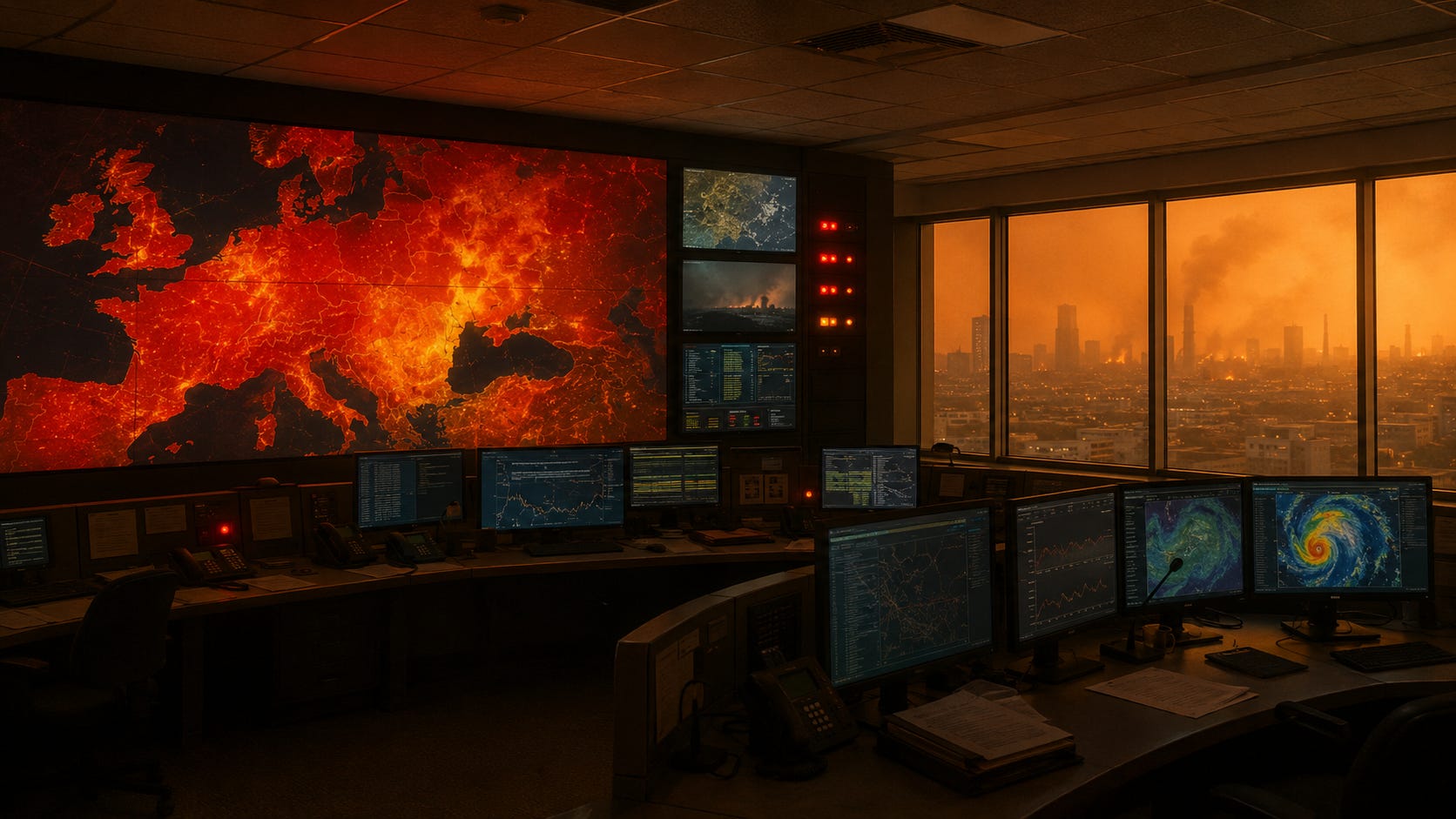
But this is 2026, so naturally the control room appears to be on fire, the alarm is going off, and half the people in charge are arguing over whether the alarm has been sufficiently loyal.
The climate story isn’t off to the side today. It’s not the weather segment, not the little green box at the bottom of the broadcast, not the soft-focus footage of people eating ice cream near a fountain while the anchor says “scorcher” in the tone usually reserved for county fair pie contests. It’s the room, the heat pressing its palm against the glass while Washington spends another day proving that the institutions built to notice danger are being rewired by men who seem to regard warning systems as rude.
Start with the Supreme Court, which had itself a busy day in the maintenance closet of the republic. The justices ruled that President Trump can fire leaders of most independent federal agencies, weakening a 91-year-old precedent that had helped insulate certain bodies from direct presidential control. The Federal Trade Commission, the National Labor Relations Board, the Merit Systems Protection Board, and the Consumer Product Safety Commission are now apparently expected to do their work with one eye on the law and the other on the mood of the man upstairs.
But the Court also carved out a little protected nook for the Federal Reserve, allowing Governor Lisa Cook to remain in her job while she challenges Trump’s attempt to remove her. So, there we have it. The watchdogs may be placed on shorter leashes, but the central bank still gets a fence, because even in the demolition derby of American governance, someone eventually remembers that the mortgage market doesn’t enjoy interpretive dance.
It’s a remarkable thing, watching power expand in one direction and hesitate in another, as if the Court were saying yes to executive dominance, but only until the bond market starts breathing into a paper bag. The same alarm system that can apparently be muted for labor rights, consumer safety, and administrative independence still rings loudly enough when the room contains interest rates.
Meanwhile, the Court also ruled that states may count mail ballots that arrive after Election Day, so long as they are postmarked by Election Day. That one landed like a small, clean bell in the middle of the smoke. After Trump targeting mail voting as though absentee ballots were tiny paper raccoons sneaking through the democratic garbage cans, the Court rejected the latest Republican-led attack. For now, at least, a ballot is not disqualified simply because the postal system moves at the speed of a federal agency being asked to operate after several rounds of political sabotage.
There was also one personal legal alarm the Court declined to silence. The justices refused to review Trump’s appeal of the $5 million E. Jean Carroll verdict, leaving intact the civil judgment against him for sexual abuse and defamation. On a day when presidential power got a generous new hallway, the Court didn’t open this particular side door. It’s not nothing, even if “not nothing” has become a depressingly crowded category in American life, somewhere between “could have been worse” and “please enjoy this single functioning flashlight.”
Over in Congress, the alarm system was not so much broken as being held upside down and shaken for parts. House Speaker Mike Johnson is trying to get Republicans back on track after internal GOP chaos derailed votes on spending bills and veterans’ benefits. AP reports there are only about 28 workdays left before the midterms, which is a small problem when you still have to fund the government, manage a war-spending request, pass defense legislation, satisfy the hardliners, please the president, and somehow convince voters that the party is capable of doing something besides stapling itself to the furniture.
Johnson told Fox, “We have got a lot more to do,” which is one way of putting it. Another way would be to say that the House has entered the group-project phase where the presentation is tomorrow, one student has eaten the poster board, another is demanding the whole thing be about voter ID, and the teacher is quietly updating her résumé.
The bipartisan housing bill, which passed by overwhelming margins and might have given Republicans something to show people who enjoy living indoors, has become part of the voter ID standoff. Trump reportedly refused to sign it until Congress moves on election legislation. Housing, in other words, has been escorted into a back room and told it may come out when it proves its citizenship.
Then there is public health, where the alarms are ringing from the clinic, the pharmacy, the waiting room, and possibly the ducts. Senator Bill Cassidy, a Republican physician who helped confirm Robert F. Kennedy Jr. as Health and Human Services secretary, is now accusing him of breaking promises and running public health on what Cassidy called a “foundation of lies.” This is quite a thing to hear from a man who helped hand him the keys, like watching someone release a raccoon into the pantry and then hold a press conference about the alarming decline in cracker security.
Cassidy’s concern, according to the reporting, centers partly on vaccine messaging and the CDC’s language around autism, which isn’t a small dispute, not a branding issue, not a little academic scuffle between people who own too many tweed jackets. Public health depends on trust, and trust depends on telling the truth with enough clarity that frightened parents aren’t left wandering through a swamp of insinuation while preventable diseases wait politely by the door.
And while Europe bakes, while American public health wobbles, while Congress tries to run the government like a vending machine with a grudge, the Trump administration is reportedly moving to slash public input on fossil fuel drilling on federal lands. According to The Guardian, officials are pushing changes that would shorten or eliminate key public comment periods, reduce cleanup obligations for drillers, and allow more methane emissions. This is the climate section of the control-room story, and it is not even trying to hide the wiring. The planet is overheating, and the proposed solution appears to be giving the public less time to object to more drilling.
There is an almost elegant shamelessness to it, if one can say that without being escorted from polite society. Public lands are called public because the word “public” is meant to do some work there. It’s meant to imply that the people who breathe the air, drink the water, live near the lease sites, pay for the cleanup, and inherit the damage get more than a ceremonial nod before the machinery rolls in. But in the new arrangement, the suggestion box remains, technically, provided you can locate it within ten days, decode the filing system, take time off work, hire an expert, and whisper your concerns into the intake vent before the fossil fuel industry is done measuring the curtains.
California, too, is in the crosshairs, with the administration targeting the California Coastal Commission as part of a broader fight over energy production, offshore wind, oil, SpaceX launches, and state environmental authority. The phrase “environmental terrorism” has reportedly been thrown around by Commerce Secretary Howard Lutnick, because apparently trying to keep the coastline from becoming a federal suggestion is now a form of extremism.
This is where satire begins to sweat through its shirt. There is funny, and then there is a federal government looking at the Pacific coast, at rising seas, at oil spills, at heat records, at a continent overflowing its mortuaries, and declaring that the real problem is too much caution.
Outside the domestic control room, the global alarms aren’t waiting their turn. The U.S. and Iran appear to be pausing strikes for now, even as the Strait of Hormuz remains tense and oil transit, though rebounding, is still fragile. There is something deeply 2026 about the phrase “pausing strikes,” as though war has become a subscription service with temporary buffering. Everyone is very relieved, or trying to be, because the world’s energy system is still threaded through a chokepoint where one more incident can send prices, markets, and governments scrambling back to the emergency panel.
And then Ukraine, because Ukraine is still there, still absorbing the cost of everyone else’s attention span. Russian missile and drone attacks killed at least 11 civilians and wounded dozens more, and President Volodymyr Zelenskyy called them “horrific attacks.” Ukraine says it shot down most of the incoming drones, which is both a testament to defense and a terrible measure of the life civilians are being asked to normalize. Imagine praising the roof because only some of the fire got through.
This is the day, then. Every alarm is ringing. Not one isolated system failure that can be blamed on an intern, a county clerk, a woke thermometer, a rogue prosecutor, or whatever imaginary gremlin is currently living rent-free inside the presidential communications strategy. The whole panel is lit. Climate, war, elections, health, accountability, public lands, and the basic question of whether a government exists to serve the public or simply manage the public’s access to power.
And still, the people in charge keep reaching for the wrong tools. At some point, a society has to decide whether an alarm is annoying because it’s wrong, or annoying because it’s telling the truth.
Today, the truth is loud. The control room is on fire, and the people holding the extinguishers appear to be debating whether smoke has standing.
sort of good news. except that your local post office may not put a postmark on a piece of mail that they collect - incoming mail can be batched and trucked to a centralized collection point, and postmarked *there - and THEN*. if you bring a ballot to the local USPS, have it postmarked at that time and place!
Wow