


Two weeks ago, New York Representative Alexandria Ocasio-Cortez made headlines by displaying jars of the brown, polluted drinking water from Morgan County, Georgia during a House Committee on Energy and Commerce meeting. The county residents point to the data center campus and its considerable construction projects as the culprit, though Meta claims their independent groundwater study found no impacts from the center’s operation and construction. Tech companies denying environmental impacts using independent studies is well-trod table stakes, but the scale and speed of the current data center buildout is new. The increased use of LLMs requires ever-greater water and energy usage, and those costs often fall on the communities the data centers are built around.
Increased AI use means data centers demand greater electricity and water due to the structure of Large Language Models, or LLMs. In brief, LLMs must make many calculations to generate answers to queries. An example of a particularly large model such as GPT 3.0 (now succeeded by larger models) would require billions of calculations per second over one billion years just to train the model. The way around this is to use GPUs to run many, many calculations simultaneously and use programming known as transformers to read all query text in parallel. The result is that LLMs can respond quickly, but data centers require ever more resources just to function as a product.
The AI boom has led to rapid and troubling trends. For example, EPRI’s 2024 report shows that Virginia currently hosts the most data centers and the highest energy consumption by them. In 2023, data centers used just over 25% of the state’s electricity, a figure that has likely grown by 2026 and is projected to reach up to 46% by 2030 under high-growth scenarios. This constant power guzzling puts considerable strain on the electric grids of cities under this burden. The Dell’Oro Group’s analysis notes current average power rack density today (15kW/rack) is no longer sufficient for the 60-120 kW/rack that AI workloads will dictate. The exponential growth of the industry as well as ‘hyperscale’ data centers are predicted to triple the already staggering power consumption by 2030 and may reach 100 MW continuously, roughly the draw of a small city. The concern of grid strain has driven companies to push for greater on-site power generation, but this has its own costs.
Many data centers do provide their own power, but often through diesel generators that lower air quality. One notable case is Amazon’s data centers polluting Canton, Mississippi. The construction of a new data center led to not just noise pollution and heavy machinery keeping nearby families up at night, but significantly worse air quality due to dust and diesel fumes that caused respiratory illnesses in residents. In order to avoid the smallest disruptions in service, the Canton data centers must be powered by hundreds of these diesel generators. These generators release nitrogen oxides and benzene, among other pollutants, that can worsen existing respiratory conditions, heart health, and cause cancer. When the expansions to the Canton complex are complete, there will be over 300 diesel generators producing 240 tons of nitrogen oxide and 140 tons of carbon monoxide per year according to Amazon’s permit applications, and none of that electricity generated will go to the residents of the city.
An even more unsustainable requirement of AI data centers is water consumption. Due to the high computation rate, servers must be constantly cooled using freshwater and if there are on-site power plant facilities, the use of water increases further still. An article by the EESI estimates that a 100-word AI prompt uses about 1 bottle of water. Large data centers can use up to 5 million gallons of water per day, or 1.8 billion gallons annually. Virginia’s vast data center network used at least 1.85 billion gallons of water in 2023. To further the issue, a 2021 paper by Siddik et al. estimated that one-fifth of data center water consumption occurs in moderate to highly stressed watersheds, a problem for drought-prone states such as Oregon.
Oregon was ranked 5th by data center energy consumption in 2023 and committed approximately 11% of energy to data centers. Some of the most notorious are the centers Google has operated in The Dalles since 2006. Oregon Public Broadcasting reports that in 2012, The Dalles reported that Google used about 100,000,000 gallons of water, accounting for 12% of the city’s water use. By 2024, it had ballooned to over 430,000,000, and accounted for 33% of the city’s water use. Google needs more water for its expanding data center, and its solution has been to use the city of The Dalles as a political lever to acquire it.
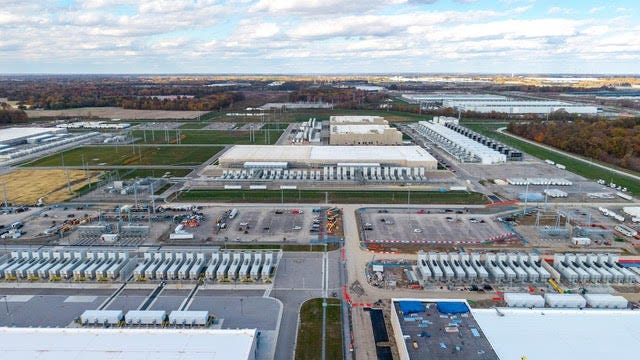
The Dalles gets its water from the Dog River (diverted into Crow Creek Reservoir) and groundwater. The city is currently attempting to take ownership of the land around Crow Creek Reservoir from the Mt. Hood National Forest to raise the dam and triple the capacity of the reservoir via a bill sponsored by U.S. Rep. Cliff Bentz. This would considerably lower the water level of the Dog River and may even run it dry. The effects on local wildlife would be immediate. Fish and amphibians would lose crucial habitat in the Dog River itself, but in the Hood and Columbia rivers as well. Since the Dog River contains so much snowmelt and oxygen more readily dissolves in cold water, the Dog River cools and oxygenates the Hood and Columbia. This makes it ideal spawning and rearing habitat for ecologically valuable fish such as Coho salmon. If the Dog River is continually diverted, fish and other aquatic life throughout the watershed could suffer severe harm.
The city’s other water source, underground aquifers, is also at risk. When Google acquired the rights to pump up to 3.88 million gallons per day from these aquifers in 2021, they put massive strain on water infrastructure needed for residents and businesses. Google previously tried to cover up their parasitic drain on the city. In 2021, when they acquired the right to pump groundwater, it attempted to stop the public knowing how much water was being consumed, referring to it as a “trade secret” as reported in the Oregonian. It was only after The Dalles settled a lawsuit by The Oregonian that the records were made public. And The Dalles isn’t the only Oregon city under threat by data centers.
There are currently plans for Amazon to expand an existing site near Boardman, OR and add a 1,300 acre data center. This would be the first ‘exascale’ data center in Oregon. The Oregonian writes that the development plans are not finalized and there’s no current timetable, but the land has already been purchased. Once the data center is running, its power consumption could rival the entire Portland Metro area. All of this after Amazon already paid a $20.5 million settlement for alleged nitrate pollution that has contaminated the Morrow County groundwater. Amazon has not admitted to any wrongdoing however, instead settling on the payment that pales in comparison to the $8 billion it will be investing in its planned ‘exascale’ data center.
All of this for Artificial Intelligence. An industry that provides no material goods, much less to the communities it impacts. The resources poured into these enormous facilities would indicate they’re necessary infrastructure for modern society, and that’s certainly the picture presented to us by Amazon, Google, and Meta. Yet the endless discharge of AI slop these data centers exist to maintain is anything but. “Artificial Intelligence” such as ChatGPT or Claude only serve to devalue human labor. The terrible cost of these data centers to our environment and communities for something so trivial makes these large tech companies as cartoonishly evil as a Captain Planet villain, though the damage is not only real, but lasting. Aquifers take years to regenerate water capacity, and air pollution causes lifelong conditions such as asthma. Amazon and Google cannot be allowed to keep putting communities under their boot while stripping their power, water, and health. We must unite to fight back and rid our lands of these parasitic constructs, not only in Oregon, but across the country.
This is clear and terrifying information. Thank you for the work you do to inform the complacent among us. Add in the rise in temperature surrounding these centers and the fact that the "AI" industry is driving the US economy and we have a truly abhorrent soup!
Hello from Memphis -- home of the data center owned and operated by none other than one of the most amoral and evil beings ever - Elon Musk.
Part of the deal with him was that he would build a "graywater" processing plant to protect the drinking water supply.
Construction is on an "indefinite hold" pending the completion of two additional operating sites. Onsite project manager has changed -- a diversionary and delay tactic in my mind to start conversations/relationships all over at ground zero.
my money is on that the water facility will never come to fruition.