

Good morning! On May 19, 2025, Jensen Huang stood on a stage in Taipei and gave his hometown a gift. Nvidia would build an AI supercomputer for Taiwan, he announced, in partnership with the island’s government, Foxconn and TSMC. The crowd received him the way Taiwan always does: as the local boy who conquered the world and came home bearing presents.
Three days later he was hosting a business dinner at Sanliusifu, a Taipei restaurant he favors. Taiwan’s television cameras, which trail him everywhere, caught a woman in a pink dress at his side. She leaned in to speak into his ear and kissed his cheek, and when he stepped out to talk with reporters, she was standing just behind him.
Her name was Alice Huang. According to the New York Times, U.S. officials would later conclude she was working for China’s Ministry of State Security.
Nobody in Taipei knew that then. News crews simply filmed Taiwan’s most celebrated technology executive enjoying an evening out.
The scandal is being investigated in Washington. The photographs came from Taipei.
Nvidia designs the world’s most coveted AI chips, and Taiwan builds them. TSMC fabricates the processors, and a web of Taiwanese manufacturers, from Foxconn to Wistron, assembles them into the machines that power the AI boom. In May 2026, Huang said Nvidia was spending roughly $100 billion a year in Taiwan, up from $10 billion to $15 billion five years earlier, and expected that figure to reach $150 billion. He has called the island “the epicenter of the AI revolution” and himself “a very good ambassador of Taiwan.”
That may help explain why the allegations have struck a particular nerve in Taiwan. Tim Culpan, who has covered Huang for 26 years, says the people he spoke with weren’t principally shocked by the infidelity. They were disturbed by who the other woman was reported to be.
Fan Yun, caucus secretary-general for Taiwan’s governing Democratic Progressive Party, drew the line carefully: Huang’s private life deserves privacy, but the security questions are a serious public matter.
That distinction carries more weight in Taipei than anywhere else. Taiwan is not merely a supplier to American industry. It is a self-governing democracy facing a government in Beijing that claims it and has never ruled out taking it by force.
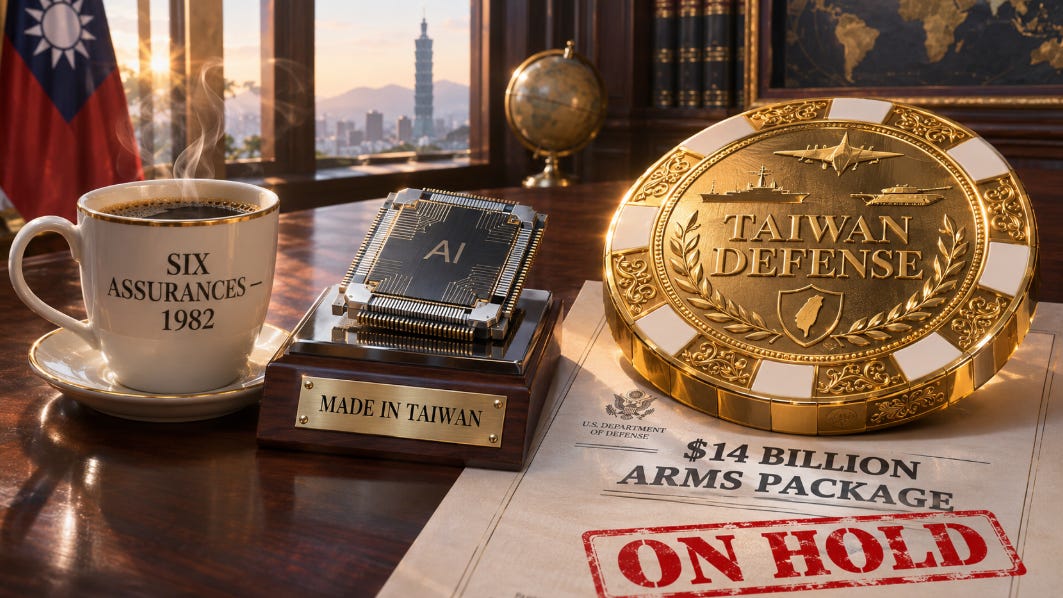
For all its importance to America’s technological future, Taiwan has discovered that even the weapons intended for its defense can become bargaining chips in someone else’s negotiations.
By March, a proposed $14 billion arms package for Taiwan, the largest ever contemplated for the island, was ready for Trump’s approval.
Then it waited.
Come May, Trump flew to Beijing for a summit with Xi Jinping. Huang, absent from the initial delegation list, joined Trump aboard Air Force One during a refueling stop in Alaska. Trump returned saying he had discussed the Taiwan arms sale with Xi “in great detail,” and told Fox News the package was “a very good negotiating chip for us, frankly.” That ran up against the Six Assurances, a commitment Ronald Reagan made to Taiwan in 1982 that the United States would not consult Beijing before deciding on arms sales to the island.
Days after the summit, Taiwanese security officials reported that China had deployed more than 100 vessels across regional waters stretching from the Yellow Sea to the western Pacific, with numbers increasing after Trump and Xi met. Taiwan’s National Security Council chief, Joseph Wu, published a map of the deployments. By August, the USS George Washington, the Navy’s only forward-deployed carrier, had left the western Pacific to relieve the exhausted crew of the Abraham Lincoln in the Iran war, temporarily leaving the western Pacific without an American carrier strike group. Trump’s verdict on the Lincoln’s record-breaking deployment: “Not nearly enough.”
Xi came to the White House for a state dinner in September. Huang was seated at the head table.
None of this shows that Huang shaped Taiwan policy. It shows who had a seat at the table, and whose security was on the menu.
Megaspeed began life as 7Road International, a Singapore company connected to a Chinese online gaming business. It acquired its new name in 2023, just months after Washington imposed sweeping restrictions on advanced AI-chip exports to China. The timing was exquisite. Whether it was coincidence or design remains an open question.
According to the New York Times, Alice Huang was listed as managing director and later described herself as chief executive. The company’s balance sheet then ballooned at a pace that would embarrass a meme stock. The Financial Times reports that it grew from $33 million to $3 billion in 2024, much of the increase reflecting transactions among subsidiaries. An impressive transformation, although a balance sheet isn’t quite the same thing as a cash register.
Its anchor customer was Alibaba, which also became its lender. In June 2024, Megaspeed’s Malaysian subsidiary pledged its entire business as collateral for a loan from an Alibaba affiliate. Nvidia, the FT reports, first met with Megaspeed because of its computing-leasing contract with Alibaba. In early 2025, Alice Huang was pitching Chinese investors on another data-center project, assuring them there would be “no problem securing GPUs.”
Here’s where the fine print becomes a national-security question. Chinese companies can legally rent computing power from overseas data centers under certain conditions. Acquiring restricted Nvidia processors is another matter. When a company’s business depends on hardware Washington doesn’t want transferred to China, its financing arrangements deserve a closer look.
What happens if the borrower defaults? Who gets control of the assets? Does the export-control paperwork travel with the foreclosure notice?
Then there’s the inventory.
Bloomberg examined customs records showing Megaspeed imported at least 136,000 Nvidia GPUs through late 2025. Yet Nvidia’s inspection teams reportedly saw only a few thousand of the advanced Blackwell chips at the data centers they visited. Those aren’t directly comparable totals: the import figure covers multiple chip types, and Nvidia says additional equipment was accounted for in warehouses. Separately, Commerce Department inspectors found Nvidia equipment still boxed at a Malaysian facility in September 2024.
Megaspeed denies wrongdoing, and Nvidia insists its equipment is where it belongs.
Jensen Huang told Bloomberg in October that Nvidia had “counted every one” of the GPUs and described his interactions with Alice Huang as “completely normal and not unusual.”
On Sunday, acknowledging his intimate relationship with Alice Huang, he offered a different assessment of his personal conduct: there was “no excuse” for what he had done.
The affair is now acknowledged. Questions about chip inventories, financing arrangements and possible foreign influence remain unresolved.
What the Beijing trip didn’t advertise: before Trump flew to China in May with Huang aboard, Secretary of State Marco Rubio had overseen a highly classified memo warning top officials that Huang was in a close relationship with a woman U.S. intelligence believed had been recruited by China’s Ministry of State Security, according to the New York Times. The warning circulated before the May summit and before Huang joined the president aboard Air Force One.
Trump had been briefed on the underlying intelligence even earlier. The Times reports he learned of the suspected operation roughly a year ago and chose not to act.
Huang says no one warned him. He told Bloomberg the government never informed him of its suspicions, and the Times reports he never received a defensive counterintelligence briefing. The reason is unknown, and tipping him off might have endangered the surveillance. Still, it leaves an uncomfortable picture: the president was briefed, the CEO says he wasn’t, and the CEO continued advising the president on technology policy affecting China.
Asked Sunday whether he wished he’d acted on the intelligence, Trump said, “No, I don’t think so.” Huang was “an honorable guy” who “probably has an excuse.” Then, unprompted, came the evidence for the defense: “We have the highest stock market.”
Huang, for his part, had already written that there was no excuse.
Earlier, in an interview with CBS’s Ross Douthat, Trump had said he couldn’t bring himself to forgive political enemies, even if getting into heaven depended on it. Trump can imagine an excuse for Jensen Huang’s relationship with a woman identified by U.S. intelligence as a Chinese spy. But he cannot imagine forgiving Nancy Pelosi.
The White House still hasn’t answered an important question: What safeguards, if any, did the administration put in place after learning that a suspected Chinese intelligence operative had established a close relationship with one of the most influential technology executives in America?
Ukraine has already lived a version of this. In October, satellite communications that its soldiers and drone operators depend on were throttled in the middle of a war. Who ordered the restrictions remains disputed. Asked about it in an interview broadcast Sunday, Trump said he didn’t know who was responsible, then volunteered that he probably had “a lotta power over everything.” He questioned whether the disruption had happened at all, yet claimed service was restored once he heard about it.
Musk and Huang haven’t done the same thing. The main point, however, is that the security of sovereign nations increasingly depends on technologies controlled by a handful of enormously powerful companies, and on decisions the public rarely sees and absolutely never votes on. Nvidia designs the processors that Taiwan manufactures. SpaceX operates the satellites an army at war needs to communicate.
That is a Lords and Serfs problem. The remedies range from public ownership to public control to enforceable public-service obligations on companies too essential to answer only to themselves. Which one fits which industry is a debate worth having. Pretending we don’t need the debate is not an option.
Nvidia’s board has assigned its investigation of the reported foreign intelligence effort to independent directors and outside counsel, while assuring everyone it remains confident in Huang’s leadership. Three Republican House committee chairs have requested a closed-door briefing with Huang on November 18, the day after Nvidia reports earnings. Trump is heading to Asia next week, where he hopes to meet Xi, and says he’d “certainly take” Huang along. In January, Democrats take control of both chambers and their investigative committees. Senators Chris Coons and Elizabeth Warren are already raising questions about Nvidia, Chinese access to advanced chips and the government’s handling of corporate accountability.
Determining whether a foreign intelligence service tried to influence the most important executive in the AI economy, and what the government did once it knew, is actual governing.
The investigations will answer narrower questions, however, than the one this story raises. When an essential service becomes someone else’s private property, the public’s ability to depend on it can become contingent on decisions the public has no power to make. The danger isn’t only that one powerful man might choose badly. It’s that whole countries must live with his choice and have no say in it.
Taiwan manufactures the chips, recorded the dinner and lives under the threat of Chinese military force, while its defensive weapons remain a bargaining chip in Washington’s dealings with Beijing.
The lords may own the infrastructure. But the consequences belong to everyone.
What to watch next
Nov. 11
Requested deadline for Huang to accept or propose an alternative congressional briefing date.
Nov. 17
Nvidia’s quarterly earnings announcement and analyst call.
Nov. 18
Requested closed-door briefing with three Republican-led House committees.
Nov. 18–19
APEC leaders’ summit in Shenzhen, where Trump expects to meet Xi.
It's hard to control what happens when the leader of the United States is beholden to the buck and is a traitor.
This another one of your detailed & delicate analysis of a complex & nuanced problem. Thank you for all the thought you put into this. I’m glad to be one of your supporters.