

Good morning! First, a confession. I could not bring myself to sit through another Trump rally speech. I know the drill by now: the grievance inventory, the crowd-size census, the weave that wanders off somewhere around 2016 and never quite finds its way home. Trumpology can survive one skipped field session. So yesterday, I took the cure instead and listened to Barack Obama and Jon Ossoff work a crowd in Atlanta.
It was restorative. Obama walked through the receipts on prices, tariffs and the Iran war, then arrived at the part I’d been waiting for. “We have never seen a president so intent on selling favors like this,” he said, ticking off meme coins and taxpayer-funded contracts for the president’s sons’ companies. Then he named the category. “That’s what dictators in other countries do.”
He also shared a revealing detail about how the White House handles criticism. After making similar corruption charges in an earlier speech, Obama recalled the administration’s response. “I accused this administration based on the facts that they were engaging in unprecedented levels of corruption. They didn’t say anything about that.”
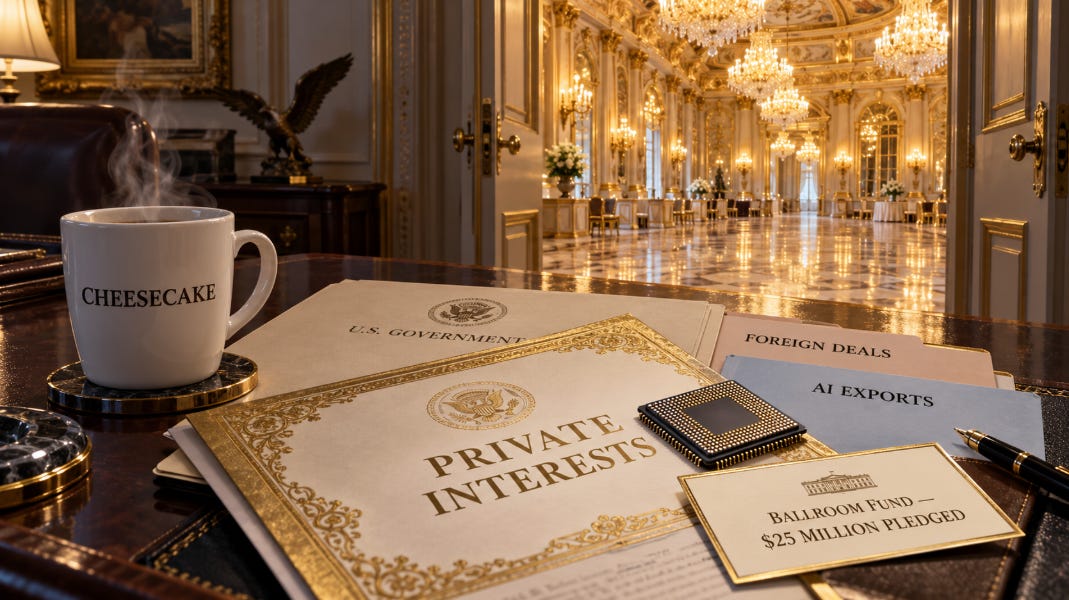
What drew a response was his crack that the redecorated White House looks like “Saddam Hussein opened a Cheesecake Factory.”
Some of the president’s friends in conservative media obligingly followed his lead. Fox News portrayed the joke as evidence of Obama’s supposed restaurant snobbery, while Fox Business and Breitbart devoted coverage to Treasury Secretary Scott Bessent’s spirited defense of the president’s decorating tastes. The allegations of presidential self-enrichment were conspicuously absent from those exchanges.
According to Obama, the White House even dispatched Bessent, the man charged with helping oversee the nation’s finances, to hold a press availability outside an actual Cheesecake Factory and discuss his lunch order.
Inflation got a talking point. The Cheesecake Factory got a cabinet secretary.
Ossoff, warming up the crowd before Obama, skipped the subtlety altogether. He gave us “the Mar-a-Lago mafia,” the crypto payoffs backing “Prince Don and Prince Eric’s” investments, and a line I suspect will outlive the campaign: “Never before has so little effort been made to cover up so much corruption.”
Rally rhetoric is rally rhetoric, and I hold it to that standard. But this week it arrived bookended by receipts. The Financial Times has published a meticulous account of the Trump sons’ global dealmaking, including meetings with foreign officials by two men who hold no government office. The New York Times reported that a suspected Chinese intelligence asset had cultivated Nvidia’s Jensen Huang, that Trump was briefed, and that he did nothing.
The politicians made the accusation. The reporters did the paperwork. Let’s open the files.
Start with the number: eighteen. That’s the minimum number of encounters the Financial Times documented between the president’s two eldest sons and foreign political figures since January 2025. The list includes at least six current or former prime ministers and heads of state, nine senior ministers and officials, and delegations of politicians from Vietnam to Serbia to Somaliland. Neither Donald Jr. nor Eric holds any government position.
His spokesperson says Don Jr. never deals with federal regulators on behalf of these companies. The companies have benefited from the regulatory changes regardless.The president’s reported income topped $2 billion in 2025, including more than $500 million from token sales at World Liberty Financial, the cryptocurrency venture his sons co-founded. Few private citizens generate that kind of income for their father.
Consider the private citizen’s early-autumn travel. In Ulaanbaatar, Don Jr dined with Mongolia’s president, Ukhnaagiin Khürelsükh. A government spokesperson posted photos of the meeting, noting that the two discussed U.S.-Mongolian relations and business ties. Then the photos vanished. The spokesperson told the FT that someone from Don Jr’s side asked him to take them down. Don Jr’s team says it knew nothing about the post, that the two men mostly talked about the outdoors, and that he accepted the invitation only after clearing it with Secretary of State Marco Rubio.
Sit with that last detail for a moment. Most private citizens don’t run their dinner plans past the Secretary of State.
Days later, his jet touched down in Estonia at 5 a.m. for a dinner in the offices of an online casino software company. The guest list reads like a casting call for a prestige miniseries: Brad Parscale, Fyre Festival founder Billy McFarland, and former mafioso Michael Franzese, with Miss World Estonia turning up at the cigar-lounge after-party. The evening’s host, Craig Hilton, told the FT that everyone with firsthand knowledge was bound by a 55-page nondisclosure agreement, which he considered understandable given the guest list. Also at the table was Estonia’s foreign minister, Margus Tsahkna, whose country would very much like American help deterring Russia. Ukraine came up quite a lot, he told Estonian broadcaster ERR. Tsahkna described the experience as meeting “someone who — while not an active politician — wields significant influence,” and suggested that contacts with unconventional figures in the Trump administration might prove useful. The host country’s top diplomat apparently didn’t get the private-citizen memo.
Eric, meanwhile, has been selling the family name. In the first term, the Trump Organization paused foreign deals. This time it wrote itself guidance permitting them, so long as the partner isn’t a government. Asked by the FT why the family abandoned its earlier pledge, Eric explained that they “got absolutely no credit for doing it.” The credit has since arrived in another form: foreign licensing, development and management revenue rose 40 percent in a year, to $63 million.
Georgia shows why the distinction between private business and public diplomacy becomes so difficult to maintain. Last month, the country’s elite gathered to launch Trump Tower Tbilisi, set to be the nation’s tallest skyscraper, complete with a drone show and a speech by Prime Minister Irakli Kobakhidze. Kobakhidze is a close ally of billionaire Bidzina Ivanishvili, sanctioned in 2024 for undermining Georgia’s democratic future to Russia’s benefit. Eric, appearing by video, praised the prime minister and declared that the Georgian people love the United States and the United States loves them back. One week later, Kobakhidze was chatting with President Trump and Rubio at a UN reception. He now describes relations as substantially healthier. The Trump Organization says the company operates completely separately from the presidency, which must come as news to Tbilisi.
In Vietnam, the government didn’t bother with subtext. At the groundbreaking for a Trump resort in May 2025, seven weeks after “liberation day” tariffs hammered Vietnamese exporters, the then prime minister called the project significant to strengthening relations with the United States. Thousands of residents were asked to move, and a cemetery’s dead are slated for relocation to make room for a golf course.
At the Atlanta rally, Keisha Lance Bottoms said the living and the dead are paying the price for Trump’s tariffs. She meant the rising cost of caskets. In Vietnam, a Trump-branded golf course may require literally moving the dead.
The brothers’ stateside investments read like a map of whatever their father’s administration happens to be deregulating, financing or buying.
Don Jr is a partner at 1789 Capital, a venture fund co-founded by Republican donors including Rebekah Mercer. Its assets under management have reportedly grown from $200 million at its 2023 founding to more than $3 billion, helped by access to hot AI investment rounds that ordinary investors can’t get near. The portfolio has a striking talent for landing federal business. Rare-earths start-up Vulcan Elements received a $620 million Pentagon loan shortly after 1789 invested. Drone maker Unusual Machines, also backed by Don Jr, won a military contract. And this year Reflection AI, another 1789 company, struck a deal to put its technology inside classified Pentagon networks. The fund’s spokesperson notes that Don Jr sits off the investment committee, that it takes only minority stakes, and that its defense companies won contracts under Biden too.
Richard Painter, the Bush White House ethics lawyer quoted by the FT, finds the branding less than subtle, singling out a fund named for the year the Constitution took effect. Longtime readers may recall that 1789 is also the opening year of what Trump once called America’s wealthiest era. The founders built a republic. The investors built a brand around its birth year.
Then there are the prediction markets. Don Jr received roughly $300,000 in Kalshi equity as a strategic adviser, and he also advises its chief rival, Polymarket, in which 1789 holds a stake. Both have flourished under a newly permissive Commodity Futures Trading Commission that lets them offer sports bets. His spokesperson says Don Jr is a big believer in prediction markets and never deals with the federal government on behalf of the companies he advises. Fortunately, the regulators seem to have gotten the message without him.
World Liberty Financial, the brothers’ crypto venture, issues a stablecoin called USD1, with roughly $4.1 billion in circulation. The company earns interest on the assets backing those tokens, and among its investors is Sheikh Tahnoon bin Zayed al-Nahyan, the United Arab Emirates’ national security adviser. In August, the Office of the Comptroller of the Currency granted preliminary conditional approval for a federal trust bank charter that would allow World Liberty to issue the tokens and manage their reserves directly. The company says it neither sought nor received special treatment. That story deserves its own piece, and it’s coming.
The rest of the ledger is a grab bag: through American Ventures, a stake in a construction company slated to merge with a Kazakhstan critical-minerals developer that received direct assistance from the Trump administration; a hunting magazine; a podcast; and Executive Branch, a Washington members’ club where annual dues can reportedly reach $15,000 on top of a six-figure initiation fee. In Washington, apparently even the unofficial Executive Branch charges admission.
Painter, who pressed hard on Hunter Biden’s Burisma board seat, says the Trump sons operate on a different scale entirely, with their father encouraging it. Which brings us to the guest at Xi Jinping’s state dinner.
Jensen Huang used to keep his distance from Washington. Then the Trump administration began weighing a ban on Nvidia chip sales to China, and Huang and his wife turned up at a high-end donors’ dinner at Mar-a-Lago to make the case for keeping the trade open. By the New York Times’ account, he dazzled the president with the story of his own rise. Trump, a connoisseur of rags-to-riches tales so long as he’s the one rewriting them, was won over.
What followed was a remarkable convergence of commercial and political interests. Nvidia announced plans to produce up to $500 billion in American-made AI infrastructure over four years. The Washington Post subsequently obtained fundraising records showing the company committed $25 million to Trump’s ballroom fund and requested that its contribution remain anonymous. The administration permitted sales of certain Nvidia chips to China under arrangements that included an expectation of receiving at least 15 percent of revenue from licensed sales, never formally codified, and later a 25 percent tariff on specified advanced chips routed through the United States. Current and former officials told the Times that some Commerce Department investigations and proposed sanctions involving China or Nvidia ground to a halt. Last month, Huang sat at the head table for Xi Jinping’s state dinner. None of this establishes that the ballroom contribution purchased favorable treatment. But the ballroom, it turns out, comes with a donation window and chandeliers.
Now the part that should have stopped the music. For nearly two years, U.S. investigators have been looking at Megaspeed, a Singapore-based data center company. In late 2024, a Commerce official visited its Malaysian site and found the Nvidia equipment still sitting in boxes, suggesting it might be moving through the facility rather than being installed there. A Malaysian sister company purchased at least $4.8 billion in advanced AI equipment containing Nvidia chips between June 2024 and February 2026, an extraordinary sum for an obscure firm whose principal customer is Alibaba. Investigators suspect some of those chips have been smuggled into China. Nvidia says it investigated and debunked the smuggling allegations, and it still lists Megaspeed as a cloud partner.
Megaspeed’s former top executive, Alice Huang, is a Chinese citizen whom American intelligence officials concluded was collecting information for Beijing. Electronic surveillance showed her communicating with an American citizen. When intelligence officials used the established procedure to identify that American, the name came back Jensen Huang. The two had been photographed drinking whiskey with other technology executives at a Taipei bar in June 2024, weeks before Megaspeed’s enormous purchasing spree began, and leaving a business dinner together a year later. Nvidia says Huang’s interactions with her were ordinary customer relations and that Megaspeed received neither sensitive trade secrets nor national security information. The Times could not establish what information Alice Huang passed to Beijing or its intelligence value.
Trump was briefed roughly a year ago. According to the Times, he chose not to act on the intelligence findings, wary of disrupting Nvidia’s chip sales, which were helping drive the economy and stock market, and of complicating trade relations with Beijing. Jensen Huang never received a defensive briefing, a warning sometimes given to Americans who may be targeted by foreign intelligence services. There may have been an operational reason: warning him could have alerted Alice Huang to the surveillance, which is ongoing. Officials initially believed Jensen Huang was unaware of her intelligence activities, although some senior administration officials have since expressed doubts. Megaspeed affiliates continued purchasing Nvidia chips this year, and the company is building a large new data center in Malaysia with the necessary chips reportedly already secured.
Nvidia’s spokesman says the company is confident the government would warn it if someone posed a threat to American industry. According to the Times, no such warning came. Whether that silence protected an intelligence operation or reflected other priorities remains unanswered. China’s embassy calls the allegations groundless smears. Megaspeed says it has retained outside counsel to investigate and cooperate with American authorities. The White House and intelligence agencies declined to comment.
One last detail, and it’s my favorite. The procedure that identified Jensen Huang is called unmasking, the routine process by which authorized officials learn the identity of an American whose name has been hidden in an intelligence report. Longtime readers will remember it as the great scandal of 2017. That April, Trump told the New York Times he believed Susan Rice had committed a crime in connection with the alleged unmasking of his associates, offering no evidence. In 2020, his acting intelligence chief declassified a list of Obama administration officials who had sought identities in intelligence reports concerning Michael Flynn, and Senator John Cornyn compared the revelations to Watergate. Attorney General William Barr assigned U.S. Attorney John Bash to investigate.
Bash found no evidence of systematic political abuse of unmasking. More remarkably, he concluded that Flynn’s intercepted conversations with the Russian ambassador had not been revealed through an unmasking request at all. More remarkably, he concluded that the leak of Flynn’s conversations with the Russian ambassador could not have resulted from an unmasking request at all. An investigation commissioned amid allegations of intelligence misconduct had failed to substantiate the central political accusation.
Nine years after the original uproar, the same routine intelligence procedure was used to identify an American whose communications had surfaced during surveillance of a suspected Chinese intelligence asset. His name was Jensen Huang. The president was briefed about the findings, according to the Times. Nvidia’s CEO was never warned.
Unmasking was a scandal right up until it identified someone who’d been to Mar-a-Lago.
Somewhere in the middle of his Atlanta speech, between the Cheesecake Factory and the gold medallions, Obama said the plainest thing anyone has said about this presidency in a while: “You cannot trade the office of the presidency and policy that affects Americans to make yourself money.”
It shouldn’t need saying. The presidency is a public trust, held on behalf of people who will never sit at a state dinner or receive a 55-page NDA. The FT documented the financial interests accompanying the Trump family’s access to foreign governments. The Times raised a different question: how commercial relationships and national security priorities intersect at the White House. Neither investigation proves that a particular government decision was purchased. Both demonstrate why independent oversight matters. As Walker Davis of the watchdog group CREW put it to the FT, Americans shouldn’t have to wonder whether a decision served them or served Trump’s bottom line.
The wondering is already widespread. In an FT/Focaldata poll published last weekend, 69 percent of registered voters said they were concerned about corruption, self-dealing or conflicts of interest. Americans hardly need persuading that conflicts of interest deserve scrutiny. At issue is what they can do about them.
The guardrails we have, from financial disclosure to congressional oversight, exist because ordinary people once demanded them. The post-Watergate ethics laws didn’t come from the conscience of the powerful; they were forced on Washington by a public that had seen enough. Those laws have gaps, and the Trump family’s business arrangements have exposed some consequential ones. The principal federal conflict-of-interest statute doesn’t apply to the president, and his sons, as private citizens, aren’t bound by the ethics rules governing officials. That leaves independent investigations and congressional oversight carrying an especially heavy burden. The conflict-of-interest statute exempts the president himself, and his sons hold no office to be bound by anything. That leaves oversight, which depends on who holds the gavel.
When Ossoff told the crowd that the people involved would be raising their right hands before Congress next year, he was describing what accountability looks like when it works: subpoenas, sworn testimony, documents that can’t be deleted from a Facebook page in Ulaanbaatar. None of that happens on its own. It requires a majority willing to ask the questions, and that majority is on the ballot Tuesday.
The lords have their ballroom, their preliminary bank charter approval and their seats at the head table. The majority of us still have the vote.
I can understand the restorative powers of listening to Barack Obama and Jon Ossoff; what a pleasure it is.
Looking forward to to your piece on World Liberty Financial, too.
"Obama said the plainest thing anyone has said about this presidency in a while: “You cannot trade the office of the presidency and policy that affects Americans to make yourself money.” But you can take a huge swath of public parkland in Chicago pay $1.00 for it, tear down hundreds of trees and destroy a migratory bird site to build a monument to yourself. And you can get a seawall exemption from environmental laws for your Hawaiian house property. I just have to point this out because I do not see Obama as someone who can talk about private profit and the Presidency.