


Good morning! The ceasefire is apparently one of those modern miracles where nothing actually stops, everything still costs more, and the people in charge keep insisting you should be grateful, anyway. The Strait of Hormuz is still not functioning like an open commercial waterway so much as a geopolitical toll booth run by men with missiles and a flair for extortion. Shipping traffic remains sharply reduced, insurers are still charging ruinous war-risk premiums, and vessels are being pushed into Iranian-controlled routing under threat and permission politics. We still do not have independent confirmation that Iran actually mined the Strait, but in the only metric global markets care about, it almost doesn’t matter. Commerce slowed to a crawl, regardless. Once again, Trump gets to wave around the word ceasefire while the rest of the world gets the bill.
To make sure this fragile little fiction had absolutely no chance of stabilizing, Israel appears determined to kick over every diplomatic chair in the room. The Wall Street Journal reporting makes the point plain: the White House is now scrambling to keep Israel’s war in Lebanon from derailing talks with Iran, to the point that Trump reportedly told Netanyahu to tone it down. A man who set his kitchen on fire is now begging someone else not to touch the curtains. Israeli strikes reportedly intensified immediately after the Iran ceasefire announcement. Lebanese officials are demanding a halt, and even analysts quoted in the piece say scaling back Israeli attacks has become a prerequisite for getting U.S.-Iran talks off the ground. Netanyahu, naturally, responded with the subtle diplomacy of a wrecking ball: “There is no ceasefire in Lebanon. We continue to strike Hezbollah with full force.” Well then, mystery solved. If you were wondering who is most actively sabotaging de-escalation, the answer appears to be the country throwing bombs at it.
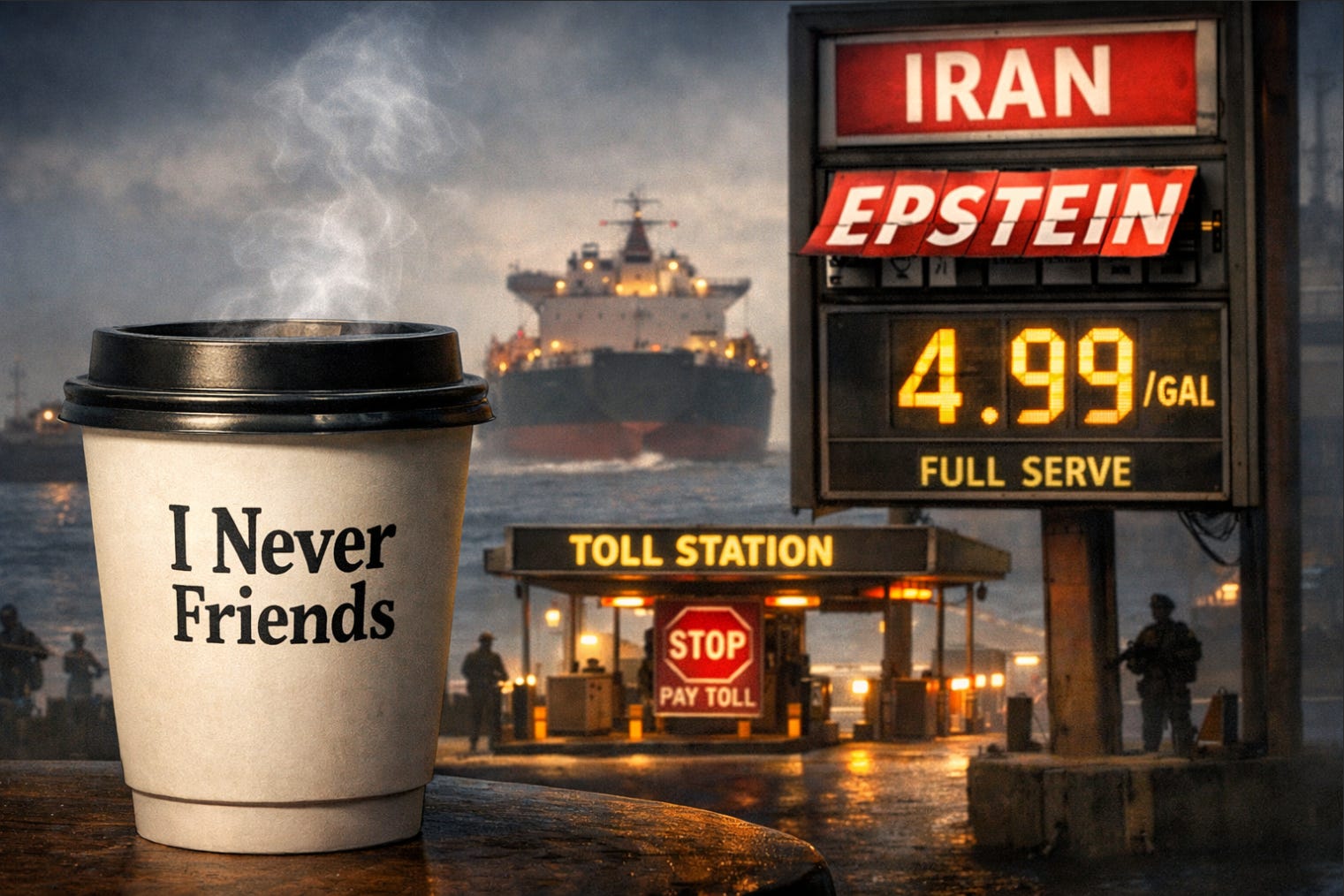
The economic fallout is now spreading exactly the way critics warned it would. First came the shipping choke point, then came the insurance spike, followed by the oil shock. Now that shock is moving through consumer prices and aviation fuel like a bad smell through an overpriced hotel lobby. Financial Times reporting says U.S. inflation jumped to 3.3 percent in March, driven largely by a historic monthly surge in gasoline prices, while Europe is now staring at the possibility of systemic jet fuel shortages within weeks if Hormuz is not reopened in a stable way. That is what a fake ceasefire looks like in real life: not peace or normalcy, just a slower-moving supply chain crisis with a gas pump and an airport departure board attached. Americans are paying for this war every time they fill up their tanks. Europeans may soon be paying for it every time they try to board a plane.
Because the world has eyes, memories, and apparently a basic instinct for self-preservation, it is moving on without the United States. Canada is now pushing to join the UK-Italy-Japan Global Combat Air Programme as an observer, explicitly as part of an effort to diversify defense procurement and strengthen ties with like-minded allies outside the American orbit. Read that again slowly: even Canada is shopping for a future that depends less on Washington. GCAP was built in part to reduce reliance on U.S. fighters and preserve sovereign control over advanced military technology, and now Ottawa wants in while reviewing the rest of its planned F-35 purchases because of tensions with the Trump administration. This is really about alliances. America’s closest partners are no longer assuming the United States will remain the stable anchor of the Western order. They are building lifeboats while the captain is still on deck insisting the iceberg respects strength.
That brings us to the obvious question: if Israel is now the biggest impediment to an actual ceasefire, why is Washington still paying to keep the impediment standing? In a recent Zeteo interview, Rep. Ro Khanna said flatly, “I don’t think U.S. taxpayer dollars should go for that,” referring to Iron Dome funding, before adding that “Israel can buy it with their own money. They’ve got a $45 billion defense budget.” He said what changed his view was “the war in Gaza” and “the utter extremism” of figures like Netanyahu and Ben-Gvir. The interview goes further than the usual sterile Beltway dance about “concerns” and “guardrails.” It gets to the actual point: what gets marketed as purely defensive support also lowers the cost of Israel’s continued offensives and helps sustain the blank-check arrangement that has made accountability optional for years. If Israel can blow up Lebanon, batter Gaza, menace Iran, and still expect Washington to refill the arsenal and cover the tab, then why would it ever feel compelled to honor a ceasefire it does not like? Amazing how the obstacle to peace keeps showing up with a U.S. invoice attached.
Back at home, the administration is also doing that charming authoritarian two-step where it destabilizes the world abroad and tries to suppress scrutiny at home. A federal judge ruled the Pentagon violated a court order to restore New York Times journalists’ access, finding that the Defense Department had essentially rewritten the same unconstitutional restrictions in slightly different language and wrapped them in a fresh policy bow. Judge Paul Friedman was not subtle about it. He called the Pentagon’s new restrictions “transparent attempts” to undermine restored access and ended with the kind of sentence that should send a chill through any functioning democracy: suppression of political speech is “the mark of an autocracy, not a democracy.” It is always a bad sign when a judge has to explain to the Department of Defense that “we used more words to say the same thing” is not, in fact, a constitutional compliance strategy.
The constitutional temperature is rising even if Congress still lacks the spine to do much with it. The impeachment effort against Trump is a long shot in a Republican-controlled Congress. But it still matters that lawmakers are now formally tying his conduct in Iran, among other actions, to removal-level offenses. The significance is not that conviction is likely. It is that the war is no longer being framed simply as a foreign-policy dispute. It is being framed as part of a broader pattern of lawlessness, recklessness, and unfitness. In the Zeteo interview, Khanna argues that Trump should be impeached over the Iran war as well as the Epstein cover-up, calling the war immoral, illegal, and strategically disastrous. So even where Congress remains feckless, the language is shifting. The story is moving from “controversial decision” to “abuse of power,” which is exactly where it belongs.
Because this White House cannot step away from the rake long enough to avoid smashing itself in the face with it, we arrive at the Epstein portion of today’s national psychodrama. Melania Trump, in one of the strangest bits of White House stagecraft in recent memory, stepped up to the podium to declare, “The lies linking me with the disgraceful Jeffrey Epstein need to end today,” and then added, in her clipped, lawyerly way, “I never been friends with Epstein.” The problem, of course, is that this was supposed to make the Epstein story go away, and instead she managed to drag it back into the center of the news cycle with both hands. Even AP noted that her extraordinary White House appearance revived a politically toxic issue the administration had been trying to leave behind.
That made the whole thing so bizarre. As Professor Tim Wilson put it, this was “a very strange event” because it combined “denial plus escalation” in a way that does not happen by accident. He argued that Melania’s remarks read less like a casual rebuttal and more like “a legal perimeter, a boundary being drawn in advance,” which is about as elegant a way as anyone could say: this looked preemptive.
What really sharpened the backlash, though, was the reaction from Epstein’s survivors. After Melania called for Congress to hold public hearings where survivors could testify, victims fired back that they had already done the hard part. In their words, “Survivors of Jeffrey Epstein have already shown extraordinary courage by coming forward, filing reports, and giving testimony,” and “Asking more of them is a deflection of responsibility, not justice.” That response landed because it exposed the grotesque little trick at the center of Melania’s performance: she tried to wrap a self-protective denial in the language of transparency, while shifting the burden right back onto the people who have already carried more than enough.
Instead of closing the book on Epstein, Melania accomplished the exact opposite. She revived the scandal her husband wants forgotten, widened the circle of scrutiny, and handed survivors a fresh opportunity to remind everyone that the problem is not a shortage of victim testimony. The problem is the people in power who still control the files, the story, and the cover-up. A remarkable bit of own-goaling, really.
That is the shape of the day: a ceasefire that does not cease, an ally that keeps sabotaging peace, a global economy starting to absorb the shock, partners quietly building futures that route around Washington, a growing argument for ending the blank check to Israel, a judge reminding the Pentagon that autocracy is not a communications strategy, an impeachment push that may fail but still matters, and an Epstein scandal that the Trump family keeps resurrecting with the enthusiasm of amateur necromancers. The world is moving on without the United States, the costs of this war are landing everywhere, and the people who caused the mess are still standing at the podium telling us the mess is proof of their strength.
Not irrelevantly, Netanyahu’s trial for corruption was supposed to start Saturday, but war postpones. Though let’s not forget that the doofi in the U.S. administration didn’t include Israel in the peace talks. When corrupt people and idiots are elected, you get corrupt and idiotic outcomes.
It's a bazaar stranglehold that Israel has on our country. We sacrifice our tax dollars for a nation of probably more wealth than us , population to dollars, and yet our elected lawmakers are so enamored with this country they can't bear parting . Cut the cord! Let them live by their rules and actions. I am outraged by their dragging us into this war and even more so by our complicity to allow it and the genocides in Gaza to go on and on and on. 25th Amendment, Article 2 section 4, or whatever other means is available, just do it, elected leaders. Grow a pair! Stand for "We the People of the United States"!