


Good morning! Well, except to the people currently trying to define a shooting war as a “vibes-based ceasefire,” they deserve the indigestion we are all feeling. And I’d just like to note, for the record, that even I, a rural Oregon grandmother with a cup of coffee and a functioning sense of cause and effect, could see and predicted that sending warships into a live choke point and daring Iran to blink first was not going to end well. Yet here we are.
This morning, Hegseth tried to sell Project Freedom as a “red, white, and blue dome” and a “direct gift” to the world, which is certainly one way to describe a military operation in which U.S. forces are actively shooting down Iranian threats while maintaining an “ironclad” blockade. General Caine, meanwhile, tallied the receipts: nine attacks on commercial ships, two seized container ships, ten-plus attacks on U.S. forces, and 22,500 mariners trapped on more than 1,550 vessels, all carefully calibrated to remain below the threshold where Congress might need to matter.
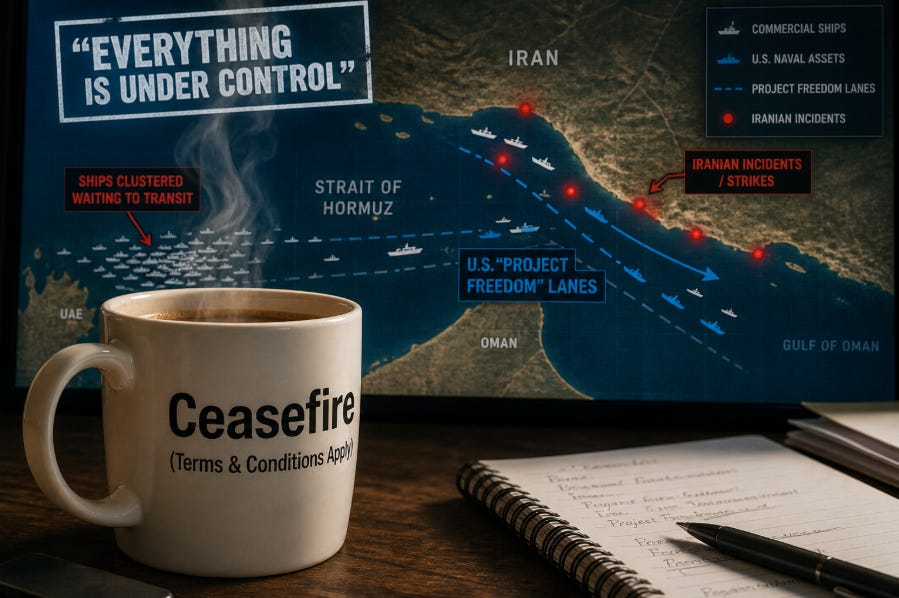
Let’s start in the Strait of Hormuz, where the United States and Iran are now actively exchanging fire, missiles are flying, drones are being shot down, boats are being sunk, and the Pentagon would like you to know that this all still technically qualifies as a robust, apparently bulletproof ceasefire, one that now includes cruise missiles and Apache helicopters.
General Dan Caine clarified the situation helpfully by explaining that whether the ceasefire is broken is “a political decision.” Which is great news if you’ve ever worried about messy things like facts or definitions. It turns out war is only war if the White House clicks “confirm.” Until then, it’s just a lightly militarized misunderstanding involving explosives.
Defense Secretary Pete Hegseth is running “Project Freedom,” a real operation involving warships, drones, and 15,000 troops trying to reopen one of the most critical oil chokepoints on Earth. Iran is responding with its traditional diplomatic toolkit: missiles, speedboats, and periodic assurances that they haven’t even begun yet.
The result? The Strait isn’t open. It isn’t controlled. It’s barely navigable. It’s just contested, which is a polite word for 22,500 sailors stuck in place while two governments insist everything is proceeding exactly as planned.
And speaking of control, Congress would like you to know that it is… not available at this time. As U.S. forces exchange fire in the Gulf, Speaker Mike Johnson has once again managed to make the House of Representatives disappear. Not officially, of course. There’s no big dramatic “we are shutting down Congress” speech. It’s more of a quiet vanishing act, poof, gone, while leadership struggles with internal GOP chaos and the administration redefines war powers in real time.
Trump, for his part, has informed Congress that hostilities have “terminated,” which is a neat trick considering the ongoing hostilities. This legal sleight of hand conveniently resets the War Powers clock, meaning no authorization is required because, say it with me, this is not a war. It’s just missiles, drones, naval combat, and regional escalation. Totally different.
Layered on top of this is a question that more and more outlets are beginning to tiptoe toward: what exactly is going on with the guy making these decisions at 2:45 in the morning?
A Daily Beast analysis found that Donald Trump posted 565 times in April, with 189 posts between 9 p.m. and 6 a.m., and activity on 83% of nights during normal sleeping hours. That includes multi-hour posting sprees deep into the night, followed by early morning threats, policy pronouncements, and the occasional AI-generated self-aggrandizement meme.
We don’t need to diagnose anything to recognize the problem.
A 79-year-old commander-in-chief is posting through the night, nodding off in public, threatening to end civilizations before breakfast, and improvising military policy in real time, while American troops are under fire.
That’s not a partisan observation. That’s a basic question of whether the person at the center of this is operating on anything resembling a stable decision-making cycle.
And if you think that concern is overblown, let’s check in on how things are going at the White House.
Trump hosted small business owners this week for National Small Business Week, where he covered, in no particular order: the Iran war, Venezuela (resolved in 48 minutes, he’d like you to know), Rick Harrison of Pawn Stars, the cognitive test he has now aced three times under extraordinary pressure, and a reflecting pool renovation that came in at $1.9 million versus the government’s $350 million estimate, painted American Flag Blue. Small business was mentioned periodically throughout, like a polite guest at its own party. The actual Small Business Person of the Year got approximately four minutes at the end.
So that’s where we are: a war in the Gulf, a disappearing Congress, and a president who thinks a small business forum is the ideal venue to workshop his reflecting pool color palette.
Naturally, the next logical step was to pick a fight with the pope.
Trump has now accused Pope Leo XIV of “endangering Catholics” because the pontiff has been calling for ceasefire and dialogue instead of, you know, more war. This has been reinterpreted by Trump as “the pope wants Iran to have nuclear weapons,” which is not something the pope has said, implied, or even vaguely gestured toward.
Marco Rubio is now headed to the Vatican to smooth things over, which is a bit like sending the assistant manager to apologize after the CEO sets the building on fire. The official line is that the meeting will be “frank,” which in diplomatic language means everyone will be smiling while quietly wondering how this conversation became necessary.
While all of this unfolds, the global economy is watching one thing: energy. China spent the last two decades building out wind power, massively, methodically, and with the kind of long-term planning that produces results rather than headlines. Today it dominates the global wind industry, owns the transmission infrastructure, and is substantially insulated from the oil shock now rippling out from the Strait of Hormuz.
The United States, meanwhile, has stalled more than 150 wind projects and is actively spending billions to unwind renewable investments, just in time for the fossil fuel supply chain to detonate.
Trump spent years warning that windmills were the problem. China built them. Now one country is bracing for an oil shock, and the other is largely sidestepping it.
Meanwhile, if the American chain of command feels unstable, consider what’s happening at the other end of the axis.
A leaked European intelligence dossier suggests Vladimir Putin is currently running something between a government and a bunker-based escape room. According to the report, he’s tightened internal surveillance, restricted staff access, reduced his public movements, and grown increasingly preoccupied with assassination attempts, including, reportedly, from within his own elite.
More notable still: the dossier flags former defense minister Sergei Shoigu as a potential coup risk. That kind of detail doesn’t appear in writing unless someone, somewhere, wants it to.
Add a scaled-back Victory Day parade, no tanks, no heavy weapons, just a carefully managed display of a regime trying to look unbothered, and the picture that emerges is of a government feeling the strain and working hard not to show it.
While Congress is conveniently out of the way, Republicans are quietly advancing funding packages that include tens of billions for ICE and DHS, plus approximately $1 billion for security upgrades tied to Trump’s East Wing “modernization” project, which was going to cost taxpayers nothing, if you recall.
In Florida, trademark filings are underway to sell Trump-branded merchandise through Palm Beach’s newly renamed airport. If you’re going to attach your name to public infrastructure, you might as well monetize the luggage tags.
This is all happening while gas prices climb, bond yields spike, and administration officials go on television to explain that it’s a short-term blip and, actually, a brilliant strategy.To recap:
We have a war that isn’t a war, a ceasefire that includes missiles, a Congress that isn’t governing, a president who isn’t sleeping, an economy that is wobbling, a pope who is now apparently a nuclear hawk, and a global energy crisis that China accidentally prepared for while we were arguing about windmills.
And through it all, the same unifying thread keeps emerging: The people making the decisions are insulated from the consequences, and the people living with them are not.
Marz and I slept in a bit this morning, and then I had the misfortune of needing to catch Hegseth’s latest press conference, so apologies for running behind today. I may not have mentioned this before, surely I’ve been subtle, but I do not hold Pete Hegseth in especially high regard. Still, I may try to do a more thorough recap of his remarks later, if only because someone has to wade through the red, white, and blue fog machine and come back with notes.
I love the ironic flavour of this piece - though I wish you hadn't had to write it...
Suppose ANY other leader was posting deranged rants in the small hours, insulting the spiritual leader of 1.3 billion Catholics, threatening entire civilizations with annihilation, and comparing himself to God.
This is not going to end well. I just hope the rest of us survive.